July 23, 2026
The Hidden Economics of Embedded Solar in Mining: Why the Sishen Offtake Agreement Changes the Calculus
The global mining industry has spent years debating the how of decarbonisation, but the more revealing question has always been the when. For energy-intensive operations in jurisdictions with unreliable grid infrastructure, the economic case for self-generated renewable power has been building steadily. The convergence of falling solar PV costs, tightening carbon regulations in key export markets, and the maturation of dedicated renewable energy development platforms has shifted embedded generation from an aspiration into a commercially executable strategy. The Kumba Sishen solar energy offtake agreement, executed in July 2026, represents precisely this inflection point made real.
When big ASX news breaks, our subscribers know first
What the Kumba Sishen Solar Energy Offtake Agreement Actually Involves
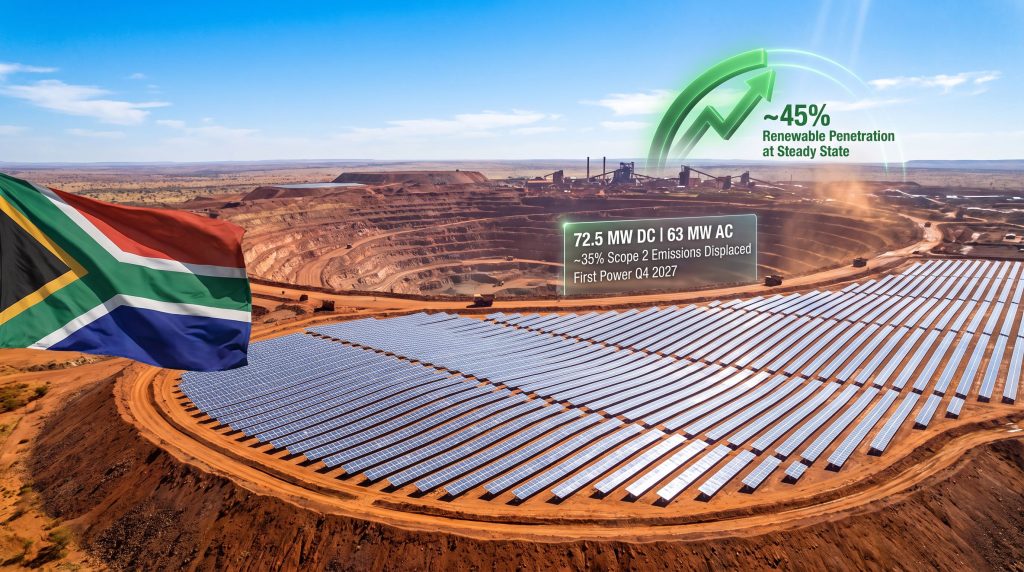
The agreement entered into between Sishen Iron Ore Company (SIOC) and Envusa Energy commits the latter to developing, constructing, and supplying electricity from an embedded solar photovoltaic facility located within the active Sishen mine boundary in South Africa's Northern Cape province. Critically, this is not a wheeled supply arrangement routed through the national transmission grid. Power generated at the facility will be consumed directly on site, making it an embedded generation project in the strictest technical sense.
Key Technical Specifications at a Glance
| Parameter | Specification |
|---|---|
| Installed Capacity (DC) | 72.5 MW |
| Delivered Capacity (AC) | 63 MW |
| Generation Type | Solar photovoltaic (PV) |
| Site Location | G80 waste rock dump, Sishen mine boundary |
| First Power Expected | Q4 2027 |
| Scope 2 Emissions Displacement | ~35% of Sishen's current Scope 2 at steady state |
The distinction between embedded and wheeled renewable energy carries significant practical weight for a mining operator. Embedded generation bypasses Eskom's transmission infrastructure entirely, eliminating the transmission and distribution losses that erode the effective value of wheeled supply. It also sidesteps the licensing complexity associated with wheeling arrangements, which require separate regulatory processes under South Africa's energy framework.
For a mine the scale of Sishen, avoiding grid dependency also provides a meaningful buffer against load-shedding risk during peak operational periods. Furthermore, this approach to renewable energy in mining is rapidly becoming the benchmark for how large-scale operations decarbonise without compromising productivity.
The Sishen solar project is the first embedded renewable energy project to reach offtake agreement stage under the Envusa Energy programme, marking a structural milestone for large-scale mining decarbonisation in Southern Africa.
The facility has been sized specifically to maximise the net present value of cost savings rather than simply maximising installed capacity, an important design philosophy distinction. This means the 72.5 MW DC / 63 MW AC specification reflects a financial optimisation exercise, not an engineering limit. Projects sized to NPV rather than capacity alone tend to deliver superior long-run economic performance because they avoid the trap of over-building infrastructure that generates power beyond the site's practical absorption capacity.
The G80 Waste Rock Dump: Engineering Complexity as Strategic Opportunity
The selection of the G80 waste rock dump as the solar facility's host site introduces geotechnical challenges that simply do not exist on conventional flat-terrain solar installations. Waste rock dumps are composed of previously blasted and compacted mining spoil, which creates an irregular, potentially unstable surface profile. Key engineering challenges addressed in the project design include:
- Managing differential settlement across a surface that lacks the uniform bearing capacity of undisturbed ground
- Designing structural mounting systems capable of accommodating topographic irregularity without compromising panel orientation
- Stabilising foundations across material with varying compaction density, a characteristic inherent to incrementally built waste dumps
- Ensuring long-term structural integrity over the project's operational life, which extends beyond typical solar project horizons due to the mine's remaining life
What makes this site selection strategically significant extends well beyond engineering problem-solving. By generating productive infrastructure from disturbed mining land, Kumba simultaneously addresses a mine closure liability and a capital asset requirement. This dual-use approach has growing relevance globally as regulators increasingly require mining companies to demonstrate progressive rehabilitation of disturbed land.
Converting a waste dump into an energy-generating facility is an approach that could inform how future mine closure plans are structured across the broader industry. Indeed, green iron production initiatives elsewhere demonstrate that repurposing industrial land for clean energy is gaining traction as a mainstream strategy.
Envusa Energy's Programme Architecture and the Koruson 2 Precedent
Understanding the Sishen solar project requires understanding the platform that enables it. Envusa Energy functions as Anglo American's dedicated renewable energy development vehicle for South African operations, designed to aggregate multiple generation projects into a coherent portfolio rather than pursuing one-off arrangements.
The Koruson 2 cluster, which spans both the Eastern and Northern Cape provinces, represents the programme's operational proof of concept. Its three constituent projects illustrate the scale at which Envusa is operating:
| Project | Technology | Capacity |
|---|---|---|
| MooiPlaats Solar PV | Solar PV | 240 MW |
| Umsobomvu Wind | Wind | 140 MW |
| Hartebeesthoek Wind | Wind | 140 MW |
Since March 2026, 11 MW of wheeled renewable electricity from the Koruson 2 cluster has been flowing to the Kolomela mine. The Sishen embedded project, once commissioned in Q4 2027, will add a further 63 MW AC of dedicated on-site generation, lifting Kumba's total renewable energy penetration to approximately 45% across both operations.
This trajectory matters from an investor perspective. Moving from 0% to 45% renewable penetration within a single programme cycle demonstrates that Envusa has achieved genuine delivery capability, not simply development pipeline — an important distinction in an industry where announced renewable energy targets frequently outpace actual commissioning progress.
Scope 2 Emissions, CBAM, and the Commercial Case for Decarbonisation
Understanding Why Scope 2 Reduction Is the Priority Lever
For iron ore mining operations, Scope 2 emissions (indirect emissions from purchased electricity consumption) represent the most structurally accessible near-term decarbonisation pathway. Unlike Scope 1 emissions embedded in diesel-powered haulage or explosives manufacturing, Scope 2 reduction through renewable energy substitution requires no fundamental change to operational processes. It is a supply-side intervention with an immediate impact on the measured carbon intensity of production.
The Sishen solar facility is projected to displace approximately 35% of Sishen's current Scope 2 carbon emissions at steady-state operation. This contributes directly toward Kumba's stated target of reducing total greenhouse gas emissions by 28% by 2030, while also supporting Anglo American's group-level climate commitments for the same year.
The CBAM Dimension: Regulatory Pressure as Commercial Incentive
The European Union's Carbon Border Adjustment Mechanism entered its operational phase in 2026, creating a pricing signal that structurally disadvantages high-carbon steel production in European markets. The mechanism imposes costs on embedded carbon in imported goods, including steel manufactured from iron ore feedstocks. For iron ore producers supplying European-market steel mills, this creates a direct commercial incentive to reduce the carbon intensity of their production processes.
Kumba's management has explicitly identified this dynamic in its half-year commentary, noting that steel mills facing growing carbon-related cost penalties under CBAM will increasingly seek out lower-emission-intensity feedstocks to manage their overall carbon liability. Higher-grade, lower-carbon-intensity iron ore commands structural pricing advantages in this environment, reinforcing Kumba's existing quality premium positioning. Consequently, the broader steel and iron ore market is being reshaped by precisely these regulatory forces.
Kumba's H1 2026 Operating Performance: Reading the Numbers in Context
Production Results by Operation
| Mine | H1 2026 Production | Year-on-Year Change | Full-Year Guidance |
|---|---|---|---|
| Sishen | 12.7 Mt | +3% | ~22 Mt |
| Kolomela | 4.9 Mt | -16% | ~10 Mt |
| Kumba Total | 17.7 Mt | -3% | 35-37 Mt |
Kolomela's 16% year-on-year production decline in H1 2026 is best understood as the product of three converging but individually manageable factors rather than a structural deterioration in the mine's operational capability:
- Planned stockpile drawdown during Q1 2026 following elevated inventory accumulation in the prior period
- Scheduled plant maintenance in Q2 2026, which is a recurring feature of mining operations management rather than an unplanned disruption
- Transnet's ten-day logistics maintenance shutdown in May 2026, executed as part of the Ore Corridor Restoration programme
The Ore Corridor Restoration programme itself warrants attention because it represents a meaningful improvement in South Africa's export infrastructure rather than simply a disruption event. Progress recorded in the period includes:
- Replacement of 101 km of rail along the export corridor
- Speed restriction removal across 26 km of previously constrained track sections
- Cold commissioning of Tippler 3 at the Port of Saldanha Bay, with full commissioning expected before year-end 2026
- A measurable reduction in the number of derailment incidents across the review period
Iron Ore Quality and Pricing Premium
Kumba's product quality metrics demonstrate why iron ore grade and lump content are not merely geological characteristics but actively bankable competitive advantages:
| Metric | H1 2026 Performance |
|---|---|
| Average Iron Content | 63.6% Fe |
| Lump-to-Fine Ratio | 66:34 |
| Average Realised Price | $90/wmt |
| Premium Over Fastmarkets 62% Fe FOB Index | +8% |
The 66:34 lump-to-fine ratio deserves particular attention from an industry mechanics perspective. Lump ore can be charged directly into a blast furnace without the sintering process required for fine ore. Sintering is energy-intensive and generates its own carbon emissions, meaning that high-lump iron ore supplies steelmakers with a raw material that reduces their own Scope 1 and Scope 2 footprint.
In a CBAM-affected market, this creates a self-reinforcing premium dynamic: high-lump, high-grade ore commands a pricing premium precisely because it helps the steelmaker reduce its own carbon liability. The China steel outlook further reinforces this trend, as Chinese port lump stocks falling to near 12-month lows in mid-2026 supported lump premium recovery from earlier in the year.
The next major ASX story will hit our subscribers first
Unit Cost Dynamics and Currency Sensitivity
Revised Guidance Parameters
| Parameter | Previous Assumption | Revised Assumption |
|---|---|---|
| Exchange Rate | R16.00/USD | R16.50/USD |
| C1 Unit Cost (USD) | ~$45/wmt | ~$45/wmt (maintained) |
| Sishen Rand Unit Cost | R530-R560/dmt | Upper end of range |
| Kolomela Rand Unit Cost | R430-R460/dmt | Middle of range |
The exchange rate revision from R16.00 to R16.50 per US dollar reflects the stronger rand environment that prevailed through H1 2026. This is a structural currency exposure that compresses the dollar-equivalent value of rand-denominated cost savings but simultaneously illustrates why locking in below-grid electricity costs through long-duration offtake agreements provides a meaningful hedge against unit cost volatility. A fixed, predictable electricity cost component reduces the portion of the cost base that fluctuates with input price inflation.
Input cost pressures during the period were attributed primarily to above-inflation increases in key mining consumables, including fuel, explosives, and tyres, with supply chain disruptions linked to ongoing Middle East geopolitical tensions cited as a contributing factor. Shifts in iron ore demand prospects from major importing economies are, however, adding a further layer of pricing complexity that operators must navigate alongside their cost management efforts.
The UHDMS Technology Upgrade: Protecting Grade Quality as the Ore Body Evolves
One dimension of Kumba's Sishen strategy that receives less attention than the Kumba Sishen solar energy offtake agreement is the commissioning of ultrahigh dense media separation (UHDMS) technology at the processing plant. This upgrade is strategically significant because it addresses a challenge that affects virtually every long-life mining operation: ore body grade evolution over time.
As an open-pit mine like Sishen deepens and extends, it inevitably encounters ore zones of varying quality. UHDMS technology improves the recovery of high-grade iron ore from lower-grade feed material through a more precise density-separation process than conventional dense media separation. This allows the processing plant to maintain product quality specifications even as the average grade of run-of-mine feed material evolves.
The first UHDMS modules entered Phase 1 commissioning in mid-2026, with pre-shutdown preparation work on track for the main plant tie-in commencing in August 2026. This timeline positions the technology to be fully integrated into Sishen's processing circuit well ahead of any meaningful deterioration in feed grade quality. According to the World Steel Association, steelmakers globally are placing greater emphasis on input quality precisely as carbon costs rise, reinforcing the commercial logic of this investment.
Community Co-Ownership: A Structural Model Beyond CSR
The 10% equity interest held by the SIOC Community Development Trust in the Sishen solar project represents a qualitatively different approach to community benefit-sharing than conventional corporate social responsibility expenditure. CSR programmes are discretionary in nature and can be reduced or eliminated at management discretion. An equity stake embedded in the project's financial structure creates an enduring, performance-linked entitlement that persists for the project's operational life.
This means host communities receive proportional dividend flows tied directly to the solar asset's generation performance and the financial performance of the Sishen mine itself, aligning community interests with long-run operational outcomes in a manner that purely transactional CSR arrangements cannot replicate.
Beyond the equity structure, the project incorporates:
- Employment prioritisation for host community members during both construction and operations phases
- Accredited skills training programmes designed to build transferable technical capabilities within local labour markets
- Preferential procurement frameworks intended to expand local business access to project-related contracts
Moreover, research published by the International Energy Agency highlights that community co-ownership models in large-scale energy projects consistently improve social licence outcomes and reduce project delivery risk — a finding directly relevant to Kumba's approach here.
Frequently Asked Questions
What is the installed capacity of the Sishen solar PV plant?
The facility carries an installed DC capacity of 72.5 MW, delivering 63 MW AC to the Sishen mine under the offtake agreement.
When will the Sishen solar plant generate its first electricity?
First power generation is targeted for Q4 2027, following completion of construction and commissioning activities.
How much will the project reduce Kumba's carbon emissions?
At steady-state operation, the project is expected to displace approximately 35% of Sishen's current Scope 2 greenhouse gas emissions, contributing toward Kumba's 2030 target of a 28% reduction in total greenhouse gas emissions.
What makes embedded generation preferable to wheeled renewable supply for Sishen?
Embedded generation bypasses transmission infrastructure, eliminates distribution losses, provides greater energy security against grid instability, and operates under a simpler regulatory licensing framework than wheeled supply arrangements.
How does the SIOC Community Development Trust benefit from the project?
The Trust holds a 10% equity stake in the solar facility, entitling host communities to a proportional share of dividend flows generated by the asset over its operational life.
What is the significance of Kumba's 66:34 lump-to-fine ratio?
Lump ore can be charged directly into blast furnaces without sintering, reducing steelmakers' energy consumption and carbon emissions. In a market where CBAM penalises high-carbon steel production, high-lump iron ore feedstocks carry a structural pricing premium because they reduce the steelmaker's own carbon liability.
Disclaimer: This article contains forward-looking statements regarding production targets, commissioning timelines, emissions reduction projections, and financial guidance. These are based on information disclosed by Kumba Iron Ore as of July 2026 and are subject to change. Nothing in this article constitutes financial or investment advice. Readers should conduct independent due diligence before making investment decisions.
Want to Stay Ahead of the Next Major ASX Mineral Discovery?
Discovery Alert's proprietary Discovery IQ model delivers real-time alerts on significant ASX mineral discoveries, transforming complex data across more than 30 commodities into clear, actionable insights for both short-term traders and long-term investors — start your 14-day free trial today and gain a market-leading edge, or explore Discovery Alert's dedicated discoveries page to understand how historic mineral discoveries have generated extraordinary returns.