July 28, 2026
When a Chokepoint Reopens: Reading the Supply Signals Behind Kuwait's July Crude Tender
Every time a critical maritime corridor closes, the global oil market fractures along a predictable fault line: buyers scramble for alternative supply, sellers lose their pricing leverage, and the invisible architecture of crude logistics becomes suddenly, uncomfortably visible. The Strait of Hormuz has long represented the most consequential single point of failure in global energy trade, and the events of mid-2026 illustrated this with unusual clarity. Understanding what happens after such a disruption resolves, and how national oil companies rebuild their commercial relationships with the market, is as strategically important as understanding the disruption itself.
The Kuwait crude July delivery tender issued by Kuwait Petroleum Corporation in late June 2026 is not simply a procurement document. It is a layered signal, communicating infrastructure readiness, geopolitical normalisation, and competitive positioning within the Asian medium-sour crude complex simultaneously.
When big ASX news breaks, our subscribers know first
From Near-Zero to 2 Million Barrels Per Day: The Scale of Kuwait's Disruption and Recovery
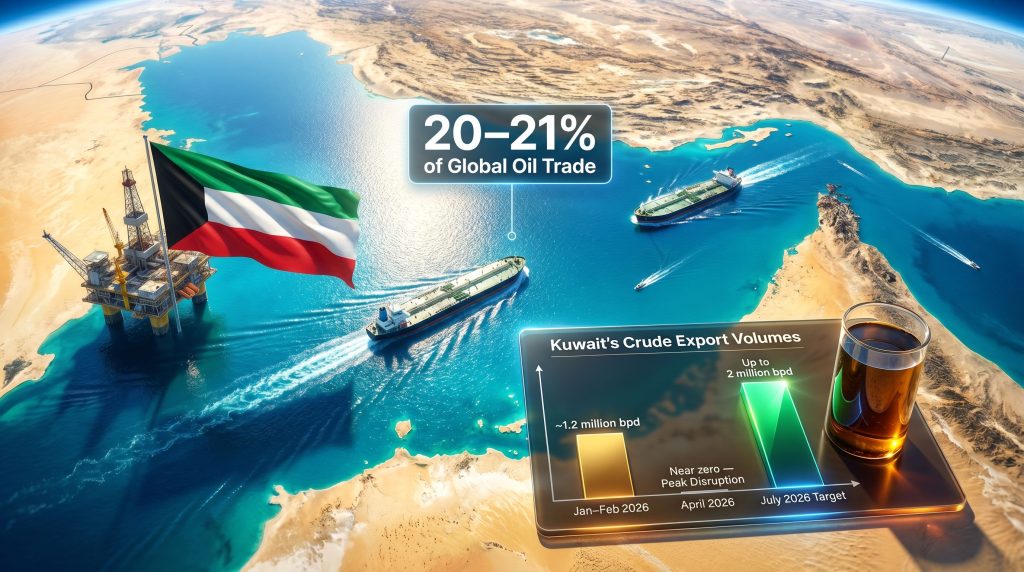
The numbers underlying Kuwait's supply disruption during the U.S.-Israeli conflict involving Iran are striking in their severity. According to shiptracking data compiled by Kpler, Kuwait averaged approximately 1.2 million barrels per day (bpd) in crude exports during January and February 2026. By April, that figure had collapsed to near zero, representing a throughput reduction of essentially 100% relative to the pre-disruption baseline.
| Period | Estimated Export Volume (bpd) | Operational Status |
|---|---|---|
| Jan–Feb 2026 (baseline) | ~1.2 million | Normal commercial operations |
| April 2026 (peak disruption) | Near zero | Force majeure active, Hormuz restricted |
| June 2026 (partial recovery) | Small fraction of baseline | STS transfers, AIS-dark vessels |
| July 2026 (post-tender target) | Up to 2 million | Full ramp-up projected |
What makes the projected recovery target particularly notable is that KPC's stated aim of reaching 2 million bpd within one week of the Strait of Hormuz reopening would actually represent a production level above its pre-war export baseline. This raises a question that markets are quietly pricing: is this figure a genuine technical ceiling on short-term output, or does it reflect an ambitious signal intended to reassure long-term contract buyers and reassert Kuwait's standing in the Asian crude hierarchy?
Operationally, ramping upstream production after a sustained curtailment period involves more complexity than simply reopening a valve. Wellhead pressure management after extended shutdowns requires careful sequencing to avoid reservoir damage. Pipeline recommissioning involves pressure testing and purging procedures that can span several days. Storage drawdown sequencing must be coordinated to ensure continuity of cargo loading at the Mina Al Ahmadi terminal. These are not trivial constraints, and traders watching Kuwait's actual export recovery trajectory in July should weigh them accordingly.
Force Majeure in Sovereign Oil Trade: Why the Lifting Matters as Much as the Declaration
In the context of state-owned petroleum corporations, force majeure declarations carry a dimension that extends well beyond standard contractual protection. When a national oil company invokes force majeure, it is simultaneously communicating upstream disruption to long-term contract buyers, suspending delivery obligations, and, perhaps most importantly, signalling to the market that sovereign output cannot be guaranteed.
The lifting of force majeure is therefore not a routine administrative step. KPC's confirmation on Thursday, June 19, 2026 that all force majeure notices issued during the conflict were lifted with immediate effect triggered a cascade of procurement decisions across Asian refinery systems. Refiners that had been operating on alternative crude slates, drawing down strategic reserves, or purchasing spot cargoes of replacement grades suddenly needed to realign their forward purchasing programmes. This dynamic is further complicated by the broader oil price trade-war impact that has continued to shape buyer behaviour throughout 2026.
Force majeure in sovereign oil trade functions as a geopolitical signal. Its lifting is as strategically meaningful as its initial declaration, often triggering cascading procurement decisions across Asian refinery systems in a compressed timeframe.
This compressed procurement response dynamic is precisely why KPC issued the Kuwait crude July delivery tender so rapidly after lifting force majeure. The window between a producer announcing its return and buyers locking in replacement volumes from competing suppliers is narrow, and the tender structure was designed to capture that window efficiently.
The Structure of the July Tender: Mechanics, Pricing, and What DES Terms Signal
The tender's operational parameters are worth examining in detail, because each structural choice communicates something about KPC's strategic posture.
Cargo size: Each parcel offered at 2 million barrels, broadly equivalent to the carrying capacity of a standard Very Large Crude Carrier (VLCC). This sizing is deliberate, targeting large-volume Asian buyers capable of absorbing VLCC-scale parcels, while excluding smaller regional refiners that typically operate on Aframax or Suezmax parcel sizes.
Pricing basis: Kuwait Export Crude (KEC) is priced at a differential to the average of Oman and Dubai price quotes. These benchmarks serve as the primary pricing reference for Middle Eastern crude sold into Asian markets. For buyers accustomed to tracking the Oman/Dubai average, the pricing structure requires no additional conversion or basis risk management, which lowers the transactional friction of participation.
Delivery terms: The tender specifies delivered ex-ship (DES) terms, meaning KPC retains freight and insurance risk until the cargo arrives at the destination port. Buyers take title at delivery, not at the loading point. This is a meaningful concession from the seller, as it effectively absorbs tanker rate risk into KPC's economics. It suggests that securing committed buyers quickly was prioritised over optimising per-barrel netback.
Timeline: The tender closed on the Tuesday following the June 19 announcement, with bid validity extending through Wednesday. A two-day validity window is notably compressed by industry standards and typically indicates the seller anticipates strong competitive buyer interest, or alternatively, seeks to minimise exposure to intra-week price movement before locking in terms.
Shadow Logistics: How Gulf Producers Kept Crude Flowing During the Hormuz Closure
One of the least publicly discussed dimensions of the Hormuz disruption period was the sophisticated logistics workaround adopted by regional state energy companies to maintain at least partial crude flows to Asian buyers. KPC, alongside Abu Dhabi National Oil Co and other Gulf producers, began marketing crude loaded aboard vessels operating with Automatic Identification System (AIS) transponders switched off, a practice associated in other contexts with sanctions evasion but applied here as a legitimate operational response to an extraordinary security environment.
The primary physical mechanism supporting these flows was ship-to-ship (STS) transfer conducted in waters adjacent to the Strait but outside the most contested transit corridor, specifically in the vicinity of Oman's Sohar area. In an STS transfer, cargo is moved between two vessels at sea rather than at a port facility, allowing producers to load crude onto smaller vessels capable of navigating closer to port infrastructure, then transfer the product onto VLCCs positioned just outside the restricted zone for onward delivery to Asia.
This is precisely what occurred with the June 2026 transitional tender, in which KPC sold approximately 4 million barrels for June delivery. Those cargoes were loaded via STS at the Sohar area onto VLCCs Sea Ruby and Maran Atalanta, both of which subsequently routed toward China according to Kpler tracking data. This transaction served as a commercial bridge between the emergency logistics phase and the resumption of standard tendering, validating that the physical supply chain was sufficiently functional before KPC committed to a full July delivery programme. Reuters has reported on Kuwait's first spot fuel cargoes since the Iran conflict began, corroborating the significance of this transitional phase.
China, India, and the Asian Procurement Reset
Asian buyers are the primary audience for the Kuwait crude July delivery tender, and their response will determine both the pace of Kuwait's commercial reintegration and the trajectory of medium-sour price differentials across the region.
China's refinery system has a structural preference for medium-sour Gulf grades, which match the hydrocracking and desulphurisation configurations of major coastal refineries. During the disruption period, Chinese state refiners and independent teapot operators drew down strategic and commercial crude inventories to compensate for reduced Gulf imports, though analysis of trade data suggests this drawdown was more measured than initially anticipated. The resumption of Kuwaiti supply therefore addresses a genuine feedstock gap rather than simply offering a cheaper alternative.
The behaviour of Chinese buyers in response to the July tender is worth monitoring closely:
- State-owned majors such as Sinopec and CNOOC tend to respond quickly to spot tender availability from established sovereign suppliers, given the relationship-based nature of their long-term contract frameworks.
- Independent teapot refiners in Shandong province, by contrast, are more price-sensitive and will compare KEC's Oman/Dubai differential against competing spot offers from Russia, West Africa, and other non-Hormuz-exposed origin points before committing.
- The routing of the Sea Ruby and Maran Atalanta toward China ahead of the formal July tender suggests Chinese buyers had already signalled procurement intent through informal channels before the tender was published.
India's state refiners present a parallel dynamic. Indian Rupee-denominated crude procurement economics, combined with Indian refiners' well-documented preference for discounted crude regardless of origin, means that the competitive position of KEC against Iraqi Basrah grades and Saudi Arab Medium will be closely scrutinised. The Oman/Dubai differential pricing basis used by Kuwait is broadly comparable to the benchmark structures used by other Gulf exporters targeting Indian buyers, reducing basis risk as a differentiating factor and forcing competition onto outright price. A thorough geopolitical oil price analysis further illustrates how regional conflicts continue to reshape these competitive dynamics.
The next major ASX story will hit our subscribers first
Three Scenarios for Kuwait's Production Recovery
Markets rarely recover in straight lines, and Kuwait's supply restoration trajectory over the coming weeks carries meaningful uncertainty. Three plausible pathways frame the range of outcomes.
Scenario A: Full Restoration Within Target Window
KPC achieves its 2 million bpd target within seven to ten days of the Strait reopening. The July tender is fully subscribed by Asian buyers, and forward tenders for August loading are issued within weeks. The primary market effect is modest downward pressure on medium-sour differentials as previously scarce supply normalises.
Scenario B: Partial Recovery With Infrastructure Constraints
Wellhead recommissioning delays, tanker scheduling bottlenecks, or partial Hormuz transit restrictions limit initial throughput to approximately 1.4 to 1.6 million bpd. Some July tender cargo slots roll into August. The Oman/Dubai spread remains neutral to mildly supportive, reflecting the incomplete supply restoration.
Scenario C: Disruption Recurrence
Geopolitical developments interrupt the normalisation trajectory before full production resumption. Force majeure is re-declared, and spot tendering is suspended. Medium-sour prices reprice sharply upward, and the premium for non-Hormuz-exposed supply, including West African grades and East of Suez Russian crude, reasserts itself aggressively.
This scenario analysis is forward-looking and speculative. Actual market outcomes will depend on geopolitical, logistical, and commercial factors that cannot be predicted with certainty. This content does not constitute investment or trading advice.
The Broader GCC Supply Restoration and OPEC+ Tensions
Kuwait's re-entry into the spot crude market does not occur in isolation. Saudi Arabia, the UAE, and Iraq's southern fields have been simultaneously ramping output following the cessation of hostilities, creating a compounding supply restoration dynamic across the Gulf. Iraq's southern crude output rose by approximately 500,000 bpd to 1.5 million bpd in the post-ceasefire period according to available reporting, adding further volume to an Asian market already recalibrating its procurement mix.
This coordinated multi-producer re-entry creates a structural tension with the OPEC+ framework's price floor objectives. OPEC production decisions will consequently play a central role in determining whether individual member states seeking to recapture lost market share are able to compete aggressively on price and availability, or whether the collective interest within OPEC+ in avoiding a volume-driven price collapse prevails. How this tension resolves over the July to September loading season will be a defining variable for medium-sour crude pricing across the remainder of 2026.
Furthermore, OPEC's market influence remains a critical backdrop against which Saudi Aramco's parallel consideration of expanding global storage capacity must be assessed. This development suggests that at least one major Gulf producer is drawing lessons from the disruption about the strategic value of pre-positioned inventory in consumer markets, a change that could modestly reduce the spot market premium that typically accompanies Hormuz supply disruptions in future episodes.
Traders monitoring the broader pricing environment should also consider WTI and Brent futures positioning, as these benchmark curves will reflect market expectations around the pace and completeness of Gulf supply normalisation throughout the second half of 2026.
Frequently Asked Questions
What is Kuwait Export Crude and how is it priced?
Kuwait Export Crude is a medium-sour crude grade marketed by Kuwait Petroleum Corporation. It carries an API gravity typically in the low-to-mid 30s and a sulphur content that classifies it firmly within the sour crude category. Pricing is expressed as a differential to the average of Oman and Dubai benchmark quotes, the standard reference for Middle Eastern crude sold into Asian markets.
What does delivered ex-ship mean in crude oil trading?
Under DES terms, the seller bears freight, insurance, and risk of loss until the cargo vessel arrives at the agreed destination port. The buyer assumes title and risk at that point of delivery, rather than at the load port. This is distinct from FOB (free on board) terms, where risk transfers at the moment of loading.
Why did Kuwait's exports collapse in April 2026?
The U.S.-Israeli military conflict involving Iran resulted in the effective closure or severe restriction of commercial shipping through the Strait of Hormuz, through which the substantial majority of Kuwait's crude exports transit. With the strait inaccessible for standard commercial tanker operations, export volumes fell to near zero.
What is an STS transfer and why was it used during the disruption?
A ship-to-ship transfer involves moving cargo between two vessels at sea, outside of port infrastructure. During the Hormuz disruption, Gulf producers used STS operations near Oman's Sohar area to load crude onto VLCCs positioned just outside the restricted transit corridor, enabling partial export flows to continue without requiring vessels to transit the strait directly. The Kuwait crude July delivery tender represents the formal commercial step that follows this transitional logistics phase, signalling KPC's readiness to resume standard procurement operations at scale.
Readers seeking ongoing coverage of GCC energy sector developments, crude trade flows, and Middle Eastern supply dynamics can explore related reporting available via Zawya's Oil and Gas coverage and the latest tender activity tracked through Kuwait's oil and gas tender listings.
Want to Stay Ahead of the Next Major Resource Discovery?
While geopolitical disruptions reshape global crude supply chains, commodity-driven market volatility consistently creates significant opportunities across the ASX's resource sector — and Discovery Alert's proprietary Discovery IQ model delivers real-time alerts the moment a significant ASX mineral discovery is announced, transforming complex geological data into actionable investment insights. Explore Discovery Alert's historic discoveries page to understand the scale of returns major finds have generated, and begin your 14-day free trial today to position yourself ahead of the broader market.