June 16, 2026
The global diamond industry faces unprecedented disruption as technological alternatives fundamentally reshape traditional market dynamics. The lab-grown diamonds impact on established mining operations creates structural challenges requiring comprehensive strategic responses from producers, investors, and supply chain participants. Furthermore, this transformation reflects broader patterns where technological substitutes achieve market acceptance through superior value propositions combined with functional equivalence to natural alternatives.
Understanding Synthetic Diamond Technology and Market Positioning
The lab-grown diamonds impact on traditional gemstone markets stems from fundamental advances in crystalline carbon production methods. Two primary manufacturing processes dominate synthetic diamond creation: Chemical Vapor Deposition (CVD) and High-Pressure High-Temperature (HPHT) synthesis. Both methods produce stones with molecular compositions identical to natural diamonds, creating crystalline structures indistinguishable from geological formations without sophisticated testing equipment.
CVD manufacturing deposits carbon atoms layer by layer in controlled chamber environments, requiring approximately 7-10 days for initial crystal formation. HPHT processes replicate subterranean pressure and temperature conditions that naturally occur over geological timeframes, compressing carbon materials into diamond structures within weeks rather than millions of years. The resulting synthetic stones exhibit identical physical properties including hardness, refractive index, and thermal conductivity as mined diamonds.
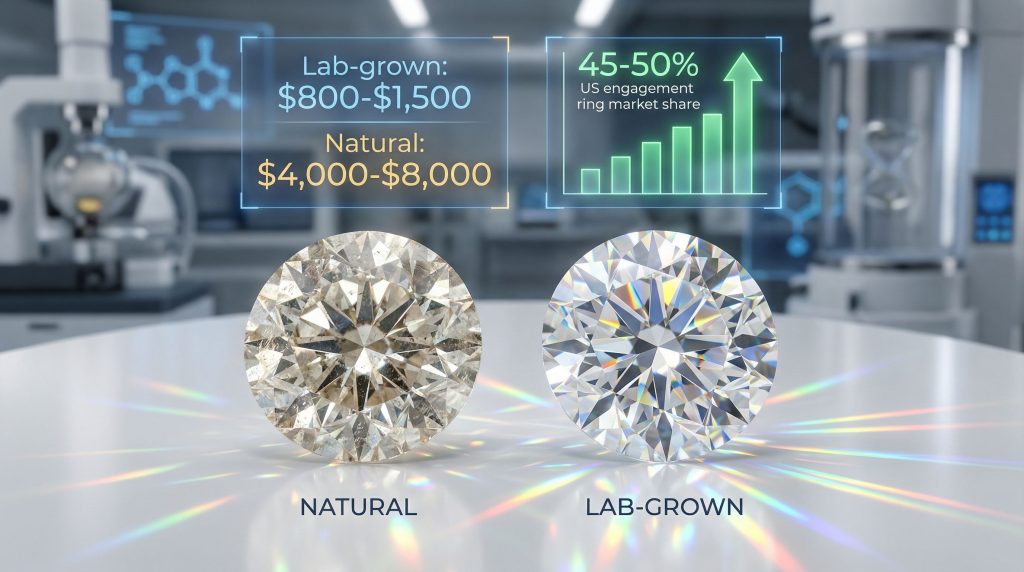
Current market pricing demonstrates the significant economic advantage synthetic diamonds maintain over natural alternatives. Recent industry evolution trends indicate 1-carat lab-grown stones retail between $800-$1,500, while comparable natural diamonds command $4,000-$8,000, representing an 80-84% price differential. This pricing gap has remained relatively stable despite increasing synthetic production volumes.
Comparative Diamond Pricing Analysis (2026)
| Stone Type | Size | Price Range | Market Share |
|---|---|---|---|
| Lab-Grown | 1 Carat | $800-$1,500 | 45-50% (US Engagement) |
| Natural | 1 Carat | $4,000-$8,000 | 50-55% (US Engagement) |
| Lab-Grown | 2 Carat | $1,800-$3,200 | Growing rapidly |
| Natural | 2 Carat | $12,000-$25,000 | Premium segment |
Industry certification protocols have evolved to accommodate synthetic diamond identification and grading. The Gemological Institute of America (GIA) and other accredited laboratories employ spectroscopic analysis and fluorescence testing to distinguish laboratory-grown stones from natural diamonds. These identification methods require specialised equipment unavailable to typical consumers, creating dependency on third-party certification for product authentication.
Consumer acceptance of synthetic alternatives reflects broader demographic shifts in luxury goods purchasing behaviour. Market research indicates millennials and Generation Z consumers demonstrate reduced attachment to traditional gemstone provenance narratives, prioritising value propositions and ethical considerations over mining heritage claims. Consequently, this generational preference change accelerates lab-grown diamonds impact across multiple consumer segments beyond engagement rings.
When big ASX news breaks, our subscribers know first
Manufacturing Revolution Disrupting Traditional Mining Economics
Global synthetic diamond production capacity has expanded dramatically, with current annual output reaching 15-20 million carats across manufacturing facilities concentrated in China, India, and the United States. This production volume represents substantial growth from historical levels and continues expanding as new facilities come online throughout 2026. However, China dominates synthetic manufacturing through both equipment production and diamond processing operations, while India's Surat processing centre adapts traditional polishing infrastructure for laboratory-grown stones.
Traditional diamond mining operations face unprecedented economic pressure as polished stone pricing declines while extraction costs remain relatively fixed. Natural diamond prices have fallen more than 40% from pandemic peaks, creating unsustainable operating margins for marginal production assets. This economic compression drives mine closure decisions and operational consolidation independent of geological depletion considerations.
De Beers, historically the industry's dominant force, experienced severe financial distress throughout 2025, losing approximately $1.5 million daily according to verified industry reports. Parent company Anglo American has written down the business three times in three years, reducing book value to $2.3 billion from $9.1 billion, representing a 74.6% valuation reduction. This dramatic revaluation quantifies investor concern about long-term natural diamond market viability under synthetic competition.
Major Diamond Company Financial Performance Impact
| Company | Metric | 2023 Value | 2026 Value | Change |
|---|---|---|---|---|
| Anglo American (De Beers) | Book Value | $9.1B | $2.3B | -74.6% |
| De Beers | Daily Losses (2025) | – | $1.5M | New |
| Surat Diamond Bourse | Office Occupancy | 4,700 planned | 250 active | 5.3% |
| Natural Diamond Prices | Decline from Peak | – | -40% | Ongoing |
Supply chain transformation accelerates as traditional processing infrastructure adapts to serve synthetic markets. The Surat Diamond Bourse, a $350 million complex designed to house thousands of natural diamond traders, operates with only 250 of 4,700 offices since opening in 2023. This 5.3% occupancy rate in newly constructed facilities demonstrates rapid contraction in traditional polishing and processing operations.
Manufacturing facilities across India's diamond processing centres increasingly add synthetic production lines, acknowledging structural market shifts toward laboratory-grown stones. Furthermore, this infrastructure repurposing represents strategic adaptation by midstream industry participants who recognise synthetic diamonds as permanent market forces rather than temporary trends. Traditional cutting and polishing expertise transfers effectively to synthetic stone processing, enabling existing operators to serve both market segments.
Regional production concentration creates competitive advantages for synthetic manufacturers operating in markets with favourable energy costs and skilled labour availability. Chinese facilities benefit from integrated equipment manufacturing and processing operations, while Indian centres leverage established gemstone processing expertise and labour cost advantages. In addition, United States production focuses on premium market segments with enhanced quality control and certification protocols.
Environmental Considerations Shaping Consumer Preferences
Environmental impact comparisons between synthetic and natural diamonds reveal complex trade-offs requiring careful analysis of energy sources, production methods, and supply chain transportation. Laboratory diamond manufacturing typically consumes 250-750 kilowatt-hours per carat depending on production method and facility efficiency, while natural diamond mining requires 500+ kWh including extraction, processing, and transportation to cutting centres.
Water usage differentials strongly favour synthetic production methods. Laboratory facilities require minimal water inputs for cooling and processing, while natural diamond mining operations average 127 gallons per carat including ore processing and dust suppression. This water intensity varies significantly by climate region and deposit characteristics, with operations in water-scarce regions facing additional environmental scrutiny.
Environmental Impact Comparative Analysis
| Impact Category | Lab-Grown Diamonds | Natural Diamonds | Advantage |
|---|---|---|---|
| Energy Consumption | 250-750 kWh/carat | 500+ kWh/carat | Varies by energy source |
| Water Usage | Minimal | 127 gallons/carat | Synthetic |
| Land Disruption | Facility footprint only | Significant ecosystem impact | Synthetic |
| Waste Generation | Contained processing | 4,383x higher volumes | Synthetic |
Carbon footprint calculations depend fundamentally on electricity grid composition where manufacturing facilities operate. Synthetic diamonds produced using renewable electricity offer substantial greenhouse gas advantages, while those powered by coal-heavy grids may exceed mined diamond emissions. This geographic variation creates opportunities for manufacturers to differentiate through documented renewable energy procurement and carbon-neutral production certifications.
Mining operations generate substantial waste rock and tailings requiring long-term environmental management. Open-pit diamond mines typically remove 10-20 tons of overburden per carat produced, creating lasting land use changes requiring post-closure remediation. In contrast, laboratory facilities generate contained processing waste without comparable ecosystem disruption, though facility construction and equipment manufacturing contribute lifecycle environmental impacts.
These environmental impact considerations require verification through third-party life cycle assessments employing standardised methodologies and system boundaries. Different studies often reach varying conclusions depending on allocation methods, energy source assumptions, and impact categories analysed. Consumers evaluating environmental trade-offs benefit from transparent reporting of assessment parameters and data sources rather than simplified marketing claims.
Transportation emissions complete environmental impact analysis for both production methods. Natural diamonds travel from remote mining locations to cutting centres in India or other processing regions, then to retail markets worldwide. Synthetic diamonds typically travel shorter distances from manufacturing facilities to retail distribution, reducing transportation-related emissions though this advantage varies by facility location and market geography.
Market Segments Experiencing Accelerated Synthetic Adoption
Engagement ring purchasing represents the most dramatic consumer segment shift toward synthetic diamonds. Industry data confirms lab-grown stones featured in nearly half of United States engagement rings between January and August 2025, representing 45-50% market penetration in this traditionally natural diamond-dominated category. This market share gain reflects fundamental changes in bridal jewellery purchasing behaviour rather than temporary price sensitivity.
Generational preferences drive synthetic adoption patterns across age demographics. Market research indicates millennials and Generation Z consumers demonstrate reduced attachment to natural diamond provenance narratives, prioritising value propositions, environmental considerations, and ethical sourcing over traditional luxury positioning. This demographic shift suggests continued synthetic market share growth as younger consumers represent increasing portions of diamond purchasing decisions.
Consumer Segment Adoption Analysis
- Engagement Rings: 45-50% lab-grown penetration (US market 2025)
- Fashion Jewellery: Rapidly growing synthetic adoption in non-bridal segments
- Investment Purchases: Natural diamonds maintain dominance due to resale value concerns
- Industrial Applications: Synthetic diamonds preferred for technology and manufacturing uses
Price sensitivity analysis reveals synthetic diamonds appeal extends beyond budget-conscious consumers to include educated purchasers seeking value optimisation. Many synthetic diamond buyers possess sufficient financial capacity for natural stone purchases but choose laboratory alternatives based on rational value assessments rather than financial constraints. Consequently, this purchasing behaviour suggests synthetic acceptance transcends economic necessity.
Regional adoption variations reflect cultural differences in luxury goods purchasing and diamond market maturity. United States markets show highest synthetic penetration rates, while traditional diamond markets in Europe and Asia demonstrate more gradual adoption patterns. These geographic differences create opportunities for targeted marketing strategies addressing specific cultural preferences and purchasing motivations.
Industrial diamond applications represent growing synthetic market segments beyond consumer jewellery. Technology sectors require synthetic diamonds for cutting tools, electronics manufacturing, semiconductor processing, and precision instruments. These applications prioritise performance characteristics over provenance, favouring synthetic stones' consistent quality and competitive pricing over natural diamond alternatives.
Strategic Responses From Traditional Diamond Companies
Natural diamond producers implement differentiated positioning strategies emphasising rarity, heritage, and emotional significance to compete against synthetic alternatives. De Beers' marketing campaigns focus on natural diamonds' unique geological formation and scarcity value, attempting to establish premium positioning that justifies significant price differentials over laboratory alternatives.
Pricing strategy adjustments reflect industry consolidation trends adapting to competitive pressure from synthetic stones. Recent data indicates De Beers raised prices for stones above five carats by more than 5% at February 2026 sales events, pursuing premium positioning in large stone categories while accepting market share losses in smaller, commodity-like segments.
Traditional Industry Response Strategies
- Premium Positioning: Emphasising natural rarity and geological uniqueness
- Heritage Marketing: Leveraging century-long industry traditions and craftsmanship
- Certification Enhancement: Developing advanced provenance tracking and authentication
- Selective Pricing: Defending premium segments while conceding mass market share
Certification and provenance tracking systems receive increased investment as natural diamond producers seek differentiation advantages. Advanced blockchain tracking, laser inscription, and gemological fingerprinting technologies enable enhanced authentication and supply chain transparency. These certification enhancements aim to establish natural diamonds as premium luxury goods distinct from synthetic alternatives.
Supply chain vertical integration strategies help traditional producers maintain margin control despite pricing pressure. Companies investing in downstream cutting, polishing, and retail operations capture additional value while reducing dependency on third-party processors increasingly serving synthetic markets. This integration also enables direct consumer education about natural diamond attributes and value propositions.
Partnership strategies with luxury retailers focus on exclusive natural diamond positioning and education programmes. Traditional producers collaborate with high-end jewellery retailers to establish synthetic-free luxury segments emphasising natural stone heritage and investment potential. These partnerships create dedicated market channels less susceptible to synthetic competition.
Geographic Production and Investment Patterns
China's synthetic diamond manufacturing leadership stems from integrated equipment production and processing capabilities developed over two decades. Chinese facilities produce both synthetic diamonds and manufacturing equipment exported globally, creating competitive advantages through technology control and production cost optimisation. This vertical integration enables rapid capacity expansion and continuous process improvement.
India's transformation from natural diamond processing centre to synthetic manufacturing hub demonstrates industry supply chain adaptation. Surat's established cutting and polishing expertise transfers effectively to synthetic stone processing, while lower labour costs maintain competitive advantages in value-added manufacturing operations. Traditional family businesses adapt operations to serve both natural and synthetic markets.
Global Production Hub Analysis
| Region | Strengths | Market Position | Growth Trajectory |
|---|---|---|---|
| China | Equipment + Manufacturing | Dominant producer | Continued expansion |
| India | Processing expertise | Growing synthetic capacity | Rapid adaptation |
| United States | Premium positioning | Quality-focused production | Selective growth |
| Other regions | Emerging capabilities | Market development | Technology acquisition |
United States synthetic diamond production targets premium market segments through enhanced quality control and certification protocols. Domestic manufacturers emphasise transparency, renewable energy usage, and advanced technology to differentiate from commodity-focused international production. This premium positioning strategy commands higher prices while serving environmentally conscious consumer segments.
Investment capital flows increasingly favour synthetic diamond technology companies over traditional mining exploration and development projects. Furthermore, investment strategy insights show venture capital and private equity funds allocate resources toward manufacturing equipment improvements, production facility expansion, and technology development rather than geological exploration for new natural diamond deposits.
Equipment manufacturer investment opportunities emerge as synthetic production scales globally. Companies developing CVD chambers, HPHT presses, and automated cutting systems benefit from expanding synthetic production capacity requirements. These technology providers capture value across the synthetic diamond supply chain without direct exposure to commodity price volatility.
The next major ASX story will hit our subscribers first
Future Industry Scenarios and Investment Implications
Coexistence model projections suggest natural and synthetic diamonds will serve differentiated market segments rather than complete substitution scenarios. Premium natural diamond markets may preserve value propositions based on rarity, investment potential, and luxury positioning, while synthetic diamonds dominate mass market segments prioritising value and ethical considerations. This market segmentation mirrors luxury goods patterns in other industries.
Technology development roadmaps indicate continued synthetic diamond production improvements through enhanced manufacturing efficiency, quality consistency, and cost reduction. Next-generation CVD and HPHT equipment enables larger stone production, improved colour grades, and reduced energy consumption. These technological advances further pressure natural diamond pricing while expanding synthetic market opportunities.
The fundamental challenge facing natural diamond suppliers centres on price competition where synthetic alternatives achieve functional equivalence at dramatically lower costs, forcing traditional producers to establish value propositions beyond basic product characteristics.
Investment portfolio considerations for diamond sector exposure require careful evaluation of technology disruption timelines, consumer preference evolution, and regulatory environment changes. Traditional mining company valuations reflect anticipated structural decline, while synthetic technology investments benefit from growth market dynamics and technological advancement opportunities.
Market saturation timeline projections vary significantly depending on consumer acceptance rates, technological improvement pace, and competitive response effectiveness from traditional producers. Conservative estimates suggest continued synthetic market share growth over 5-10 year timeframes, while accelerated adoption scenarios could compress natural diamond market segments more rapidly.
Will Technology Continue Driving Market Transformation?
The ongoing development of data-driven mining innovations demonstrates how technology advancement shapes industry competitiveness. However, sustainable diamond production remains a critical factor influencing consumer preferences and regulatory frameworks. Diamond industry evolution depends on continuous innovation in production methods, quality control, and environmental performance.
Long-term Scenario Analysis
- Market Segmentation: Premium natural vs. mass market synthetic division
- Technology Advancement: Continued production efficiency and quality improvements
- Consumer Evolution: Generational preference shifts toward value-based purchasing
- Industry Consolidation: Traditional producer mergers and capacity rationalisation
Regulatory framework development may influence competitive dynamics through disclosure requirements, labelling standards, and trade classification policies. Enhanced consumer protection regulations requiring clear synthetic diamond identification benefit natural producers while potentially creating compliance costs for synthetic manufacturers. International trade policies also affect global production and pricing patterns.
Educational initiatives become critical for consumer decision-making as product knowledge requirements increase. Both synthetic and natural diamond sectors invest in consumer education programmes addressing product characteristics, value propositions, and purchasing considerations. Additionally, implementing effective waste management solutions becomes essential for sustainable industry development. These educational efforts influence long-term consumer preferences and market development trajectories.
Disclaimer: This analysis contains forward-looking statements about industry trends, market projections, and investment considerations that involve inherent uncertainty and risk. Historical performance does not guarantee future results, and readers should conduct independent research and consult qualified professionals before making investment decisions. Market conditions, technology developments, and consumer preferences may differ from projections presented in this analysis.
Looking to Capitalise on Emerging Industry Disruptions?
Discovery Alert's proprietary Discovery IQ model delivers real-time alerts on significant ASX mineral discoveries, instantly empowering subscribers to identify actionable opportunities while markets undergo major transformations like those reshaping the diamond industry. Whether tracking traditional mining operations adapting to technological disruption or emerging technology companies gaining market advantages, Discovery Alert ensures you stay ahead of critical developments that drive investment returns.