June 29, 2026
The Rarest Objects Earth Has Ever Made
Deep beneath the surface of every continent lies a largely invisible record of planetary history, written in pressure, heat, and chemistry rather than rock layers or fossil beds. Most of what geologists understand about the deep mantle comes from inference: seismic waves, laboratory simulations, and computer models. But scattered through the pipework of ancient volcanic conduits are objects that carry the mantle's chemistry directly to the surface, undisturbed and intact. These objects are diamonds. And the largest of them, it turns out, have been telling a story that took science over a century to properly read.
The deep-earth origin of the world's largest diamonds has long posed a fundamental challenge to conventional geology. Standard diamond science could explain stones formed in the lithospheric mantle at depths of 150 to 200 kilometres. It struggled badly, however, to account for the exceptional giants: stones of extraordinary purity, irregular morphology, and enormous mass that clearly did not belong to the same geological population as ordinary diamonds. Recent research from the University of Cape Town's Kimberlite Research Group, published in Nature Communications in May 2026, has now closed that explanatory gap with a methodology that approaches the problem from an entirely new angle.
When big ASX news breaks, our subscribers know first
What Makes the Largest Diamonds Scientifically Anomalous
The geological paradox at the centre of giant diamond formation is not merely a matter of size. It is a matter of chemistry, purity, and mineralogical context. Ordinary diamonds form in relatively oxidised mantle environments within the lithospheric keel beneath ancient continents. They frequently incorporate mineral inclusions such as olivine, pyrope garnet, and eclogitic minerals that act as chemical signatures of their environment.
The world's largest diamonds carry completely different inclusion assemblages, or in many cases, virtually no inclusions at all. This anomalous purity is not coincidental. It is the direct product of the radically different chemical environment in which these stones crystallised.
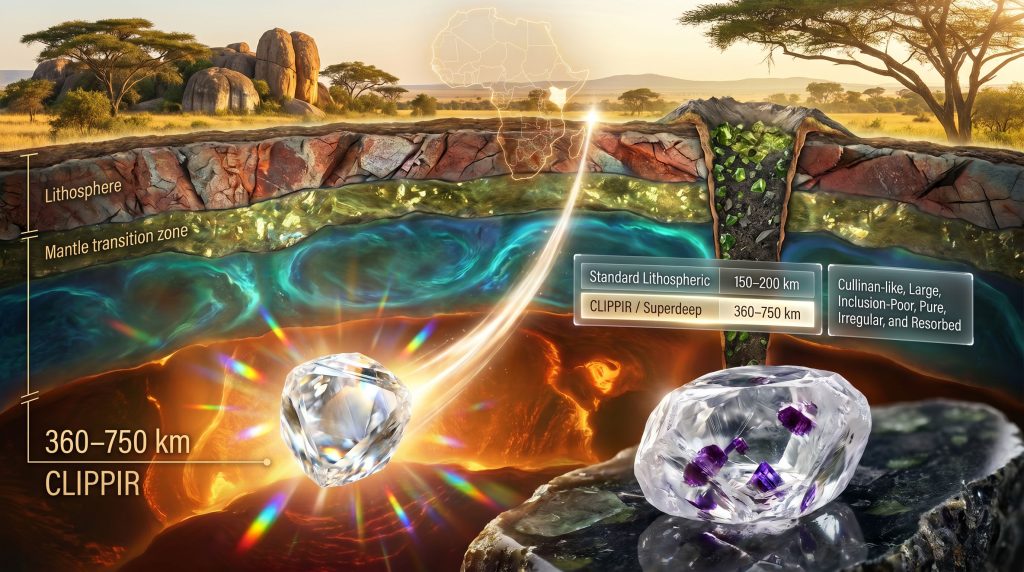
Scientists have classified the most exceptional of these stones under the acronym CLIPPIR: Cullinan-like, Large, Inclusion-Poor, Pure, Irregular, and Resorbed. Each descriptor reflects a measurable physical or chemical property:
- Cullinan-like anchors the classification to the most famous specimen of this type
- Large distinguishes these stones by mass, typically well above 100 carats in the rough
- Inclusion-Poor describes the near-total absence of trapped minerals during crystallisation
- Pure refers to their exceptional chemical composition, predominantly Type IIa with minimal nitrogen impurities
- Irregular reflects their non-octahedral crystal morphology, which differs markedly from conventional diamonds
- Resorbed indicates partial dissolution of crystal surfaces during transport through the mantle
The Cullinan Diamond, recovered from South Africa's Premier Mine in 1905 and weighing 3,106 carats in its rough state, remains the largest gem-quality rough diamond ever recovered. It became not only a historical artefact of extraordinary value but the scientific reference point against which all CLIPPIR-class stones are now measured.
Formation Environments: A Tale of Two Mantles
Understanding the deep-earth origin of the world's largest diamonds requires appreciating that the mantle is not a uniform environment. It is a chemically and thermally stratified system in which conditions change dramatically with depth.
| Diamond Type | Formation Depth | Key Environment | Typical Size Range |
|---|---|---|---|
| Conventional Lithospheric | 150 to 200 km | Oxidised silicate mantle | Small to moderate |
| CLIPPIR / Superdeep | 360 to 750 km | Iron-rich metallic liquid pockets | Exceptionally large |
| Lower Mantle | Greater than 660 km | High-pressure bridgmanite hosts | Rare, small inclusions only |
At 360 to 750 kilometres below Earth's surface, pressures exceed anything replicable in most laboratory settings, and the dominant mineral phases shift entirely. The transition zone between the upper and lower mantle spans roughly 410 to 660 kilometres depth. Within and just below this boundary, mineral structures that are stable near the surface become unstable and transform into denser, more compressed phases.
It is within this extraordinary pressure regime that the iron-rich metallic liquid pockets responsible for CLIPPIR diamond formation are thought to persist. These pockets, composed primarily of iron, nickel, carbon, and sulfur, exist in conditions of extremely low oxygen availability. This oxygen-deficient environment is the critical ingredient. Without oxidising conditions to react with carbon, large volumes of pure carbon can accumulate and crystallise within the metallic liquid over geological timescales potentially spanning hundreds of millions of years.
Why Oxygen Fugacity Is the Hidden Variable
One of the least widely understood aspects of diamond formation is the role of oxygen fugacity: the effective partial pressure of oxygen within a given chemical system. In the lithospheric mantle where conventional diamonds form, oxygen fugacity is relatively high, meaning carbon tends to form carbonate minerals rather than pure elemental diamond. The conditions are competitive.
In the deep mantle environments where CLIPPIR diamonds crystallise, oxygen fugacity is exceptionally low. Metallic iron absorbs available oxygen, creating domains where carbon has no oxidising partner. Within these domains, diamond crystallisation is not only possible but favoured. The resulting stones grow slowly and without competition from carbonate phases, producing the characteristic purity that defines the CLIPPIR classification.
This mechanism also explains why CLIPPIR diamonds are inclusion-poor. The surrounding metallic liquid is compositionally simple, containing few silicate minerals or other phases that might become trapped during crystal growth. The isolation of these metallic pockets from the broader silicate mantle is precisely what produces diamonds of such extraordinary clarity.
The Subduction Connection: Ancient Seafloor Reborn as Gemstone
The carbon that eventually becomes a CLIPPIR diamond does not originate in the deep mantle. Its journey begins at the ocean floor, hundreds of millions to billions of years before the diamond crystallises. Understanding this pathway reshapes the entire concept of what these stones represent.
The process operates through the following sequence:
- Oceanic crust forms at mid-ocean spreading centres and accumulates carbon through seafloor hydrothermal activity, carbonate sedimentation, and the preservation of organic material
- Tectonic subduction drives this carbon-enriched crust downward into the mantle at convergent plate boundaries, carrying its chemical cargo to progressively greater depths
- At extreme depths, the subducted material begins to interact with iron-rich mantle phases, creating localised domains of metallic liquid that are chemically isolated from the surrounding silicate environment
- Carbon within these metallic domains reaches saturation conditions and begins crystallising as diamond, with growth continuing over geological timescales
- Kimberlite eruptions, originating from extraordinary depths, transport the diamonds upward at speeds estimated at 10 to 30 metres per second, preserving their mineralogy intact during rapid decompression
This pathway establishes CLIPPIR diamonds as products of the deep carbon cycle: the long-term planetary system that transfers carbon between Earth's surface environments and its deep interior. Each giant diamond is, in a meaningful scientific sense, a piece of ancient seafloor that has been transformed under conditions of extreme pressure and chemical isolation into one of the rarest solid objects on the planet.
Each CLIPPIR diamond functions as a sealed geochemical archive, preserving direct physical evidence of conditions at depths that no drilling technology can reach and no seismic survey can resolve in chemical detail. The inclusions they occasionally contain, and the chemical signatures of the metallic environments where they grew, represent the only direct samples scientists have from these extreme depths.
The UCT Methodology: Reading Mantle History Through Olivine
The central scientific innovation in the University of Cape Town study lies in its analytical approach. Rather than examining the diamonds themselves, the research team focused on olivine minerals extracted from the kimberlite rocks that host and transport diamonds to the surface.
Olivine is one of the most abundant minerals in the upper mantle. When kimberlitic magma ascends through the mantle column, it interacts chemically with the surrounding olivine-bearing rocks, and the olivine that becomes incorporated into the kimberlite preserves isotopic signatures that record the chemistry of the mantle environments through which the magma passed.
By analysing these isotopic fingerprints and cross-referencing them with established datasets on mineral inclusions found within CLIPPIR diamonds, the UCT team reconstructed the deep-mantle chemical environments where these stones formed. Furthermore, the methodology provides an independent line of evidence, separate from diamond inclusion analysis, that confirms the superdeep iron-rich origin of CLIPPIR stones. Carnegie Science's research into the very deep origin of these diamonds provides additional context for this confirmatory work.
The Key Mineral Witnesses
While olivine provided the new methodological pathway, the mineral inclusions preserved within CLIPPIR diamonds themselves remain critical corroborating evidence:
| Inclusion Mineral | Why It Matters | Depth Confirmation |
|---|---|---|
| Majoritic Garnet | Only stable under extreme pressure conditions | Greater than 300 km depth |
| Calcium Perovskite | Stable exclusively in lower mantle pressure regimes | Greater than 660 km depth |
| Metallic Iron Phases | Direct evidence of oxygen-deficient environment | Superdeep mantle formation |
| Iron-Nickel Sulfides | Consistent with metallic liquid host composition | Superdeep mantle formation |
The presence of calcium perovskite inclusions within some CLIPPIR diamonds is particularly significant. Calcium perovskite is only stable at pressures corresponding to depths exceeding 660 kilometres, placing the origin of these stones firmly within the lower mantle. When such inclusions decompose during transport toward the surface, they leave behind characteristic mineral assemblages that geoscientists can identify and interpret.
Geographic Distribution and the Craton Factor
The deep-earth origin of the world's largest diamonds is not randomly distributed. There is a coherent geological architecture explaining where CLIPPIR diamonds are found, and it is anchored to one of the oldest structures in continental geology: the craton.
Cratons are ancient, tectonically stable segments of continental crust that have remained undisturbed for billions of years. Their distinguishing feature relevant to diamond geology is the depth of their lithospheric roots. Cratonic lithosphere extends far deeper than younger, more tectonically active continental crust, with some roots descending to depths of 200 to 250 kilometres or more.
This depth provides the geometric connection to CLIPPIR diamond-forming environments. Cratons situated above iron-enriched mantle domains that extend into the transition zone and lower mantle represent the most geologically prospective settings for superdeep diamond occurrences. The world's most significant diamond deposits are concentrated in cratonic terranes across:
- Southern Africa: The Kaapvaal Craton, hosting the Premier Mine and multiple other significant kimberlite fields
- Russia: The Siberian Craton, host to the Mirny and Udachnaya pipe systems
- Canada: The Slave Craton in the Northwest Territories, site of the Ekati and Diavik deposits
- Australia: The Kimberley Craton, historically significant for the Argyle deposit
The UCT study's findings suggest that iron-anomalous mantle domains capable of producing CLIPPIR diamonds may be more geographically widespread than the current distribution of known occurrences implies. Consequently, regions with ancient cratonic architecture overlying geochemically anomalous mantle may warrant renewed scientific and commercial attention.
The next major ASX story will hit our subscribers first
Implications That Extend Far Beyond the Diamond Industry
The scientific significance of establishing the deep-earth origin of the world's largest diamonds reaches well beyond gemology or even mineralogy. It touches on fundamental questions about how Earth's interior is structured, how it evolves over geological time, and how surface processes are connected to conditions hundreds of kilometres below.
The confirmation that subducted oceanic crust creates iron-enriched chemical domains at extreme depths fundamentally challenges earlier models of mantle homogeneity. For decades, geodynamic models treated the mantle as a broadly uniform convecting system, with chemical heterogeneities considered minor or transient. The evidence from CLIPPIR diamonds suggests the opposite: that the mantle preserves distinct chemical domains, including ancient subducted materials, over timescales of hundreds of millions of years.
This has downstream consequences for:
- Mantle convection models: If chemical heterogeneities persist at depth, convection patterns are more complex than uniform models suggest
- Volcanic geochemistry: Distinct mantle domains sampled by different volcanic systems would explain isotopic variations in ocean island basalts and other magmatic rocks
- Deep carbon budget estimates: If significant volumes of subducted carbon are stored as diamonds or within metallic liquids at extreme depths, global carbon cycle budgets require revision
- Kimberlite exploration methodology: Olivine geochemistry as a predictive tool for identifying prospective diamond targets could transform how exploration drilling programs are structured
The research establishes that Earth's mantle is not a well-mixed reservoir but a chemically stratified archive of ancient tectonic events. CLIPPIR diamonds are the physical evidence that ancient subduction zones continue to influence deep-earth chemistry billions of years after the original plate movements that created them.
A New Exploration Framework for Giant Diamond Discovery
One of the most practically significant aspects of the UCT research is the exploration framework it implies. By demonstrating that iron-anomalous olivine chemistry in kimberlite rocks correlates with superdeep diamond-forming environments, the study provides exploration geologists with a new geochemical screening tool.
Historically, diamond exploration has focused on identifying kimberlite pipes through geophysical surveys, soil sampling techniques of indicator minerals in soil and stream sediments, and drilling programs. The UCT methodology adds a new layer: the systematic analysis of olivine chemistry from sampled kimberlites to identify those most likely connected to iron-enriched mantle domains capable of hosting CLIPPIR diamonds.
This approach does not replace existing exploration methods but augments them with a targeted geochemical criterion. Kimberlite systems displaying anomalous iron signatures in their olivine populations would move up in exploration priority, while those lacking these signatures might be deprioritised for CLIPPIR-class targets.
The practical implication is that currently underexplored cratonic terranes in regions including central Africa, northern Canada, and parts of Australia and Antarctica may warrant systematic olivine geochemistry surveys as a first-pass screening tool for the next generation of giant diamond discoveries. In addition, gossans in mineral exploration offer complementary surface expression evidence that experienced geologists increasingly integrate alongside deeper geochemical methods. Furthermore, downhole geophysics represents another analytical layer that can help characterise subsurface conditions in prospective kimberlite targets.
Frequently Asked Questions
What separates CLIPPIR diamonds from all other diamonds?
CLIPPIR diamonds form at depths of 360 to 750 kilometres within oxygen-deficient metallic liquid environments in the deep mantle. This contrasts with conventional diamonds, which form at 150 to 200 kilometres depth in more oxidised, silicate-dominated conditions. The metallic liquid environment produces extraordinary purity, exceptional size, and irregular crystal morphology that defines the CLIPPIR classification.
How do scientists determine where deep-mantle diamonds originate?
Mineral inclusions trapped within diamonds during crystallisation act as pressure and temperature indicators. Minerals such as majoritic garnet and calcium perovskite are only stable under conditions found at specific extreme depths, providing direct physical evidence of superdeep origins. The UCT study added olivine isotope analysis from kimberlite host rocks as a complementary and independent methodology.
What is the connection between plate tectonics and the world's largest diamonds?
Ancient oceanic crust, subducted deep into the mantle during tectonic collisions, creates iron-enriched, carbon-bearing chemical domains at extreme depths. These domains provide the precise conditions required for CLIPPIR diamond crystallisation, making subduction tectonics the fundamental geological driver of giant diamond formation.
How do diamonds travel from 750 kilometres depth to the surface intact?
Kimberlite volcanic eruptions transport diamonds from the deep mantle to the surface at speeds estimated at 10 to 30 metres per second. This extraordinary ascent rate is fast enough to preserve the diamonds and their deep-mantle mineral inclusions before pressure equilibration can destroy them.
Could this research change how diamond exploration is conducted?
The identification of iron-anomalous mantle signatures through olivine geochemistry provides exploration geologists with a new analytical screening criterion. Kimberlite systems showing these signatures may be more likely to host CLIPPIR-class diamonds, potentially directing exploration programs toward currently underexplored cratonic regions and improving the efficiency of discovery programs globally. Why mineral exploration matters in this context extends well beyond commercial interest, touching on our fundamental understanding of planetary chemistry and deep-earth processes.
Disclaimer: This article presents geological and scientific information for educational purposes. Statements regarding future diamond discoveries, exploration outcomes, and scientific applications involve forward-looking elements subject to uncertainty. Readers should consult primary scientific literature and qualified geological professionals before drawing conclusions relevant to commercial exploration or investment decisions.
Ready to Uncover the Next Major Mineral Discovery Before the Broader Market?
Discovery Alert's proprietary Discovery IQ model delivers real-time alerts the moment significant ASX mineral discoveries are announced, transforming complex geological data into actionable investment insights for traders and long-term investors alike — explore historic discovery returns to understand the scale of opportunity, and begin your 14-day free trial today to position yourself ahead of the market.