June 12, 2026
When Junior Miners Think Like Strategists: The Logic Behind Critical Minerals Consolidation
The global mining industry has entered a phase where geological merit alone no longer determines which companies attract capital. What matters increasingly is the ability to demonstrate scale, commodity diversification, and credible partnerships with major offtake counterparties. In this environment, the junior end of the ASX has been undergoing a quiet but significant structural shift: companies are merging not out of distress, but out of strategic ambition. The Larvotto acquisition of Hammer Metals is a textbook illustration of this dynamic, combining imminent production capability with one of Queensland's most compelling undeveloped copper portfolios into a single, institutionally credible vehicle.
Understanding why this deal matters requires stepping back from the transaction itself and examining the forces reshaping the critical minerals demand landscape in Australia. Copper demand projections tied to electric vehicle manufacturing, grid infrastructure expansion, and industrial electrification continue to widen the gap between committed mine supply and projected consumption through 2030. Junior developers in proven geological districts are responding to this structural imbalance by consolidating land packages, pooling technical expertise, and positioning themselves as acquisition targets or development partners for major miners and trading houses.
When big ASX news breaks, our subscribers know first
What the Larvotto Acquisition of Hammer Metals Actually Represents
At its surface, this is a merger between two ASX-listed junior miners. At a deeper level, it is the deliberate construction of a multi-commodity critical minerals platform designed to attract institutional capital at a scale that neither company could have achieved independently.
Larvotto Resources had been building toward production at its Hillgrove Antimony-Gold Project in New South Wales, with antimony and gold output targeted to commence in August 2026. Hillgrove is not a speculative exploration play; it carries a binding offtake agreement with Glencore for gold concentrate, providing concrete near-term revenue certainty that few junior developers can claim. However, Larvotto's standalone profile was anchored to a single asset in a single jurisdiction, limiting its appeal as a diversified critical minerals investment.
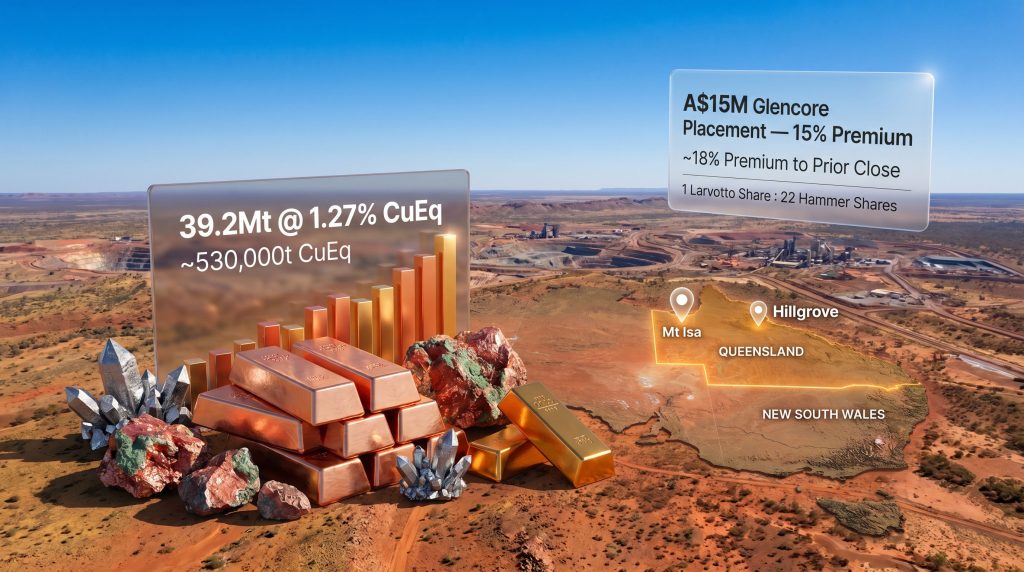
Hammer Metals, meanwhile, had assembled an impressive copper and critical minerals land package in Queensland's Mt Isa corridor, including the Kalman Project, a JORC-compliant resource of 39.2 million tonnes at 1.27% copper equivalent containing approximately 420,000 tonnes of copper-equivalent metal. By the standards of Australia's junior copper development landscape, Kalman's grade is notable. The industry average for development-stage copper projects in Australia sits broadly in the 0.8% to 1.0% copper equivalent range, meaning Kalman's 1.27% positions it toward the upper end of what is commercially attractive at the pre-feasibility stage. Yet Hammer, without an imminent production asset or major offtake partner, lacked the near-term revenue pathway required to fund aggressive development of its Queensland portfolio.
The combination resolves both constraints simultaneously. Hillgrove provides cash flow. Kalman and the broader Mt Isa portfolio provide the development pipeline that institutional investors are increasingly demanding.
How the Deal Structure Works: Scheme Mechanics and Share Exchange
The Larvotto acquisition of Hammer Metals is structured as a court-approved scheme of arrangement rather than a conventional off-market takeover bid. This distinction carries practical significance for investors and observers.
Scheme structures require approval from two sources: the shareholders of the target company and the Federal Court of Australia. The shareholder vote requires 75% approval by value of shares voting and more than 50% approval by number of shareholders voting, a dual threshold designed to protect minority shareholders. Once both court sanction and shareholder approval are obtained, the scheme binds all shareholders, eliminating the fragmented share register outcomes that can result from partial-acceptance takeover bids.
Under the terms agreed by both boards, Hammer Metals shareholders will receive one newly issued Larvotto share for every 22 Hammer shares held at the scheme record date. Based on Larvotto's closing price of A$1.33 on 5 June 2026, this implies an offer price of approximately A$0.06 to A$0.067 per Hammer share, representing an approximately 18% premium to Hammer's prior closing price, as reported by Mining Technology.
The resulting ownership structure of the enlarged entity is as follows:
| Shareholder Group | Post-Scheme Ownership |
|---|---|
| Existing Larvotto shareholders | ~92.7% |
| Former Hammer Metals shareholders | ~7.3% |
| Glencore (via separate placement) | Strategic equity participant |
The Hammer Metals board has unanimously recommended the scheme to its shareholders, conditional on the absence of a superior competing proposal and subject to the findings of an Independent Expert's Report prepared in accordance with the Corporations Act 2001 (Cth). Under Australian law, directors of a target company bear fiduciary obligations to act in the best interests of shareholders, and a unanimous recommendation signals that the board has determined, subject to those conditions, that the scheme delivers fair value.
What the Glencore Placement Adds to the Equation
Running alongside the scheme is a A$15 million share placement priced at a 15% premium to market, with Glencore participating as the strategic investor. This element of the transaction deserves careful attention because it transforms what might otherwise be a straightforward junior-to-junior merger into something more strategically layered.
Glencore's involvement is not new. The company had already executed a binding offtake agreement with Larvotto for gold concentrate from the Hillgrove project prior to this transaction. The placement deepens that commercial relationship into an equity partnership, creating a configuration where Glencore holds both offtake rights over Larvotto's gold production and an equity stake in the enlarged company that will develop the Mt Isa copper portfolio.
This dual positioning — as both offtake counterparty and equity participant — creates a vertically integrated commercial relationship that materially strengthens the combined entity's near-term revenue and capital position. Placement pricing at a premium signals institutional conviction rather than distressed capital raising.
The A$15 million raised through the placement is earmarked to support the expansion and development of Larvotto's copper strategy in Queensland, as well as continued progress at Hillgrove ahead of its August 2026 production commencement.
The Combined Asset Portfolio: A Dual-Commodity Critical Minerals Platform
The enlarged Larvotto entity will control a portfolio spanning two Australian states, two primary commodity streams, and two distinct development stages — an unusual combination in the junior mining sector.
| Asset | Location | Stage | Primary Commodities | Resource Scale |
|---|---|---|---|---|
| Hillgrove Project | New South Wales | Near-production (Aug 2026) | Antimony, Gold | JORC-compliant, binding offtake secured |
| Kalman Project | Mt Isa, Queensland | Development | Copper (420,000t CuEq) | 39.2Mt @ 1.27% CuEq |
| Mt Isa Portfolio (total) | Queensland | Exploration/Development | Copper + Critical Minerals | ~530,000t CuEq |
Hillgrove: Antimony's Rising Strategic Importance
Antimony is not a commodity that typically attracts mainstream investment coverage, yet it occupies an increasingly critical position in several high-growth technology and defence applications. Furthermore, the antimony shortage risks facing importing nations have heightened the strategic relevance of domestic Australian production. Its primary industrial role in flame retardants has expanded in strategic importance as electric vehicle battery adoption accelerates, since antimony trioxide is used as a flame-retardant synergist in battery casing materials and electronic components.
Separately, antimony is a key input in certain military-grade ammunition and night-vision equipment, adding a defence demand layer that is structurally uncorrelated with broader base metals cycles. Australia classifies antimony as a critical mineral, reflecting its supply chain concentration risk. Global antimony production is heavily concentrated in a small number of countries, creating price and availability vulnerabilities for importing nations. Hillgrove's resource therefore carries strategic relevance beyond its standalone financial metrics.
Kalman and the Mt Isa Copper Portfolio
The Kalman Project is the centrepiece of what Hammer Metals had been building in the Mt Isa corridor. Its JORC-compliant resource of 39.2 million tonnes graded at 1.27% copper equivalent contains approximately 420,000 tonnes of copper-equivalent metal, making it one of the larger undeveloped copper resources in the district.
The Mt Isa corridor itself warrants context for investors unfamiliar with Australian base metals geology. The region is one of the world's most significant base metals districts, hosting world-class deposits of copper, zinc, lead, and silver. The geological framework, dominated by sediment-hosted stratiform mineralisation, is well understood by the industry and has been productive at depth and along strike extensions from known deposits.
Crucially, the region benefits from established processing infrastructure, rail connections to the coast, and power access — development cost advantages that are difficult to replicate in greenfield jurisdictions and that compress the capital intensity of bringing new projects into production. The total copper-equivalent resource across Hammer's Mt Isa portfolio reaches approximately 530,000 tonnes, with Kalman representing the most advanced and largest single component of that portfolio.
Strategic Scenarios Enabled by the Merger
This transaction is not simply an asset aggregation exercise. It creates optionality across three distinct forward pathways that were unavailable to either company on a standalone basis.
Scenario 1: Staged producer with institutional backing. Hillgrove commences antimony and gold production in August 2026, generating cash flow that reduces the combined entity's reliance on equity markets to fund Queensland copper development. Simultaneously, the A$15 million Glencore placement funds early-stage work at Kalman, potentially advancing a feasibility study within a 12 to 24 month window. This pathway positions the enlarged Larvotto as a rare dual-production ASX-listed critical minerals company within a 24 to 36 month horizon.
Scenario 2: Platform for further consolidation. With a larger resource base, two jurisdictions, and Glencore as a strategic equity partner, the enlarged entity presents a more compelling profile for additional bolt-on acquisitions in the Mt Isa corridor, where several junior explorers hold prospective ground adjacent to Kalman. The mining industry consolidation trend currently reshaping the ASX resource sector means the combined entity's market capitalisation and institutional relationships create M&A optionality that simply did not exist for either company independently.
Scenario 3: Strategic acquisition target. Major mining companies and large commodity trading houses have historically used equity investments in junior developers as a prelude to full acquisition once project development reaches a more advanced stage. Glencore's deepening equity and commercial relationship with Larvotto fits a pattern of upstream positioning that precedes larger strategic decisions. This scenario remains speculative and investors should treat it as a possibility rather than a probability, recognising that execution risk, copper price volatility, and permitting timelines all represent material uncertainties.
Why the Mt Isa District Commands Attention
The Mt Isa corridor's resurgence as a focal point for copper investment reflects a combination of geological, infrastructure, and market factors that are worth disaggregating for investors evaluating this transaction.
From a geological standpoint, the district's sediment-hosted copper systems remain underexplored at depth relative to the scale of known surface and shallow mineralisation. Historical mining in the region prioritised economic extraction over systematic exploration of depth extensions, leaving material resource upside that modern drilling techniques and improved geological modelling are now beginning to unlock.
From an infrastructure perspective, the Mt Isa region benefits from assets that took decades and billions of dollars to build: operating concentrators, a rail line connecting to the coast at Townsville, established power supply, and an experienced regional workforce. For a junior developer, accessing this infrastructure through tolling arrangements or proximity to existing facilities can substantially reduce upfront capital requirements compared to building equivalent capacity in a remote location.
From a market timing perspective, the copper supply crunch narrative has gained increasing credibility among institutional investors. The IEA and major mining consultancies have consistently projected a widening gap between committed mine supply and electricity-transition-driven demand through the late 2020s and into the 2030s. Junior and mid-tier developers in proven, infrastructure-rich districts like Mt Isa have consequently attracted disproportionate M&A interest from parties seeking to secure future production optionality before project values reflect that scarcity premium.
The next major ASX story will hit our subscribers first
Board Process, Conditions, and Deal Risk Factors
The Hammer Metals board's unanimous recommendation carries weight in Australian M&A contexts, but it is conditional rather than unconditional. The recommendation remains valid in the absence of a superior competing proposal and subject to a favourable Independent Expert's Report.
The Independent Expert, appointed to assess fairness from a financial perspective, must evaluate the scheme consideration using recognised valuation methodologies including net asset value analysis, discounted cash flow modelling, and comparable company trading multiples. If the expert concludes the scheme is not fair and reasonable, the board's recommendation would need to be reconsidered and shareholder approval would become significantly less certain.
Key risk factors investors should monitor include:
-
The Independent Expert's assessment of whether the 18% premium to prior closing price adequately reflects Hammer's underlying asset value, particularly given Kalman's resource grade and scale
-
The possibility, however limited given the premium and unanimous recommendation, of a competing bid emerging from another party with strategic interest in the Mt Isa copper portfolio
-
Court approval timelines, which in Australian schemes typically add 8 to 12 weeks from announcement to implementation, during which commodity price movements can affect relative valuations
-
Permitting and regulatory milestones required for Queensland copper development, which represent execution risk independent of the scheme's legal completion
Advisers and Deal Architecture
Larvotto has engaged Blue Ocean Equities and MA Moelis Australia as joint financial advisers, with Allion Partners appointed as legal adviser. The use of dual financial advisers is relatively uncommon in junior-to-junior resource sector transactions. It signals that the deal structure — combining a court-approved scheme, a concurrent strategic placement, and coordination with an existing offtake counterparty — required sophisticated capital markets execution capability across multiple workstreams simultaneously. Furthermore, the involvement of majors-junior partnerships of this kind increasingly characterise the most credible transactions in Australia's critical minerals sector.
Frequently Asked Questions
What is the total implied value of the Larvotto acquisition of Hammer Metals?
The transaction values Hammer Metals at approximately A$54 million (approximately US$37.85 million), based on Larvotto's closing price of A$1.33 on 5 June 2026, implying an offer price of approximately A$0.06 per Hammer share, as detailed in the ASX announcement published on the scheme binding agreement.
What will Hammer shareholders receive?
Hammer shareholders will receive one newly issued Larvotto share for every 22 Hammer shares held at the scheme record date, subject to court and shareholder approval.
What premium does the scheme represent?
The implied offer price represents approximately an 18% premium to Hammer Metals' prior closing share price based on reported trading prices before the announcement.
Why is Glencore participating?
Glencore is investing A$15 million via a share placement priced at a 15% premium to market, extending its existing commercial relationship with Larvotto beyond the binding gold concentrate offtake agreement for Hillgrove into a direct equity partnership with the enlarged entity.
When does Hillgrove production begin?
Antimony and gold production at Hillgrove is targeted to commence in August 2026, providing near-term revenue generation for the combined entity.
What is the Kalman Project?
Kalman is the flagship asset within Hammer's Mt Isa portfolio, holding a JORC-compliant resource of 39.2 million tonnes at 1.27% copper equivalent containing approximately 420,000 tonnes of copper-equivalent metal.
What happens to Hammer's Western Australian assets?
Reporting indicates Hammer's Western Australian gold assets may be subject to a separate demerger or spin-off structure, allowing those assets to be distributed or retained independently from the main scheme transaction.
Key Takeaways: What This Deal Reveals About ASX Critical Minerals M&A in 2026
-
Platform consolidation is accelerating: Complementary asset combinations are replacing single-asset development models as the preferred structure for attracting institutional capital and major offtake partnerships
-
Strategic investors are entering earlier: Glencore's equity participation at a premium to market demonstrates that major commodity trading houses are willing to take upstream equity positions in Australian critical minerals developers ahead of production, not just at the offtake agreement stage
-
Antimony is an underappreciated critical mineral: Its applications in electric vehicle battery flame retardants and defence technologies are structurally growing, and domestic Australian production capability carries supply chain diversification value that extends beyond simple commodity economics
-
Mt Isa copper remains a high-conviction development target: The district's combination of geological endowment, established regional infrastructure, and resource depth potential continues to attract M&A capital from parties taking a long-dated view on copper demand fundamentals
-
Scheme structures signal board-level conviction: Unanimous board recommendations in court-approved schemes, combined with premium-priced strategic placements, are among the strongest available signals of transactional credibility in Australian resource sector M&A
This article is intended for informational purposes only and does not constitute financial advice. The Larvotto acquisition of Hammer Metals remains subject to court approval, shareholder approval, and Independent Expert assessment. Forward-looking statements and scenario projections involve uncertainty, and actual outcomes may differ materially from those described. Readers should conduct their own due diligence and seek independent financial advice before making investment decisions. All financial figures are sourced from Mining Technology's reporting dated June 12, 2026.
Want to Know When the Next Major ASX Mineral Discovery Hits the Market?
The Larvotto-Hammer Metals consolidation illustrates exactly how quickly strategic value can materialise in Australia's critical minerals sector — and Discovery Alert's proprietary Discovery IQ model ensures subscribers receive real-time alerts the moment significant ASX mineral discoveries are announced, turning complex geological and market data into actionable investment insights. Explore historic examples of exceptional discovery returns and begin your 14-day free trial today to position yourself ahead of the next major critical minerals opportunity.