July 23, 2026
Understanding Latin America's Strategic Mineral Landscape
South America has emerged as the epicenter of global lithium extraction, with vast salt flat deposits containing an estimated 60% of the world's proven reserves. This geographic concentration has created unprecedented opportunities for international partnerships, particularly as battery manufacturers seek supply chain diversification beyond traditional Australian hard rock operations. Bolivia lithium energy deals represent more than geological fortune within this strategic triangle alongside Chile and Argentina.
The convergence of geopolitical realignment and economic necessity has created conditions where Bolivia's vast Salar de Uyuni deposits have become central to international energy security planning. Unlike conventional mining operations that extract lithium from hard rock sources, Bolivia's salt flat methodology offers significantly higher lithium concentrations and potentially lower environmental impacts through brine extraction processes.
Furthermore, the Argentina lithium brine market demonstrates similar extraction methodologies that could complement Bolivia's approach.
When big ASX news breaks, our subscribers know first
Bolivia's Reserve Scale in Global Context
Bolivia maintains approximately 21 million metric tons of lithium reserves, representing roughly 22% of global identified resources according to U.S. Geological Survey data. This positions the country as the world's largest holder of lithium reserves, surpassing Chile's 11 million metric tons and Argentina's 2.7 million metric tons.
The scale differential becomes particularly significant when considering production capacity potential through 2030. However, these developments must align with broader critical minerals strategy initiatives across the region.
| Country | Lithium Reserves (Million MT) | Global Share (%) | Primary Extraction Method |
|---|---|---|---|
| Bolivia | 21.0 | 22.0 | Salt flat brine |
| Chile | 11.0 | 11.5 | Salt flat brine |
| Australia | 7.3 | 7.6 | Hard rock spodumene |
| Argentina | 2.7 | 2.8 | Salt flat brine |
| China | 1.5 | 1.6 | Mixed sources |
The technical advantages of Bolivia's salt flat extraction become evident when examining lithium concentrations. Salar de Uyuni contains lithium concentrations ranging from 200 to 400 milligrams per liter, comparable to Chile's Atacama Desert operations but with substantially larger geographic coverage.
This concentration level enables direct lithium extraction technologies to achieve recovery rates exceeding 80%, significantly higher than traditional evaporation pond methods that typically recover 30-50% of available lithium. Production capacity projections through 2030 suggest Bolivia could theoretically produce 200,000 metric tons annually if fully developed, representing approximately 25% of projected global lithium demand.
International Investment Framework Analysis
Bolivia's approach to foreign lithium investment reflects a carefully structured balance between attracting international capital and maintaining state ownership principles. The investment framework mandates 51% Bolivian state ownership in all lithium joint ventures, with foreign partners contributing technology, financing, and market access while accepting minority ownership positions.
This ownership structure differs significantly from other Latin American lithium jurisdictions. Chile operates through private concession models with minimal state ownership requirements, while Argentina employs provincial-level negotiations that vary by jurisdiction. Bolivia's standardised majority state ownership approach represents a more restrictive yet potentially more stable framework for long-term resource development.
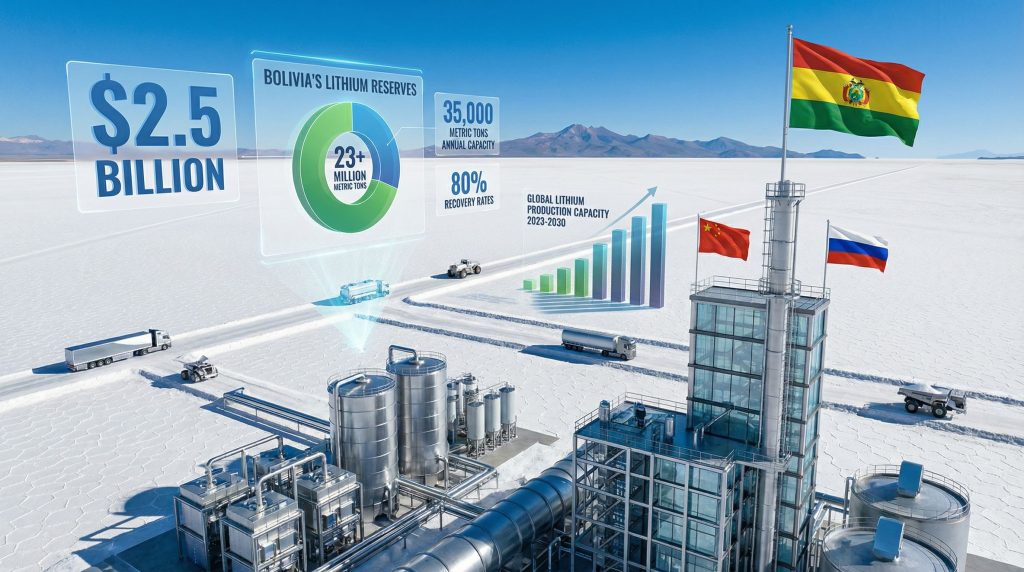
The combined international commitments approaching $2.5 billion represent the largest foreign investment package in Bolivia's mining sector since nationalisation policies began in 2006. These investments encompass not only extraction facilities but comprehensive processing infrastructure designed to produce battery-grade lithium carbonate and lithium hydroxide for direct supply to electric vehicle manufacturers.
Chinese Strategic Mineral Engagement
China's lithium strategy in Bolivia extends beyond simple resource extraction to encompass comprehensive supply chain integration. The Chinese approach involves deploying advanced direct lithium extraction technologies that bypass traditional 12-18 month evaporation pond cycles, enabling continuous production regardless of seasonal weather variations.
CBC Investments, operating as a subsidiary of Contemporary Amperex Technology (CATL), represents China's broader battery manufacturing vertical integration strategy. CATL currently holds approximately 37% of global battery market share, making secure lithium supply access critical for maintaining competitive positioning against South Korean and Japanese battery manufacturers.
The planned dual-plant configuration totalling 35,000 metric tons annual capacity would supply approximately 15% of CATL's projected lithium requirements through 2030. This capacity represents enough lithium to produce batteries for approximately 700,000 electric vehicles annually, assuming standard lithium-ion battery configurations requiring 50 kilograms of lithium per vehicle.
Technology transfer agreements include training programmes for 2,000 Bolivian technical workers and establishment of lithium processing research facilities at Universidad Mayor de San Andrés in La Paz. These educational components aim to develop local technical expertise capable of eventual independent operation.
Russian Energy Diversification Strategy
Russia's entry into Bolivia's lithium sector through Uranium One represents a strategic diversification beyond traditional uranium and fossil fuel operations. Uranium One, controlled by Russian state corporation Rosatom, brings extensive experience in mineral extraction and processing from uranium operations across Kazakhstan, Canada, and Namibia.
The $450 million commitment for a 14,000 metric ton annual facility reflects Russia's recognition that battery minerals represent critical components of future energy security. This investment aligns with Russia's broader strategy of maintaining influence in Latin American resource sectors despite international sanctions.
Russian lithium extraction methodology emphasises rapid deployment of proven technologies rather than experimental approaches. The planned facility would utilise conventional brine evaporation methods with enhanced processing efficiency, targeting operational status within 36 months of final approvals.
Geopolitically, Russian lithium investment provides Bolivia with diversified international partnerships, reducing dependency on any single foreign partner while maintaining leverage in negotiations with both Chinese and Western companies seeking similar agreements.
Political Risk Assessment Framework
Bolivia's political landscape presents complex challenges for long-term mining investments. The November 2025 election of centrist President Rodrigo Paz marked a significant departure from nearly two decades of leftist governance under Evo Morales and Luis Arce.
This political transition creates both opportunities for improved foreign investment relations and risks from policy reversals. According to Reuters, Energy Minister Mauricio Medinaceli's commitment to "honoring existing agreements provides crucial investor reassurance following years of contract disputes and nationalisation threats."
However, the Opposition-controlled Legislative Assembly maintains authority over mining contract approvals, creating potential bottlenecks despite executive branch support for foreign investment.
| Political Risk Factor | Impact Level | Mitigation Strategy | Timeline |
|---|---|---|---|
| Legislative approval delays | High | Separate law drafting process | 6-12 months |
| Indigenous rights challenges | Medium | Community consultation protocols | 12-24 months |
| Labour union opposition | Medium | Negotiated benefit agreements | 3-6 months |
| Currency devaluation | High | USD-denominated contracts | Ongoing |
| Judicial intervention | Low | Constitutional compliance review | 6 months |
Indigenous community concerns focus primarily on environmental protection and benefit-sharing arrangements rather than fundamental opposition to lithium extraction. The Confederation of Bolivian Workers (COB) has generally supported lithium development projects that include employment guarantees and skills training programmes for local workers.
In addition, court suspension precedents from previous mining disputes emphasise the importance of comprehensive environmental impact assessments and community consultation processes.
The next major ASX story will hit our subscribers first
Economic Reform Integration
Bolivia's fuel subsidy elimination in December 2025 represents a fundamental shift toward market-oriented energy policies that support broader foreign investment attraction. The subsidy cuts, while sparking initial protests, demonstrate government commitment to fiscal stabilisation that international investors typically require for long-term project commitments.
The transition from YPFB monopolistic control to competitive wholesale distribution blocks creates precedent for private sector participation in other strategic industries, including lithium processing and export operations. This policy evolution suggests potential for additional foreign investment opportunities beyond current extraction-focused agreements.
Private sector fuel supply arrangements through 10 wholesale distribution blocks, each operating under five-year contracts, provide templates for similar competitive frameworks in lithium processing and battery component manufacturing. These arrangements balance continued state oversight with operational efficiency improvements that foreign investors typically demand.
Furthermore, labour union negotiations following subsidy elimination established frameworks for managing workforce transitions in other sectors. The successful resolution of fuel sector protests through negotiated benefit packages demonstrates government capacity to implement economic reforms while maintaining social stability.
Global Supply Chain Implications
Bolivia lithium energy deals address critical concentration risks in global battery supply chains. Currently, Australia provides approximately 55% of global lithium production through hard rock spodumene mining, creating potential supply vulnerabilities from single-country dependence.
Bolivian production capacity would provide geographic diversification essential for international energy security planning. This aligns with broader critical minerals energy security initiatives worldwide.
The integration of Bolivian production with existing lithium triangle operations in Chile and Argentina creates potential for regional processing hubs that could compete with Chinese battery manufacturing dominance. Combined production capacity from all three countries could theoretically supply 70% of projected global lithium demand through 2035, assuming full development of identified reserves.
Regional processing versus raw material export models present strategic choices with significant economic implications. Raw lithium carbonate exports generate approximately $8,000-12,000 per metric ton in current market conditions, while processed battery-grade materials command $15,000-25,000 per metric ton.
Logistics infrastructure development for lithium exports requires substantial investment in transportation corridors connecting Bolivia's landlocked position to Pacific Ocean ports in Chile and Peru. These infrastructure investments create additional economic benefits through improved connectivity for other Bolivian exports.
Technology Deployment Analysis
Direct lithium extraction technology deployment in Bolivia represents a significant advancement over traditional evaporation pond methods that dominate Chilean and Argentine operations. DLE systems utilise selective ion exchange or membrane separation to extract lithium directly from brine sources, eliminating weather dependency and reducing water consumption by up to 70%.
The 80% recovery rates achievable through DLE technology contrast sharply with 30-50% recovery rates from conventional evaporation ponds. This efficiency differential means DLE operations can extract significantly more lithium from identical brine volumes, effectively multiplying the economic value of Bolivia's reserve base.
Processing timelines present another crucial advantage. Traditional evaporation methods require 12-18 months to produce lithium carbonate from initial brine extraction, while DLE systems can complete the same process in 24-48 hours.
This time compression enables rapid response to market demand fluctuations and reduces inventory carrying costs that burden conventional operations. Such mining innovation trends are transforming the entire sector.
Environmental impact considerations favour DLE deployment in Bolivia's environmentally sensitive Altiplano region. Traditional evaporation ponds require large surface areas and consume substantial water resources, while DLE systems operate within compact industrial facilities with closed-loop water recycling.
Investment Risk Mitigation Strategies
Currency risk represents a primary concern for international investors in Bolivia's lithium sector. Historical boliviano volatility and limited foreign exchange reserves create potential for significant currency devaluation that could erode project returns. USD-denominated contracts with automatic adjustment mechanisms provide partial protection.
Regulatory risk mitigation requires comprehensive compliance with evolving environmental and social standards. International finance institutions increasingly mandate adherence to Equator Principles and IFC Performance Standards for major mining investments.
Projects that proactively exceed these standards typically experience fewer regulatory delays and community opposition. Political insurance from multilateral institutions provides additional risk protection for qualified investments.
The Multilateral Investment Guarantee Agency (MIGA) and similar institutions offer political risk insurance covering expropriation, currency inconvertibility, and war/civil disturbance. Premium costs typically range from 0.5-2.0% annually of insured amounts.
Local partnership requirements mandate careful selection of Bolivian joint venture partners with complementary capabilities and aligned interests. Successful partnerships typically involve established Bolivian mining companies with government relations experience rather than newly formed entities.
Market Dynamics and Price Implications
Global lithium market dynamics suggest sustained demand growth through at least 2035, driven primarily by electric vehicle adoption and stationary energy storage deployment. Bloomberg NEF projects global lithium demand reaching 3.0 million metric tons annually by 2030, compared to current production of approximately 800,000 metric tons annually.
Price volatility remains a significant challenge for long-term investment planning. Lithium carbonate prices have fluctuated between $8,000-80,000 per metric ton over the past five years, creating substantial uncertainty for project economics.
Long-term supply agreements with fixed pricing mechanisms provide some stability, though such arrangements typically involve pricing discounts to spot market rates. Bolivia's potential market share of 15-25% by 2030 could provide sufficient scale to influence global pricing dynamics.
Competition from alternative battery technologies, including sodium-ion and solid-state batteries, presents long-term demand risks for lithium producers. However, current technological trajectories suggest lithium-ion batteries will remain dominant through at least 2035.
What Factors Drive Lithium Price Volatility?
Several key factors contribute to lithium price instability:
- Supply chain disruptions from weather events or political instability
- Demand fluctuations from electric vehicle market cycles
- Inventory management by major battery manufacturers
- Speculation in commodity markets
- New supply additions from major projects coming online
Future Scenario Analysis
Successful implementation of Bolivia's lithium investment strategy could transform the country's economic profile within a decade. Annual lithium export revenues of $8-15 billion would represent 40-70% of current total export earnings, potentially doubling Bolivia's foreign exchange generation.
Alternative scenarios involving project delays or political reversals could perpetuate Bolivia's economic dependence on natural gas exports while missing the critical window for lithium market entry. Delayed development risks allowing alternative supply sources, including Australian lithium innovations and North American projects, to capture market share during the crucial 2025-2030 demand acceleration period.
According to S&P Global, regional integration scenarios suggest potential for South American lithium processing confederation among Bolivia, Chile, and Argentina. Combined bargaining power could enable more favourable terms with Asian battery manufacturers while developing indigenous processing capabilities.
Technology evolution scenarios must account for potential breakthrough developments in lithium extraction or battery chemistry that could alter competitive dynamics. Continuous monitoring of technological developments and maintenance of operational flexibility will be essential for long-term project success.
How Could Regional Cooperation Transform the Lithium Triangle?
Coordinated development across Bolivia, Chile, and Argentina could create:
- Shared processing infrastructure reducing individual country investment requirements
- Unified pricing strategies strengthening negotiating position with buyers
- Technology exchange programmes accelerating innovation adoption
- Environmental standards harmonisation improving sustainability credentials
- Joint marketing initiatives promoting South American lithium globally
The convergence of international investment commitments, political stability improvements, and global demand growth creates a potentially transformative opportunity for Bolivia's economic development. Success will depend on effective execution of complex political, technical, and commercial arrangements while maintaining the delicate balance between foreign investment attraction and national resource sovereignty.
Consequently, Bolivia lithium energy deals represent a critical juncture in the country's economic development trajectory, with implications extending far beyond national boundaries to influence global energy transition dynamics and supply chain security.
Please note: This analysis contains forward-looking projections and investment considerations that involve inherent risks and uncertainties. Potential investors should conduct comprehensive due diligence and seek professional advice before making investment decisions in Bolivia's lithium sector or related opportunities.
Looking to Capitalise on Critical Minerals Investment Opportunities?
Discovery Alert's proprietary Discovery IQ model delivers real-time alerts on significant ASX mineral discoveries, instantly empowering subscribers to identify actionable opportunities in lithium, rare earths, and other critical minerals ahead of the broader market. Understand why historic discoveries can generate substantial returns by exploring major breakthroughs that have transformed investor portfolios, then begin your 30-day free trial today to position yourself ahead of the next big discovery.