July 24, 2026
India's Fuel Pricing Tightrope: When Cost Absorption Reaches Its Limits
Supply-side energy shocks expose a fundamental tension in modern monetary economics: the tools designed to manage inflation work best when prices are set by markets, not by administrative decree. When a government chooses to suppress retail fuel prices during periods of sustained global crude oil cost elevation, it does not eliminate the inflationary pressure. It defers it, concentrates it, and ultimately amplifies the eventual adjustment. Understanding this dynamic is essential context for interpreting why the RBI warns of retail fuel price hike in India, as the Reserve Bank's top official has publicly signalled that an increase is becoming increasingly difficult to avoid.
When big ASX news breaks, our subscribers know first
How India's Fuel Price Suppression Mechanism Actually Works
The Administrative Pricing Model: A Policy Tool With a Shelf Life
India operates a fuel pricing framework that differs fundamentally from market-linked systems used in many peer economies. Rather than allowing retail petrol and diesel prices to float in real time with global crude oil benchmarks, the Indian government maintains de facto administrative control over pump prices through state-owned oil marketing companies (OMCs), principally Indian Oil Corporation, Bharat Petroleum, and Hindustan Petroleum.
When global crude prices rise, these OMCs absorb the cost differential between what they pay for imported crude and what they are permitted to recover at the retail level. This is not a subsidy in the conventional fiscal sense, where the government directly transfers funds to consumers. It is a cost-deferral mechanism that temporarily shields consumers by loading financial losses onto state enterprise balance sheets, creating contingent liabilities that accumulate silently until they demand resolution.
The distinction matters: a traditional subsidy requires immediate budget outlay and is visible in fiscal accounts. OMC under-recoveries are off-budget obligations that create sovereign financial exposure without appearing directly in deficit calculations until the pressure becomes acute.
The government has historically deployed two parallel buffers to manage this system. First, excise duty adjustments allow the state to modulate its own revenue take on fuel sales, effectively creating headroom to partially offset OMC losses without changing pump prices. Second, OMC balance sheets absorb the remainder, sustained by their access to state-backed financing and the implicit government guarantee underpinning their operations.
Where the Numbers Stand Right Now
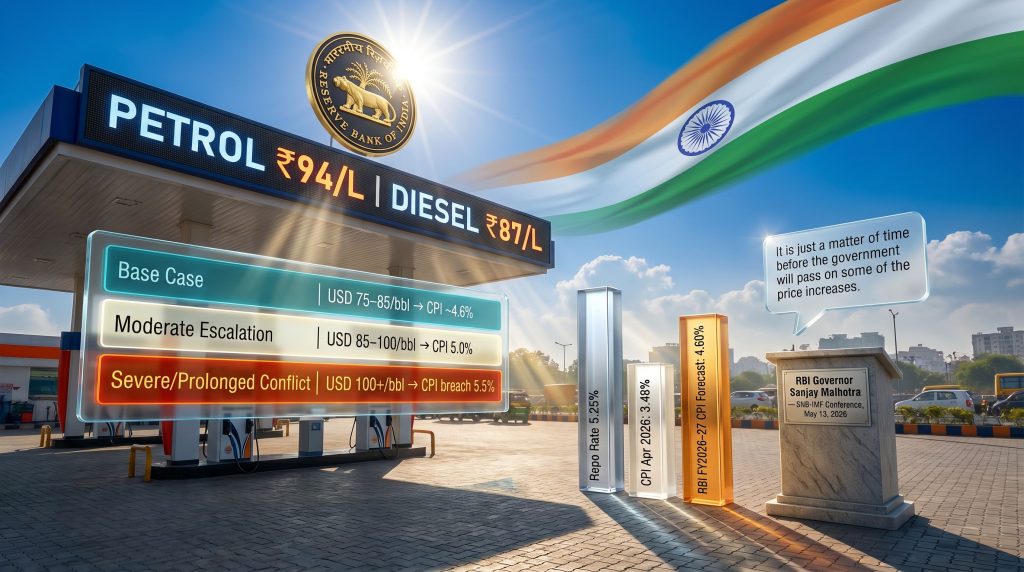
As of May 2026, petrol is priced at approximately ₹94 per litre in Delhi, with diesel at approximately ₹87 per litre. These figures have remained administratively frozen even as global crude oil costs have risen under pressure from the ongoing West Asia conflict. The gap between current pump prices and what a fully market-linked system would demand represents the accumulated financial strain being carried by OMC balance sheets.
The financial viability of this suppression mechanism is directly sensitive to two variables: the price of crude oil and the duration of elevated prices. Furthermore, understanding current crude oil price dynamics is essential here. Under moderate crude oil scenarios in the USD 75 to 85 per barrel range, OMC losses remain manageable. As prices approach and exceed USD 100 per barrel for sustained periods, the absorption capacity erodes rapidly, and the implicit fiscal liability transforms from a contingent risk into an active one.
What the RBI's Warning Actually Signals About India's Inflation Architecture
Decoding the RBI Governor's Statement at the SNB-IMF Conference
On May 13, 2026, RBI Governor Sanjay Malhotra, speaking at a conference jointly hosted by the Swiss National Bank and the International Monetary Fund in Switzerland, confirmed that India's state-run fuel retailers and the government were currently absorbing elevated crude oil costs. He then made a statement that carried significant weight in central bank communication terms: if this situation were to continue for a longer period, it would only be a matter of time before some of those cost increases were passed on to consumers at the retail level.
Central bank governors communicate in carefully calibrated language. When the head of a major emerging market central bank uses a public international forum to signal an anticipated fiscal policy action by the government, it is not an offhand remark. It is a forward guidance signal designed to prepare market participants, businesses, and consumers for a policy adjustment that the central bank regards as increasingly probable. The RBI is, in effect, pre-conditioning inflation expectations management for an event it cannot control but must plan for.
The significance of this signal being delivered by the RBI rather than the finance ministry also reflects an important institutional dynamic. The central bank has the mandate and the analytical infrastructure to assess when cost absorption becomes fiscally unsustainable, and it has a direct interest in communicating this risk because a sudden, large fuel price adjustment would directly challenge its inflation targeting mandate.
The Limits of Flexible Inflation Targeting During Supply Shocks
India adopted a flexible inflation targeting framework as the anchoring mechanism for its monetary policy, with a target of 4 per cent CPI inflation and a tolerance band of 2 to 6 per cent. This framework is well-suited to managing demand-driven inflation, where adjusting interest rates influences borrowing costs, consumption, and investment to bring price growth back within target.
However, Governor Malhotra explicitly acknowledged at the May 13 conference that flexible inflation targeting alone may not be sufficient during large supply shocks. This is not a minor caveat. It reflects a structural limitation that monetary economists have long debated: when inflation is driven by persistent external supply disruptions rather than domestic demand excess, raising interest rates imposes economic cost without addressing the underlying price pressure source.
The policy implication Malhotra drew from this is that fiscal coordination becomes crucial when supply shocks are severe. This language points toward the need for government action on excise duties, OMC financial relief, or targeted support mechanisms, rather than relying solely on the RBI's interest rate toolkit to manage an inflationary surge that rate policy cannot effectively resolve.
What "Data Dependent, Meeting by Meeting" Means for Rate Policy
The RBI maintained its key repo rate at 5.25 per cent following the April 2026 policy review. Governor Malhotra's characterisation of the RBI's approach as increasingly data-dependent and taken on a meeting-by-meeting basis signals a deliberate departure from forward guidance commitments. In practical terms, this means the central bank is not pre-committing to a rate path, preserving its optionality to hold, cut, or tighten depending on how the geopolitical situation and domestic inflation data evolve.
The June 5, 2026 monetary policy review becomes a critical inflection point. If May CPI data (due before the meeting) shows material acceleration, if OMC under-recovery disclosures indicate balance sheet strain is intensifying, or if crude oil prices maintain elevated levels, the conditions for a policy shift sharpen considerably.
| RBI Policy Metric | April 2026 Status |
|---|---|
| Repo Rate | 5.25% (unchanged) |
| CPI Inflation (April) | 3.48% |
| CPI Inflation (March) | 3.40% |
| GDP Growth Projection (FY2026-27) | 6.9% |
| Average Inflation Forecast (FY2026-27) | 4.6% |
| Next Policy Review | June 5, 2026 |
How the West Asia Conflict Is Reshaping India's Energy Import Economics
India's Structural Vulnerability as a Net Crude Importer
India imports approximately 85 to 88 per cent of its crude oil requirements, making it one of the world's most import-dependent major economies for petroleum. This structural exposure means that sustained disruption in global oil supply chains does not remain a distant macroeconomic variable. It transmits directly and rapidly through landed crude costs, OMC refining margins, and ultimately the retail price suppression gap that the government is working to maintain.
The transmission mechanism operates through several channels simultaneously:
- Direct cost escalation: Higher crude import prices increase the per-barrel cost to OMCs, widening the gap between production cost and capped retail prices.
- Foreign exchange pressure: Larger crude import bills drain foreign exchange reserves more rapidly, intensifying current account deficit concerns.
- Logistics disruption: Conflict in West Asia affects shipping routes and insurance premiums for tankers transiting the region, adding additional cost layers beyond the benchmark crude price itself.
- Second-order supply chain effects: Energy cost increases percolate through manufacturing, road transport, and cold-chain logistics, elevating prices across a wide basket of consumer goods.
The Geopolitical Premium Embedded in Current Crude Prices
One of the less-discussed dimensions of current crude oil pricing is the distinction between the commodity's fundamental supply-demand equilibrium price and the geopolitical risk premium embedded on top of it. Markets price crude not just on current physical supply and demand, but on probability-weighted scenarios involving supply disruption risk. Indeed, oil price movements during trade tensions have demonstrated how quickly these premiums can escalate.
When conflict persists in a region that hosts a significant share of global oil production and transit infrastructure, the geopolitical premium becomes sticky rather than transient. This is precisely why the RBI Governor distinguished between temporary price spikes, which a central bank can responsibly look through without policy response, and structurally elevated price environments, which eventually demand a response because they begin to reshape inflation expectations rather than simply creating a one-time price level adjustment.
Governor Malhotra confirmed that the RBI was prepared to absorb temporary shocks but would act if inflationary pressures became entrenched. The word entrenched is doing significant analytical work here: it signals that the RBI is monitoring whether elevated energy costs are beginning to feed through into broader wage and price-setting behaviour, which would indicate that the shock has shifted from transient to structural.
Supply Chain Disruption: Beyond the Pump Price
Malhotra's May 13 remarks confirmed that supply chain disruptions in the West Asia region were already beginning to affect India. This acknowledgement is significant because it extends the inflation risk analysis beyond crude oil prices alone. Disrupted maritime shipping lanes, elevated freight insurance costs, and rerouted cargo flows affect a broad range of goods that India imports, not solely petroleum products.
For an economy where food and transport carry heavy weighting in the consumer price index, supply chain disruption in a major global transit region creates a multi-channel inflation risk that monetary policy is poorly positioned to address in isolation.
India's Inflation Trajectory and the Risk of Entrenched Price Pressures
Reading the April 2026 CPI Data in Context
April 2026 CPI inflation came in at 3.48 per cent, a marginal increase from March's 3.40 per cent, and below most market expectations. On the surface, this appears to confirm that India's inflation situation remains comfortably within the RBI's target band, with considerable buffer before the upper tolerance limit of 6 per cent is threatened.
However, this reading is structurally misleading as a forward indicator for a specific reason: it reflects a price level that has been artificially compressed by government cost absorption. The headline CPI number does not capture the full inflationary pressure building in the economy. It captures the portion that has been permitted to flow through to consumers. The suppressed portion sits in OMC balance sheets, waiting for the policy decision that will release it.
When the fuel price adjustment eventually occurs, its inflationary impact will appear as a sudden discrete jump in the CPI rather than a gradual accumulation. This creates a data environment where the headline inflation number understates risk until it abruptly overshoots, making proactive policy preparation more important than reactive response.
The RBI's own forward projection tells a more revealing story. While current CPI sits at 3.48 per cent, the central bank's full-year average inflation forecast for FY2026-27 stands at 4.6 per cent. The gap between the current reading and the projected average implies a significant acceleration expected in coming months, precisely the trajectory a fuel price pass-through event would amplify.
The Fiscal Dimension: What Prolonged Absorption Costs the Government
The government faces a compounding fiscal dilemma as the fuel price freeze extends. Each week of maintained price suppression under elevated crude conditions adds to OMC under-recovery accumulation. The longer the freeze persists, the larger the eventual required price adjustment becomes, and the greater the inflationary shock when it arrives.
This dynamic creates a perverse incentive structure: political resistance to a small, early adjustment often produces the conditions for a larger, more disruptive one later. Governments that have successfully managed fuel price reform in other emerging market contexts have typically found that phased, graduated adjustments with accompanying consumer protection measures produce less economic disruption than deferred large adjustments.
The government's response to this pressure has moved beyond the fuel sector alone. Prime Minister Modi's call for voluntary reductions in petrol and diesel consumption, alongside deferred gold purchases by households, signals awareness at the highest political level that import pressure on foreign exchange reserves has become a live policy concern rather than a theoretical risk.
Gold Import Duties and the Foreign Exchange Reserve Defence
The doubling of gold import duties represents a targeted measure to reduce the foreign exchange drain from discretionary commodity imports. India is one of the world's largest gold import markets, and in addition, gold investment amid economic uncertainty has become a significant consideration for households managing purchasing power risk. Elevated gold demand alongside high crude import costs creates a compounding pressure on the current account deficit and reserve adequacy.
By raising the cost of gold imports and appealing for voluntary restraint, the government is attempting to manage the foreign exchange dimension of the energy shock without directly raising fuel prices. This approach buys time but does not eliminate the underlying cost accumulation problem.
What a Retail Fuel Price Hike Would Mean for Indian Consumers and the Broader Economy
Modelling the Inflation Pass-Through Scenarios
| Scenario | Crude Oil Price Range | Likely Policy Response | Estimated CPI Impact |
|---|---|---|---|
| Base Case | USD 75-85/barrel | Status quo maintained | Broadly within 4.6% forecast |
| Moderate Escalation | USD 85-100/barrel | Partial price pass-through | CPI pressure toward 5.0-5.5% |
| Severe/Prolonged Conflict | USD 100+/barrel | Full or staged retail price hike | Potential CPI breach of 5.5%, rate review triggered |
Each of these scenarios produces a materially different monetary policy calculus for the June 5 review. Under the base case, the RBI can maintain its current accommodative stance without contradiction. Under moderate escalation with partial pass-through, the central bank faces a more complex judgment about whether the inflationary impulse is temporary or persistent. Under the severe scenario, the combination of a large fuel price adjustment and pre-existing supply chain disruption would likely require active tightening despite the growth cost.
The distributional consequences of a fuel price hike are also significant. Lower-income households allocate a disproportionately large share of consumption expenditure to transport and food, both of which are directly sensitive to fuel cost changes. Rural communities that depend on diesel-powered agricultural equipment and road-based supply chains would face amplified cost pressures relative to urban, higher-income populations.
The Monetary Policy Response Toolkit Under Energy-Driven Inflation
Conventional rate hikes are a genuinely blunt instrument when applied to supply-side energy inflation. Raising the repo rate increases borrowing costs across the economy, reducing investment and consumption, but it does not lower the price of crude oil or reduce the cost of OMC under-recoveries. The economic pain of tightening falls on domestic demand, while the inflationary pressure originates entirely outside India's borders and monetary policy reach.
This is precisely why Governor Malhotra's emphasis on fiscal-monetary coordination is analytically important. The most effective policy response toolkit for energy-driven inflation combines:
- Excise duty recalibration to reduce the government's own revenue take on fuel, partially offsetting the need for full retail price adjustment.
- Targeted consumer compensation for the most price-sensitive households, preserving overall reform while limiting distributional harm.
- Strategic petroleum reserve deployment to manage short-term supply tightness and price volatility.
- Monetary policy patience that avoids premature tightening while inflation expectations remain anchored, combined with readiness to act quickly if expectations begin to drift.
The next major ASX story will hit our subscribers first
How Does India's Fuel Price Policy Compare to Other Major Emerging Economies?
A Comparative Policy Framework Analysis
| Country | Pricing Mechanism | Government Absorption Capacity | Recent Policy Response to Oil Shock |
|---|---|---|---|
| India | Administratively managed via OMCs | Moderate (excise duty + OMC losses) | Prices frozen; partial excise adjustments |
| China | NDRC-regulated with market linkage | High (SOE balance sheets) | Gradual pass-through with subsidies |
| Indonesia | Subsidised retail pricing | Limited (fiscal constraint) | Partial hike with targeted compensation |
| Brazil | Petrobras pricing policy | Variable (political sensitivity) | Market-linked with periodic intervention |
India's approach sits in a distinctive category: unlike Indonesia, which applies explicit fiscal subsidies, India uses OMC balance sheet absorption as the primary buffer. This approach keeps the cost off-budget in the short term but creates concentrated financial risk in state enterprises that eventually requires resolution. Consequently, understanding how trade wars impact oil prices offers a useful parallel for how external shocks compound domestic pricing pressures. The precedent from economies that have successfully transitioned away from administered pricing suggests that clear communication, phased implementation, and accompanying support mechanisms are the key variables determining whether adjustment is orderly or disruptive.
The Policy Crossroads: What Happens at the June 5 RBI Review
Three Scenarios the RBI Is Preparing For
-
De-escalation scenario: Geopolitical tensions in West Asia ease, global crude prices normalise toward USD 75 to 80 per barrel, the fuel price freeze is maintained without expanding OMC losses, and the RBI holds the repo rate at 5.25 per cent with its growth and inflation forecasts broadly intact.
-
Prolonged stalemate scenario: The conflict continues at current intensity through Q2 2026, OMC under-recovery accumulation reaches a threshold that triggers a partial fuel price pass-through announcement by the government, and the RBI signals in its June statement that it is monitoring inflation developments closely with a readiness to tighten if the pass-through feeds into broader price expectations.
-
Escalation scenario: The conflict broadens materially, crude oil prices spike above USD 100 per barrel on a sustained basis, the government implements a staged retail price hike across petrol and diesel, CPI accelerates toward or above 5.5 per cent, and the RBI moves toward a rate increase at or shortly after the June review.
Key Indicators to Watch Before June 5
- Weekly Brent and WTI crude oil benchmark movements and the trajectory of the geopolitical risk premium
- OMC quarterly earnings releases and any disclosed under-recovery figures
- May 2026 CPI release, expected before the June policy meeting
- Any government announcement on excise duty recalibration or fuel price revision
- Geopolitical developments in the West Asia theatre and their impact on shipping and supply chain logistics
- Foreign exchange reserve data from the RBI, tracking whether reserve drawdown is accelerating
Economists broadly expect India's GDP growth forecast of 6.9 per cent to face downward revision pressure if geopolitical disruption extends beyond near-term projections, with inflationary pressures simultaneously pushing the average CPI forecast above the RBI's current 4.6 per cent projection for FY2026-27.
Frequently Asked Questions: RBI Warning on India's Fuel Price Hike
Why is the RBI warning about fuel price hikes rather than the government?
The Reserve Bank of India carries a statutory mandate for inflation management, and a fuel price pass-through event would directly affect consumer price indices and potentially threaten the integrity of the flexible inflation targeting framework. Central bank governors routinely signal fiscal risks that intersect with monetary policy outcomes, particularly when supply-side developments threaten to breach inflation targets that the central bank is legally responsible for managing.
What is the current petrol price in India as of May 2026?
Petrol is priced at approximately ₹94 per litre in Delhi, with diesel at approximately ₹87 per litre. These prices have remained administratively frozen while global crude costs have risen due to the sustained West Asia conflict.
Will the RBI raise interest rates if fuel prices increase?
Governor Malhotra has confirmed the RBI will act if inflationary pressures become entrenched rather than temporary. A staged fuel price hike would likely trigger a reassessment at the June 5, 2026 monetary policy review, with the repo rate currently held at 5.25 per cent. The scale and speed of any rate response would depend on how significantly the pass-through feeds into broader inflation expectations.
How does the West Asia conflict affect India's fuel prices?
India imports approximately 85 to 88 per cent of its crude oil requirements. Sustained geopolitical disruption in West Asia elevates landed crude costs, compresses OMC margins, disrupts supply chain logistics, and ultimately forces a policy choice between continued cost absorption and retail price adjustment. Furthermore, as Bloomberg's reporting on India's RBI fuel outlook confirms, the longer the conflict persists, the narrower the range of viable options becomes.
What did Prime Minister Modi's austerity appeal mean in this context?
Prime Minister Modi's call for voluntary reductions in petrol and diesel consumption, alongside deferred gold purchases, reflects a strategy to reduce pressure on foreign exchange reserves while the government maintains the retail price freeze in the near term. It signals official awareness that import costs, across both crude oil and gold, are creating measurable current account and reserve management pressures that require a coordinated response beyond fuel pricing alone. For additional context, tariff mechanics and their economic impact illustrate how policy instruments interact when external cost pressures intensify. India Today's coverage of the RBI's fuel price warning further contextualises how the central bank's signal is being interpreted across domestic markets.
This article is based on publicly available information and reported statements from official sources including the Reserve Bank of India and related media coverage. It does not constitute financial advice. Economic forecasts and scenario projections involve inherent uncertainty, and actual outcomes may differ materially from those described. Readers making investment or financial planning decisions should seek independent professional advice.
Want To Stay Ahead of Market-Moving Economic Shifts?
Discovery Alert's proprietary Discovery IQ model delivers real-time alerts on significant ASX mineral discoveries the moment they're announced, transforming complex market data into actionable investment insights — the same way macro forces like energy shocks and inflation signals reshape commodity valuations overnight. Explore how historic mineral discoveries have generated extraordinary returns and begin your 14-day free trial today to position yourself ahead of the broader market.