June 16, 2026
The Geological Lottery That Shaped a Continent's Strategic Value
Hundreds of millions of years of tectonic activity along the western edge of South America produced something that no policy document or trade agreement could replicate: a concentration of critical minerals so dense and so varied that the region now sits at the intersection of nearly every major industrial supply chain on the planet. The mining sector in Latin America is not simply large — it is structurally irreplaceable at a moment when the global economy is undertaking its most significant energy transformation in over a century.
Understanding what is unfolding across this region requires more than tracking commodity prices. It demands a close reading of geological realities, political risk gradients, evolving deal structures, and the emerging frontier of deep-sea resource extraction — each of which is reshaping where capital flows and how projects advance.
When big ASX news breaks, our subscribers know first
Why the Mineral Endowment Here Is Unlike Anywhere Else
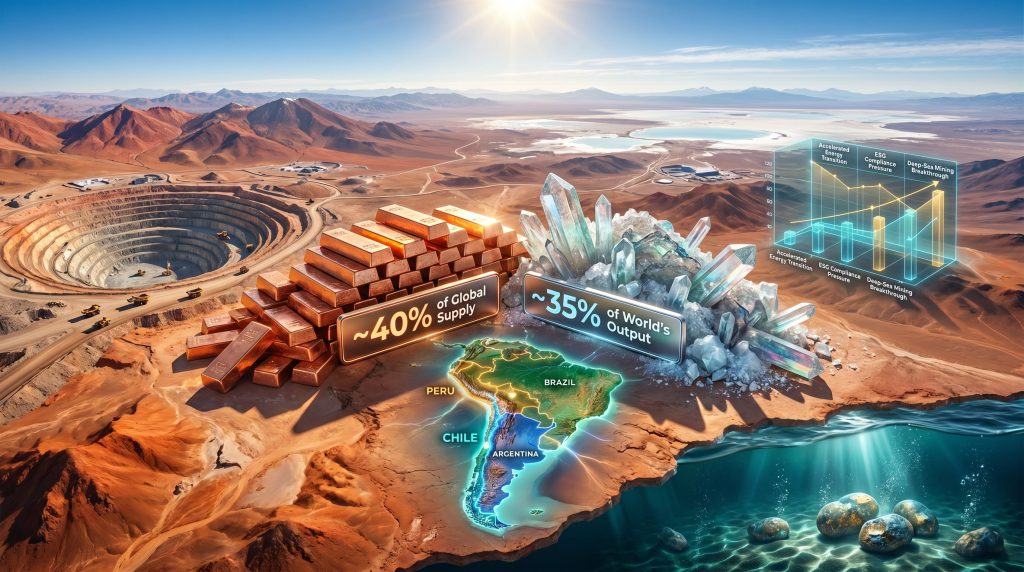
Latin America accounts for approximately 40% of global copper supply and roughly 35% of the world's lithium output. These are not marginal contributions — they represent geological dominance over minerals that are foundational to battery manufacturing, electrification infrastructure, and the broader clean energy transition. No credible decarbonisation scenario operates without sustained access to Latin American copper and lithium.
Brazil adds a further dimension that is often underappreciated in headline coverage. Beyond copper and lithium, the country holds meaningful reserves of nickel, graphite, manganese, and rare earth elements, positioning it as a multi-mineral strategic resource hub rather than a single-commodity play. As Western governments and technology companies accelerate efforts to diversify away from Chinese-dominated rare earth supply chains, Brazil's geological diversity is attracting a new category of strategic attention.
| Mineral | Latin America's Approximate Global Share | Primary Producing Nations |
|---|---|---|
| Copper | ~40% | Chile, Peru, Mexico |
| Lithium | ~35% | Chile, Argentina |
| Nickel | Significant reserves | Brazil |
| Rare Earth Elements | Emerging producer | Brazil |
| Graphite | Notable deposits | Brazil |
| Manganese | Major reserves | Brazil |
Incremental demand from AI data centre construction, electric vehicle manufacturing, and grid-scale energy storage is compressing the timeline within which global operators need to secure long-life assets. The result is intensifying competition for Latin American mineral rights among institutional investors, state-owned enterprises, and major mining conglomerates simultaneously.
M&A Activity and the Restructuring of Regional Deal Flow
Merger and acquisition activity across the mining sector in Latin America has accelerated materially as majors seek to replace depleting reserves and position for demand peaks projected through the 2030s. What has changed is not simply the volume of deals but their structural complexity. Furthermore, mining industry consolidation patterns are reshaping how capital is deployed across the entire region.
Rather than outright acquisitions, deal architects are increasingly constructing transactions around:
- Joint ventures that distribute permitting and community engagement risk across multiple partners
- Royalty and streaming arrangements that provide capital to project developers while offering investors commodity exposure without operational liability
- Strategic offtake contracts that lock in downstream supply agreements before final investment decisions are made
- Earn-in agreements that allow larger operators to acquire equity stakes incrementally as exploration milestones are reached
This structural evolution reflects heightened institutional risk awareness. Capital allocators are no longer simply buying exposure to a mineral deposit — they are pricing in jurisdictional risk, social licence uncertainty, and the increasingly complex stakeholder environments that define project development across the region.
Key markets attracting the most concentrated M&A attention include Chile and Peru for copper assets, Argentina lithium brines for brine systems, and Brazil for diversified critical mineral portfolios. Consolidation patterns mirror dynamics observed in other resource-intensive regions, where mid-tier operators are progressively absorbed by majors seeking both production scale and reserve replacement depth.
Greenfield Pipelines: The Long Game in Project Development
A significant wave of greenfield exploration and feasibility-stage projects is advancing across Latin America, concentrated in the lithium triangle spanning Chile, Argentina, and Bolivia, and along Peru's southern copper belt. These pipelines represent the region's medium-term production capacity, but translating geological potential into operating mines involves navigating one of the most complex multi-stakeholder environments in global resource development.
Project development timelines in Latin America routinely extend to 5–10 years in pre-production phases, driven by permitting complexity, environmental impact assessment requirements, and community consultation processes that are themselves subject to legal challenge and political change.
Capital expenditure commitments for new mining projects across the region are expected to remain elevated through the late 2020s. The funding mix is broadening, with sovereign wealth fund participation, development bank financing, and ESG-aligned institutional capital increasingly supplementing traditional mining finance from commodity traders and resource-specialist funds.
One structural dynamic that receives insufficient attention is the ore grade decline problem affecting established copper districts. Average copper grades at operating mines in Chile have fallen steadily over recent decades, meaning that maintaining equivalent production volumes requires processing significantly more material. This reality is a powerful driver of greenfield investment — the industry needs new, higher-grade discoveries to offset grade deterioration at existing operations. For instance, the identification of a major copper system in Argentina illustrates how explorers are increasingly looking beyond traditional districts to meet this demand.
Deep-Sea Mining: Frontier Opportunity or Regulatory Quagmire?
Several Latin American nations hold exclusive economic zones (EEZs) that overlap with documented deposits of polymetallic nodules, seafloor massive sulphides, and cobalt-rich ferromanganese crusts. These mineral formations have attracted growing commercial interest as the limitations of terrestrial supply become more apparent. However, the deep-sea mining controversy surrounding environmental impacts continues to complicate commercial progress.
It is important to frame this opportunity accurately. Deep-sea mining in Latin American waters is a long-horizon strategic consideration, not a near-term production reality. Commercial viability depends on resolving three interconnected challenges:
- Technological maturity — extraction equipment capable of operating at depths exceeding 4,000 metres with acceptable reliability and recovery rates does not yet exist at commercial scale
- Regulatory frameworks — the International Seabed Authority governs extraction in international waters, but nations retain jurisdiction over their own EEZs, creating a fragmented governance landscape that complicates investment planning
- Environmental assessment — scientific evidence on biodiversity disruption, sediment plume dispersal, and ecosystem recovery timelines remains incomplete, leaving regulators with insufficient data to approve large-scale extraction
Countries including Chile, Peru, and Brazil are in various stages of evaluating governance frameworks for their maritime jurisdictions, but none has established the regulatory architecture necessary to support commercial deep-sea mining activity in the near term.
Country-by-Country: Where Capital Is Flowing and Why
Chile
Chile produces approximately 25–27% of global copper output, making it the world's single largest copper-producing nation. The Chile lithium reserves in the Atacama brine system represent one of the highest-grade lithium deposits on earth, adding a second pillar to its resource dominance. State-owned Codelco remains the dominant copper producer but faces mounting capital reinvestment challenges to sustain production at ageing, deepening operations. Ongoing royalty reform discussions and nationalisation debates continue to introduce uncertainty for private investors, though Chile's institutional depth and established mining tradition maintain its status as the region's premier mining jurisdiction.
Peru
Peru ranks as the world's second-largest copper producer and is a major exporter of silver and zinc. The country's geological endowment is exceptional, but project development is persistently disrupted by community opposition, social conflict, and regional political instability. These dynamics create a structural risk premium that investors must price into project economics. Despite this, exploration capital continues to flow into Peru's southern copper belt, where deposit quality justifies the elevated risk profile.
Argentina
Argentina holds the second-largest lithium reserves globally and is central to the lithium triangle investment thesis. The Milei administration's economic liberalisation agenda has introduced a more investor-friendly regulatory posture, with RIGI (the Large Investment Incentive Regime) offering tax and customs benefits for qualifying mining projects. However, macroeconomic volatility and currency risk remain structural concerns that complicate long-term project financing. Lithium development is most advanced in Salta, Jujuy, and Catamarca provinces, with several projects approaching final investment decisions.
Mexico
Mexico is a significant silver, copper, and gold producer with a deeply established mining tradition. Recent legislative changes restricting open-pit mining and the government's decision to nationalise lithium resources have created regulatory uncertainty for foreign investors. Silver and gold projects continue to attract capital, but the broader investment case has been complicated by the direction of resource policy under recent administrations.
Brazil
Brazil's positioning is arguably the most underappreciated story in the regional mining sector. Its reserves span nickel, graphite, manganese, rare earths, and copper across a geographic area larger than the continental United States. Infrastructure deficits in remote mining regions remain a persistent operational constraint, but the country's rare earth supply chain potential is attracting strategic attention from industrial consumers and technology companies seeking alternatives to Chinese-sourced material. According to research on critical minerals in Latin America, Brazil's multi-mineral endowment positions it as a cornerstone of future supply chain strategy.
The next major ASX story will hit our subscribers first
The Multi-Dimensional Risk Architecture Investors Must Navigate
Social Licence: The Constraint That Overrides Geology
No risk factor in the mining sector in Latin America generates more project disruption than community opposition. Social conflict is responsible for project suspensions, cost overruns, and permanent cancellations across multiple jurisdictions, and its financial consequences are severe. Industry research has estimated that a major mining project can lose approximately US$20 million per week during periods of community-driven operational disruption.
The mechanisms through which social conflict materialises are well understood but frequently underweighted in early-stage project economics:
- Indigenous land rights and FPIC (Free, Prior, and Informed Consent) failures have triggered high-profile project blockades in Chile, Peru, and Mexico
- Water access disputes in arid mining regions are intensifying as aquifer depletion becomes measurable and communities perceive direct competition between mining operations and agricultural livelihoods
- Inadequate benefit-sharing structures create resentment in communities that observe mining activity generating wealth without proportionate local economic participation
Social licence failure is not a reputational risk that can be managed through communications strategies. It is an operational and financial risk with direct implications for project economics, insurance coverage, and debt covenant compliance.
Political and Regulatory Volatility
The contrast between Argentina's current liberalisation trajectory and Mexico's resource nationalisation approach illustrates the ideological divergence that investors must simultaneously navigate across the region. Frequent changes in royalty regimes, environmental permitting standards, and resource nationalism policies create a volatile operating environment that complicates long-term capital allocation.
Political risk insurance and bilateral investment treaty protections are increasingly factored into project financing structures, particularly in higher-risk jurisdictions. The growing use of international arbitration mechanisms by mining companies challenging adverse regulatory changes has itself become a deterrent factor in some jurisdictions, where governments weigh policy ambitions against arbitration exposure.
Water Governance and Climate Physical Risk
Mining operations in arid high-altitude regions, particularly in Chile's Atacama and Argentina's Puna plateau, face intensifying scrutiny over freshwater consumption and brine extraction impacts. The Atacama is not simply an arid environment — it is one of the driest places on earth, and the hydrological systems that support both lithium brine deposits and fragile endemic ecosystems are poorly understood at the scale of commercial extraction.
Climate change is introducing additional physical risk dimensions that mine planners are only beginning to integrate into long-term planning frameworks, including glacial retreat altering water availability, changed precipitation patterns affecting tailings management, and increased seismic activity in tectonically active mining regions.
ESG Integration and the Transformation of Supply Chain Governance
International institutional investors, development finance institutions, and export credit agencies are applying increasingly rigorous ESG screening criteria to mining investments across Latin America. This is not philanthropic positioning — it reflects the downstream regulatory environment that battery manufacturers, automotive OEMs, and technology companies now operate within.
European Union supply chain due diligence regulations, provisions within the US Inflation Reduction Act, and evolving OECD guidelines are compelling mining companies to demonstrate mineral traceability from the point of extraction. Blockchain-based chain-of-custody systems and digital traceability platforms are being piloted across copper and lithium supply chains originating in the region, with demand for independently verified ESG data growing steadily among downstream industrial consumers.
Companies that invest proactively in community development programmes, environmental restoration, and transparent governance structures are demonstrating measurably lower project disruption rates. This correlation is increasingly visible to capital markets, creating a financial incentive for responsible operating practices that extends beyond reputational considerations. Analysts tracking major mining opportunities across the region consistently highlight ESG performance as a differentiating factor in project valuations.
The Investment Outlook Through 2030: Scenarios and Structural Drivers
The structural demand case for Latin American mining assets remains compelling across a range of scenarios. The global energy transition, AI infrastructure expansion, and semiconductor manufacturing growth all converge on the same set of minerals — copper, lithium, nickel, manganese, and rare earths — that the region produces in disproportionate abundance.
| Scenario | Primary Driver | Likely Regional Outcome |
|---|---|---|
| Accelerated Energy Transition | Strong EV and grid storage demand | Elevated copper and lithium prices; major project FIDs advance |
| Resource Nationalism Wave | Policy shifts in Chile and Mexico | Reduced FDI; state-led development models gain ground |
| ESG Compliance Tightening | EU and US supply chain regulations | Premium pricing for responsibly sourced minerals |
| Deep-Sea Mining Breakthrough | Technology and regulatory clarity | New frontier assets enter EEZ development pipelines |
| Social Conflict Escalation | Community opposition intensifies regionally | Widespread project delays; risk premiums increase across jurisdictions |
Development finance institutions including the Inter-American Development Bank and World Bank Group are increasing their focus on sustainable mining finance as a mechanism for channelling private capital toward responsible resource development. This institutional capital layer provides a buffer against pure commodity cycle volatility and introduces governance standards that can improve project-level outcomes.
Disclaimer: Forward-looking statements and scenario projections in this article are analytical in nature and do not constitute financial advice. Commodity markets, regulatory environments, and geopolitical conditions are subject to material change. Investors should conduct independent due diligence before making capital allocation decisions in relation to any mining jurisdiction or company.
Frequently Asked Questions
What minerals does Latin America produce the most of?
Latin America is the dominant global supplier of copper and lithium, accounting for approximately 40% and 35% of world production respectively. Brazil contributes significant reserves of nickel, graphite, manganese, and rare earth elements, making the region a multi-mineral strategic resource base.
Which country leads the mining sector in Latin America?
Chile is the region's largest mining economy by output value, anchored by its position as the world's top copper producer and a major lithium supplier via the Atacama brine system. Peru ranks second in copper production and is also a leading silver and zinc exporter.
What is driving M&A activity in Latin American mining right now?
The primary drivers are critical mineral demand from clean energy and technology supply chains, reserve replacement imperatives among global majors, and the availability of high-quality, long-life assets at various development stages across the region. Deal structures are becoming more complex, incorporating royalties, streaming, and joint ventures rather than straightforward acquisitions.
How significant is deep-sea mining for the region?
Several Latin American nations hold exclusive economic zones containing known polymetallic nodule and seafloor sulphide deposits. However, commercial deep-sea mining remains a long-horizon opportunity constrained by immature extraction technology, incomplete environmental science, and underdeveloped regulatory frameworks at both national and international levels.
What are the primary risks for investors in Latin American mining?
The principal risk categories include social conflict and community opposition, political and regulatory instability, environmental governance pressures, water scarcity in arid mining regions, and macroeconomic volatility in markets such as Argentina. Social licence failure is consistently identified as the most operationally disruptive risk factor across the region.
Want To Identify The Next Major Mineral Discovery Before The Broader Market Does?
Discovery Alert's proprietary Discovery IQ model delivers real-time alerts on significant ASX mineral discoveries — instantly translating complex mineral data into actionable investment insights for both short-term traders and long-term investors. Explore historic examples of major discoveries and their returns on Discovery Alert's dedicated discoveries page, and begin your 14-day free trial today to position yourself ahead of the market.