August 6, 2026
The LNG Chokepoint That Exposed a Fundamental Flaw in Global Energy Architecture
For decades, energy strategists warned that the world's liquefied natural gas supply chain carried a structural vulnerability hiding in plain sight. Roughly one-fifth of all global LNG supply flowed through a single industrial complex, in a country bordered by one of the most geopolitically volatile maritime corridors on earth. That theoretical risk became a lived reality in 2026, when the Strait of Hormuz closed and the Ras Laffan Industrial City fell silent.
Understanding what the Qatar LNG production restart after Strait of Hormuz reopening means for global energy markets requires more than tracking shipping lanes. It demands a clear-eyed assessment of how concentrated infrastructure creates systemic fragility, how restart mechanics actually work at industrial scale, and what the permanent damage to two production trains means for supply ceilings in the years ahead.
When big ASX news breaks, our subscribers know first
Ras Laffan: The Single Facility That Moves Global Gas Prices
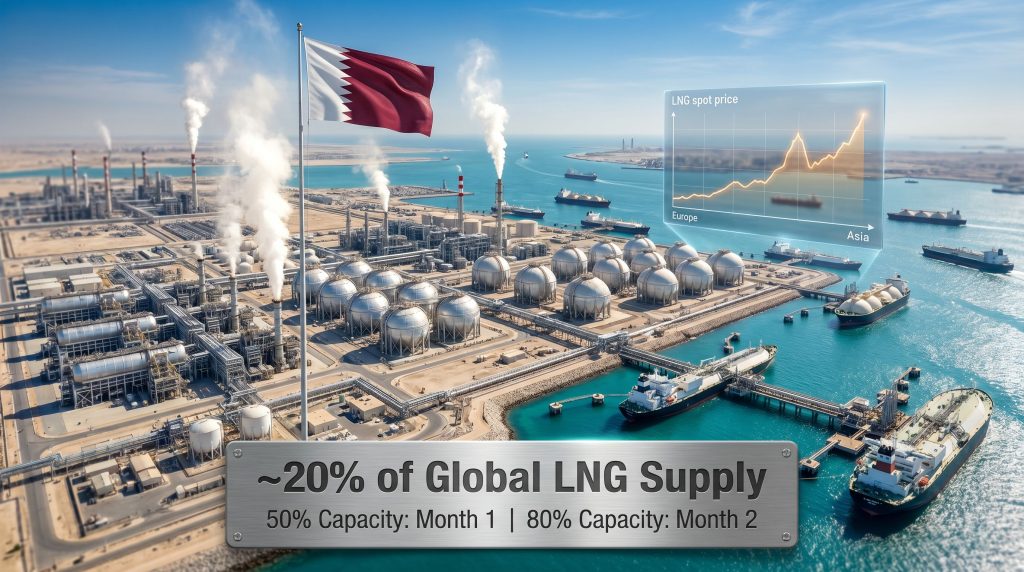
Few industrial sites carry the market weight of Ras Laffan Industrial City. Located on Qatar's northeastern coastline, this complex was responsible for approximately 20% of total global LNG supply in the year preceding the conflict. That figure alone explains why its closure triggered immediate price dislocations across European and Asian spot markets simultaneously.
The facility operates multiple liquefaction trains, each capable of processing vast volumes of natural gas drawn from the North Field, the world's largest single natural gas reservoir, which Qatar shares with Iran. The North Field's scale is extraordinary: it holds an estimated 1,760 trillion cubic feet of recoverable reserves, a resource base that has underpinned Qatar's strategy of locking in decades-long supply agreements with buyers across Japan, South Korea, India, China, and Europe.
What made Ras Laffan particularly valuable to global markets was not just its volume, but its operational consistency. Qatar had cultivated a reputation built over multiple decades as an anchor supplier in long-term LNG contracts, offering buyers the kind of supply certainty that commands premium pricing and preferred counterparty status. That reliability premium has now been structurally tested, and understanding the global LNG supply outlook is essential to grasping the full weight of this disruption.
The True Cost of Three Months of Silence
The prolonged idling of Ras Laffan, now exceeding three months of near-total operational suspension, represents one of the most significant unplanned supply disruptions in the recorded history of the global gas trade. The scale of the impact can be understood across several dimensions:
| Impact Category | Estimated Scope |
|---|---|
| Duration of facility suspension | 3+ months (as of June 2026) |
| Share of global LNG supply affected | ~20% |
| Production trains damaged by missile strikes | Equivalent to 2 full trains |
| Force majeure status | Extended by QatarEnergy throughout closure |
| LNG price trajectory | Elevated above pre-conflict levels in Europe and Asia |
The Ras Laffan shutdown did not simply remove volume from global markets. It stripped Qatar of the reliability premium it had spent decades building, introducing counterparty risk considerations into long-term supply relationships that had previously been treated as near-certain.
A detail worth noting that receives limited mainstream attention: QatarEnergy did not completely cease all operations during the closure. Several production trains were maintained at reduced operational capacity, and according to analysts, a limited number of LNG cargoes were dispatched to buyers in Asia, with vessel tracking data deliberately obscured as a security and operational precaution. These deliveries, while commercially meaningful for specific counterparties, remained well below normal export volumes and provided no meaningful relief to the broader global supply shortfall.
How an LNG Restart Actually Works: The Industrial Mechanics
One of the least understood aspects of this situation among general audiences is the technical complexity involved in restarting a large-scale LNG liquefaction facility. Unlike a factory that can resume production by simply switching on machinery, LNG plants require a carefully sequenced restart protocol that cannot be safely accelerated beyond certain physical constraints.
Sequential Train Restart: Why Speed Has Engineering Limits
LNG liquefaction operates by cooling natural gas to approximately minus 162 degrees Celsius, at which point it shrinks to roughly 1/600th of its gaseous volume for efficient transport by tanker. The process involves multiple stages of compression and cooling through heat exchangers and cryogenic systems that are extremely sensitive to thermal stress.
Rapid temperature changes in these systems can cause:
- Thermal shock fractures in cryogenic piping and heat exchanger components
- Seal and gasket failures across compression train assemblies
- Instrumentation calibration drift requiring recertification before safe operation
- Catalyst bed disturbances in upstream gas treatment units
- Structural integrity concerns in liquefaction cold boxes if pressurised too quickly
This is why QatarEnergy began equipment testing and targeted maintenance operations from April 2026, establishing a preparatory window of approximately six to eight weeks before any Hormuz reopening. That decision to begin pre-positioning restart activities while the strait remained closed reflects sophisticated operational planning and explains how the aggressive restart timeline became achievable.
The Two-Phase Ramp-Up: Faster Than Markets Expected
The production recovery timeline communicated by QatarEnergy to buyers is structured as follows:
- Month 1 post-reopening: Output targeted at approximately 50% of nameplate capacity
- Month 2 post-reopening: Output targeted at approximately 80% of nameplate capacity
- Remaining 20% capacity (two damaged trains): Full restoration expected to require multiple years
Industry benchmarks suggest that LNG facilities operating through maintenance-intensive restart cycles typically require four to twelve weeks to normalise throughput across all active trains. Qatar's two-month ramp to 80% sits at the faster end of this range, a pace that reportedly exceeded the expectations of many market analysts and commodity traders when it was communicated to buyers.
The acceleration is largely attributable to the pre-positioning work conducted since April. By running reduced-capacity operations on undamaged trains throughout the closure, QatarEnergy avoided the cold restart problem entirely for a significant portion of the facility. The systems that remained in operation require ramp-up rather than full restart, a materially simpler engineering challenge.
The Hormuz Variable: Why Diplomatic Timelines and Operational Timelines Are Not the Same Thing
A critical distinction that often gets lost in media coverage of this situation is the difference between a political ceasefire announcement and the conditions necessary for large-scale LNG tanker transit to safely resume. Furthermore, the broader geopolitical risk landscape across the region continues to introduce variables that no restart timeline can fully account for.
Mine Clearance: The Independent Variable No Politician Controls
The Strait of Hormuz is approximately 21 nautical miles wide at its narrowest point, with two navigable channels of only two nautical miles each. Qatar's LNG export fleet relies on Q-Flex and Q-Max class tankers, the largest LNG carriers in the world, with Q-Max vessels measuring up to 345 metres in length and carrying up to 266,000 cubic metres of liquefied gas per voyage.
These vessels cannot safely transit waters where naval mines have been deployed without confirmed clearance. Senior US military officials confirmed that mines remained in the waterway even as diplomatic frameworks were being negotiated. This creates a fundamental disconnect:
| Stakeholder | Position on Hormuz Reopening |
|---|---|
| US Administration | Publicly optimistic; cited specific reopening date |
| European Allied Governments | Expressed significant reservations about timeline certainty |
| Senior US Military Officials | Confirmed mines remain, requiring active clearance |
| Commercial Shipping Industry | Awaiting independent safety verification before routing vessels |
| War Risk Insurers | Applying elevated premium frameworks pending clearance confirmation |
| LNG Buyers in Asia and Europe | Monitoring force majeure status; seeking contractual clarity |
Naval mine removal is a technically demanding and time-consuming process. Modern influence mines, which activate in response to magnetic signatures, pressure changes, or acoustic profiles, are specifically designed to resist rapid clearance. A single undetected mine in a major shipping lane can suspend commercial transit for weeks as the investigation and expanded sweep operations proceed.
Even where political will exists to reopen Hormuz quickly, the physical mine-clearance timeline operates on its own schedule. This is the single variable most capable of disrupting Qatar's aggressive restart targets, and it remains outside the control of any government or energy company.
Price Dynamics and Buyer Positioning: What the Restart Sequence Means for Markets
The sequencing of Qatar's production recovery has direct and differentiated implications depending on where a buyer sits in the supply chain. Consequently, global energy price volatility has intensified across both spot and forward markets throughout the disruption period.
How the 50% and 80% Thresholds Drive Market Psychology
LNG spot prices in both European and Asian hubs have remained elevated above pre-conflict benchmarks throughout the Ras Laffan closure. The market has partially absorbed the supply deficit through alternative sourcing, but the structural gap created by removing roughly one-fifth of global supply has not been bridgeable by incremental increases from other exporters.
The 50% restart threshold, achievable within 30 days of safe Hormuz transit, is the point at which price psychology begins to shift. Market participants will start pricing in the return of Qatari volume before cargoes actually arrive, creating a forward curve adjustment that may frontrun the physical supply recovery by several weeks.
The 80% threshold at 60 days is the more significant price inflection point. At this level, Qatar's contribution to global LNG supply returns to a scale large enough to meaningfully alter the supply-demand balance that has been sustaining elevated spot prices.
Buyer Segments and Their Divergent Exposures
Different buyer categories face very different dynamics as the restart unfolds:
- Northeast Asian long-term contract holders (Japan, South Korea) have been absorbing shortfalls through expensive spot market purchases. These buyers stand to benefit most immediately from restart confirmation and may begin unwinding spot exposure before physical cargoes resume.
- Indian importers operated under existing long-term agreements with QatarEnergy and have been among the most directly affected by force majeure declarations. India's LNG import infrastructure has grown substantially, making supply restoration particularly consequential for domestic gas pricing.
- European utilities that pivoted to US Gulf Coast, Australian, and West African LNG cargoes during the closure face a more complex rebalancing. Some of these alternative supply arrangements carry their own contractual obligations that cannot simply be abandoned when Qatar returns.
- Regional Middle Eastern and South Asian buyers who received limited Qatari cargoes during the closure through the obscured-tracking arrangement are best positioned for early access to restart volumes given proximity and existing logistics.
The Permanent Capacity Ceiling: A Multi-Year Structural Deficit
Perhaps the most consequential aspect of this situation, and the one receiving insufficient analytical attention, is the permanent near-term capacity ceiling created by the two damaged production trains.
Iranian missile strikes in March 2026 caused damage assessed as requiring years of restoration work before full nameplate capacity can be recovered. This means that even after the phased restart reaches 80% in month two, Qatar's contribution to global LNG supply will remain structurally below its pre-conflict potential for an extended period.
This is not a temporary disruption followed by full recovery. It is a step-change reduction in Qatar's operational ceiling that will persist through the medium term, with the following market implications:
- Spot prices will not fully normalise to pre-conflict levels even after the 80% restart threshold is reached
- Alternative supplier relationships established during the closure will face reduced competitive pressure from Qatar, potentially becoming permanent fixtures in buyer portfolios
- QatarEnergy's ambitious North Field expansion program, which was targeting additional LNG capacity before the conflict, faces an altered competitive landscape upon any eventual restoration
The next major ASX story will hit our subscribers first
Competing Exporters and the Restructuring of Long-Term Supply Relationships
The extended Qatari outage has been a windfall opportunity for competing LNG exporters, and the degree to which those gains become permanent depends heavily on how the restart sequence unfolds.
| Competing Supplier | Response to Qatar Outage |
|---|---|
| United States (LNG) | Increased spot and short-term cargo availability to European buyers |
| Australia | Redirected flexible volumes toward premium Asian spot markets |
| West Africa (Nigeria, Angola) | Captured opportunistic spot demand from European utilities |
| Russia (LNG and pipeline) | Severely constrained by existing sanctions frameworks |
The longer Qatar's return to full capacity is delayed by the damaged train restoration timeline, the more entrenched these alternative relationships become. Furthermore, the supply chain disruption risks introduced by the conflict have reinforced European energy security policy that explicitly evolved since 2022 to prioritise supply diversification, and the Qatar outage of 2026 has reinforced that strategic direction with fresh operational evidence.
Scenario Pathways: Three Trajectories for the Qatar LNG Restart
Scenario A: Base Case
Hormuz mine clearance completes within two to four weeks of ceasefire formalisation. QatarEnergy achieves 50% output within 30 days and 80% within 60 days. LNG spot prices in Europe and Asia begin moderating within six to eight weeks of restart confirmation. The structural deficit from damaged trains persists but is partially offset by increased output from undamaged trains running at higher utilisation.
Scenario B: Risk Case
Mine clearance or war-risk insurance frameworks extend the effective reopening timeline by four to eight additional weeks. Qatar's restart is pushed into Q3 2026, sustaining elevated LNG prices through the Northern Hemisphere summer demand period. Some Asian buyers lock in additional long-term contracts with US or Australian exporters, making those relationships more difficult for Qatar to displace upon its return.
Scenario C: Tail Risk
A maritime incident during the mine-clearance phase, whether from an undetected mine or a deliberate provocation, triggers renewed shipping avoidance of the Persian Gulf. QatarEnergy's restart is indefinitely postponed. Global LNG prices reach new cycle highs, and European energy security emergency protocols are activated across multiple member states.
What the Qatar Disruption Reveals About Systemic LNG Market Fragility
The events of 2026 have exposed a structural truth about global LNG markets that commodity strategists had identified but that energy policy had never fully internalised: geographic concentration in mega-facilities creates non-linear systemic risk.
When a single facility accounts for roughly one-fifth of global supply, its disruption does not create a proportional market impact. It creates a disproportionate shock, because the facility's scale means no combination of smaller alternative sources can substitute at the same speed, cost, or volume. The market absorbs the disruption gradually through a combination of demand rationing, spot price spikes, and opportunistic supply reallocation, but the adjustment period is measured in quarters, not weeks.
The investment and policy responses likely to emerge from this disruption include:
- Accelerated development of LNG import terminal infrastructure across Europe and Asia to reduce single-source dependency
- Increased appetite for geographically diversified long-term supply agreements spanning US Gulf Coast, Australian, and East African exporters
- Renewed industry focus on force majeure contract provisions, particularly around conflict-related shutdowns affecting critical maritime corridors
- Exploratory frameworks for strategic LNG reserves, analogous to oil strategic petroleum reserve mechanisms, to provide buffer capacity during supply disruptions
The Qatar LNG production restart after Strait of Hormuz reopening is not simply a return to pre-conflict conditions. It is the beginning of a structurally altered global LNG market, one in which energy's role in the global economy is once again being scrutinised by policymakers across every major consuming nation. Qatar remains a dominant player, however it no longer operates as the unchallenged anchor of global supply reliability that it was before March 2026. Reports confirm that the path back to full operational capacity will be measured in years, not months, fundamentally reshaping how buyers approach long-term supply security in the decade ahead.
Disclaimer: This article contains forward-looking analysis, scenario projections, and market commentary based on publicly available information as of June 2026. Forecasts regarding LNG price trajectories, restart timelines, and geopolitical developments involve significant uncertainty. Readers should not interpret any content herein as financial or investment advice. Outcomes may differ materially from those described.
Want to Stay Ahead of the Next Major Resource Disruption?
Discovery Alert's proprietary Discovery IQ model delivers real-time alerts on significant ASX mineral discoveries, instantly translating complex resource data into actionable investment insights — so subscribers can identify opportunities before the broader market reacts. Explore historic examples of major discoveries and their market returns, then begin a 14-day free trial at Discovery Alert to position yourself ahead of the next significant market-moving event.