May 14, 2026
Economic Forces Behind Latin American Steel Protection Policies
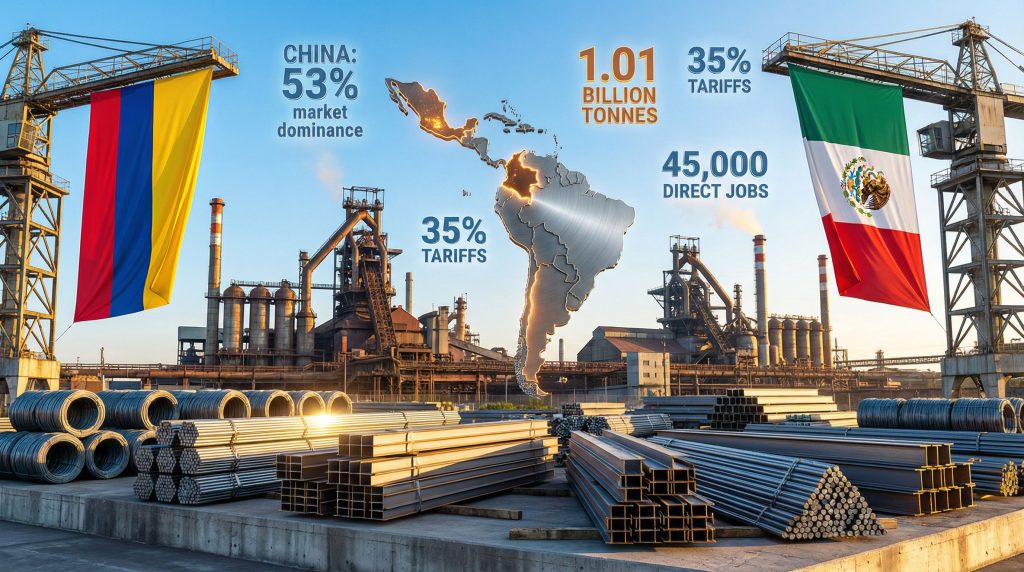
Colombia raises steel tariffs 35% in response to mounting pressure from Asian oversupply conditions that have fundamentally disrupted traditional steel manufacturing relationships across the region. This decisive policy action reflects broader concerns about domestic industrial capacity preservation and strategic supply chain security.
The concentration of steel production in specific geographic regions creates complex dependencies that expose national economies to significant vulnerabilities. Furthermore, these conditions prompt defensive policy responses that extend far beyond simple trade protection measures.
Industrial capacity utilisation rates across major steel-producing regions reflect deeper structural imbalances that have developed over decades of globalisation. Consequently, domestic producers struggle to maintain viable operations despite serving strategically critical sectors including construction, infrastructure development, and energy transition manufacturing.
Regional Industrial Vulnerability Patterns
Latin American steel industries demonstrate significant economic concentration effects that extend beyond direct production metrics. Colombia's steel sector contributes approximately 10% of the nation's industrial GDP while supporting a complex employment ecosystem encompassing 45,000 direct positions alongside an additional 25,000 roles within supplier networks.
This employment multiplier effect creates political economy pressures that transcend purely economic considerations. Moreover, the tariff impact on investment extends across multiple industrial sectors that depend on reliable steel supply chains.
Mexico's industrial landscape reveals more severe capacity constraints, with domestic steel operations achieving only 55% utilisation rates during recent periods. This underperformance occurs alongside a dramatic 55% decline in steel exports to the United States over six months, representing what industry observers characterise as the most significant production crisis in 25 years.
The strategic importance of steel extends across multiple economic sectors that form the backbone of Latin American development strategies:
• Construction and residential development projects
• Infrastructure expansion including transportation networks
• Energy sector equipment and transmission systems
• Capital goods manufacturing for industrial applications
• Energy transition technologies requiring specialised metallurgy
Asian Production Dominance Creating Market Pressures
Global steel production exhibits extreme geographic concentration that fundamentally alters competitive dynamics. China maintains dominant market position with 1.01 billion tonnes of annual production, representing 53% of worldwide output.
This concentration level creates pricing influence that extends far beyond China's domestic market needs. In addition, the US‑China trade war effects have intensified regional competition pressures across Latin American markets.
Asian production capabilities continue expanding with projections indicating regional output reaching 721 million tonnes by 2027. This growth trajectory occurs despite global crude steel production stabilising at approximately 1.88 billion tonnes since 2020, suggesting regional capacity additions may not align with actual demand growth.
Export volume patterns reinforce Asian dominance with China leading international sales at 117.1 million tonnes annually. Japan contributes an additional 31.2 million tonnes while South Korea exports 28 million tonnes, creating combined Asian export capacity that significantly exceeds many regional markets' total consumption.
Corporate concentration within the steel industry demonstrates how individual companies achieve production scales that rival entire national industries. China Baowu Group leads global producers with 130.09 million tonnes annually, followed by ArcelorMittal at 65 million tonnes and Ansteel Group at 59.55 million tonnes.
When big ASX news breaks, our subscribers know first
Colombia's Trade Barrier Framework Compared to Global Approaches
Implementation Structure and Timing Mechanisms
Colombia raises steel tariffs 35% through Decree 0264 of 2026, targeting imports specifically from China, Russia, Turkey, and India. This selective approach contrasts with broader sectoral protection by focusing on countries lacking active trade agreements with Colombia.
The decree establishes a one-year evaluation period during which the Committee on Customs, Tariff and Foreign Trade Affairs will assess economic impacts and determine policy continuation. However, the global trade impacts suggest these measures may need longer timeframes to achieve desired industrial restructuring.
The tariff coverage encompasses strategically selected product categories including bars, profiles, tubes, wire products, barbed wire applications, and various iron, steel, and aluminium goods. This itemised approach suggests targeted protection for specific manufacturing inputs rather than comprehensive sectoral shielding.
President Gustavo Petro's administration frames the policy as reindustrialisation strategy, emphasising domestic production capabilities and supply chain resilience. Ministers Diana Marcela Morales Rojas (Commerce, Industry and Tourism) and Germán Ávila Plazas (Finance) joined the decree signing, indicating cross-ministerial coordination on implementation.
Mexico's Permanent Protection Strategy Evolution
Mexico's approach demonstrates policy escalation from temporary to indefinite protection measures. Originally imposed in April 2024 on 1,466 products with scheduled expiration in April 2025, the tariffs now continue permanently affecting 220 steel products from South Korea, Vietnam, China, and other nations without Mexican trade agreements.
Economy Minister Marcelo Ebrard announced the permanent extension during the National Chamber of Iron and Steel's 78th General Assembly, emphasising government commitment to industry protection. The tariff range spans 10% to 35% depending on product classification and country of origin.
Mexico's regulatory framework includes significant modifications to special import programs:
• IMMEX program restrictions requiring domestic sourcing or tariff payment
• PROCET oversight enhancement with customs coordination
• Regla Octava Club monitoring through SAT tax authority collaboration
• Anti-transshipment measures preventing Asian goods routing to the United States
The Mexican government plans increased public procurement requirements establishing domestic content thresholds for federal and state construction projects. Furthermore, the North American tariff effects demonstrate how regional coordination influences national policy decisions.
Macroeconomic Supply Chain Transformation Analysis
Domestic Production Capacity Evaluation
| Country | Current Status | Key Challenges | Policy Response |
|---|---|---|---|
| Colombia | 10% of industrial GDP | Asian import competition | 35% tariffs (1-year term) |
| Mexico | 55% capacity utilisation | US Section 232 restrictions | Permanent tariff extension |
| Regional | Export decline | Oversupply pressures | Coordinated protection |
Colombia's steel recycling infrastructure processes more than 1.2 million tonnes of scrap materials annually, providing domestic resource base that reduces dependence on imported primary inputs. This circular economy integration supports environmental policy objectives while strengthening supply chain resilience.
The recycling capacity represents significant domestic resource utilisation that could theoretically satisfy substantial portions of national steel demand. However, the proportion of total consumption covered by recycled materials requires analysis to determine actual import substitution potential.
Manufacturing Cost Structure Implications
Tariff protection creates cascading cost effects throughout manufacturing supply chains that extend beyond steel production itself. Construction projects, automotive assembly, appliance manufacturing, and machinery production all incorporate steel inputs at various cost percentages.
Downstream industries face strategic sourcing decisions as import costs increase. Manufacturers must evaluate alternative suppliers from countries maintaining trade agreements with Colombia and Mexico, potentially shifting procurement patterns toward Brazilian, Canadian, or European sources.
Input cost transmission mechanisms:
• Construction material price increases affecting building project economics
• Automotive component costs impacting vehicle assembly competitiveness
• Capital equipment prices influencing industrial investment decisions
• Infrastructure project budgets requiring adjustment for higher material costs
The IMMEX program modifications create particular disruption for export-oriented manufacturers previously sourcing steel duty-free for production destined to international markets. These companies face either absorbed cost increases or supply chain reconfiguration to maintain competitiveness.
Global Steel Trade Pattern Influences on Policy Decisions
Worldwide Production Hierarchy and Market Structure
Global steel production maintains relative stability at 1.88 billion tonnes annually since 2020, despite significant regional variations in capacity utilisation and export patterns. Production concentration reflects both resource availability and industrial policy priorities across major producing nations.
Leading steel producing countries (2024):
• China: 1.01 billion tonnes (53% of global output)
• India: 149.4 million tonnes
• Japan: 84 million tonnes
• United States: 79.5 million tonnes
• Russia: 71 million tonnes
Export patterns demonstrate how production concentration translates into trade flow dominance. World steel exports reached 449.2 million tonnes in 2024, representing 25.5% of finished steel production globally.
China's 117.1 million tonne export volume significantly exceeds many countries' total production capacity. In addition, these patterns reflect how US economy tariffs influence regional trade flows and competitive positioning.
Import distribution reveals market demand concentration in developed economies. The United States leads imports with 27.3 million tonnes, followed by the European Union at 42.8 million tonnes and Turkey at 19.7 million tonnes.
Corporate Market Power and Production Scale
Individual steel companies achieve production volumes that demonstrate significant market influence. China Baowu Group's 130.09 million tonnes annual production represents approximately 6.9% of global output, providing substantial economies of scale and pricing influence within regional markets.
ArcelorMittal's 65 million tonne production combines with global operations spanning multiple continents, creating operational flexibility that enables market-specific pricing strategies. Ansteel Group's 59.55 million tonnes focuses primarily on regional Asian markets but influences global capacity availability.
This corporate concentration creates competitive dynamics where national steel industries compete against individual companies possessing greater production scale than entire countries. Consequently, the competitive asymmetry explains policy responses favouring protection over pure market competition.
Regional Manufacturing Sector Reshaping Through Protection Policies
Public Procurement Integration and Local Content Requirements
Colombian and Mexican approaches demonstrate coordination between trade policy and government spending priorities. Public procurement modifications establish domestic content thresholds that create guaranteed demand for locally produced steel, reducing market uncertainty for domestic producers.
Federal and state-level procurement changes affect multiple project categories:
• Infrastructure construction requiring domestic steel specifications
• Public building projects mandating local sourcing percentages
• Transportation network development using domestic materials
• Energy sector installations incorporating local content requirements
These procurement modifications shift government spending from lowest-cost bidding toward strategic sourcing that supports domestic industrial capacity. Furthermore, the policy integration creates demand stability that enables capacity expansion planning by domestic producers.
USMCA Trade Framework Integration Complexities
Mexico's tariff policies operate within North American trade agreement constraints that create additional coordination requirements. The United States maintains Section 232 tariffs of 50% on Mexican steel exports, creating bilateral tensions that influence Mexico's approach to Asian import protection.
Upcoming USMCA negotiations include steel trade as a priority agenda item, potentially affecting Mexico's tariff policy sustainability. The trade agreement framework requires coordination mechanisms to prevent Asian goods transshipment through Mexico to US markets.
Anti-transshipment measures involve multiple government agencies including customs authorities, tax administration, and trade oversight bodies. This administrative coordination prevents Mexico from becoming a routing point for Asian steel destined for protected US markets.
Investment and Industry Expansion Opportunities
Domestic Capacity Development Potential
Protection policies create investment incentives for domestic steel capacity expansion by reducing Asian competition uncertainty. Capacity utilisation improvements enable existing facilities to operate at higher efficiency levels while justifying technological upgrade investments.
Employment multiplier effects extend through supplier networks as domestic production increases. Colombia's 25,000 supplier positions demonstrate how steel industry expansion affects broader manufacturing ecosystems including transportation, energy, maintenance, and support services.
Investment opportunity categories:
• Production capacity expansion at existing facilities
• Technology modernisation for competitive positioning
• Supplier network development for domestic value chains
• Recycling infrastructure enhancement for circular economy integration
Regional consolidation opportunities emerge as smaller producers gain market share protection from Asian competition. However, domestic companies may pursue merger and acquisition strategies to achieve economies of scale necessary for long-term competitiveness.
Supply Chain Diversification Strategic Options
Manufacturers affected by tariff policies must evaluate alternative sourcing arrangements that maintain cost competitiveness while complying with new trade restrictions. Countries maintaining active trade agreements with Colombia and Mexico offer tariff-free or reduced-rate access that creates sourcing arbitrage opportunities.
Vertical integration strategies become economically attractive as import costs increase. Companies previously relying on imported steel inputs may invest in upstream production capabilities or secure long-term domestic supply contracts.
Raw material security through enhanced domestic recycling creates strategic advantage for companies investing in scrap processing and circular economy infrastructure. Colombia's 1.2 million tonne annual recycling capacity suggests expansion potential for companies developing closed-loop manufacturing systems.
The next major ASX story will hit our subscribers first
Understanding Latin American Steel Trade Policy Through Key Questions
Why Do Multiple Countries Implement Steel Tariffs Simultaneously?
The coordinated timing reflects shared concerns about Asian oversupply conditions and what officials characterise as unfair trade practices. Regional steel industries face similar competitive pressures from low-cost imports that threaten domestic production viability across strategic industrial sectors.
Economic integration within Latin America creates spillover effects where trade policies in one country influence neighbouring markets. Mexico and Colombia raises steel tariffs 35% through similar approaches that suggest regional coordination to prevent trade diversion effects that might undermine individual country policies.
How Long Will Protective Measures Continue?
Colombia establishes a one-year evaluation framework with Committee on Customs, Tariff and Foreign Trade Affairs review determining continuation. This approach contrasts with Mexico's permanent extension, indicating different national approaches to long-term industrial policy.
Policy duration depends on several factors including domestic capacity utilisation improvements, employment effects, downstream industry cost impacts, and international trade dispute developments. Furthermore, the evaluation mechanisms suggest data-driven assessment rather than predetermined timelines.
Which Economic Sectors Benefit Most From Steel Protection?
Construction and infrastructure development gain from reliable domestic steel supply chains with reduced import dependency uncertainty. Energy sector projects requiring specialised steel grades benefit from domestic production capabilities that can meet specific technical requirements.
Transportation infrastructure, capital goods manufacturing, and energy transition technologies represent high-value applications where supply chain reliability provides strategic advantages beyond pure cost considerations.
How Do Tariffs Affect Regional Economic Competitiveness?
Short-term cost increases may affect manufacturing sectors using steel inputs, potentially reducing competitiveness in export markets. However, long-term benefits include industrial capacity retention, employment preservation, and reduced vulnerability to supply chain disruptions.
The net competitiveness effect depends on whether domestic steel production improvements offset input cost increases for downstream industries. Circular economy integration and recycling capacity development may provide environmental and cost advantages that enhance overall competitiveness.
Additionally, recent developments show broader global implications. According to a Bloomberg report, Colombia raises steel tariffs 35% specifically targeting cheap imports that undercut domestic producers. Moreover, analysis from Rio Times suggests these measures represent part of broader Latin American efforts to protect regional steel industries from Asian competition.
Investment Disclaimer: This analysis presents information for educational purposes and should not be construed as investment advice. Steel industry investments involve significant risks including commodity price volatility, regulatory changes, and global trade policy uncertainty. Prospective investors should conduct independent research and consult qualified financial advisors before making investment decisions. Trade policy measures remain subject to modification, international dispute resolution, and economic condition changes that may affect industry prospects.
Considering Investments in Latin American Steel and Mining Sectors?
Discovery Alert's proprietary Discovery IQ model delivers real-time notifications on significant ASX mineral discoveries, instantly empowering subscribers to identify actionable trading opportunities ahead of the broader market. Discover why historic mineral discoveries can generate substantial returns and begin your 14-day free trial today to position yourself with a market-leading advantage.