
July 21, 2026
Legal Framework Enabling Maritime Asset Seizures
The recent US forfeiture of Venezuelan oil tanker operations demonstrates how maritime law enforcement has evolved dramatically as global energy markets fragment along geopolitical lines. Traditional frameworks governing vessel operations face unprecedented challenges when state-sponsored enterprises operate outside conventional regulatory boundaries. The intersection of international sanctions regimes with maritime commerce creates complex jurisdictional puzzles that test decades-old legal doctrines.
The legal mechanisms available to nations for seizing foreign-flagged vessels represent one of the most contentious aspects of modern maritime enforcement. Furthermore, recent developments in US civil forfeiture applications demonstrate how domestic legal frameworks extend beyond territorial waters to address sanctions violations.
Civil Forfeiture vs. Criminal Standards
Civil asset forfeiture operates under fundamentally different principles than criminal prosecution, creating unique advantages for enforcement agencies pursuing sanctions violations. The in rem proceeding targets property directly rather than requiring criminal conviction of individuals, establishing the vessel and cargo as defendants in legal proceedings.
The burden of proof in civil forfeiture cases requires only preponderance of evidence rather than the beyond reasonable doubt standard applied in criminal courts. Under the Civil Asset Forfeiture Reform Act (18 U.S.C. § 983), government agencies must demonstrate that property is more likely than not connected to illegal activity.
This lower evidentiary threshold proves particularly significant in maritime sanctions cases where:
• Documentary evidence may be distributed across multiple jurisdictions
• Vessel ownership structures deliberately obscure beneficial ownership
• Financial transactions occur through complex intermediary networks
• Physical evidence collection requires international cooperation
The property presumption doctrine further shifts the burden to claimants who must prove legitimate ownership and lawful use of seized assets. This reversal of traditional legal presumptions reflects the practical challenges of investigating transnational financial crimes.
Jurisdictional Reach in Maritime Enforcement
US sanctions enforcement authority extends globally through several mechanisms that transcend traditional territorial limitations. The dollar nexus requirement creates jurisdiction when transactions involve US financial institutions, correspondent banking relationships, or dollar-denominated payments.
Maritime sanctions violations typically establish US jurisdiction through:
• SWIFT messaging systems routing through US financial infrastructure
• Insurance policies underwritten by US or US-affiliated companies
• Port calls at facilities with US commercial interests
• Fuel purchases using US banking networks
The Treasury Department's Office of Foreign Assets Control (OFAC) applies strict liability standards to sanctions violations, meaning intent becomes irrelevant once prohibited conduct occurs. This approach significantly broadens enforcement possibilities for maritime cases involving complex ownership structures, particularly as seen in recent US production executive order initiatives targeting supply chain security.
When big ASX news breaks, our subscribers know first
International Legal Principles Governing High Seas Operations
Maritime enforcement actions must navigate the competing frameworks of national jurisdiction and international maritime law. The United Nations Convention on the Law of the Sea (UNCLOS) establishes foundational principles that constrain unilateral enforcement actions on the high seas.
Flag State Jurisdiction and Boarding Rights
Article 92(1) of UNCLOS grants flag states exclusive jurisdiction over vessels flying their flags while operating on the high seas. This principle creates significant legal obstacles for third-party enforcement actions, requiring either:
• Explicit consent from the flag state government
• Hot pursuit initiated within territorial waters (Article 111)
• Universal jurisdiction for specific crimes (piracy, slavery, trafficking)
The hot pursuit doctrine permits continuation of enforcement actions begun within territorial waters, but requires continuous pursuit without interruption. Maritime law scholars debate whether sanctions evasion qualifies for universal jurisdiction treatment similar to piracy or human trafficking.
Sanctions Evasion as International Maritime Crime
The classification of sanctions evasion under international maritime law remains contested amongst legal scholars. Unlike piracy or trafficking, sanctions violations derive from national rather than international legal frameworks, complicating enforcement cooperation.
Current enforcement mechanisms rely on:
- Bilateral agreements between flag states and enforcing nations
- UN Security Council resolutions creating binding international obligations
- Regional cooperation frameworks (EU, Five Eyes intelligence sharing)
- Industry self-regulation through insurance and banking networks
The European Union and United Kingdom coordinate maritime sanctions enforcement through joint task forces, sharing intelligence and enforcement resources. However, legal authority ultimately derives from domestic rather than international law.
Shadow Fleet Circumvention Techniques
Sanctions evasion vessels employ sophisticated concealment methods that challenge traditional maritime tracking and enforcement capabilities. These techniques exploit gaps between international monitoring systems and regulatory oversight mechanisms.
Vessel Identification Manipulation
Modern sanctions evasion relies heavily on Automatic Identification System (AIS) spoofing, where vessels transmit false position data to maritime tracking networks. This technique involves:
• Position falsification showing vessels in permitted locations whilst operating elsewhere
• Identity switching between multiple AIS transponder codes
• Signal interruption during sensitive operations or transfers
• Coordinate manipulation placing vessels outside enforcement zones
Flag-hopping represents another common concealment method, with vessels frequently changing registry to obscure ownership patterns and evade specific flag state obligations. Recent analysis indicates some vessels change flags multiple times per year, creating regulatory gaps between registration periods.
Ship-to-Ship Transfer Operations
Cargo transfers at sea enable sanctions evasion by separating origin vessels from delivery vessels, complicating cargo tracking and ownership verification. These operations typically occur:
• Beyond territorial waters to avoid coastal state jurisdiction
• In regions with limited surveillance such as remote Pacific or Atlantic areas
• During adverse weather when satellite monitoring becomes difficult
• Near legitimate shipping lanes to blend with commercial traffic
Detection of ship-to-ship transfers relies increasingly on satellite imagery analysis combined with AIS data correlation. However, sophisticated operators coordinate multiple vessels to create plausible alternative explanations for proximity patterns. In addition, the US-China trade war has intensified scrutiny of these operations.
Economic Impact Assessment Framework
Large-scale maritime asset seizures create ripple effects throughout global energy markets, affecting pricing mechanisms, insurance markets, and alternative supply arrangements. The economic implications extend beyond immediate cargo values to broader market confidence and compliance costs.
Market Disruption Mechanisms
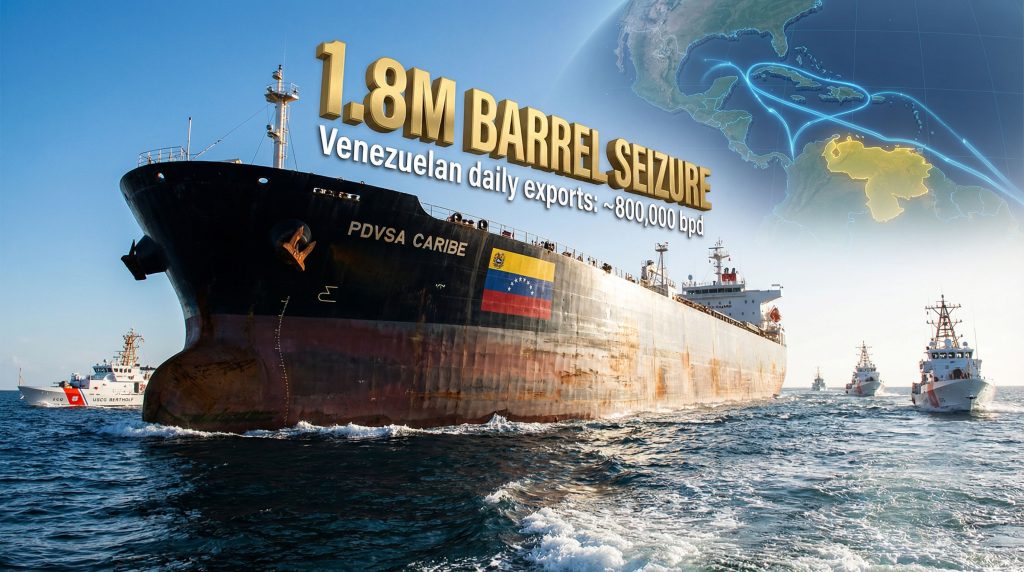
Seizure of Venezuelan crude cargoes affects multiple market segments simultaneously. The US forfeiture of Venezuelan oil tanker operations demonstrates significant market impact when considered against typical daily export volumes.
Supply Side Impacts:
• Immediate removal of cargo volumes from global markets
• Deterrent effects on future sanctions evasion attempts
• Increased operational costs for compliant Venezuelan exports
• Risk premiums affecting Venezuelan crude pricing differentials
Demand Side Adjustments:
• Buyer migration toward compliant supply sources
• Premium payments for verified compliant crude origins
• Increased due diligence costs for Venezuelan crude purchases
• Alternative refinery sourcing arrangements
The seizure of 1.8 million barrels represents significant market impact when considered against typical daily Venezuelan export volumes. Energy markets demonstrate sensitivity to enforcement actions through risk premium adjustments that affect broader regional pricing.
Insurance and Compliance Cost Evolution
Maritime insurance markets respond rapidly to enforcement actions through coverage modifications and premium adjustments. Furthermore, the DOJ has pursued forfeiture of oil tankers and crude oil linked to Iran and Venezuela. Key changes include:
| Risk Category | Insurance Response | Market Impact |
|---|---|---|
| Sanctions Violation | Coverage exclusions expand | Premiums increase 25-50% |
| Asset Forfeiture | Policy limits reduced | Self-insurance increases |
| Regulatory Compliance | Enhanced documentation required | Administrative costs rise |
Insurance carriers increasingly require enhanced due diligence documentation for Venezuelan crude cargoes, including:
• Origin verification through multiple independent sources
• Beneficial ownership disclosure for all transaction participants
• Sanctions compliance certifications from legal counsel
• Real-time cargo tracking throughout transportation
Competing Legal System Challenges
Maritime enforcement actions create complex disputes when multiple legal systems assert competing claims over vessels, cargo, and proceeds. These conflicts reflect broader tensions between unilateral sanctions enforcement and international law principles.
Sovereign Rights and Diplomatic Responses
State-owned enterprises like PDVSA present unique challenges for civil forfeiture proceedings, as Venezuelan authorities may assert sovereign immunity claims or characterise seizures as violations of international law. Potential legal responses include:
• UNCLOS Article 87 challenges asserting freedom of navigation violations
• Diplomatic immunity claims for state-owned vessel operations
• International arbitration under bilateral investment treaties
• Counter-seizure actions against US commercial interests
The effectiveness of these responses depends largely on political relationships and enforcement capabilities rather than purely legal considerations. However, executive order enforcement regarding critical minerals demonstrates the administration's commitment to comprehensive sanctions implementation.
Third-Party Commercial Interests
Asset forfeiture proceedings must address legitimate commercial interests that may exist independent of sanctions violations. Complex ownership structures create disputes over:
Cargo Ownership vs. Transportation:
• Bill of lading holders may differ from beneficial cargo owners
• Charter agreements separate vessel control from ownership
• Insurance policies may cover cargo independent of vessel coverage
• Letters of credit create banking interests in cargo proceeds
Port State Complications:
• Detention authorities vary between jurisdictions
• Local maritime liens may take priority over forfeiture claims
• Crew welfare obligations continue during legal proceedings
• Environmental liability remains with vessel operators
Resolution typically requires extensive legal proceedings across multiple jurisdictions, with outcomes depending on specific contractual arrangements and local legal frameworks. Moreover, recent US sanctions on tankers have intensified these legal complexities.
Enforcement Precedent Development
Current maritime sanctions enforcement represents an evolution of legal doctrines originally developed for drug trafficking and terrorism financing cases. The application of these frameworks to state-sponsored sanctions evasion creates new precedents with broader implications.
Evolution from Targeted to Comprehensive Enforcement
Early sanctions enforcement focused primarily on designated individuals and entities, requiring specific evidence of participation in prohibited activities. Recent cases demonstrate expansion toward enterprise-wide enforcement theories that target entire operational networks.
This shift reflects several factors:
• Intelligence capabilities enabling network-wide surveillance and analysis
• Financial system integration creating multiple intervention points
• Asset fungibility making targeted approaches less effective
• Deterrent requirements demanding visible enforcement consequences
Integration with Anti-Terrorism Financing
Maritime sanctions enforcement increasingly incorporates anti-terrorism financing statutes (18 U.S.C. § 1956) alongside traditional sanctions violations. This approach provides additional legal tools including:
• Money laundering charges for disguising transaction origins
• Conspiracy theories for coordinated evasion activities
• Forfeiture enhancements for terrorism-related violations
• International cooperation mechanisms through terrorism financing frameworks
The designation of Iran's Islamic Revolutionary Guard Corps as a terrorist organisation creates legal pathways for applying terrorism financing statutes to Venezuelan oil trade that benefits IRGC operations. Consequently, these developments align with broader Trump tariffs analysis regarding comprehensive economic enforcement strategies.
The next major ASX story will hit our subscribers first
Technology-Enhanced Policy Tools
Traditional maritime enforcement faces capacity limitations that technology solutions could address more effectively than current manual oversight methods. Advanced monitoring and compliance verification systems offer potential improvements to existing frameworks.
Blockchain-Based Cargo Tracking
Distributed ledger technology could create immutable records of cargo ownership and transfer history, addressing current verification challenges through:
• Origin certification recorded at production facilities
• Chain of custody documentation through all transfer points
• Smart contract execution for automated compliance verification
• Multi-party validation requiring consensus for record changes
Implementation challenges include industry adoption costs, technical standardisation requirements, and integration with existing documentation systems.
Mandatory Vessel Identification Enhancement
Current AIS systems rely on voluntary compliance and lack cryptographic security features, enabling the spoofing techniques employed by sanctions evasion vessels. Enhanced identification systems could include:
Technical Requirements:
• Tamper-resistant hardware with cryptographic authentication
• Satellite-based backup systems independent of vessel control
• Blockchain-recorded identity verification for ownership changes
• Real-time sanctions screening integration
Implementation Framework:
• International Maritime Organisation standardisation
• Phased deployment beginning with high-risk trade routes
• Insurance premium incentives for early adoption
• Port state enforcement of enhanced identification requirements
Global Energy Security Implications
Maritime sanctions enforcement affects global energy flows in ways that extend beyond immediate bilateral relationships between sanctioning and sanctioned states. These impacts create strategic considerations for energy-importing nations and alternative suppliers.
Supply Chain Vulnerability Assessment
Enforcement actions against Venezuelan crude highlight broader vulnerabilities in global energy supply chains, particularly regarding:
Alternative Routing Development:
• Asian refineries seeking non-sanctioned crude alternatives
• African light crude premium development for Venezuelan crude substitutes
• Middle Eastern supplier capacity utilisation for displaced demand
• Strategic petroleum reserve policy adjustments for supply security
Regional Price Impact Mechanisms:
• Caribbean refinery feedstock availability changes
• Latin American energy infrastructure investment implications
• European refined product import requirement adjustments
• Asian heavy crude processing capacity utilisation effects
Geopolitical Realignment Consequences
Sanctions enforcement accelerates the development of alternative energy trade relationships that may persist beyond current sanction regimes. Key developments include:
Russia-Venezuela-Iran Cooperation:
• Joint sanctions evasion infrastructure development
• Shared maritime insurance and financing mechanisms
• Technology transfer for sanctions circumvention capabilities
• Coordinated energy export pricing strategies
Non-Aligned Nation Responses:
• India's refined product import diversification strategies
• China's neutral shipping corridor development for sanctioned suppliers
• Turkey's energy transit hub development for sanctioned suppliers
• Regional development bank financing for alternative infrastructure
Legal Framework Modernisation Requirements
Current maritime enforcement capabilities reflect legal frameworks developed before modern global financial integration and digital communication systems. Addressing current enforcement gaps requires comprehensive legal modernisation across multiple domains.
International Maritime Law Updates
UNCLOS provisions governing high seas enforcement predate modern sanctions regimes and digital tracking capabilities. Potential modernisation areas include:
• Digital age enforcement authority for cyber-enabled sanctions evasion
• Sanctions evasion classification as universal jurisdiction crime
• Cross-border asset recovery mechanisms for forfeiture proceedings
• Real-time compliance verification requirements for commercial vessels
International consensus on these changes faces significant political obstacles given competing national interests and sovereignty concerns.
Domestic Legal Enhancement Options
US legal frameworks could address current enforcement limitations through several mechanisms:
Expedited Forfeiture Procedures:
• Fast-track processing for sanctions violation cases
• Preliminary asset preservation during legal proceedings
• Administrative forfeiture expansion for maritime assets
• Enhanced emergency detention authorities for high-value cases
Enhanced Penalties and Deterrents:
• Corporate death penalty provisions for systematic violations
• Individual accountability for beneficial ownership concealment
• Whistleblower incentives for sanctions evasion reporting
• Industry debarment authorities for facilitating violations
These enhancements require careful balance between enforcement effectiveness and due process protections, particularly regarding international commercial relationships and diplomatic considerations.
The US forfeiture of Venezuelan oil tanker operations demonstrates the evolving intersection of maritime law, sanctions enforcement, and global energy security. As enforcement capabilities advance through technology and legal framework development, the effectiveness of traditional sanctions evasion techniques will likely diminish, requiring continuous adaptation by both enforcement agencies and compliance professionals.
This analysis is for educational purposes only and should not be construed as legal advice. Maritime sanctions enforcement involves complex legal and regulatory considerations that require consultation with qualified legal counsel.
Ready to Stay Ahead of Global Energy Market Shifts?
Discovery Alert's proprietary Discovery IQ model provides real-time notifications on significant ASX mineral discoveries, helping investors capitalise on market opportunities before they become mainstream knowledge. With ongoing geopolitical tensions reshaping global energy markets, understanding how mineral discoveries can generate substantial returns becomes increasingly valuable through Discovery Alert's discoveries page, and you can begin your 14-day free trial today to position yourself ahead of these market-moving developments.