July 18, 2026
Why LFP Cathode Manufacturing Is Becoming a Winner-Takes-Most Industry
Few industrial sectors illustrate the dynamics of scale economics more starkly than lithium iron phosphate cathode production. In markets where raw material access, process efficiency, and customer qualification cycles all compound over time, the producers who reach critical mass earliest tend to reinforce their advantages faster than competitors can close the gap. Understanding this structural reality is essential context for assessing what the Hunan Yuneng LFP complex in China actually represents, and why its latest expansion announcement carries implications that extend far beyond a single construction project.
When big ASX news breaks, our subscribers know first
China's Structural Grip on the LFP Supply Chain
Lithium iron phosphate has undergone a remarkable transformation over the past decade. Once considered a second-tier chemistry relative to nickel-manganese-cobalt (NMC) cathode materials, LFP has emerged as the preferred choice for a growing share of both electric vehicle and stationary energy storage applications. The reasons are well-documented but worth restating clearly.
LFP cells offer several decisive advantages over NMC alternatives:
- Thermal stability: LFP's olivine crystal structure resists oxygen release during thermal stress, dramatically reducing fire and explosion risk compared to layered oxide chemistries.
- Cycle life: LFP cathodes routinely deliver 3,000 to 5,000 charge-discharge cycles before significant capacity degradation, compared to 1,000 to 2,000 cycles for standard NMC formulations.
- Cost: The absence of cobalt and nickel, both of which carry substantial supply concentration risk and cost volatility, makes LFP materially cheaper to produce per kilowatt-hour of energy stored.
- Safety at scale: For grid-scale battery energy storage systems where thermal runaway in a single cell can cascade through a large installation, LFP's inherent stability profile is increasingly valued by system integrators and insurers.
China's dominance in LFP production is not accidental. The country controls the upstream phosphate rock deposits, iron ore processing infrastructure, and battery raw materials refining capacity that form the essential inputs for LFP cathode synthesis. Furthermore, Guizhou province alone holds some of the world's largest high-grade phosphate rock reserves, making it a natural anchor point for integrated LFP manufacturing investment.
What the Hunan Yuneng LFP Complex in China Actually Encompasses
A Production Network Spanning Five Provinces
Hunan Yuneng New Energy Battery Material Co. is not a single-site manufacturer. The company, listed on the Shenzhen Stock Exchange and headquartered in Xiangtan, Hunan province, operates a distributed manufacturing network that spans five Chinese provinces. This geographic diversification across resource corridors is itself a strategic asset, reducing logistical bottlenecks and providing redundancy across the supply chain.
| Manufacturing Base | Location | Approximate LFP Capacity | Status |
|---|---|---|---|
| Yunnan Base | Anning, Yunnan | ~200,000 mt/year | Operational since June 2022 |
| Guizhou Base | Fuquan, Guizhou | ~150,000 mt/year | Operational |
| Sichuan Base | Suining, Sichuan | ~120,000 mt/year | Operational |
| Hunan HQ | Xiangtan, Hunan | ~60,000 mt/year | Operational |
| Guangxi Base | Jingxi, Guangxi | ~30,000 mt/year | Operational |
Combined across these bases, Hunan Yuneng's designed LFP production capacity reached approximately 850,000 to 994,500 metric tons per year by end-2025. Crucially, the company reported operating at over 110% of its stated design capacity, a figure that reflects both the intensity of customer demand and the company's operational capability to push facilities beyond their nameplate limits through process optimisation.
Six Years at the Top: What Market Leadership Actually Means
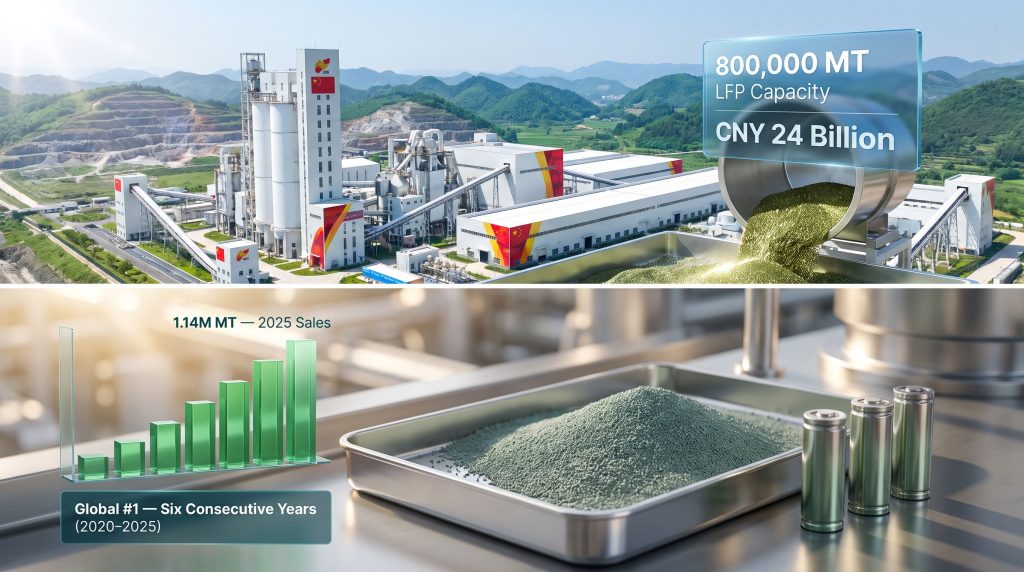
Hunan Yuneng has held the global number one position in LFP cathode material shipments for six consecutive years, from 2020 through 2025. Total 2025 sales reached 1.14 million metric tons of phosphate-based cathode materials. These figures are not merely impressive in isolation. They reflect the compounding effect of customer qualification cycles in the battery supply chain, where cathode producers must undergo rigorous testing and approval processes with cell manufacturers before securing long-term supply agreements. Six years of market leadership translates into a qualification moat that new entrants cannot replicate quickly.
The Yunnan Base: Flagship of the Existing Network
The Yunnan base in Anning represents the most instructive template for the Weng'an project. Phase 1 of the Yunnan facility, completed in June 2022, established 160,000 tons per year of LFP capacity alongside 240,000 tons per year of iron(III) phosphate precursor production. Phase 2 committed RMB 8 billion toward LMFP (lithium manganese iron phosphate), additional iron phosphate, and hydrogen peroxide production lines, with a long-term planned capacity ceiling of 500,000 tons per year of LFP at the single site.
The Yunnan base demonstrates a deliberate phased development philosophy: establish precursor co-location first, then expand cathode output as customer demand is confirmed. The Weng'an project appears designed to replicate and substantially scale this model.
The CNY 24 Billion Weng'an Expansion: Scope and Strategic Logic
What Is Being Built and Why Weng'an?
Weng'an county in Guizhou province is not a random selection. The area sits within one of China's most phosphate-rich geological corridors, with accessible deposits of both phosphate rock and pyrite, the sulfur-bearing mineral used to produce sulfuric acid for phosphoric acid synthesis. Locating an integrated LFP complex adjacent to these resources compresses the supply chain in a way that non-integrated cathode producers simply cannot replicate without similar geographic positioning.
The total planned investment stands at CNY 24 billion (approximately USD 3.5 billion), executed through a newly established wholly owned subsidiary over an estimated five-year construction and ramp-up timeline. Capital deployment is structured to limit early-stage financial exposure, with CNY 5 billion to CNY 8 billion committed within the first 18 months following formal construction commencement, with subsequent tranches calibrated to actual market demand signals.
Production Targets That Redefine Scale
| Product Category | Annual Capacity Target |
|---|---|
| Lithium Iron Phosphate (LFP) | 800,000 metric tons |
| Iron Phosphate (precursor) | 1,000,000 metric tons |
| Upstream inputs | Phosphate rock, pyrite, sulfuric acid, lithium carbonate |
| Circular economy | Lithium-ion battery recycling |
The 800,000 metric ton LFP target from a single greenfield site is genuinely extraordinary in context. Hunan Yuneng's entire existing five-base network currently operates at approximately 850,000 to 994,500 metric tons of combined annual LFP capacity. The Weng'an complex alone would nearly replicate the company's current total footprint within a single geographic cluster. Combined with existing assets, total operational capacity could approach 1.8 million metric tons per year, a scale with meaningful influence over global LFP pricing dynamics.
Vertical Integration as Competitive Architecture
The design philosophy behind the Weng'an complex goes beyond simple capacity addition. The project is engineered to capture value at every stage of the LFP production chain:
- Resource extraction: Phosphate rock mining and pyrite processing provide the foundational raw material inputs.
- Intermediate chemistry: Sulfuric acid production from pyrite and phosphoric acid synthesis reduce dependency on third-party acid suppliers, a cost category that LFP producers in non-integrated settings find difficult to control.
- Lithium carbonate: Onsite lithium carbonate dynamics create a critical feedstock advantage, particularly relevant given the historical volatility of lithium spot prices.
- Cathode manufacturing: The 800,000 ton LFP line and 1 million ton iron phosphate precursor operation form the commercial core.
- Battery recycling: End-of-life lithium-ion cell processing recovers lithium carbonate and iron phosphate for reinjection into the production cycle, creating a self-reinforcing circular material flow.
This architecture is particularly significant for understanding cost positioning. A producer that controls its own sulfuric acid, phosphoric acid, iron phosphate, and lithium carbonate inputs is structurally insulated from the input cost inflation that periodically compresses margins for non-integrated LFP manufacturers.
Market Signals: What the August 2026 Price Increase Reveals
One of the more revealing data points in Hunan Yuneng's recent announcements is the decision to implement a CNY 2,000 per metric ton price increase across all LFP products from August 1, 2026. The stated rationale encompasses elevated raw material costs, sustained full-capacity operation, and insufficient near-term capacity headroom to accommodate all incremental customer order growth.
A dominant cathode producer choosing to raise prices unilaterally in a market where multiple Chinese competitors are simultaneously expanding capacity is a meaningful signal. It implies that demand for qualified, high-performance LFP grades is outpacing available supply, and that Hunan Yuneng's customer relationships are sufficiently entrenched to absorb the price adjustment without significant order diversion.
This dynamic is connected to the company's high-density product strategy. The CN-5 and YN-9 product families together recorded 588,500 metric tons of sales in 2025, representing approximately 51% of total sales volume. These high-density LFP variants command premium positioning relative to standard-grade material, and their growing share of the sales mix reflects a deliberate push toward products where technical differentiation reduces direct price competition.
Financial Mechanics and the Risks That Cannot Be Ignored
Balance Sheet Tension and the H-Share Listing
The CNY 24 billion investment envelope exceeds Hunan Yuneng's cash balance at the end of March 2026 by more than three times. This is not unusual for a company undertaking a transformative greenfield build, but it introduces a set of financing risks that merit clear-eyed assessment.
Funding is expected to combine internal cash generation, debt financing, and equity capital raising. The company is pursuing an H-share listing on the Hong Kong Stock Exchange specifically to access offshore capital markets and diversify its funding base. However, the listing process remains subject to regulatory review and prevailing market conditions, introducing a material timeline uncertainty into the financing plan.
The Copper Project Cancellation: A Capital Reallocation Signal
Simultaneously, Hunan Yuneng is terminating a planned 500,000-ton copper smelting project in Fuquan, Guizhou. New policy requirements mandating equity ownership of copper concentrate resources rendered the project unviable. Assets previously invested in the copper facility are expected to be redeployed into existing or future LFP operations, which partially offsets the capital requirements of the Weng'an expansion and reinforces the company's strategic focus on battery materials.
Risk Assessment: Execution Challenges in Full
| Risk Category | Specific Concern | Assessed Impact |
|---|---|---|
| Financial | Funding gap if H-share listing is delayed | High |
| Market demand | LFP oversupply from simultaneous competitor expansions | Medium to High |
| Regulatory | Mining and environmental approvals in Guizhou | Medium |
| Technology | Faster-than-expected sodium-ion or LMFP adoption | Medium |
| Execution | Five-year greenfield construction complexity | Medium |
The market demand risk deserves particular attention. Several Chinese cathode producers are announcing large LFP capacity expansions concurrently, and the aggregate supply additions entering the market between 2026 and 2030 could exceed demand growth if electric vehicle adoption rates disappoint or grid-scale storage deployment timelines slip. LFP price compression during the construction period would consequently pressure the project's return economics.
The next major ASX story will hit our subscribers first
International Footprint and the Recycling Imperative
The Hunan Yuneng LFP complex in China does not exist in isolation from the company's international ambitions. According to Benchmark Mineral Intelligence, a 50,000 ton per year LFP plant in Spain commenced construction in 2024, and a 90,000-ton facility in Malaysia extends the production footprint into Southeast Asia. These overseas assets serve a different strategic function from the domestic network: they satisfy battery cell manufacturers outside China who face localisation requirements from their customers or governments in Europe and Southeast Asia.
On the recycling dimension, the battery recycling outlook for Hunan Yuneng already includes 20,000 metric tons per year of battery-grade lithium carbonate recycling capacity approved in Hunan as an operational precursor to the much larger recycling integration planned for Weng'an. As China tightens its extended producer responsibility regulations for spent batteries, and as the EU's Battery Regulation mandates minimum recycled content thresholds for cells sold into European markets, recycling capability transitions from a sustainability credential to a commercial necessity.
What Successful Completion Would Mean for Global Battery Markets
If the Weng'an complex reaches its planned operational state, the consequences for global LFP supply chain economics would be substantial. A producer controlling approximately 1.8 million metric tons of annual LFP capacity, with integrated upstream resource processing and closed-loop recycling, would possess structural cost advantages that non-integrated competitors cannot easily neutralise through process improvements alone.
The conditions required for this outcome include:
- Disciplined phasing of capital expenditure aligned with actual demand confirmation rather than optimistic projections.
- Successful completion of the Hong Kong H-share listing to secure the equity capital component of the financing structure.
- Timely resolution of Guizhou provincial mining approvals and environmental impact assessments for the integrated chemical processing operations.
- Advances in lithium extraction technology that could influence upstream input costs and efficiency across the production chain.
- Sustained customer preference for high-performance LFP grades over competing chemistries, particularly as sodium-ion and LMFP technologies mature, supported by continued battery storage expansion across global markets.
The Weng'an project is, at its core, a high-conviction structural bet: that LFP will remain the dominant global cathode chemistry through the 2030s, and that vertical integration from phosphate rock to recycled material will define the cost frontier in cathode manufacturing. Whether that conviction is rewarded will depend as much on financing discipline and regulatory navigation as on the underlying demand trajectory it is designed to serve.
In addition, as noted by Argus Media, the company's European expansion signals a broader internationalisation strategy that extends well beyond domestic capacity accumulation, further reinforcing the structural significance of the Hunan Yuneng LFP complex in China's role in shaping global cathode supply chains.
Readers seeking additional context on China's battery materials industry and LFP supply chain dynamics can explore related coverage at ESS News (pv magazine group), which tracks global energy storage manufacturing and market developments.
Disclaimer: This article contains forward-looking statements, capacity projections, and financial analysis based on publicly available information. These represent analytical perspectives and not investment advice. Readers should conduct independent due diligence before making any investment decisions related to companies or sectors discussed herein.
Want to Capitalise on the Next Major Battery Materials Discovery Before the Market Moves?
Discovery Alert's proprietary Discovery IQ model scans ASX announcements in real time, instantly identifying significant mineral discoveries across lithium, phosphate, and other battery-critical commodities — translating complex geological data into actionable investment insights for both traders and long-term investors. Explore how historic ASX mineral discoveries have generated substantial returns, and begin your 14-day free trial at Discovery Alert to position yourself ahead of the broader market.