May 19, 2026
Battery chemistry evolution continues reshaping energy storage markets through fundamental material science breakthroughs. LG Energy Solution sodium-ion battery pilot production represents a strategic shift toward cost-effective energy storage solutions, leveraging abundant earth elements to address critical supply chain vulnerabilities that have plagued the industry for decades.
The technical foundation of sodium-ion batteries centers on sodium's chemical properties, which enable operational temperatures as low as -40°C compared to lithium iron phosphate (LFP) systems limited to -20°C operation. This temperature resilience stems from sodium's ionic conductivity characteristics in electrolyte solutions, maintaining performance under extreme conditions that would compromise traditional lithium cells.
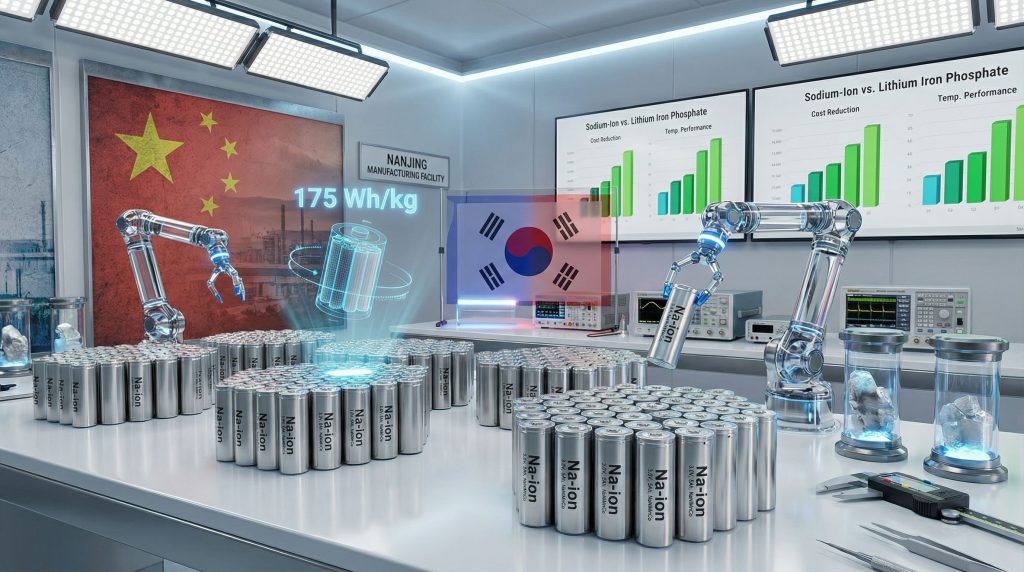
Energy density achievements mark another crucial milestone, with industry leaders like CATL reaching 175 Wh/kg through their Naxtra sodium-ion technology. This benchmark approaches competitive parity with established LFP systems operating between 160-180 Wh/kg, eliminating previous assumptions about sodium-ion performance limitations.
Core Technical Advantages Over Lithium-Ion Technology
Raw material economics fundamentally distinguish sodium-ion technology from lithium alternatives. Sodium-ion batteries deliver 40% lower raw material costs compared to lithium-ion systems, primarily through elimination of lithium carbonate dependencies that have created supply chain bottlenecks across global markets.
The cost advantage extends beyond raw materials to manufacturing processes. Sodium abundance enables extraction from diverse sources including mineral salts, seawater, and geological formations distributed globally, contrasting sharply with lithium's concentrated geographic availability in South America, China, and Australia.
Performance trade-offs remain measurable but manageable for specific applications. Cycle life specifications show sodium-ion batteries supporting 3,000+ cycles, slightly below LFP's 3,500+ cycles but sufficient for stationary storage and secondary vehicle applications where cost optimization outweighs maximum longevity requirements.
Safety Profile and Thermal Stability Characteristics
Thermal stability represents a critical safety advantage inherent to sodium-ion chemistry. The electrolyte systems operate with different thermal coefficients compared to lithium-ion cells, potentially reducing thermal runaway risks during edge-case failure scenarios.
Material safety extends to transportation and handling protocols. Sodium-based active materials demonstrate lower reactivity with atmospheric moisture compared to lithium compounds, simplifying manufacturing environments and reducing specialized storage requirements that increase production complexity.
Furthermore, these developments align with broader critical minerals energy transition initiatives, where supply chain diversification becomes increasingly important for global energy security.
Table: Sodium-Ion vs Lithium-Ion Performance Comparison
| Metric | Sodium-Ion | Lithium Iron Phosphate | Advantage |
|---|---|---|---|
| Energy Density | 175 Wh/kg | 160-180 Wh/kg | Competitive |
| Raw Material Cost | 40% lower | Baseline | Sodium-Ion |
| Low Temperature Performance | -40°C operation | -20°C operation | Sodium-Ion |
| Cycle Life | 3,000+ cycles | 3,500+ cycles | LFP |
When big ASX news breaks, our subscribers know first
How Does LG Energy Solution's Multi-Stage Development Process Work?
Manufacturing validation methodology represents a systematic approach to technology commercialization, designed to minimize market entry risks through phased capability building. LG Energy Solution sodium-ion battery pilot production strategy demonstrates industry best practices for scaling emerging battery chemistries from laboratory concepts to mass production readiness.
The three-phase development pathway reflects careful risk management, progressing from fundamental chemistry validation to commercial-scale manufacturing optimization. This methodology ensures each stage validates specific technical and economic parameters before advancing to higher-volume production commitments.
Research Phase at Daejeon Technology Research Institute
The Daejeon Technology Research Institute serves as LG Energy Solution's advanced R&D hub, focusing on next-generation battery chemistry validation, cell performance testing, and failure analysis protocols. This separation of research from production ensures rigorous scientific validation before manufacturing scale-up begins.
Prototype development at Daejeon concentrates on fundamental chemistry optimization, including:
- Electrode material formulation for sodium-ion active materials
- Electrolyte composition testing for ionic conductivity optimization
- Cell design validation for thermal and mechanical performance
- Safety protocol establishment through accelerated testing methodologies
The research phase timeline targets Q2 2026 completion, establishing baseline technical specifications that inform subsequent manufacturing phases. Additionally, these research efforts complement broader mining industry innovation trends that are revolutionising material extraction and processing techniques.
Sample A Production at Ochang Mother Plant
Ochang Mother Plant in North Chungcheong Province functions as LG Energy Solution's flagship production facility, designated as "mother plant" to indicate its role in technology transfer and process validation before international expansion.
Sample A production represents the critical transition from laboratory-scale prototypes to commercial-grade equipment manufacturing. This phase validates manufacturing processes including:
- Coating line optimization for electrode production at commercial speeds
- Assembly process validation using production-scale equipment
- Quality control protocol establishment for consistent output metrics
- Yield optimization to identify manufacturing bottlenecks before scaling
The Q3 2026 timeline for Sample A production establishes manufacturing baselines essential for China-based operations, ensuring process transfer maintains quality and efficiency standards.
Advanced Prototyping Strategy for Samples B and C
Nanjing facility operations represent the culmination of LG Energy Solution's validation strategy, producing Samples B and C for market-ready applications. The China location provides strategic advantages including proximity to established cathode material suppliers and access to cost-effective manufacturing infrastructure.
Sample B development focuses on finished product optimization, suitable for customer testing and performance verification with original equipment manufacturers (OEMs). Sample C represents mass-production-ready iterations optimized for high-volume manufacturing with established yield targets and supply chain integration.
Table: LG Energy Solution's Sodium-Ion Development Timeline
| Development Stage | Location | Sample Type | Expected Completion |
|---|---|---|---|
| R&D Phase | Daejeon, South Korea | Prototype | Q2 2026 |
| Initial Production | Ochang Plant | Sample A | Q3 2026 |
| Pilot Manufacturing | Nanjing, China | Samples B & C | Q4 2026 |
Why Is China the Strategic Location for Sodium-Ion Battery Manufacturing?
Global manufacturing dynamics heavily favor China's integrated supply chain ecosystem for advanced battery technologies. China controls approximately 60% of global sodium-ion battery production capacity, with established supply chains for critical cathode materials that reduce manufacturing costs by 15-25% compared to alternative regions.
The concentration of specialized suppliers creates cluster effects that reduce procurement costs and lead times significantly. This vertical integration spans raw material processing, precursor manufacturing, active material production, and cell assembly, eliminating geographical dispersion inefficiencies that characterise other manufacturing regions.
Supply Chain Ecosystem for Cathode Materials
China's sodium-ion battery supply chain demonstrates remarkable vertical integration across critical production stages. The ecosystem includes manganese ore extraction and beneficiation from Jiangxi and Hunan provinces, specialised transition metal oxide synthesis, cathode material refinement, and comprehensive cell assembly capabilities.
Regional specialisation enhances efficiency through geographic concentration:
- Jiangsu Province: Primary hub for lithium-ion and sodium-ion battery manufacturing, housing CATL facilities and LG Energy Solution's Nanjing pilot operations
- Guangdong Province: Secondary manufacturing cluster with specialised materials suppliers
- Shandong Province: Emerging production centre targeting cost-sensitive applications
This geographic distribution optimises transportation costs while maintaining access to skilled manufacturing labour and established regulatory frameworks for battery production. Moreover, these developments represent a significant battery recycling breakthrough that enhances the circular economy aspects of sodium-ion technology.
Manufacturing Cost Advantages in Chinese Facilities
Chinese manufacturing enables substantial cost reductions through multiple structural advantages. Labour cost differentials provide significant savings, with skilled manufacturing workers operating at wage scales substantially lower than South Korea, North America, or European alternatives.
Equipment utilisation rates benefit from established manufacturing infrastructure, reducing capital expenditure requirements for new facility development. Access to diverse energy sources including hydroelectric, coal, and renewable options provides competitive electricity pricing essential for energy-intensive battery manufacturing processes.
Regulatory harmonisation across Chinese provinces reduces compliance complexity compared to multi-jurisdictional manufacturing strategies, streamlining facility licensing and operational approvals.
Local Market Demand and Application Opportunities
China's domestic market provides immediate commercialisation opportunities for sodium-ion battery production. The country's electric vehicle sector installed 400.0 GWh of battery capacity from January-November 2025 through CATL alone, demonstrating substantial market absorption capacity for alternative battery chemistries.
Similarly, India's increasing focus on lithium refinery developments creates additional regional opportunities for sodium-ion technology deployment across emerging markets.
China controls approximately 60% of global sodium-ion battery production capacity, with established supply chains for critical cathode materials that reduce manufacturing costs by 15-25% compared to other regions.
What Are the Key Performance Metrics Driving Industry Adoption?
Technical specifications determine commercial viability across diverse application segments, with performance benchmarks establishing competitive positioning against established lithium-ion alternatives. Industry adoption accelerates when sodium-ion systems achieve cost-adjusted performance parity with existing technologies.
Market acceptance criteria extend beyond pure technical performance to include supply chain reliability, manufacturing scalability, and total cost of ownership calculations over complete product lifecycles. These multi-dimensional assessments drive purchasing decisions across automotive, energy storage, and industrial applications.
Energy Density Comparison: CATL's 175 Wh/kg Benchmark
CATL's Naxtra sodium-ion batteries represent the current industry benchmark, achieving 175 Wh/kg energy density that approaches competitive parity with lithium iron phosphate systems. This performance level eliminates previous concerns about sodium-ion suitability for weight-sensitive applications.
The energy density achievement results from advanced cathode material optimisation and cell design improvements that maximise active material utilisation. Layered oxide cathode materials combined with optimised carbon-based anodes enable higher energy storage capacity per unit weight compared to earlier sodium-ion formulations.
Competitive positioning becomes crucial as energy density directly impacts vehicle range and energy storage system sizing. The 175 Wh/kg specification enables sodium-ion adoption across passenger vehicle segments where previous generations were limited to stationary applications.
Cycle Life and Degradation Characteristics
Longevity specifications influence total cost of ownership calculations across all application segments. Sodium-ion batteries supporting 3,000+ cycles provide sufficient service life for most commercial applications, though slightly below LFP's 3,500+ cycles capability.
Degradation patterns differ between sodium-ion and lithium-ion chemistries due to distinct ionic transport mechanisms and electrode material interactions. Understanding these characteristics enables application-specific optimisation for maximum economic value.
Calendar life represents another critical consideration, particularly for energy storage systems with infrequent cycling. Sodium-ion batteries demonstrate competitive calendar ageing characteristics, maintaining capacity retention over extended periods with minimal active cycling.
Temperature Performance in Extreme Conditions
Operating temperature range provides sodium-ion technology with distinctive competitive advantages. The -40°C operational capability significantly exceeds lithium iron phosphate limitations of -20°C, enabling deployment in harsh climate conditions where conventional systems fail.
Cold weather performance stems from sodium's ionic conductivity characteristics in electrolyte solutions, maintaining cell functionality under temperature extremes that compromise lithium-ion performance. This capability expands market opportunities across northern climate regions and specialised applications.
High temperature stability also benefits from sodium's chemical properties, potentially reducing cooling system requirements and improving overall system efficiency in hot climate applications.
Which Market Applications Will Drive Commercial Adoption?
Application segmentation determines commercialisation pathways for sodium-ion technology, with specific use cases optimising cost-performance trade-offs inherent to the chemistry. Early adoption concentrates on applications where sodium-ion advantages offset any performance limitations compared to established alternatives.
Market penetration strategies focus on segments where cost sensitivity outweighs maximum energy density requirements, including stationary energy storage, commercial vehicle fleets, and battery swap infrastructure supporting urban transportation systems.
Battery Swap Infrastructure Requirements
Battery swap systems benefit substantially from sodium-ion cost advantages, as infrastructure operators prioritise battery acquisition costs over maximum energy density. The 40% lower raw material costs translate directly to improved system economics for high-volume deployments.
Standardised battery pack designs enable interoperability across vehicle platforms, with sodium-ion systems providing cost-effective solutions for urban transportation networks. The robust temperature performance supports outdoor storage and handling systems without specialised climate control requirements.
Cycle life characteristics align well with battery swap operational patterns, where batteries experience frequent but shallow discharge cycles rather than deep discharge patterns typical of vehicle ownership models.
Energy Storage System Integration Opportunities
Stationary energy storage applications represent ideal early adoption opportunities for sodium-ion technology. Grid-scale storage prioritises cost per kilowatt-hour over energy density, directly favouring sodium-ion's economic advantages.
Integration with renewable energy systems benefits from sodium-ion's temperature stability and long cycle life. Solar and wind installations require energy storage capable of handling variable charging patterns and extended standby periods where sodium-ion characteristics provide operational advantages.
Commercial and industrial energy storage markets offer substantial growth potential, particularly for demand charge management and peak shaving applications where cost optimisation drives technology selection decisions.
Commercial Vehicle Fleet Applications
Commercial vehicle segments prioritise total cost of ownership over maximum energy density, creating favourable conditions for sodium-ion adoption. Fleet operators evaluate battery costs across entire vehicle lifecycles, where sodium-ion's cost advantages provide compelling economic benefits.
CATL recently launched sodium-ion batteries specifically designed for light commercial vehicles, validating market demand for application-specific optimisation. This targeted approach acknowledges that energy density requirements vary significantly across transportation segments.
Urban delivery vehicles, municipal bus fleets, and specialised commercial applications represent high-volume adoption opportunities where operational cost savings justify any performance trade-offs compared to lithium-ion alternatives.
How Do Global Market Dynamics Influence Production Strategies?
Raw material price volatility fundamentally shapes battery technology adoption patterns, with sodium-ion systems benefiting from lithium carbonate price increases that improve relative economics. Market dynamics create cyclical opportunities for alternative chemistries when primary battery materials experience supply constraints.
Geopolitical considerations increasingly influence technology selection, as supply chain diversification becomes a strategic imperative for battery manufacturers and end-users. Sodium-ion technology offers reduced dependence on geographically concentrated lithium resources, particularly relevant for countries pursuing securing lithium supply strategies.
Lithium Price Volatility Impact on Alternative Technologies
Lithium carbonate price fluctuations create market windows for sodium-ion adoption, particularly when lithium costs surge due to supply-demand imbalances. Historical patterns show alternative technologies gaining attention during lithium price peaks, then facing renewed competition when prices normalise.
Recent lithium carbonate price increases have reignited industry interest in sodium-ion systems after periods of reduced focus. This cyclical pattern suggests sodium-ion commercial success depends partly on sustained lithium price levels that maintain favourable cost comparisons.
Long-term price projections indicate continued lithium market volatility due to concentrated supply sources and growing demand from electric vehicle adoption, creating structural opportunities for sodium-ion technology commercialisation.
Supply Chain Diversification Imperatives
Battery manufacturers increasingly prioritise supply chain resilience to reduce risks associated with single-source dependencies. Sodium's global abundance enables diversified sourcing strategies that improve supply security compared to lithium's geographic concentration.
Strategic considerations extend beyond raw materials to processing capabilities, manufacturing equipment, and technical expertise. Sodium-ion technology development reduces strategic dependencies while maintaining competitive performance characteristics.
Government policies supporting domestic battery production favour technologies utilising locally available materials, creating regulatory incentives for sodium-ion adoption in regions with limited lithium resources.
Regulatory Environment for Battery Manufacturing
Environmental regulations increasingly influence battery technology selection, with sodium-ion systems offering potential advantages through simplified recycling processes and reduced environmental impact from raw material extraction.
Manufacturing regulations across different jurisdictions create compliance costs that vary by technology type. Sodium-ion production may benefit from reduced regulatory complexity due to material safety characteristics and established industrial processes for sodium compounds.
Trade policies affecting battery material imports create additional considerations for technology selection, particularly when tariffs or export restrictions impact lithium-based system economics compared to sodium-ion alternatives.
LG Energy Solution's sodium-ion battery pilot production represents a strategic shift toward cost-effective energy storage solutions, targeting completion of their Nanjing facility pilot line by Q4 2026 to validate mass production feasibility across multiple market segments.
The next major ASX story will hit our subscribers first
What Competitive Landscape Challenges Face New Market Entrants?
Market leadership dynamics heavily favour established players with proven manufacturing capabilities and customer relationships. CATL's 38.2% global market share and 400.0 GWh installation volume demonstrates the scale advantages required for competitive positioning in battery markets.
Technology differentiation becomes crucial as multiple companies develop sodium-ion capabilities simultaneously. Success requires distinctive value propositions beyond basic chemistry advantages, including specialised applications, manufacturing efficiency, or integrated system solutions.
CATL's Market Leadership and Naxtra Brand Strategy
CATL's dominant market position provides substantial competitive advantages through scale economies, established customer relationships, and comprehensive product portfolios. The company's Naxtra brand represents a strategic approach to sodium-ion commercialisation, leveraging existing market presence to accelerate adoption.
First-mover advantages in sodium-ion technology provide CATL with technical expertise and manufacturing experience that newer entrants must overcome. Furthermore, LG Energy Solution advances sodium-ion battery development alongside CATL's established presence in the market.
Brand recognition and customer trust represent significant barriers for new market entrants, particularly in automotive applications where safety and reliability requirements demand proven track records.
Emerging Players: Zoolnasm and Hina Battery Positioning
Chinese startups including Zoolnasm and Hina Battery represent specialised competitors developing focused sodium-ion capabilities. These companies target specific market segments rather than competing directly with established players across all applications.
Specialisation strategies enable smaller players to develop competitive advantages through application-specific optimisation, niche market focus, or innovative manufacturing approaches that differentiate from broad-market competitors.
Funding capabilities and partnership strategies determine survival prospects for emerging players competing against well-capitalised incumbents with established production facilities and customer relationships.
Technology Differentiation Strategies
Performance optimisation across specific applications enables differentiation beyond basic sodium-ion chemistry advantages. Companies developing specialised formulations for particular use cases may achieve competitive positioning despite overall market leadership by established players.
Manufacturing process innovations represent another differentiation pathway, with companies developing proprietary production techniques potentially achieving cost or quality advantages over competitors using standard manufacturing approaches.
Integrated system solutions combining battery cells with specialised electronics, thermal management, or software capabilities provide additional value proposition opportunities beyond commodity cell production.
Table: Global EV Battery Market Share Analysis (Jan-Nov 2025)
| Company | Market Share | Installation Volume (GWh) | YoY Growth |
|---|---|---|---|
| CATL | 38.2% | 400.0 | +12.5% |
| BYD | 16.7% | 175.2 | +8.3% |
| LG Energy Solution | 9.3% | 96.9 | +11.1% |
| CALB | 4.9% | 50.9 | N/A |
| Gotion High-tech | 4.3% | 44.9 | N/A |
What Manufacturing Challenges Must Be Overcome for Scale-Up?
Production scaling represents the critical transition from laboratory success to commercial viability, requiring resolution of manufacturing challenges that don't appear during small-scale development. LG Energy Solution sodium-ion battery pilot production must validate manufacturing processes capable of achieving competitive costs and quality at volume production levels.
Yield optimisation becomes crucial as production volumes increase, with minor efficiency improvements translating to significant cost advantages or disadvantages at commercial scale. Manufacturing consistency requirements exceed laboratory standards, demanding process controls that maintain specifications across thousands of production units.
Production Line Equipment Specifications
Manufacturing equipment requirements for sodium-ion batteries share similarities with lithium-ion production but require specific modifications for material handling and process optimisation. Coating line specifications must accommodate sodium-ion electrode formulations while maintaining throughput rates competitive with established production lines.
Assembly process equipment needs validation for sodium-ion cell configurations, ensuring mechanical handling systems, welding parameters, and quality control sensors operate effectively with new chemistry requirements.
Equipment utilisation rates directly impact manufacturing economics, requiring production line optimisation that maximises throughput while maintaining quality standards essential for automotive and energy storage applications.
Quality Control Systems for Sample Validation
Quality assurance protocols must establish testing procedures specific to sodium-ion characteristics while maintaining compatibility with existing battery testing infrastructure. Performance validation requires development of test procedures that accurately predict long-term behaviour under diverse operating conditions.
Statistical process control systems need calibration for sodium-ion production parameters, establishing control limits and monitoring procedures that ensure consistent output quality during scale-up operations.
Customer validation requirements demand extensive testing protocols that demonstrate safety, performance, and reliability characteristics across intended applications before commercial release approval.
Yield Optimisation and Cost Reduction Pathways
Manufacturing yield improvements provide direct cost reduction opportunities, with each percentage point of yield increase translating to meaningful economic benefits at commercial production volumes.
Process optimisation focuses on:
- Material utilisation efficiency to minimise waste during electrode coating and cutting operations
- Assembly sequence optimisation to reduce handling steps and potential defect introduction
- Equipment maintenance scheduling to maximise uptime and minimise production interruptions
- Quality control integration to identify and correct issues before defective units proceed through expensive processing steps
Cost reduction pathways extend beyond yield optimisation to include supply chain improvements, energy consumption reduction, and labour efficiency enhancements that compound over high-volume production operations.
How Will Sodium-Ion Technology Impact Future Energy Storage Markets?
Long-term market transformation depends on sodium-ion technology achieving sustained cost advantages while meeting performance requirements across diverse applications. Industry projections suggest sodium-ion batteries could capture 15-20% of the stationary energy storage market by 2030, driven primarily by cost advantages and improved supply chain security.
Market penetration rates will vary significantly across application segments, with stationary storage leading adoption due to cost sensitivity, followed by commercial vehicles and specialised applications where sodium-ion advantages provide compelling value propositions.
Grid-Scale Storage Integration Potential
Utility-scale energy storage represents sodium-ion technology's most promising commercialisation opportunity, where cost per kilowatt-hour determines technology selection more than energy density considerations. Grid storage installations prioritise long-term economics over maximum performance specifications.
Integration with renewable energy systems creates substantial market opportunities as solar and wind installations require large-scale storage to manage intermittency. Sodium-ion's cost advantages enable economically viable storage deployments that improve renewable energy utilisation.
Grid stabilisation applications benefit from sodium-ion's cycle life characteristics and temperature stability, providing reliable performance across diverse climate conditions without expensive cooling systems required by some lithium-ion alternatives.
Automotive Sector Penetration Timeline
Automotive adoption will likely concentrate in commercial vehicle segments before expanding to passenger cars, following typical technology adoption patterns where commercial applications lead due to different cost-performance priorities.
Battery swap systems represent an early automotive adoption pathway, where infrastructure operators prioritise battery acquisition costs over maximum energy density. Urban transportation networks could drive significant sodium-ion demand through standardised battery pack deployments.
Mass market passenger vehicle adoption requires further energy density improvements and manufacturing scale development, likely occurring in budget-conscious vehicle segments before premium applications. Additionally, Tesla supplier LG gears up for sodium-ion battery production indicates growing confidence in automotive applications.
Geopolitical Implications of Material Independence
Sodium-ion technology adoption reduces strategic dependencies on lithium supply chains concentrated in specific geographic regions, improving energy security for countries with limited lithium resources but abundant sodium availability.
Trade relationship independence becomes increasingly valuable as battery technologies represent critical infrastructure components for transportation and energy systems. Sodium-ion capabilities provide strategic alternatives reducing vulnerability to supply disruptions.
Domestic manufacturing incentives may favour sodium-ion development in regions seeking battery production independence, creating policy support that accelerates technology adoption beyond pure economic considerations.
Industry analysts project sodium-ion batteries could capture 15-20% of the stationary energy storage market by 2030, driven primarily by cost advantages and improved supply chain security.
What Investment and Partnership Opportunities Emerge?
Strategic investment patterns increasingly focus on battery technologies offering differentiated value propositions rather than direct competition with established lithium-ion systems. Sodium-ion technology represents opportunity areas where specialised capabilities command premium valuations.
Partnership structures enable technology sharing, manufacturing scale development, and market access acceleration that individual companies cannot achieve independently. Strategic alliances become crucial for navigating complex battery supply chains and customer relationships.
Strategic Alliances in the Asian Market
Asian market dynamics favour collaborative approaches to technology development and commercialisation, with established players seeking partnerships that accelerate sodium-ion capabilities while sharing development risks and costs.
LG Energy Solution's China manufacturing strategy demonstrates recognition that market success requires regional partnerships providing supply chain access, regulatory expertise, and customer relationships essential for commercial success.
Joint venture structures enable technology transfer while sharing financial commitments required for manufacturing scale development, reducing individual company risk exposure during commercialisation phases.
Technology Licensing and IP Considerations
Intellectual property portfolios represent significant value creation opportunities for companies developing distinctive sodium-ion technologies, particularly in specialised applications or manufacturing processes.
Licensing strategies enable technology monetisation without requiring full manufacturing investments, providing revenue opportunities for companies focusing on R&D rather than production scaling.
Cross-licensing agreements facilitate technology sharing that accelerates industry development while protecting competitive positioning through patent portfolios and trade secret protection.
Capital Requirements for Scaling Production
Manufacturing facility development requires substantial capital investments that exceed individual company capabilities in many cases, creating opportunities for strategic investors and financial partners.
Production scaling economics demand high-volume commitments that justify equipment investments and facility development costs, requiring customer partnerships or market guarantees before financial commitments.
Investment timing becomes crucial as early-stage funding provides technology development support while later-stage investments target manufacturing scaling and commercialisation activities with different risk-return profiles.
Disclaimer: This analysis contains forward-looking projections and market assessments that involve significant uncertainties. Battery technology development timelines, market adoption rates, and competitive dynamics may differ materially from projections presented. Investment decisions should consider comprehensive due diligence beyond the scope of this overview.
Ready to Capitalise on the Next Battery Technology Breakthrough?
Discovery Alert's proprietary Discovery IQ model instantly identifies emerging opportunities in critical battery materials and mining companies developing the resources essential for next-generation technologies like sodium-ion batteries. With major players like LG Energy Solution and CATL driving demand for alternative battery materials, subscribers gain immediate alerts on significant ASX mineral discoveries that could supply the materials powering tomorrow's energy storage revolution. Start your 30-day free trial today to position yourself ahead of this rapidly evolving market transformation.