
August 6, 2026
The Silent Furnace: What the Collapse of Australia's Last Manganese Smelter Reveals About Industrial Fragility
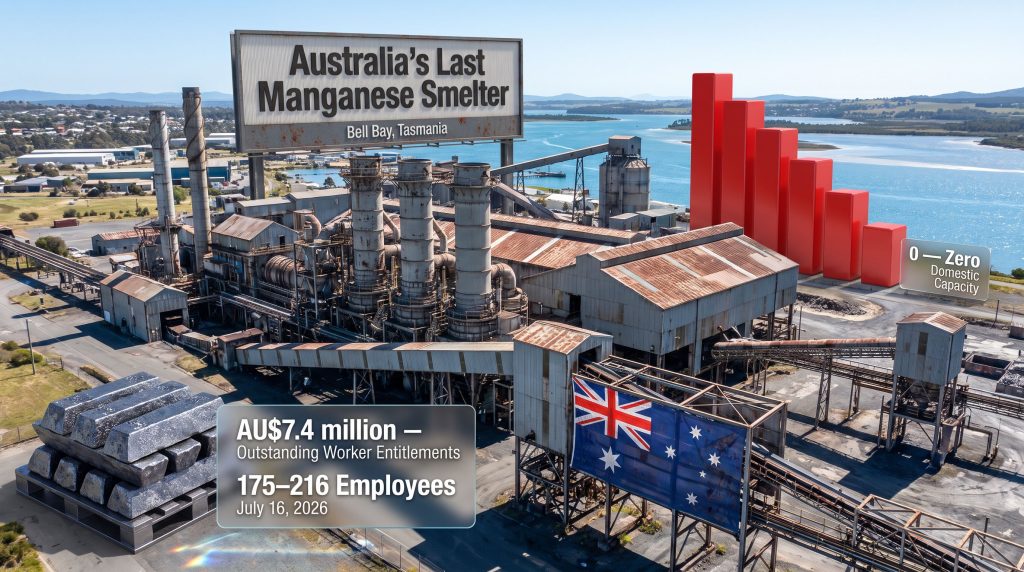
Across the global critical minerals landscape, there is a pattern that repeats with uncomfortable regularity. Nations rich in raw mineral wealth consistently struggle to capture the value-added stages of processing, refining, and manufacturing. For Australia, this structural tension has never been more visible than in the fate of the Liberty Bell Bay manganese smelter closure in northern Tasmania, which on July 16, 2026, was ordered to close immediately and permanently after a consortium sale process collapsed without warning.
This is not simply a story about one facility failing. It is a case study in how compounding vulnerabilities, stretched across ownership risk, natural disaster, regulatory inaction, and capital market withdrawal, can dismantle the last piece of a sovereign industrial capability in the space of just a few years.
When big ASX news breaks, our subscribers know first
What Made Bell Bay Irreplaceable in Australia's Industrial Architecture
The Bell Bay industrial precinct in northern Tasmania has long served as one of Australia's most significant heavy manufacturing corridors. Positioned near the mouth of the Tamar River, the precinct benefits from deep-water port access, established grid infrastructure, and proximity to hydroelectric power capacity — all factors that historically made it viable for energy-intensive industries like aluminium smelting and, crucially, manganese alloy production.
The Liberty Bell Bay manganese smelter closure removed a genuinely singular asset from the Australian industrial economy. As the only manganese alloy smelter on Australian soil, it was responsible for producing two specific alloy products — ferro-manganese and silicomanganese — that sit at the heart of steel manufacturing. These are not niche materials. Every tonne of structural steel requires manganese additions to control sulphur content, improve hardness, and enhance tensile strength.
Ferro-Manganese vs. Silicomanganese: Understanding What Was Lost
To appreciate the full implications of this closure, it helps to understand the distinction between these two alloy types:
- Ferro-manganese typically contains between 70 and 80 percent manganese and is produced by smelting manganese ore with iron ore and coke in an electric arc furnace. It is used primarily as a deoxidiser and desulphuriser in steelmaking.
- Silicomanganese contains roughly 65 to 70 percent manganese combined with 15 to 20 percent silicon. It serves a dual alloying function, simultaneously adding both manganese and silicon to steel, making it cost-efficient for bulk steelmaking applications.
Both products were manufactured at Bell Bay. With the facility now closed, Australian steel producers and defence-supply manufacturers have no domestic source for either material. Consequently, they must rely entirely on imports — predominantly from South Africa, China, India, and Georgia — which together account for the overwhelming majority of global manganese alloy output.
Australia's Ore-to-Alloy Processing Gap
Australia holds some of the world's most significant manganese ore deposits. The Groote Eylandt Mining Company (GEMCO) operation in the Northern Territory, majority-owned by South32, has historically been one of the largest single sources of high-grade manganese ore globally, with ore grades that have consistently ranked among the richest available to any smelter in the world.
Yet despite this resource endowment, Australia has never developed a robust downstream manganese processing sector. Bell Bay was the exception, not the rule, and even it depended almost entirely on GEMCO ore to operate. This created a single-point-of-failure dependency that would prove catastrophic when Tropical Cyclone Megan struck the Northern Territory coast in March 2024, severing the ore supply pipeline to the Tasmanian smelter.
Furthermore, the broader critical minerals demand surge across allied economies makes this processing gap all the more strategically significant at a national level.
A Timeline of Compounding Failures
The Liberty Bell Bay manganese smelter closure did not happen in isolation or suddenly. It was the end point of a multi-year deterioration that combined external shocks with internal governance failures in a way that left no viable commercial exit.
| Event | Approximate Date | Consequence |
|---|---|---|
| GFG Alliance financial distress escalates | Late 2023 | Ownership instability deepens |
| Tropical Cyclone Megan damages GEMCO mine | March 2024 | Primary ore supply severed |
| Smelter placed on care and maintenance | May 2025 | Full production suspended |
| Voluntary administration commences | March 2026 | EY Parthenon appointed |
| Binding consortium sale agreement signed | May 2026 | Temporary rescue appeared possible |
| Lead financial backer withdraws from consortium | June 2026 | Sale thrown into serious doubt |
| Consortium abandons acquisition entirely | July 15, 2026 | Closure ordered with immediate effect |
The GFG Alliance Ownership Problem
Few corporate collapses in recent Australian industrial history have had as far-reaching downstream consequences as the financial deterioration of GFG Alliance, the global steel and energy conglomerate controlled by the Gupta Family Group. GFG's financial difficulties, which became acute after the collapse of Greensill Capital in 2021, left numerous industrial assets globally in a state of prolonged ownership uncertainty.
The Bell Bay smelter sat within this troubled corporate structure. Without stable ownership and dependable access to working capital, the facility's ability to navigate commodity price volatility, execute maintenance investment, and maintain supplier relationships was severely compromised long before the cyclone struck.
Compounding this, the Australian Securities and Investments Commission (ASIC) took regulatory action against GFG-linked entities, filing a winding-up application in the NSW Supreme Court. The basis for this action was the failure to lodge financial reports for five consecutive years spanning 2021 to 2024, as well as non-compliance with a court order requiring the submission of the 2024/25 financial reporting period. This persistent failure to meet basic disclosure obligations signals a depth of governance dysfunction that made meaningful commercial rescue increasingly unlikely. As reported by the AFR, Sanjeev Gupta's decision to halt production had already put approximately 250 jobs at risk well before administration was formally declared.
When a Cyclone Becomes an Industrial Catalyst
The impact of Tropical Cyclone Megan in March 2024 on the GEMCO mine deserves more analytical attention than it typically receives. The GEMCO ore body on Groote Eylandt produces exceptionally high-grade manganese ore, with some deposits grading above 40 percent Mn, which is premium material by global standards. The Bell Bay smelter was specifically configured to process this ore profile.
When the cyclone damaged GEMCO's export infrastructure, the Bell Bay operation faced an immediate and practically irreplaceable supply disruption. Unlike iron ore or coal, where multiple large-scale Australian producers can substitute for one another, high-grade manganese ore supply in Australia has no ready alternative source. No other domestic mine could step in and supply ore at the volume and quality the smelter required.
The gap between the March 2024 cyclone event and the March 2026 administration filing suggests that the operation limped along under care-and-maintenance conditions for approximately twelve months before the financial weight of zero production income became untenable.
The Sale Process That Could Not Close
A Consortium Under Pressure
When EY Parthenon announced in May 2026 that a consortium including OM Holdings and White Oak had entered a binding sale agreement for the Liberty Bell Bay business, there was genuine optimism that the facility could be preserved. OM Holdings, a Singapore-listed manganese and ferroalloy company with existing operational expertise in the sector, appeared a logical strategic buyer. White Oak represented the financial structuring component of the consortium.
The binding nature of the May agreement was significant. It suggested that due diligence had progressed far enough for parties to commit contractually. However, what the market did not yet know was how dependent the entire transaction was on a single lead financial backer whose participation was, in retrospect, never fully secured.
When that backer withdrew in June 2026, the consortium was granted a six-week extension to source alternative financing. In distressed asset transactions, a six-week window to rebuild the capital structure of a deal for a high-temperature industrial smelter — in a volatile global commodity environment — is an exceptionally narrow timeframe. Private capital markets for distressed manganese smelting assets are thin under any conditions.
On July 15, 2026, the consortium formally notified administrators that it had ceased pursuing the transaction. The following morning, EY Parthenon announced the immediate and permanent closure of the business.
The Four Scenarios That Administrators Considered
Administrator reports from the Bell Bay process identified four distinct pathways that were evaluated before the closure decision was reached:
- Full business sale as a going concern — This was the preferred outcome and the basis for the consortium process. It required both a willing buyer and executable financing.
- Partial asset sale with operational wind-down — A hybrid approach in which specific valuable plant or equipment could be divested while the broader operation ceased.
- Restructured operations under a new ownership model — This may have involved a different corporate structure, potentially including co-investment from government or strategic partners, to reduce the financial burden on any single private entity.
- Permanent closure and asset realisation — The outcome that ultimately became unavoidable, involving the orderly sale of remaining plant, equipment, and inventory alongside safe site demobilisation.
The progression from Scenario 1 to Scenario 4 occurred with a speed that reflects how little commercial runway remained once the lead backer exited.
The Human and Economic Cost in Northern Tasmania
175 to 216 Workers and AU$7.4 Million in Entitlements
The immediate human impact of the closure falls on a workforce of between 175 and 216 employees, all of whom received notification on the morning of July 16, 2026. Outstanding wages and entitlements owed to the workforce are estimated at more than AU$7.4 million. For a regional labour market like northern Tasmania, this figure carries weight that extends beyond the individuals directly affected.
The Australian Workers' Union had been vocal throughout the crisis period, emphasising that Bell Bay is critical to Australia and that the only manganese smelter in the country must be saved. Workers in this situation have access to the Fair Entitlements Guarantee (FEG) scheme, a federal safety net designed to protect employees when an employer enters insolvency and cannot meet its outstanding obligations.
What Orderly Closure Actually Involves
The term "orderly closure" carries specific operational meaning in the context of a high-temperature industrial smelter. A retained skeleton workforce will be responsible for:
- Safe thermal shut-down and stabilisation of electric arc furnace infrastructure
- Management of hazardous materials on site in compliance with Tasmanian environmental regulations
- Asset identification and preparation for sale, including plant, machinery, and any remaining raw material inventory
- Engagement with environmental regulators to ensure site obligations are met before formal decommissioning
This process typically spans months rather than weeks for a facility of this complexity. The risk, from an industrial policy perspective, is that every week of non-operation increases the technical and financial cost of any future restart.
Policy Implications: The Processing Gap That Cannot Be Ignored
Zero Domestic Capacity in a Critical Material
Australia now produces zero tonnes of manganese alloy domestically. Every kilogram of ferro-manganese and silicomanganese used by Australian steel producers, manufacturers, and defence contractors must now be imported. This is a significant strategic shift in a material that is classified as critical under multiple national and allied-nation frameworks.
The policy tension here is well understood but chronically unresolved. Australia excels at extracting raw ore and exporting it at low margins. The value capture in downstream processing, where the economic multiplier is substantially higher, has consistently eluded the country's industrial policy — not through lack of resource endowment, but through structural underinvestment in processing incentives. In this context, the prospect of a critical minerals strategic reserve framework becomes increasingly urgent.
How Other Nations Are Responding
The contrast with peer economies is instructive:
| Country/Bloc | Policy Mechanism | Focus Area |
|---|---|---|
| United States | Inflation Reduction Act (IRA) | Critical mineral processing tax credits |
| European Union | Critical Raw Materials Act | Domestic processing benchmarks and strategic stockpiles |
| Japan | Mineral Security Partnership | Upstream investment and processing joint ventures |
| South Korea | K-Battery Initiative | Integrated battery mineral supply chains |
None of these frameworks are perfect, but each reflects a deliberate policy decision to subsidise or incentivise the processing stage of the critical minerals value chain — not just the extraction stage. Australia's equivalent policy environment, while evolving, has not yet produced instruments capable of sustaining an asset like the Bell Bay smelter through the volatility inherent in global commodity cycles.
Defence and Sovereign Supply Chain Vulnerability
Manganese alloys are not simply a commercial steel input. High-strength manganese steels are used in armoured vehicle plating, naval hull construction, and various defence-grade structural applications. The complete absence of domestic smelting capacity creates an import dependency for a material that, in a supply disruption scenario, could not be easily or quickly replaced.
Australia's defence critical materials strategy has increasingly acknowledged these risks, yet the Bell Bay closure makes Australia an outlier among allied nations that are actively investing in strategic reserves and domestic processing capacity. This arguably strengthens the case for a formal sovereign capability review of manganese alloy supply.
In addition, projects such as the Butcherbird manganese expansion and the development of a strategic manganese deposit in Europe illustrate that other jurisdictions are actively building resilience into their manganese supply chains — something Australia has failed to do at the processing stage.
The next major ASX story will hit our subscribers first
Could Bell Bay Ever Restart?
The Narrow and Closing Window
Industrial smelting assets are among the most difficult of all heavy industrial facilities to recommission once they have been fully decommissioned. Electric arc furnace linings deteriorate. Refractory materials require replacement. Control systems become obsolete. The skilled workforce disperses into other industries and geographies.
Any credible restart scenario for Bell Bay would require all of the following to align simultaneously:
- Full restoration of the GEMCO mine's export capacity and a long-term ore supply agreement
- Manganese alloy market prices at levels sufficient to justify the capital expenditure required for recommissioning, which for a facility of this scale could run into the hundreds of millions of dollars
- A stable ownership structure, whether private, government-backed, or a joint venture model, capable of sustaining the asset through commodity price cycles
- A supportive energy cost environment in Tasmania, given that electric arc furnace smelting is extraordinarily power-intensive
The GEMCO mine's recovery trajectory from Cyclone Megan's 2024 damage is therefore directly relevant to any Bell Bay restart conversation. Without a reliable, high-grade ore supply, no smelting business case is viable regardless of market conditions or policy support.
Frequently Asked Questions: Liberty Bell Bay Smelter Closure
What did the Liberty Bell Bay smelter produce?
The facility produced ferro-manganese and silicomanganese, two critical alloy inputs used primarily in steelmaking. Both products were manufactured using electric arc furnace technology and high-grade manganese ore, predominantly sourced from the GEMCO mine in the Northern Territory.
Why did the Liberty Bell Bay manganese smelter closure occur?
A convergence of four distinct failure modes led to the permanent closure: ownership instability arising from GFG Alliance's broader financial deterioration, ore supply disruption caused by Tropical Cyclone Megan's damage to the GEMCO mine in March 2024, ASIC regulatory action for persistent financial reporting non-compliance, and the ultimate failure of a consortium sale process in July 2026 when the lead financial backer withdrew.
How many workers were affected?
Between 175 and 216 employees were directly affected by the immediate closure order, with more than AU$7.4 million in outstanding wages and entitlements owed to the workforce.
What government support was extended to the smelter?
More than AU$9 million in government bridging loan support was deployed to keep the facility operational during the administration period from March 2026 onwards. Despite this, the absence of a commercially viable transaction made continued operation unsustainable.
What happens to affected workers now?
Workers are eligible to access the Fair Entitlements Guarantee (FEG) scheme, which provides a federal safety net covering unpaid wages, leave entitlements, and notice payments when an employer becomes insolvent. Formal redundancy details were communicated in the days following the July 16 announcement.
Is there any possibility of the site reopening?
A restart is theoretically possible but would require the simultaneous resolution of ore supply, capital availability, energy costs, and stable ownership — conditions that are not currently in alignment. The longer the facility remains fully decommissioned, the higher the technical and financial barriers to any future recommissioning become.
This article is intended for informational purposes only and does not constitute financial or investment advice. Forecasts and scenario analysis reflect available information as of publication date and are subject to change. Readers should conduct independent research before making any investment or policy-related decisions.
Want to Stay Ahead of the Next Major ASX Mineral Discovery?
Australia's processing gap in critical minerals like manganese underscores just how rapidly the landscape can shift — and how important it is to identify significant discoveries before the broader market reacts. Discovery Alert's proprietary Discovery IQ model delivers real-time alerts on significant ASX mineral discoveries, turning complex commodity data into actionable insights so both short-term traders and long-term investors can position themselves ahead of the curve — start your 14-day free trial at Discovery Alert today.