
August 1, 2026
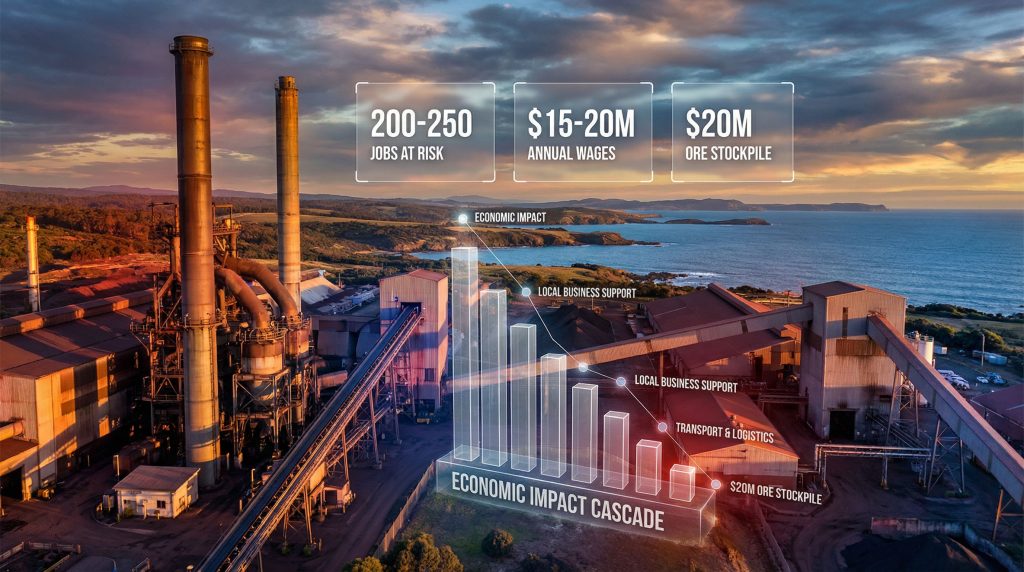
Industrial transitions expose the fragile equilibrium between economic efficiency and national strategic interests, particularly when critical infrastructure becomes subject to liquidation proceedings. Australia's heavy industry landscape demonstrates these vulnerabilities through systematic asset concentration, where single-point-of-failure scenarios can cascade across entire supply chains. The Liberty Bell Bay smelter liquidation reveals fundamental weaknesses in the nation's industrial architecture, furthermore highlighting how critical minerals reserve strategies intersect with corporate compliance enforcement and industrial sovereignty.
Strategic Asset Vulnerability Assessment: When Critical Infrastructure Faces Liquidation
Australia's Manganese Processing Monopoly Under Threat
The Liberty Bell Bay smelter liquidation reveals fundamental weaknesses in Australia's industrial architecture. As the nation's only manganese alloy processing facility, Liberty Bell Bay represents a classic single-point-of-failure in critical supply chains. This strategic vulnerability extends far beyond the immediate 200 workers facing job termination or the $1.7 million owed to 23 local contractors.
Manganese alloys serve essential roles in steelmaking processes, functioning as deoxidizers and desulfurizers that ensure steel quality and structural integrity. The elimination of domestic processing capacity would force Australian steel producers into complete import dependency, exposing the sector to supply chain crisis scenarios including disruptions, currency fluctuations, and geopolitical risks.
International benchmarking reveals that most developed nations maintain strategic redundancy in critical industrial processes. Germany operates multiple ferroalloy facilities across different ownership structures, while South Korea maintains both private and state-influenced processing capacity. Australia's concentration risk in manganese processing mirrors broader patterns of mining industry consolidation that have characterized the past two decades.
Regulatory Enforcement Versus Economic Pragmatism
The Australian Securities and Investment Commission's liquidation application against Liberty Bell Bay illuminates tensions between corporate compliance enforcement and national economic interests. ASIC's action stems from years of unreported financial statements, representing systematic regulatory non-compliance that triggered statutory enforcement procedures.
However, the timing and mechanism of enforcement raise strategic questions. The liquidation application proceeds through NSW Supreme Court directions hearings, where Liberty Bell Bay intends to resist the action. This legal framework prioritises creditor protection and statutory compliance over broader economic considerations, creating potential conflicts with national strategic interests.
Corporate law expert Professor Jason Harris from the University of Sydney notes that liquidators operate under statutory mandates to dispose of assets for creditor benefit, regardless of broader economic implications. This legal structure ensures that employment termination becomes virtually automatic once liquidation proceedings commence, with limited consideration for industrial transition planning.
The Fair Entitlements Guarantee program provides some worker protection through coverage of outstanding wages and accrued leave entitlements. However, critical gaps remain, particularly the exclusion of superannuation contributions from federal protection schemes. This limitation creates additional financial hardship for workers in extended industrial transitions.
When big ASX news breaks, our subscribers know first
Corporate Liquidation Impact on Regional Economic Ecosystems
Quantified Multiplier Effects Beyond Direct Employment
The Liberty Bell Bay smelter liquidation demonstrates classical economic multiplier effects cascading through regional supply chains. Direct employment impacts encompass 200 workers facing immediate job loss, but secondary effects extend substantially beyond primary workforce disruption.
Economic Impact Analysis:
| Impact Category | Affected Parties | Financial Exposure | Timeline |
|---|---|---|---|
| Direct Employment | 200 workers | $15-20M annual wages | Immediate |
| Contractor Payments | 23 local suppliers | $1.7M+ outstanding debts | 0-3 months |
| Supply Chain Revenue | Regional businesses | 35% revenue decline | 3-12 months |
| Secondary Employment | Contractor workforces | Undisclosed layoffs | 6-18 months |
Bell Bay Advanced Manufacturing Zone CEO Susie Bower reported that affected contractors are already implementing workforce reductions, stating that businesses face tough decisions requiring employee layoffs. This secondary employment disruption operates through reduced contractor revenue streams rather than direct smelter closure impacts.
Case Study: Supplier Vulnerability Assessment
Beams Brothers quarry provides a detailed case study of supply chain disruption mechanics. The company supplied limestone, dolomite, and iron ore to Liberty Bell Bay for decades, maintaining what company head Donald Beams described as exemplary payment relationships until May 2025 when payments ceased.
Beams Brothers Impact Metrics:
- Outstanding debt exposure: $50,000
- Revenue decline: 35% reduction in sales
- Lost income estimate: Millions in foregone revenue
- Payment cessation period: 10+ months (May 2025 to March 2026)
The company's preference for operational resumption over debt recovery highlights the strategic importance of ongoing business relationships versus one-time payment recovery. Consequently, this demonstrates how supply chain partners often prioritise long-term industrial continuity over immediate financial settlement.
Regional Economic Flow Disruption
The Liberty Bell Bay smelter liquidation creates ripple effects throughout northern Tasmania's economic ecosystem. Contractor businesses experiencing 35% revenue declines reduce their own supplier purchases, creating tertiary economic contractions. Local service providers, from equipment maintenance to professional services, face reduced demand as primary and secondary businesses implement cost-reduction strategies.
Employment effects extend beyond direct job losses through reduced overtime hours, delayed hiring, and postponed capital investments across affected businesses. These cumulative impacts often exceed the direct employment losses from the primary facility closure, creating prolonged regional economic adjustments.
Realistic Buyer Scenarios for Distressed Industrial Assets
Strategic Buyer Profile Analysis
The Liberty Bell Bay smelter liquidation presents multiple potential acquisition pathways, each with distinct risk profiles and strategic implications. Current buyer interest appears active, with Bell Bay Advanced Manufacturing Zone reporting meetings with potential acquisition candidates and Tasmania's Deputy Premier Guy Barnett confirming ongoing discussions with interested parties.
International Steel Group Scenario: The Georgian company Steel International Trading Company (SITC) signed a five-year memorandum of understanding with Liberty Bell Bay in 2025, establishing precedent for international ownership interest. SITC's existing relationship suggests familiarity with operational requirements and market conditions, potentially accelerating acquisition timelines.
Australian Mining Conglomerate Integration: Large Australian mining companies could view Liberty Bell Bay as vertical integration opportunity, securing manganese alloy supply for domestic steel production or export markets. This scenario offers operational synergies and strategic supply chain control.
Government-Backed Consortium Models: Federal and state government coordination could facilitate hybrid ownership structures combining private investment with strategic public interest protection. Professor Harris noted that governments could offer tax concessions, energy cost support, and guaranteed output contracts to attract buyers.
Private Equity Turnaround Specialists: Distressed asset specialists might pursue acquisition strategies focused on operational restructuring, cost reduction, and eventual resale. However, this scenario typically prioritises financial returns over employment stability or strategic industrial considerations.
Valuation Challenges in Distressed Industrial Sales
Asset valuation complexity increases significantly under liquidation pressure. Professor Harris highlighted that deferred maintenance likely reduces asset values and may deter potential buyers or lower purchase prices. Industrial facilities require substantial ongoing maintenance investment, and operational dormancy since May 2025 likely created accumulated maintenance backlogs.
Key Pricing Factors:
- Energy cost competitiveness in Tasmania's electricity market
- Global manganese price volatility affecting long-term profitability projections
- Regulatory compliance catch-up costs from years of unreported financial statements
- Workforce transition expenses for new operational requirements
- Infrastructure condition assessments following extended dormancy
The liquidation timeline creates additional valuation pressure, as forced sales typically achieve lower prices than voluntary transactions. Professor Harris warned that commodity market uncertainty makes the sale process likely to be lengthy, further complicating valuation stability.
Government Intervention in Industrial Asset Transitions
Tasmania's $20 Million Ore Stockpile Strategy
The Tasmanian government's $20 million taxpayer loan to secure ore stockpiles through receiver appointment represents unprecedented state intervention in industrial asset protection. This mechanism demonstrates how sub-national governments can protect strategic assets while exposing public finances to commercial risks.
Professor Harris assessed that Tasmania's receiver appointment strategy strengthens the state's position in sale negotiations, providing leverage over asset disposal outcomes. However, this approach also creates fiscal exposure for taxpayers, particularly if asset sales fail to recover the full loan amount.
The ore stockpile intervention reveals broader questions about appropriate government roles in industrial transitions. Furthermore, these concerns reflect broader industry evolution trends where state governments typically lack the fiscal capacity for large-scale industrial support, yet federal coordination mechanisms often prove too slow for urgent asset protection requirements.
Federal-State Coordination Framework
Federal Industry Minister Tim Ayres emphasised that primary responsibility remains with GFG Alliance to honour all obligations including wages, entitlements, and supplier contracts. This position establishes corporate accountability principles while positioning government intervention as secondary measures.
The Department of Employment and Workforce Relations will coordinate immediate workforce response with Tasmania upon administration entry, indicating pre-positioned federal-state protocols for industrial transitions. However, coordination effectiveness often depends on timing and resource allocation across multiple government levels.
Strategic Policy Analysis: Federal emphasis on sovereign capability intersects with Tasmania's direct financial exposure, creating tension between national strategic interests and state fiscal responsibility. This dynamic requires careful coordination to avoid conflicting policy interventions.
Worker Protection Program Limitations
The Fair Entitlements Guarantee program provides critical worker protection but demonstrates structural gaps in industrial transition support. Coverage includes outstanding wages and accrued leave entitlements but explicitly excludes superannuation contributions, creating additional financial hardship during extended unemployment periods.
Processing timelines for 200+ workers seeking FEG protection could extend beyond immediate financial needs, particularly given the program's application-based structure. International worker protection schemes often provide more comprehensive coverage, including retraining support and extended income protection during industrial transitions.
Australia's Industrial Policy Framework Gaps
Single-Point-of-Failure Vulnerabilities
The Liberty Bell Bay smelter liquidation exposes systematic vulnerabilities in Australia's industrial policy framework. As the nation's only manganese alloy processing facility, Liberty Bell Bay represents critical infrastructure that lacks strategic redundancy or protection mechanisms.
This vulnerability pattern extends across multiple industrial sectors where Australia maintains limited domestic processing capacity. The automotive industry exit demonstrated similar strategic risks, where supply chain dependencies created cascading effects throughout related industries.
Manganese processing capacity loss forces Australian steel producers into complete import dependency, exposing the sector to supply chain disruption risks during geopolitical tensions, currency fluctuation exposure affecting input cost stability, quality control limitations from reduced supply source options, and strategic vulnerability in defence and infrastructure applications.
Foreign Ownership Versus Industrial Sovereignty Balance
GFG Alliance's ownership of Liberty Bell Bay through the embattled Sanjeev Gupta empire demonstrates risks associated with foreign control of strategic industrial assets. The systematic financial difficulties across GFG's Australian portfolio, including 238 redundancies at Tahmoor Colliery, suggest broader strategic asset management challenges.
Critical Strategic Questions:
- Should manganese processing require domestic ownership majority?
- What ownership transparency standards apply to strategic facilities?
- How do other nations protect critical industrial infrastructure?
- What triggers justify government intervention in foreign-owned assets?
International comparisons reveal varying approaches to strategic asset protection. In addition, concerns about investment management red flags have become increasingly relevant as South Korea maintains government equity positions in critical industrial facilities, while Germany employs foreign investment screening for strategic sectors. Australia's framework relies primarily on general corporate regulation rather than strategic asset-specific protections.
Liquidation Process Mechanics and Timeline Analysis
NSW Supreme Court Proceedings Structure
The Liberty Bell Bay smelter liquidation proceeds through NSW Supreme Court directions hearing scheduled for March 17, 2026, with Liberty Bell Bay indicating resistance to ASIC's liquidation application. This legal framework establishes specific procedural timelines and stakeholder rights throughout the process.
Court-supervised liquidation provides creditor protection and asset disposal oversight but typically prioritises legal compliance over broader economic considerations. The directions hearing will establish case management procedures, evidence requirements, and timeline parameters for final resolution.
Liberty Bell Bay's resistance strategy likely focuses on demonstrating financial recovery prospects or challenging ASIC's statutory grounds for liquidation. However, years of unreported financial statements create substantial regulatory compliance deficits that complicate defence strategies.
Asset Disposal Priorities and Creditor Hierarchies
Liquidation proceedings operate under statutory creditor priority frameworks that determine payment sequences and recovery prospects. Professor Harris outlined the standard hierarchy prioritising secured creditors with equipment financing arrangements over unsecured suppliers like Beams Brothers.
Creditor Payment Sequence:
- Secured creditors – Equipment financiers with registered security interests
- Employee entitlements – Wages, leave, and redundancy payments
- Unsecured creditors – Suppliers, contractors, and service providers
- Shareholder distributions – Highly unlikely in distressed scenarios
The $1.7 million owed to 23 local contractors falls into unsecured creditor categories, creating uncertainty about recovery prospects. Asset sale proceeds must satisfy higher-priority creditors before unsecured suppliers receive payments, potentially resulting in partial recovery or total loss.
The next major ASX story will hit our subscribers first
Regional Economic Resilience Post-Industrial Transition
Economic Diversification Pathways
Northern Tasmania's post-smelter economic transition requires strategic diversification beyond traditional heavy industry dependence. The region possesses significant infrastructure assets including port facilities, electrical grid capacity, and industrial zoning that could support alternative economic activities.
Potential Development Scenarios:
- Advanced manufacturing utilising existing infrastructure and skilled workforce
- Renewable energy projects leveraging Tasmania's hydro-electric capacity
- Food processing facilities serving both domestic and export markets
- Research and development centres focused on materials science and industrial innovation
However, workforce transition challenges require substantial retraining investment. Smelter workers possess specialised skills that may not directly transfer to alternative industries without significant professional development support.
Infrastructure Legacy Value Assessment
The Liberty Bell Bay smelter liquidation leaves substantial infrastructure assets with potential alternative applications. Port facilities maintain strategic value for bulk commodity handling, while electrical connections support high-energy industrial applications.
Industrial zoning permissions and environmental approvals represent significant regulatory assets that could accelerate alternative development projects. However, environmental remediation obligations may create substantial liability exposure that affects asset values and development feasibility.
Transportation infrastructure, including rail connections and road access, supports various industrial applications beyond manganese processing. These assets provide foundation infrastructure for economic diversification strategies if properly leveraged through coordinated development planning.
Investment Implications and Industrial Transition Analysis
Sector-Wide Risk Assessment for Australian Heavy Industry
The Liberty Bell Bay smelter liquidation signals broader stress indicators across GFG Alliance's Australian portfolio, with Tahmoor Colliery announcing 238 redundancies simultaneously. This pattern suggests systematic challenges affecting multiple industrial assets under common ownership structures.
Heavy Industry Risk Factors:
- Commodity price volatility affecting processing margins
- Energy cost competitiveness in global markets
- Regulatory compliance burdens requiring substantial administrative investment
- Infrastructure maintenance deferrals reducing asset values over time
Australian heavy industry faces particular challenges from high energy costs, skilled labour shortages, and competition from lower-cost international producers. These structural factors create ongoing viability challenges that extend beyond specific ownership or management issues.
Government Support Mechanism Effectiveness
Analysis of government intervention strategies reveals mixed effectiveness across different support approaches. Tasmania's $20 million ore stockpile investment demonstrates direct financial intervention, while federal coordination through DEWR represents administrative support frameworks.
Successful Support Framework Characteristics:
- Clear strategic rationale linking intervention to national interests
- Private sector co-investment requirements ensuring commercial viability
- Performance milestone enforcement with defined success metrics
- Exit strategy planning from intervention commencement
Professor Harris identified that government concessions on tax and energy costs plus guaranteed output contracts could effectively attract buyers by improving financial projections and reducing investment risks. This approach leverages public policy tools without direct fiscal exposure.
Strategic Lessons from Critical Industrial Asset Distress
Policy Recommendations for Future Asset Protection
The Liberty Bell Bay smelter liquidation reveals systemic gaps in Australia's industrial policy framework that require strategic addressing. Early warning systems for critical asset distress could provide government intervention opportunities before liquidation proceedings commence.
Recommended Policy Framework Elements:
- Strategic asset designation criteria identifying facilities requiring special protection
- Enhanced reporting requirements for foreign-owned critical infrastructure
- Government intervention triggers based on employment, supply chain, or strategic importance
- Coordinated transition planning between federal and state governments
Public-private partnership models could provide transition period support while maintaining commercial incentives for operational efficiency. These frameworks require careful design to avoid market distortions while protecting strategic national interests.
Australia's Industrial Future in Global Supply Chain Context
The broader implications of industrial asset distress extend beyond immediate employment and economic impacts to fundamental questions about Australia's industrial positioning. Complete import dependency for critical materials like manganese alloys creates strategic vulnerabilities that require policy consideration.
Strategic Development Questions:
- How should Australia balance cost competitiveness versus strategic independence?
- What level of industrial redundancy justifies public support investment?
- How can regional development objectives align with national industrial strategy?
- What coordination mechanisms ensure effective crisis response across government levels?
International experience demonstrates that successful industrial economies maintain strategic processing capacity through various policy mechanisms, from direct ownership to regulatory frameworks requiring domestic production capacity. Australia's approach requires careful calibration between market efficiency and strategic resilience objectives.
The Liberty Bell Bay smelter liquidation ultimately represents a test case for Australia's industrial policy framework, revealing both vulnerabilities and opportunities for more effective strategic asset protection. Future policy development must incorporate lessons from this transition while building more resilient frameworks for critical industrial infrastructure protection.
This analysis is provided for educational purposes only and should not be considered as investment advice. Industrial asset transitions involve complex factors that require professional assessment for specific investment decisions.
Want to Capitalise on Australia's Industrial Transition Opportunities?
The Liberty Bell Bay smelter liquidation highlights how industrial disruptions create unique investment opportunities across critical minerals and processing sectors. Discovery Alert's proprietary Discovery IQ model delivers instant notifications on significant ASX mineral discoveries, enabling subscribers to identify actionable opportunities in Australia's evolving industrial landscape and secure market-leading advantages ahead of broader industry recognition.