August 12, 2026
When Energy Infrastructure Becomes a Battlefield
The history of oil-producing nations caught in internal conflict reveals a consistent and troubling pattern: energy infrastructure does not merely suffer collateral damage during political crises, it becomes the primary instrument of coercion. From the Niger Delta to Iraq's southern pipeline corridors, armed factions have long understood that striking at oil and fuel systems creates leverage that conventional military pressure cannot replicate. Libya drone strikes on Zawiya oil facilities, occurring in August 2026, represent a sharper, more technologically sophisticated version of this same dynamic, one where commercial drone technology has lowered the barrier to attacking strategic industrial assets with precision and near-total deniability.
When big ASX news breaks, our subscribers know first
Libya's Zawiya: More Than a Refinery Town
To understand why the Libya drone strikes on Zawiya oil facilities have sent alarm signals across international energy markets, it is necessary to appreciate just how much critical infrastructure is concentrated within this single coastal city located roughly 45 kilometres west of Tripoli. Furthermore, the broader oil market geopolitics surrounding Libya makes this situation especially consequential for global energy observers.
Zawiya hosts Libya's largest operating refinery, with a nameplate capacity of approximately 120,000 barrels per day. Alongside this sits a major crude export terminal, fuel storage depots operated by the Brega Oil Marketing Company, a power generation facility, and a water desalination plant. For western Libya and the capital Tripoli, this cluster of assets is not optional infrastructure; it is the lifeblood of daily fuel supply and industrial function.
Control over these assets has never been purely a technical or commercial matter. For years, the city has operated under the de facto influence of Mohamed Bahroun, a militia commander whose forces have exercised authority over parts of Zawiya and its surrounding infrastructure. The Tripoli-based Government of National Unity has been pressing to consolidate centralised authority over western Libya, placing it in direct friction with Bahroun's faction.
That political friction, according to analysts at the Royal United Services Institute (RUSI), creates conditions in which armed actors facing increasing pressure may resort to destabilising infrastructure as a form of asymmetric resistance. Consequently, the geopolitical oil price tensions stemming from this confrontation are being closely monitored by international energy traders and policymakers alike.
A Chronological Account of the August 2026 Attacks
The sequence of strikes between August 9 and 12, 2026 was not a single incident but a coordinated campaign against multiple facility types within the Zawiya energy corridor. According to AP News reporting, the scale and coordination of the attacks marked a significant escalation in Libya's infrastructure conflict.
| Date | Target | Reported Outcome |
|---|---|---|
| August 9, 2026 | Zawiya energy infrastructure (initial strike) | Operations disrupted; emergency response activated |
| August 10-11, 2026 | Gasoline storage tank, Brega Oil depot | Tank holding ~4.5 million litres ignited; structural collapse followed |
| August 10-11, 2026 | Two diesel storage tanks | Targeted in follow-up strikes; damage confirmed |
| August 10-11, 2026 | Zawiya power plant | Firefighting systems damaged; operational capacity reduced |
| August 10-11, 2026 | Water desalination plant | Strike reported; damage extent under assessment |
| August 10-11, 2026 | Secondary fuel tank area | Drone landed near tank without causing explosion or casualties |
Key Fact: A total of five drone attacks struck Zawiya's energy corridor across this period. No fatalities were recorded, though some individuals required treatment for smoke inhalation. No group has claimed responsibility for any of the strikes.
The most severe individual incident was the ignition and subsequent structural collapse of a gasoline storage tank at the Brega Oil depot. Reuters reporting confirmed that the Zawiya refinery itself was not directly struck in the initial attacks, though a partial shutdown of depot operations occurred. NOC emergency response teams brought fires under control, and the corporation stated that fuel reserves remained available and deliveries to filling stations in western Libya continued, with some operations temporarily shifted to Brega's Tripoli depot.
How Did Firefighters Respond?
Firefighters battled the enormous blaze at the Zawiya facility under extremely challenging conditions, with damaged firefighting systems at the power plant compounding their efforts. Emergency crews worked to prevent fires from spreading to adjacent storage infrastructure, which, if breached, could have triggered a far more catastrophic chain of events across the entire energy corridor.
What a Full Shutdown Would Mean: Quantifying the Risk
The immediate physical damage, while serious, is arguably less significant than what a sustained campaign could trigger. NOC has issued an explicit warning that continued attacks could compel it to halt refinery operations entirely and invoke force majeure, a legal mechanism suspending contractual obligations to international buyers and partners.
Analyst Warning: A force majeure declaration at Zawiya would not merely disrupt Libyan domestic fuel supply. It would introduce contractual uncertainty for every international partner that has recently signed long-term agreements with NOC, while simultaneously signalling to prospective investors that physical security cannot be guaranteed at the country's most critical energy node.
The scale of potential disruption can be assessed across several dimensions:
| Facility | Function | Volume at Risk | Post-Strike Status |
|---|---|---|---|
| Zawiya Refinery | Crude processing | ~100,000 bbl/day | Operational but under active threat |
| Port of Zawiya | Crude export terminal | ~200,000 bbl/day | Operational but under active threat |
| Brega Oil Depot | Fuel storage and distribution | ~4.5M litres gasoline tank destroyed | Partially disrupted |
| Zawiya Power Plant | Energy supply to facilities | Undisclosed MW capacity | Firefighting system damaged |
| Sharara Field Pipeline | Crude supply to refinery | Feeds 100,000 bbl/day processing | Indirectly exposed |
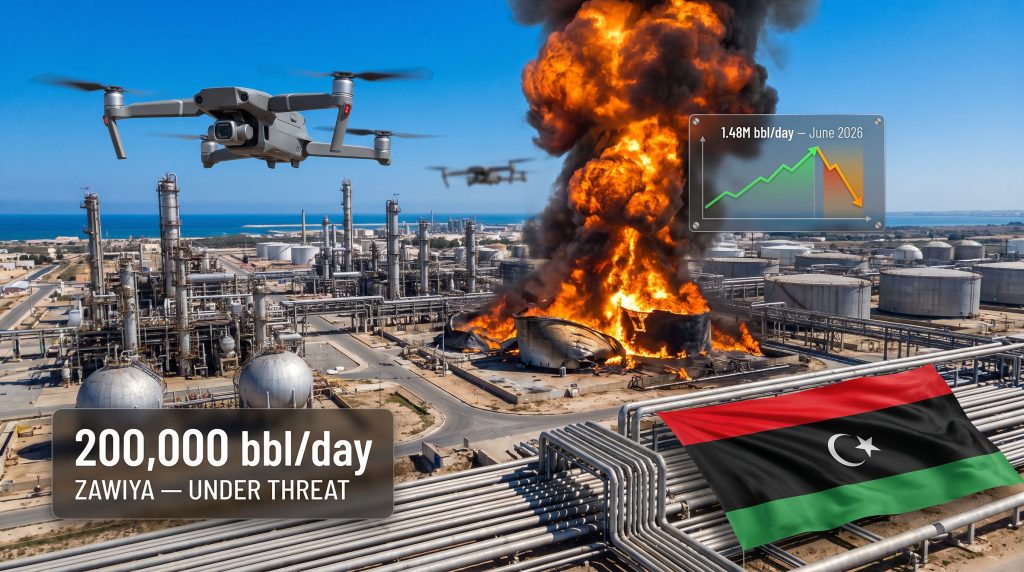
A full operational halt would remove approximately 100,000 barrels per day of refining capacity from Libya's supply chain and suspend around 200,000 barrels per day of crude exports routed through the Port of Zawiya. For a country that has only recently clawed its way back to production levels not seen since 2013, this represents a potentially crippling setback.
Libya's Oil Revival: The Stakes Could Not Be Higher
The timing of the drone campaign could hardly be more consequential. In June 2026, Libya's combined crude oil and condensate output reached 1.48 million barrels per day, including 1.44 million barrels per day of crude, the highest level recorded since 2013 according to NOC data. The corporation has set a short-term target of 1.6 million barrels per day and an ambitious 2030 goal of 2.0 million barrels per day.
Alongside this production recovery, NOC achieved a landmark in international commercial relations. In June 2026, it signed production-sharing contracts with five major international energy companies, the first such agreements concluded in nearly two decades.
| Company | Country of Origin | Contract Framework |
|---|---|---|
| Repsol | Spain | EPSA V |
| TPAO | Turkey | EPSA V |
| Eni | Italy | EPSA V |
| QatarEnergy | Qatar | EPSA V |
| MOL Group | Hungary | EPSA V |
The EPSA V framework represents a deliberate departure from the preceding EPSA IV model, engineered to offer foreign partners meaningfully more attractive commercial terms. Libya is also preparing auction processes covering more than 40 marginal oil fields, broadening the investment pipeline beyond its major producing assets.
The Mabrouk field, previously rendered non-operational by years of conflict-related damage, has returned to full production with a potential output ceiling of 40,000 barrels per day. NOC has also expanded technical cooperation with oilfield services giant SLB and the Project Management Institute to strengthen operational capacity.
However, none of these commercial and technical milestones can insulate against a sustained campaign of drone strikes on the infrastructure that underpins the entire investment thesis. In addition, the oil trade disruption risks seen elsewhere in global markets serve as a cautionary reference point for what prolonged insecurity can do to export reliability.
The Drone Escalation Pattern: Three Scenarios for Investors and Operators
Understanding what happens next requires thinking in scenarios rather than linear projections. Libya's security trajectory is not deterministic, and outcomes depend heavily on how the government-militia confrontation in Zawiya evolves.
Scenario A: Contained Disruption (Base Case)
- Drone attacks remain sporadic and do not intensify in scale or frequency.
- NOC maintains operations with enhanced security protocols at key facilities.
- Force majeure is not declared; export volumes experience minor, temporary reductions.
- International companies maintain their EPSA V commitments but accelerate security due diligence before advancing field development activities.
Scenario B: Partial Shutdown (Elevated Risk)
- Sustained attacks force NOC to suspend Zawiya refinery operations.
- 100,000 bbl/day of refining capacity goes offline; domestic fuel shortages emerge across western Libya, including Tripoli.
- Force majeure is declared on refinery-linked contracts; some international partners pause field development timelines pending security reassessment.
- Insurance and political risk pricing for Libyan operations increases materially.
Scenario C: Extended Infrastructure Collapse (Tail Risk)
- Escalating militia-state conflict spreads to additional western Libyan oil infrastructure beyond Zawiya.
- Port of Zawiya is suspended; approximately 200,000 bbl/day of crude exports halted for an extended period.
- Libya's 2030 production target of 2 million bbl/day becomes structurally unachievable without comprehensive security reform and foreign technical re-engagement.
- Several EPSA V signatories invoke contract clauses allowing suspension pending improved security conditions.
The next major ASX story will hit our subscribers first
Libya in Comparative Context: Fragile Petrostates and Infrastructure Warfare
Libya is not the first oil producer to see its production capacity weaponised by internal conflict, but it is increasingly distinguished by the specific nature of the threat it faces.
| Country | Primary Security Risk | Key Infrastructure Exposed | Historical Production Impact |
|---|---|---|---|
| Libya | Militia drone warfare | Refineries, export terminals | Up to 1M bbl/day lost during peak conflict |
| Iraq | Insurgent pipeline sabotage | Pipelines, pumping stations | Periodic but recoverable disruptions |
| Yemen | Cross-border drone and missile attacks | Marib gas facilities, Aden terminal | Near-total production collapse |
| Nigeria | Pipeline vandalism | Niger Delta export infrastructure | Chronic 10-20% production shortfall |
| Sudan | Civil conflict | Heglig oil fields | Production suspended during active phases |
What distinguishes Libya's current situation from most of these comparators is that drone technology is being deployed not in an inter-state conflict or by an internationally recognised insurgency, but as a tool of internal political coercion within a domestic militia-versus-government confrontation.
The asymmetric leverage this creates is qualitatively different from pipeline sabotage: drones can strike refined product storage, power generation systems, and desalination plants simultaneously, degrading the entire operational ecosystem of a facility rather than simply interrupting a single flow path.
This also carries implications for how international insurance markets, political risk underwriters, and export credit agencies will assess Libyan exposure going forward. Historically, insurers have been able to model pipeline sabotage risk with reasonable actuarial confidence. Coordinated multi-target drone campaigns against refinery ecosystems, however, represent a newer, less modelled risk category.
The Governance Dimension: Why Security and Politics Are Inseparable in Libya
The Zawiya strikes did not occur in a vacuum. Simultaneously, a car bomb detonated in Benghazi, killing a senior military intelligence officer aligned with Khalifa Haftar's Libyan National Army, the armed force that controls eastern and southern Libya. The near-simultaneous violence in both major population centres underscores that Libya's security deterioration is systemic rather than localised.
Libya remains divided between two competing administrative structures: the Government of National Unity operating from Tripoli and a rival authority in Benghazi. This governance fracture, a direct legacy of the post-Gaddafi conflict that began in 2011, creates the conditions in which armed factions can persist indefinitely as political and commercial intermediaries within their areas of influence.
For international oil companies operating under the new EPSA V framework, this means that the commercial attractiveness of contract terms and the quality of Libya's hydrocarbon resources, which include Africa's largest proven crude reserves at an estimated 48 billion barrels, are necessary but insufficient conditions for sustained investment commitment.
Furthermore, the broader geopolitical trade tensions reshaping global commerce in 2025 and beyond make Libya's internal instability even more consequential for international supply chain planners. The ability of Libyan authorities to physically protect strategic infrastructure is the variable that will ultimately determine whether the current production recovery translates into durable long-term growth.
What Needs to Change for Libya's 2030 Target to Be Achievable
Libya's path to 2 million barrels per day by 2030 is technically plausible given its resource base, but it depends on conditions that are currently far from assured. The five conditions that would need to be met are:
- Security stabilisation of western Libya, including credible disarmament or integration of militia forces that currently control strategic infrastructure corridors.
- Physical hardening of high-value facilities at Zawiya, Sharara, Mabrouk, and other critical nodes against drone and asymmetric attack methodologies.
- Sustained foreign direct investment under the EPSA V framework, which in turn requires demonstrated and consistent security improvements rather than intermittent assurances.
- Political unification or a durable and credibly enforced power-sharing arrangement between the Tripoli and Benghazi administrations that reduces the incentive for armed factions to weaponise infrastructure.
- Operational continuity at NOC, free from politically motivated shutdowns and force majeure triggers that undermine the corporation's reliability as a commercial counterparty in the eyes of European and global buyers.
Without meaningful progress on these conditions, Libya risks a scenario in which the commercial architecture being carefully constructed through EPSA V contracts and marginal field auctions becomes structurally fragile. These concerns also mirror the energy export challenges faced by other resource-dependent nations when geopolitical instability intersects with infrastructure vulnerability.
Frequently Asked Questions: Libya Drone Strikes on Zawiya Oil Facilities
What triggered the drone strikes on Zawiya's oil facilities in August 2026?
The strikes are assessed to be connected to escalating tensions between the Tripoli-based Government of National Unity and militia forces loyal to Mohamed Bahroun, who has exercised de facto influence over Zawiya for an extended period. As central authorities moved to consolidate control over western Libya, Bahroun's faction is believed to have responded through attacks on strategically significant infrastructure. No group has formally claimed responsibility for any of the five strikes.
Has Libya declared force majeure on oil exports following the Zawiya attacks?
As of August 12, 2026, NOC had not declared force majeure, but it issued an explicit warning that continued attacks could compel such a declaration. A force majeure event would legally suspend NOC's obligations to international buyers and partners under existing contracts, creating significant supply chain disruption for European refiners that rely on Libyan light sweet crude.
How much oil production could be affected if Zawiya shuts down?
A full operational halt at Zawiya would place approximately 100,000 barrels per day of crude refining capacity and around 200,000 barrels per day of crude export volume at risk of suspension. Domestic fuel supply across western Libya, including Tripoli, would also be severely affected given the refinery's central role in the regional distribution system.
Are international oil companies still committed to Libya despite the attacks?
Repsol, TPAO, Eni, QatarEnergy, and MOL Group signed EPSA V contracts in June 2026 and have not publicly announced any withdrawal or suspension of activities. However, the escalating security situation is expected to intensify risk assessments internally and may affect the pace at which field development activities advance relative to initial timelines.
What is Libya's current oil production level?
Libya reached combined crude oil and condensate output of 1.48 million barrels per day in June 2026, the highest recorded level since 2013, with a stated ambition to reach 2 million barrels per day by 2030. The Libya drone strikes on Zawiya oil facilities represent the most serious near-term threat to sustaining and extending this recovery trajectory.
This article is intended for informational purposes only and does not constitute financial or investment advice. Forward-looking statements, scenario projections, and production targets involve inherent uncertainty and should not be relied upon as predictions of future outcomes. Readers should conduct independent due diligence before making any investment or commercial decisions related to Libya's energy sector.
Want to Capitalise on the Next Major Resource Discovery Before the Broader Market?
Libya's infrastructure crisis is a stark reminder of how swiftly geopolitical disruption reshapes commodity markets — and why positioning ahead of major resource discoveries matters. Discovery Alert's proprietary Discovery IQ model delivers real-time alerts on significant ASX mineral discoveries, transforming complex resource data into actionable investment insights for traders and long-term investors alike — explore historic discovery returns and begin your 14-day free trial today to secure a market-leading edge.