
May 13, 2026
European energy security strategies increasingly emphasize diversification pathways as geopolitical market risks expose dependency risks. North African gas resources represent critical infrastructure alternatives, yet production capabilities across the Mediterranean's southern corridor remain substantially underutilised. Libya's vast hydrocarbon reserves position the nation as a potentially transformative supplier, though operational realities have historically constrained export capacity. Understanding Libya's strategic repositioning requires examining both geological advantages and institutional challenges that have shaped energy sector performance over the past decade.
The convergence of European import requirements and Libyan production ambitions creates compelling market dynamics for the remainder of this decade. As established suppliers face infrastructure limitations and political tensions, alternative sources become increasingly valuable for continental energy planners. Libya's proximity to major European consumption centres offers logistical advantages that could reshape Mediterranean gas flows, provided systematic development programmes achieve operational targets.
Libya's Mediterranean Gateway Position in European Energy Networks
Libya occupies a strategically advantageous position for Libya gas exports to Europe, representing one of the shortest transmission distances between North African production centres and European consumption markets. The Greenstream pipeline extends approximately 520 kilometres from the Libyan coast near Mellitah to Italy's receiving terminal at Gela, Sicily, creating direct connectivity to European gas networks without intermediate transit countries.
This infrastructure provides Libya gas exports to Europe with significant competitive advantages compared to longer pipeline routes. The Greenstream system maintains a nameplate capacity of approximately 33 billion cubic metres annually, though current utilisation remains substantially below this theoretical maximum. Italian energy infrastructure serves as the primary European entry point, with potential for gas redistribution throughout southern European markets.
Comparative analysis reveals Libya's geographical superiority over several established North African exporters:
• Algeria's Medgaz pipeline: 210 kilometres from Beni Saf to Almería, Spain
• Libya's Greenstream route: 523 kilometres to southern Italy
• Egypt's LNG terminals: Require additional shipping to European import facilities
The Mediterranean gas corridor positioning allows Libya direct access to central European markets through Italian transmission networks. Sicily's Gela terminal connects to mainland Italian pipeline systems, providing onward transmission capabilities to Austria, Germany, and Central European importers. This infrastructure configuration eliminates transit dependencies that affect other North African suppliers.
European energy security frameworks increasingly recognise Mediterranean diversification as essential infrastructure development. The European Commission's Energy Security Strategy emphasises reducing supplier concentration risks through expanded North African partnerships. Libya's positioning addresses these strategic requirements while providing price competition benefits for European gas procurement.
Pipeline optimisation studies indicate Greenstream's aging infrastructure requires systematic upgrades to achieve full capacity utilisation. The system, operational since 2007, faces typical subsea pipeline maintenance challenges that limit sustained throughput. Modern compression technology and digital monitoring systems could enhance operational efficiency by 15-20%, similar to improvements achieved in Algeria's pipeline modernisation programmes.
When big ASX news breaks, our subscribers know first
Current Production Capabilities and Reserve Assessment
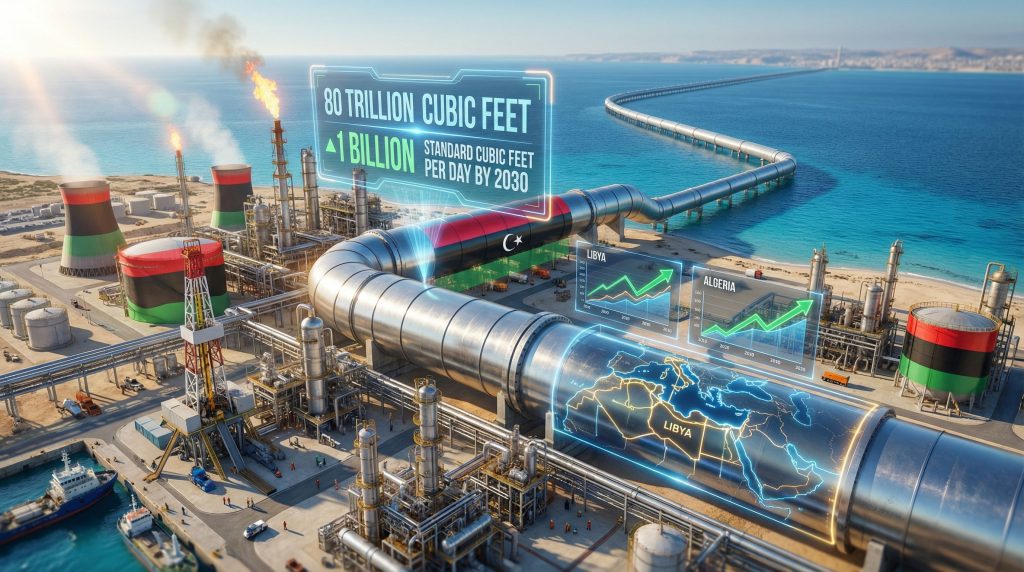
Libya maintains 80 trillion cubic feet of gas reserves, comprising both conventional onshore resources and offshore accumulations plus estimated unconventional formations. National Oil Corporation Chairman Massoud Suleman confirmed these reserve figures during industry presentations, positioning Libya among North Africa's significant underdeveloped gas resource bases.
Current production levels remain substantially below potential capacity, with Libya gas exports to Europe representing negligible volumes through existing infrastructure. The disparity between reserve base and production output reflects both technical constraints and operational disruptions that have characterised Libya's energy sector performance since 2011.
Production scaling targets aim to reach nearly 1 billion standard cubic feet per day by 2030, equivalent to approximately 365 billion cubic feet annually. This production goal represents a dramatic expansion from current output levels and would position Libya as a meaningful contributor to Libya gas exports to Europe within European gas import portfolios.
Reserve Distribution and Development Framework
Conventional reserves represent the primary development focus, located in established geological formations across the Sirte Basin:
• Waha field complex: Proven conventional gas accumulations
• Farigh field: Recently enhanced with additional gas wells
• Hofra structures: Established production infrastructure
These conventional resources comprise approximately 60% of identified reserves, offering development advantages through existing infrastructure and proven reservoir characteristics. Field development programmes focus on systematic drilling campaigns and enhanced processing capacity to achieve 2030 production targets.
Unconventional resources in the Ghadames Basin and Murzuq Basin represent secondary development opportunities. Preliminary assessments suggest shale gas resources of 20-30 TCF, representing approximately 25-37% of total reserve estimates. These formations require specialised drilling technologies and hydraulic fracturing techniques adapted to North African geological conditions.
Infrastructure requirements for achieving production targets include:
• Enhanced processing capacity at Mellitah export facility
• Pipeline throughput optimisation for increased gas volumes
• Compression and dehydration systems for consistent export quality
• Digital monitoring networks for operational efficiency
Regional production benchmarking provides context for Libya's expansion ambitions. Algeria currently produces approximately 8.2 billion cubic feet per day, while Egypt averages 7.3 BSCFD. Libya's 1 BSCFD target represents approximately 12% of Algerian output, indicating achievable scale within North African production parameters.
Technical development challenges include reservoir pressure management, water handling systems, and corrosion control in aging infrastructure. Successful expansion requires coordinated investment in drilling programmes, processing facilities, and transmission systems to maintain consistent export capacity for Libya gas exports to Europe.
Historical Performance Decline Analysis
Political Fragmentation Impact on Energy Operations
Libya's gas export performance deteriorated significantly following the 2011 political transition, with systemic challenges affecting both production capacity and international investment confidence. Post-2011 institutional fragmentation created parallel governance structures that complicated energy sector oversight and operational continuity.
Political instability metrics demonstrate the investment climate challenges:
• Country Risk Rating: Caa1 (highly speculative) according to Moody's assessments
• Political Risk Index: 78.5/100 (extremely high risk)
• Investment hesitation period: 2014-2020 marked by substantial capital withdrawal
Armed group involvement in energy asset control resulted in production shutdowns affecting 40-60% of production capacity at various intervals during peak conflict periods. Force majeure clauses were repeatedly invoked by international operators due to security concerns near production facilities and pipeline infrastructure.
Foreign investor confidence declined substantially as insurance and liability costs increased 200-300% during conflict periods, severely impacting project economics for Libya gas exports to Europe. International financing institutions suspended or limited Libya-directed energy financing between 2014-2023, constraining capital availability for infrastructure maintenance and expansion.
Comparative analysis with regional producers reveals Libya's unique challenges:
| Country | Political Stability | IOC Presence | Export Continuity |
|---|---|---|---|
| Algeria | Relatively stable | Maintained operations | Incremental growth |
| Egypt | Institutional continuity | Sustained Western Desert activity | Consistent LNG exports |
| Libya | Fragmented governance | Intermittent operations | Frequent disruptions |
Investment withdrawal by major international operators created technical expertise gaps that affected routine maintenance and optimisation programmes. The absence of systematic infrastructure investment contributed to declining operational efficiency and reduced export capacity for Libya gas exports to Europe.
Infrastructure Degradation and Operational Constraints
Greenstream pipeline utilisation remains significantly below theoretical capacity, with current exports representing less than 5% of the system's 33 billion cubic metre annual capacity. This underutilisation reflects both upstream production constraints and aging infrastructure challenges that limit operational reliability.
Subsea pipeline degradation affects throughput capacity as the 19-year-old Greenstream system experiences typical aging infrastructure issues:
• Internal corrosion and scaling reducing effective diameter
• Compressor system inefficiencies limiting pressure optimisation
• Valve infrastructure constraints affecting flow regulation
• Maintenance scheduling requiring 12-18% annual downtime
Processing facility limitations at the Mellitah complex operate substantially below design capacity. The facility, designed for approximately 1.5 BSCFD input capacity, currently processes less than 0.1 BSCFD, indicating significant operational underutilisation that constrains Libya gas exports to Europe.
Domestic consumption competition creates additional constraints on export availability. Libya's domestic gas requirements for power generation and industrial applications average 0.3-0.4 BSCFD, competing with export allocations from limited production capacity.
Maintenance scheduling challenges result from deferred infrastructure investment during conflict periods. Critical system components require comprehensive overhaul programmes to restore operational efficiency. Mediterranean pipeline operators typically achieve 5-8% efficiency gains through digital monitoring systems and predictive maintenance programmes.
Technical specifications reveal infrastructure optimisation opportunities:
• Pipeline pressure regulation improvements could enhance throughput by 10-15%
• Compression system upgrades would increase operational reliability
• Digital monitoring integration could reduce unplanned maintenance events
• Corrosion protection programmes would extend infrastructure useful life
These operational constraints directly impact Libya's capacity to expand Libya gas exports to Europe and achieve 2030 production targets without systematic infrastructure investment and modernisation programmes.
Strategic Development Framework for 2026-2030
Unconventional Resource Development Initiative
Libya's unconventional gas development programme represents a critical component of expanding Libya gas exports to Europe through the remainder of this decade. Shale gas drilling operations commence in H2 2026, targeting formations in the Ghadames Basin and Murzuq Basin that contain estimated resources of 20-30 trillion cubic feet.
Multi-stage hydraulic fracturing technology will be deployed across pilot well programmes to assess commercial viability and optimal extraction techniques. These operations require specialised equipment and technical expertise adapted to North African geological conditions, including high-pressure pumping systems and proppant delivery mechanisms suitable for desert environments.
Production ramp-up projections suggest unconventional resources could contribute 150-250 million cubic feet per day by 2030, representing approximately 15-25% of the total 1 billion cubic feet daily target. This contribution becomes essential for achieving ambitious export goals as conventional field optimisation alone cannot reach 2030 objectives.
Technology partnership requirements include:
• Horizontal drilling capabilities for extended lateral sections
• Completion design optimisation for maximum reservoir contact
• Water management systems for fracturing fluid handling
• Sand control technologies for sustained production rates
Pilot programme results from H2 2026 drilling campaigns will determine commercial development parameters and investment risk considerations for full-scale unconventional development. Successful pilots could accelerate Libya gas exports to Europe expansion timelines and enhance overall production confidence.
Environmental considerations for shale gas development include water sourcing, waste management, and regulatory compliance with international environmental standards. European gas importers increasingly require sustainability certifications that could affect market access for unconventional Libya production.
International Partnership and Investment Framework
Strategic partnerships with international operators provide essential technical expertise and financial resources for Libya's gas development ambitions. The 25-year development agreement with TotalEnergies and ConocoPhillips demonstrates renewed international confidence in Libya's energy sector stability and growth potential.
Licensing round results scheduled for February 2026 attracted participation from 37 international companies representing diverse geographical markets:
• North American operators: Chevron, ConocoPhillips
• European companies: Eni, consortium including Repsol
• Asian participants: Multiple companies from regional markets
• African operators: Continental energy companies
This broad international participation indicates restored confidence in Libya's investment climate and operational environment. Multiple bid rounds planned through 2026 will provide additional opportunities for international operator engagement and accelerated development programmes.
Furthermore, Libya aims to significantly boost its gas exports to Europe by early 2030, with technology transfer initiatives through international partnerships bringing advanced extraction techniques, digital monitoring systems, and operational optimisation programmes. These collaborations are essential for achieving Libya gas exports to Europe expansion targets within specified timelines.
Risk mitigation frameworks include:
• Political risk insurance through international institutions
• Force majeure protection clauses in development agreements
• Operational security protocols for personnel and infrastructure protection
• Revenue sharing mechanisms ensuring sustainable project economics
International operator presence also provides operational continuity during potential political transitions, reducing risks of production interruptions that historically constrained Libya gas exports to Europe. Shell and BP office reopenings signal growing confidence in long-term operational stability.
Financial structuring for development programmes utilises international project financing mechanisms, reducing dependence on domestic capital sources. Multilateral development bank participation could provide additional financial resources and technical assistance for infrastructure development.
European Market Integration and Supply Security
Diversification Strategy Implementation
European energy security planning increasingly emphasises Libya gas exports to Europe as part of comprehensive supply diversification strategies. The European Union's Energy Security Strategy specifically identifies North African gas resources as essential components for reducing dependency concentration among established suppliers.
Supply reliability assessments position Libya's geographic proximity and pipeline connectivity as strategic advantages for European energy planners. Direct transmission via Greenstream eliminates transit country dependencies that affect other supply routes, providing enhanced security for Libya gas exports to Europe compared to longer pipeline systems.
Integration challenges with European gas networks require coordination between Libyan export capacity and Italian import infrastructure. Gela terminal capacity optimisation becomes critical for accommodating increased Libya gas exports to Europe volumes and ensuring efficient distribution throughout European markets.
Regulatory compliance requirements include:
• EU Third Energy Package compliance for non-EU suppliers
• Environmental standards for gas quality and sustainability certification
• Long-term contracting frameworks versus spot market participation
• Security of supply obligations for European importers
Market access considerations involve negotiations with European transmission system operators and regulatory authorities to ensure seamless integration of increased Libyan gas volumes. Title Transfer Facility (TTF) pricing benchmarks will influence commercial terms for Libya gas exports to Europe contracts.
Regional Market Impact Assessment
Southern European markets represent primary targets for expanded Libya gas exports to Europe, with Italy serving as the principal entry point through existing Greenstream infrastructure. Italian gas demand averages 70-75 billion cubic metres annually, providing substantial absorption capacity for increased Libyan supplies.
Price impact modelling suggests Libyan gas expansion could influence regional pricing dynamics:
| Market Hub | Current Price Premium | Potential Impact |
|---|---|---|
| Italian PSV | €2-4/MWh above TTF | Downward pressure |
| Spanish PVB | €1-3/MWh regional premium | Competitive displacement |
| Greek AGIA | €3-5/MWh supply constraints | Supply security improvement |
Gas re-export potential through Italian infrastructure could extend Libya gas exports to Europe market reach to Central European consumption centres. Trans-Austria Pipeline (TAG) connections provide access to Austrian, German, and Central European markets where Libyan gas could compete with established suppliers.
LNG export facility development represents longer-term market access opportunities for Libya gas exports to Europe. Potential floating LNG (FLNG) installations could provide flexibility for reaching Northern European markets not connected to Mediterranean pipeline networks.
Competitive positioning analysis reveals market opportunities:
• Algerian gas exports currently supply 8-10% of European imports
• Russian pipeline volumes face geopolitical constraints
• LNG import capacity in Southern Europe provides alternative market access
• Seasonal demand variations create optimisation opportunities for Libyan suppliers
Infrastructure development requirements for maximising market integration include pipeline capacity expansions, compression system upgrades, and interconnection improvements with European transmission networks.
Geopolitical Frameworks and Regional Stability
Institutional Development Requirements
Libya gas exports to Europe expansion depends critically on sustained institutional capacity building and governance stability throughout the development period. International diplomatic frameworks supporting energy sector development provide essential political risk mitigation for international investors and European gas importers.
Institutional capacity requirements include:
• Regulatory framework development for transparent licensing and operations oversight
• Revenue management systems ensuring sustainable fiscal policies
• Security coordination mechanisms protecting energy infrastructure
• International agreement implementation for long-term export commitments
Comparative analysis with other post-conflict energy exporters reveals successful stabilisation models that Libya could adapt. Iraq's energy sector recovery demonstrated that systematic international support and institutional development can restore production capacity and export reliability over 5-10 year periods.
European Union engagement through technical assistance programmes and institutional partnerships provides frameworks for supporting Libya's energy sector development. Mediterranean Energy Platform initiatives could facilitate coordination between European importers and Libyan export planning.
Sovereignty and resource management considerations affect long-term sustainability of Libya gas exports to Europe expansion programmes. National Oil Corporation autonomy and professional management capabilities become essential for maintaining operational continuity during political transitions.
Regional Competition and Market Dynamics
North African gas supplier competition influences Libya's market positioning and commercial strategies for Libya gas exports to Europe. Algeria's established market presence and Egypt's LNG capabilities create competitive pressures that affect pricing and contract negotiations.
Market share implications for regional suppliers:
• Algeria: Risk of market share erosion as Libya scales production
• Egypt: Potential collaboration opportunities for LNG infrastructure
• Libya: Market entry advantages through geographic proximity
Pricing strategy considerations must account for European gas procurement diversification objectives while maintaining competitive economics for Libyan production. Cost-plus pricing models versus market-indexed contracts present different risk-return profiles for Libya gas exports to Europe.
Regional infrastructure coordination could optimise Mediterranean gas flows through interconnection projects and seasonal supply balancing arrangements. East Mediterranean Gas Forum provides multilateral frameworks for regional energy cooperation and market development.
Geopolitical risk assessment includes potential impacts from regional conflicts, migration pressures, and international sanctions regimes that could affect Libya gas exports to Europe operations. Risk-adjusted supply reliability becomes a critical factor in European procurement decisions.
The next major ASX story will hit our subscribers first
Economic Development and Investment Analysis
Revenue Generation and Economic Multipliers
Libya gas exports to Europe expansion represents substantial economic development opportunities through direct export revenues and broader economic multiplier effects. Projected export revenue streams from 2027-2030 production targets could generate $8-12 billion annually at current European gas pricing levels.
Economic impact calculations suggest each billion cubic feet of additional gas export capacity creates:
• Direct employment: 2,000-3,000 jobs in upstream operations
• Indirect economic activity: $2-3 billion in supporting services and infrastructure
• Government revenues: $1.5-2.5 billion through royalties and taxation
• Foreign currency earnings: Critical for macroeconomic stability
Infrastructure development multipliers extend beyond the gas sector through port facilities, transportation networks, and industrial services supporting energy operations. Mellitah complex expansion requires substantial construction and engineering services that create employment and technical capability development.
Regional economic development in production areas provides opportunities for sustainable growth in historically underdeveloped regions. Local content requirements for international operators could enhance domestic industrial capacity and technical skills development.
Investment Requirements and Financial Structuring
Capital expenditure estimates for achieving Libya gas exports to Europe production targets require $15-25 billion in upstream investments through 2030. This includes conventional field development, unconventional resource programmes, and infrastructure modernisation projects.
Investment allocation breakdown:
| Development Category | Capital Requirement | Timeline |
|---|---|---|
| Conventional field development | $8-12 billion | 2026-2029 |
| Unconventional programmes | $4-6 billion | 2027-2030 |
| Infrastructure upgrades | $3-5 billion | 2026-2028 |
International financing mechanisms provide essential capital mobilisation through:
• Project finance structures with international bank consortiums
• Multilateral development bank participation for infrastructure components
• Export credit agency support for equipment and technology procurement
• Private equity partnerships for specific field development programmes
Consequently, thorough evaluation of investment strategy insights becomes essential for risk mitigation strategies that include political risk insurance, completion guarantees, and revenue hedging mechanisms that enhance project bankability for Libya gas exports to Europe development programmes.
Public-private partnership models could accelerate development timelines through efficient risk allocation and specialised technical capabilities. Build-operate-transfer arrangements for processing facilities and pipeline infrastructure provide financing flexibility whilst ensuring technology transfer.
Return on investment projections suggest attractive economics for international operators, with internal rates of return ranging 12-18% depending on production ramp-up success and European gas price levels. These returns provide compelling incentives for sustained international investment in Libya's gas sector development.
Strategic Outlook and Market Positioning
Libya's natural gas development ambitions through 2030 represent both significant opportunities and considerable uncertainties within European energy security planning. However, energy security insights suggest that Libya gas exports to Europe could contribute meaningfully to continental supply diversification objectives, though successful execution requires sustained political stability, systematic infrastructure investment, and coordinated international development programmes.
Furthermore, considering current natural gas price trends, achievement of 1 billion cubic feet daily production would position Libya as a notable contributor to Libya gas exports to Europe, representing approximately 12% of Algeria's current production levels. This scale provides sufficient volume impact to influence regional market dynamics whilst offering European importers valuable supply diversification options.
Critical success factors include:
• Institutional capacity maintenance throughout development periods
• International operator engagement sustaining technical expertise and financing
• Infrastructure modernisation programmes optimising export capacity utilisation
• European market integration ensuring regulatory compliance and competitive positioning
Timeline uncertainties affect investment confidence and European procurement planning. Unconventional resource development beginning H2 2026 represents unproven technology applications in Libya's geological conditions, potentially impacting production ramp-up schedules and overall Libya gas exports to Europe expansion timelines.
European energy transition considerations influence long-term demand projections for natural gas imports. Carbon pricing mechanisms and renewable energy targets could affect commercial viability of new gas import infrastructure and long-term contracting frameworks for Libya gas exports to Europe.
Regional competition dynamics will determine Libya's ultimate market positioning as Algeria and Egypt maintain established supplier relationships with European importers. Differentiation strategies through reliable supply delivery, competitive pricing, and enhanced environmental performance become essential for successful market penetration.
Investment Disclaimer: Libya's natural gas development involves substantial political, operational, and market risks that could significantly impact projected timelines and production targets. Potential investors should conduct comprehensive due diligence and risk assessment before committing capital to Libya-related energy investments. Past performance of North African energy investments does not guarantee future results, and geopolitical developments could materially affect investment outcomes.
The convergence of European diversification requirements and Libya's resource potential creates compelling strategic opportunities for the remainder of this decade. However, execution success depends on factors beyond technical and commercial considerations, requiring sustained coordination between Libyan institutions, international operators, and European energy planners throughout the development period.
Ready to Capitalise on Libya's Energy Infrastructure Renaissance?
Libya's ambitious gas export expansion plans highlight how North African energy developments can create significant market opportunities for investors. Discovery Alert's proprietary Discovery IQ model delivers real-time alerts on major mineral and energy sector discoveries across the ASX, helping subscribers identify actionable opportunities as they emerge. Start your 14-day free trial today to gain immediate insights into Australia's discovery-driven markets and position yourself ahead of evolving energy and commodity trends.