July 8, 2026
The EU's Methane Ultimatum: Why Africa's Gas Exporters Are Running Out of Time
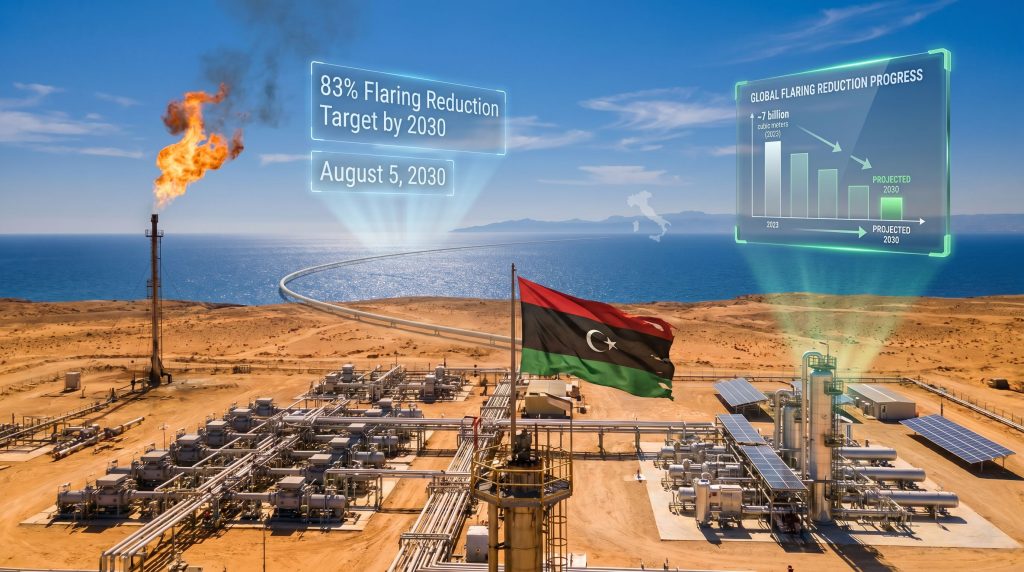
When the European Union formally adopted its Methane Regulation in November 2023, it did something rarely achieved in climate policy: it converted an environmental ambition into a hard commercial deadline. For decades, gas flaring across African hydrocarbon fields had been treated as an operational nuisance rather than a market liability. That calculus is now shifting with significant speed. The regulation, which entered into force in August 2024, establishes a phased import standard that activates from 2027 and reaches full legal force on 5 August 2030. For producers supplying European markets, that date functions less like a policy milestone and more like a contract renewal cliff.
Understanding why Libya gas flaring cuts matter requires seeing them through this lens first. The country's National Oil Corporation is not simply responding to environmental pressure. It is managing a market-access problem with a fixed expiry date.
When big ASX news breaks, our subscribers know first
What the EU Methane Regulation Actually Demands
The regulation's architecture operates in two distinct phases. Domestic EU operators faced immediate prohibitions on routine venting and flaring from August 2024. Non-EU producers, however, face the methane import standard, which phases in from 2027 and mandates full methane intensity compliance by mid-2030.
The core metrics exporters must satisfy include:
- Methane intensity ratio: Total methane emissions divided by total hydrocarbon production volume, functioning as the primary compliance benchmark
- Measurement, Reporting, and Verification (MRV): All emissions claims must be independently verified, not self-reported against activity-based estimates
- Routine flaring prohibition: Producers must demonstrate that any flaring is limited to safety or emergency scenarios, not standard operational practice
- Continuous monitoring obligations: Annual snapshot reporting will be insufficient; exporters must provide ongoing operational data streams
The regulation targets a reduction of global methane emissions from oil and gas operations by up to 30%. Given that methane carries a warming potential roughly 80 times greater than carbon dioxide over a 20-year period, according to the Intergovernmental Panel on Climate Change, the regulation carries outsized climate significance relative to the volume of gas involved. Furthermore, energy transition pressures are intensifying across multiple sectors simultaneously, making compliance timelines increasingly difficult to negotiate around.
| Regulatory Milestone | Date |
|---|---|
| EU Methane Regulation formally adopted | November 2023 |
| Enters into force for EU domestic operators | August 2024 |
| Import standard phase-in begins | January 2027 |
| Full methane intensity limit for all imports | 5 August 2030 |
| World Bank Zero Routine Flaring deadline | 2030 |
For North African producers, the exposure is disproportionately high. Unlike Gulf state producers whose infrastructure was built or substantially modernised in the 2000s and 2010s, Libya, Algeria, and Nigeria carry legacy flaring liabilities accumulated across decades of underinvestment. The EU's binary market-access logic creates a stark outcome: compliant exporters retain preferential access, while non-compliant suppliers face exclusion or pricing penalties that erode the economics of European sales. European supply chain resilience considerations are, moreover, accelerating Brussels' willingness to enforce these standards rather than defer them.
Libya's Flaring Baseline: Understanding the Scale of the Challenge
Before Libya's recent progress can be assessed meaningfully, the scale of the problem must be established clearly. According to the World Bank's Global Gas Flaring Tracker, published in July 2025, Libya's gas flaring increased by 1.4 billion cubic meters in 2023, representing a 25% year-on-year rise that brought total annual flaring to approximately 7 billion cubic meters. That figure places Libya among the world's highest-flaring oil producers on a per-output basis.
A subsequent 8% decline in 2024 might appear encouraging at first glance. However, the mechanism behind that reduction is critically important. The World Bank's data attributes the 2024 improvement primarily to political instability forcing oil field shutdowns, not to deliberate emissions mitigation programmes. This distinction separates genuine operational progress from statistical noise. Output-driven reductions are structurally fragile: when production resumes, flaring typically resumes at comparable or elevated levels unless the underlying infrastructure has been upgraded in the interim.
The gap between an output-driven flaring decline and a genuine emissions reduction programme is not semantic. It is the difference between a figure that satisfies a regulator and one that collapses under scrutiny when production recovers.
The structural causes of Libya's elevated flaring baseline are well understood:
- Decades of deferred investment in gas capture, compression, and processing infrastructure
- Chronic political fragmentation preventing sustained long-term capital planning across field operators
- Associated gas from oil production historically treated as an unwanted byproduct rather than a monetisable export commodity
- The absence of a unified national emissions monitoring framework until relatively recently
This context makes the NOC's current programme both necessary and, in isolation, insufficient to close the gap by 2030.
The NOC's Reduction Programme: What Has Been Announced and What It Means
On 6 July 2026, NOC Chairman Masoud Suleiman addressed a consultative workshop in Tripoli, presenting the corporation's most detailed public accounting of its emissions reduction progress to date. The key figures are as follows:
- Libya's NOC reduced gas flaring by more than 100 million cubic feet during 2025
- The corporation has set a target of cutting a further 180 million cubic feet by end-2026
- Libya's longer-term strategic ambition targets an 83% reduction in total gas flaring by 2030, directly aligned with the World Bank's Zero Routine Flaring initiative
The NOC attributes progress to three interconnected operational levers:
- Infrastructure modernisation: Systematic upgrades to gas capture, compression, and processing equipment at active oil field sites, converting waste streams into usable product
- Advanced methane monitoring deployment: Implementation of source-level measurement technologies capable of quantifying emissions at individual facility level, moving beyond sector-wide estimates
- Adoption of international best practices: Operational alignment with frameworks employed by major global producers, addressing procedural gaps in field management
The Tripoli workshop itself was co-organised with the European Union Mission and the International Methane Emissions Observatory (IMEO), the latter being a UNEP-linked body that aggregates satellite and ground-level emissions data to provide independent verification of reported figures. The involvement of both the EU Mission and IMEO signals that these discussions carry verification weight beyond purely domestic announcements.
There is, however, an important arithmetic reality that should temper enthusiasm. Libya's total flaring baseline sits at approximately 7 billion cubic meters annually. The reductions achieved and targeted for 2025 to 2026 represent less than 1% of that baseline when converted to comparable units. The 83% target by 2030 demands a transformation in operational infrastructure that is orders of magnitude larger than what has been achieved so far.
Is Flare Gas Recovery a Viable Solution?
Research into flare gas recovery units for Libyan refineries indicates that innovative technologies represent a credible pathway towards a zero-flare target by 2030. However, deployment at the scale Libya requires demands both financing and political continuity that remain uncertain variables.
OGMP 2.0 Membership: The Institutional Architecture Behind the Numbers
One of the more strategically significant developments in Libya's compliance trajectory is its accession to the Oil and Gas Methane Partnership (OGMP 2.0) in February 2026. Coordinated by UNEP, OGMP 2.0 represents the recognised international gold standard for methane measurement and reporting within the oil and gas sector.
The framework operates across five reporting levels:
- Levels 1 and 2 use activity-based estimates and emission factors, providing basic sector-wide approximations
- Level 3 introduces facility-level data, improving geographic granularity
- Levels 4 and 5 require direct source measurement data, the highest evidentiary standard and the tier that most directly satisfies the EU regulation's MRV requirements
The progressive architecture matters because it creates a structured pathway for Libya to build credible, independently verifiable emissions data over time. Critically, OGMP 2.0 Level 4 and Level 5 reporting aligns precisely with the transparency requirements embedded in the EU's methane import standard. Membership therefore signals to European buyers and regulators that Libya is constructing the institutional infrastructure for durable compliance, not simply producing short-term headline reductions.
What distinguishes OGMP 2.0 membership from other environmental commitments is its verification backbone. The framework does not accept self-reported estimates at higher levels; it requires measured data, independently reviewed. For a regulator designing import standards, this is exactly the kind of evidence chain that converts a producer's claim into a defensible compliance position.
This positions Libya's approach as qualitatively different from simply announcing emissions targets. The combination of source-level monitoring investment, OGMP 2.0 membership, and co-organisation of workshops with the EU Mission and IMEO builds a verifiable record that regulators require.
The Greenstream Pipeline and Europe's Strategic Dependency
Libya's compliance effort does not occur in a geopolitical vacuum. Since 2022, European energy security strategy has prioritised diversification away from Russian pipeline gas, and Libya has emerged as a preferred alternative supplier for Southern European markets. Italy, in particular, receives Libyan gas via the Greenstream pipeline, a 520-kilometre subsea connection from Mellitah on the Libyan coast to Gela in Sicily.
This structural dependency creates a powerful bilateral incentive. European buyers need Libyan supply continuity. Libya needs European export revenues to fund its state budget, which remains heavily dependent on hydrocarbon income. Non-compliance with the EU methane import standard by 2030 would risk market exclusion at precisely the moment Libya is seeking to expand, rather than contract, its European gas revenues. Consequently, resource export challenges seen in other commodity-dependent economies offer a cautionary parallel for Libyan policymakers.
The economic case for captured gas reinforces this incentive further. Gas that is currently flared represents a direct monetisable loss for Libya's national revenue base. Every cubic meter redirected from a flare stack into the Greenstream export pipeline converts an environmental liability into a fiscal asset. This alignment between compliance obligations and revenue maximisation is relatively rare in emissions regulation and provides Libya with a self-interest rationale that sits alongside its regulatory obligation.
The next major ASX story will hit our subscribers first
How Libya Compares to Regional Peers Under EU Scrutiny
The strategic divergence between Libya and its regional counterparts is one of the less-discussed dimensions of the EU methane debate.
| Country | Approximate 2023 Flaring Volume | EU Compliance Strategy | Current Posture |
|---|---|---|---|
| Libya | ~7 billion cubic meters | Infrastructure investment, OGMP 2.0 membership | Compliance-oriented |
| Algeria | High; significant legacy field exposure | Lobbying EU for rule revision | Regulatory opposition |
| Nigeria | Among world's highest | Lobbying EU alongside Algeria | Regulatory opposition |
| Qatar | Major LNG exporter | Joint lobbying with US, Algeria, Nigeria | Regulatory opposition |
In late June 2026, Algeria, Nigeria, the United States, and Qatar collectively called on the EU to urgently revise its planned methane import measures. The breadth of that coalition reflects the commercial stakes involved for major producers. However, Libya's decision to pursue a compliance-first posture rather than join the lobbying effort represents a calculated strategic bet.
If the EU holds its regulatory position — which is the more likely outcome given the political momentum behind the regulation and the EU's internal climate commitments — Libya will be better positioned to secure long-term European supply contracts in the post-2027 regulatory environment. Competitors who invested their energy in rule revision efforts rather than infrastructure upgrades may, in contrast, find themselves commercially disadvantaged. The geopolitical supply risks embedded in this realignment extend well beyond the gas sector alone.
The risk, conversely, is that if the EU materially weakens its import standard under producer pressure, Libya's compliance investments may prove commercially premature. This regulatory uncertainty is a genuine variable that analysts tracking Libyan energy sector developments should monitor closely.
The Structural Risks That Technical Compliance Cannot Resolve
Libya's compliance trajectory carries risks that no amount of monitoring technology or OGMP 2.0 reporting can address. These deserve explicit recognition:
- Political fragmentation: Libya's ongoing dual-government structure and the recurring cycles of field shutdowns create an operational environment in which sustained infrastructure investment is difficult to execute. Capital deployed in one political window may be stranded or disrupted in the next.
- Baseline data reliability: Because the 2024 flaring decline was driven by shutdowns rather than mitigation, Libya's reported operational flaring intensity may be understated in recent data. When production fully normalises, the true baseline may prove higher than current figures suggest.
- Financing requirements: Achieving an 83% reduction in flaring from a 7 billion cubic meter annual baseline requires capital investment at a scale that significantly exceeds what self-funding through the NOC's current fiscal position can sustain. External investment or project financing mechanisms will likely be necessary.
- Infrastructure execution timelines: Gas capture infrastructure upgrades at legacy fields involve complex engineering in environments with constrained logistics, potentially compressing the available window between current project timelines and the 2030 compliance deadline.
Disclaimer: Forward-looking statements regarding Libya's compliance trajectory involve material uncertainties including political risk, commodity price volatility, infrastructure financing conditions, and the potential for regulatory modification. Nothing in this analysis constitutes investment advice.
The Broader Signal for African Gas Exporters
Libya's situation illustrates a structural tension that extends across the African hydrocarbons sector. The continent holds substantial proven gas reserves that are positioned to play a significant role in European energy security over the coming decade. However, the infrastructure required to convert that reserve potential into EU-compliant export volumes requires investment, institutional capacity, and political stability that are unevenly distributed.
The EU methane regulation, regardless of any modifications that may result from producer lobbying, is reshaping the terms on which African gas can access European markets. Producers who treat the 2030 deadline as a compliance horizon to manage now are accumulating structural advantages over those who treat it as a political negotiation. In addition, the broader shift toward renewable energy in mining and heavy industry demonstrates that the direction of travel across commodity sectors is firmly towards lower-emissions operations.
Libya gas flaring cuts, viewed in this context, represent not merely an environmental programme but an early-stage repositioning in the competitive landscape for European gas supply contracts through the 2030s and beyond. The challenge for Libya remains transforming that strategic positioning into operational reality, against a backdrop of political complexity that has historically undermined exactly the kind of sustained institutional commitment that the EU methane framework demands.
Want to Stay Ahead of the Next Major Resource Discovery on the ASX?
Discovery Alert's proprietary Discovery IQ model delivers real-time alerts on significant ASX mineral discoveries across energy, metals, and critical resources — instantly converting complex market data into actionable investment insights for traders and long-term investors alike. Explore historic discoveries and their exceptional market returns, then begin your 14-day free trial at Discovery Alert to position yourself ahead of the broader market.