July 8, 2026
The Capital Allocation Paradox: When Enthusiasm Meets the Budget Sheet
There is a persistent tension running through the modern mineral exploration industry. On one side sits genuine excitement about artificial intelligence, remote sensing platforms, hyperspectral imaging, and a growing suite of pre-drilling analytical tools that promise to revolutionise how geologists identify targets. On the other side sits the budget spreadsheet, which tells a rather different story.
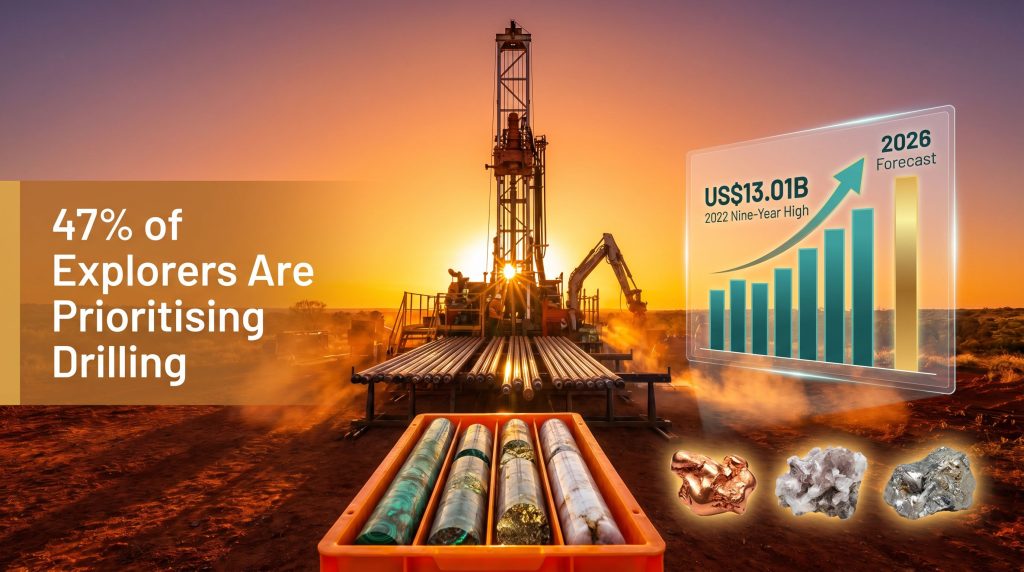
Survey data from the Mining IQ Exploration Insights 2026 report, drawn from 75 industry respondents, reveals that 47% of exploration professionals expect drilling to receive the largest budget increase over the next 12 months. That figure is not a rounding error or a statistical anomaly. It reflects a durable truth that experienced mineral explorers understand: technology can refine a target, but only a drill bit can confirm it.
The gap between innovation interest and capital commitment is one of the defining characteristics of the current exploration cycle. Companies are trialling new tools, attending demonstrations, and integrating AI-assisted target generation into early-stage workflows. Yet when the annual budget allocation meeting concludes, the lion's share of incremental capital continues to flow toward drilling programs. Understanding why requires a closer look at what is actually driving the mineral exploration drilling budget increase underway in 2026.
When big ASX news breaks, our subscribers know first
What Is Driving the Mineral Exploration Drilling Budget Increase in 2026?
Gold Price Escalation as the Primary Catalyst
Few forces reshape exploration capital allocation as rapidly or decisively as commodity price movements. The sustained elevation of the gold price has fundamentally altered the economics of drilling decisions across the industry.
Projects that carried marginal economics at gold prices of US$1,500 per ounce have been transformed at current levels approaching and exceeding US$4,500 per ounce. That shift compresses the risk threshold required to justify greenfield drilling, unlocking targets that would have been shelved during lower-price environments. For many mid-tier operators, this price environment has cleared the way for drill budgets exceeding US$25 million on key growth targets.
The relationship between commodity price and drill budget is not linear. It operates through a confidence mechanism: when prices sustain above critical thresholds for extended periods, boards approve programs that sentiment previously blocked. The current gold cycle appears to have crossed that threshold decisively, with exploration committees approving budgets that were deferred through the cautious years of 2020 to 2022.
Critical Minerals Demand and the Energy Transition Effect
Beyond gold, the structural demand shift created by global decarbonisation commitments has repositioned several commodities as urgent exploration targets. The surge in critical minerals demand has driven copper, lithium, and nickel to attract significant incremental drilling capital as project teams and corporate strategists recognise that future supply chains depend on discoveries being made now.
The scale of the preceding investment cycle provides useful context:
- Global non-ferrous exploration budgets reached a nine-year high of US$13.01 billion in 2022, fuelled by energy transition enthusiasm and a surge in battery mineral interest
- Lithium exploration spending increased by approximately 50% during peak energy transition investment cycles, reflecting how quickly capital can concentrate around a commodity narrative
- The incremental budget increases recorded for individual critical minerals in 2023 data illustrate the commodity-level dynamics at work
| Critical Mineral | Incremental Budget Increase | Strategic Rationale |
|---|---|---|
| Lithium | +US$362M | Battery storage and EV supply chains |
| Copper | +US$327M | Grid infrastructure and EV motor demand |
| Nickel | +US$117M | Battery cathode material requirements |
Copper deserves particular attention as a drilling budget driver. Unlike lithium, where the exploration investment surge was partly speculative and subsequently corrected, copper's supply deficit is structural. Grade decline across existing major deposits, combined with the rising copper intensity of electrification infrastructure, means that explorers and majors alike are under genuine pressure to replenish reserves through the drill bit.
Sovereign Capital Entering the Funding Gap
A relatively underappreciated dynamic in the current mineral exploration drilling budget increase is the growing role of government-sourced funding. Sovereign capital is increasingly being directed toward early-stage domestic exploration programs as governments seek to reduce reliance on imported critical minerals.
Notable funding commitments include:
- Australia: US$373 million committed to domestic mineral exploration incentives
- Saudi Arabia: US$182 million directed toward supporting domestic mineral exploration programs
- United States: Department of Defense funding channelled toward critical mineral supply chain development
This sovereign participation is structurally significant because it partially de-risks the early stages of exploration investment, potentially encouraging additional private capital to follow into programs that might otherwise struggle for junior exploration funding in tight equity market conditions.
How Global Exploration Budgets Have Shifted Between 2022 and 2026
The trajectory of global exploration spending over the past four years reflects the interaction of commodity cycles, financing conditions, and the diverging fortunes of major versus junior operators.
| Period | Global Exploration Budget | Primary Driver |
|---|---|---|
| 2022 Peak | US$13.01B (nine-year high) | Energy transition and lithium boom |
| 2023 | US$12.7B (moderate decline) | Gold funding reduction; junior cutbacks |
| 2026 Trajectory | Recovering and expanding | Gold price surge and critical mineral focus |
The 2023 contraction warrants careful interpretation. Junior exploration companies reduced drilling budgets by approximately 8% in response to the combined pressure of elevated inflation, rising interest rates, and deteriorating access to equity financing. However, major mining companies partially absorbed this contraction by increasing their own exploration budgets by 1 to 2%, reaching approximately US$6 billion across the sector.
According to exploration spending data published by the Australian Bureau of Statistics, these trends are reflected at the national level, with quarterly exploration expenditure closely tracking commodity price cycles and financing conditions.
The divergence between major company budget expansion and junior company contraction reflects a structural dynamic in exploration finance. As debt and equity financing conditions tighten, capital concentrates among well-capitalised operators. Junior explorers with less balance sheet resilience face compounding barriers to maintaining consistent drilling programs across commodity cycles.
This concentration effect has implications beyond the current cycle. Discovery pipelines in most commodities depend heavily on junior explorer activity, which means sustained junior contraction eventually creates a discovery gap that no amount of major company spending can fully offset. The geology of new discovery tends to favour risk-tolerant, early-stage operators working in underexplored terrains where major companies rarely focus their efforts.
Is Minesite Drilling Replacing Greenfield Exploration in Budget Priorities?
One of the more consequential budget shifts occurring beneath the headline figures is the accelerating preference for minesite and brownfield drilling programs over greenfield exploration.
| Drilling Type | Budget Trend | Risk Profile | Timeline to Value |
|---|---|---|---|
| Greenfield Exploration | Selective; commodity-price dependent | High | Long (5 to 15 years) |
| Minesite / Brownfield | Consistently increasing | Moderate | Short to medium |
| Infill / Resource Definition | Stable | Low | Immediate |
The economic logic is straightforward. Existing infrastructure dramatically reduces per-metre drilling costs. Access roads, power, water, and accommodation infrastructure are already in place. The geological model is understood, reducing the interpretive risk associated with each hole drilled. Furthermore, resource conversion timelines from drill result to mine plan are measured in months rather than years.
For investors evaluating exploration companies, this brownfield preference has a dual implication. It reflects capital discipline and pragmatism, but it also signals a degree of risk aversion that may eventually constrain the industry's ability to replace reserves with genuinely new discoveries.
How Major Mining Companies Are Reshaping the Exploration Landscape
Budget Concentration at the Top
The behaviour of major mining companies acts as a gravitational centre for the broader exploration industry. When BHP, Rio Tinto, and South32 expand exploration allocations, they signal commodity confidence that filters through to junior valuations, financing conditions, and drilling contractor activity levels.
During the 2023 period of junior contraction, major company budgets held firm and expanded modestly, providing a floor for global exploration spending and maintaining drilling contractor utilisation rates that might otherwise have fallen more sharply. This counter-cyclical behaviour by well-capitalised majors is a feature of mature mining cycles that investors in junior explorers often underestimate when assessing sector-wide risk.
Strategic Drilling Targets: How Tier-1 Operators Prioritise Programs
Major mining companies apply a rigorous capital allocation framework to exploration spending that differs fundamentally from junior explorer decision-making. Their programs are typically weighted toward:
- Brownfield extensional drilling at existing operations to extend mine life and defer major capital decisions
- Acquisition-support drilling to validate targets identified through corporate transactions
- Strategic greenfield programs in commodities where reserve replacement is a stated board-level priority
- Joint venture participation in junior-operated programs, providing exposure to discovery upside while limiting balance sheet commitment
This structured approach means major company exploration spending is simultaneously more predictable and less nimble than junior activity. It consequently creates opportunity for well-positioned junior explorers operating in commodities and jurisdictions that attract major company attention.
What Role Does Technology Play in Modern Exploration Drilling Programs?
Emerging Tools Gaining Ground Without Displacing the Drill
The exploration technology landscape is evolving rapidly. The growing use of AI in mineral exploration, alongside remote sensing platforms, ground-penetrating geophysical survey tools, and hyperspectral analysis, is demonstrating genuine utility in refining drill targets and reducing the number of unsuccessful holes drilled per discovery.
The efficiency argument is compelling in theory. If AI-assisted target generation can reduce the number of metres drilled before a significant intersection is achieved, the capital efficiency of a drilling program improves materially. Some practitioners working in well-defined geological settings report that systematic application of these tools has meaningfully improved their drill success ratios.
However, the survey data tells a more measured story. Technology spending within exploration budgets remains subordinate to core drilling capital commitments. The enthusiasm for emerging tools is genuine, but the willingness to redirect capital away from drilling toward technology procurement has not yet materialised at scale.
Why Drilling Remains Non-Negotiable
Physical drilling is the only mechanism capable of delivering the subsurface confirmation that resource estimation, regulatory compliance, and investor confidence all require. No satellite image, geophysical model, or AI prediction can substitute for an assayed core sample from depth.
This is not a conservative or anti-innovation position. It reflects the epistemological reality of mineral exploration. Resource categories under internationally recognised reporting standards such as JORC and NI 43-101 require drill-based evidence. Mineral resource estimates cannot be published without it. Mine feasibility studies cannot proceed without it. Project financing cannot be secured without it.
Technology can direct where the drill goes and improve the probability of success at each location. However, it cannot replace the drill itself. This constraint will remain regardless of how sophisticated pre-drilling analytical tools become, which is precisely why the mineral exploration drilling budget increase of 2026 is flowing predominantly toward metres drilled rather than software subscriptions.
A sound mineral exploration strategy therefore balances technological investment in target generation with sustained capital commitment to physical drilling programs that can actually convert geological concepts into reportable resources.
The next major ASX story will hit our subscribers first
Three Scenarios for Global Exploration Drilling Investment Through 2028
The following scenarios represent forward-looking projections based on current market conditions and industry trends. They are speculative in nature and should not be treated as financial advice or definitive forecasts. Actual outcomes will depend on commodity price movements, financing conditions, and geopolitical factors that cannot be predicted with certainty.
Scenario 1: Sustained Commodity Strength
Gold remains above US$3,500 per ounce and copper demand accelerates through grid infrastructure buildout. Drilling budgets expand 10 to 15% annually across major and mid-tier operators. Junior financing conditions improve as equity markets follow commodity sentiment. Discovery rates improve as more metres are drilled across a wider range of targets.
Scenario 2: Moderate Rebalancing
Commodity prices stabilise at levels that support continued but slower budget growth. Junior financing improves incrementally as interest rate conditions ease. Budget growth concentrates in brownfield and minesite drilling programs where capital efficiency is demonstrably superior. Technology adoption accelerates as operators seek efficiency improvements within constrained budgets.
Scenario 3: Contraction Risk
Interest rate pressures persist longer than market consensus anticipates. Equity market appetite for junior explorers deteriorates. Major company budgets hold but junior drilling activity contracts further, deepening the discovery gap already visible in several critical mineral supply chains. Government grant programs provide partial support but cannot substitute for private capital at scale.
Frequently Asked Questions: Mineral Exploration Drilling Budgets
What is causing the mineral exploration drilling budget increase in 2026?
The primary driver is the sustained elevation of gold prices above levels that make previously marginal targets economically viable. Secondary drivers include government grant programs for critical minerals exploration and major company budget expansion in copper and battery minerals.
How much did global mineral exploration spending reach at its peak?
Global non-ferrous exploration budgets reached a nine-year high of approximately US$13.01 billion in 2022, driven by energy transition investment and a surge in lithium exploration spending.
Why did junior exploration companies cut drilling budgets in 2023?
Junior companies reduced exploration drilling budgets by approximately 8% in 2023 due to the combined pressure of elevated inflation, rising interest rates, and tighter equity financing conditions that made raising capital for early-stage programs significantly more difficult.
Which commodities are seeing the largest exploration drilling budget increases?
Lithium (+US$362M), copper (+US$327M), and nickel (+US$117M) recorded the most significant incremental increases, reflecting their strategic importance to battery technology and energy transition supply chains. In addition, according to recent industry reporting, Australian exploration spending has surged toward $949 million, reinforcing the global trend.
Is physical drilling still the dominant form of exploration spending despite new technologies?
Survey evidence from the exploration sector indicates that approximately 47% of respondents expect drilling to receive the largest budget increase over the next 12 months, confirming that physical drilling remains the capital priority over emerging technology solutions.
Key Takeaways: Mineral Exploration Drilling Budget Trends in 2026
- 47% of exploration professionals anticipate drilling will receive the largest budget increase in the next 12 months, according to the Mining IQ Exploration Insights 2026 survey of 75 respondents
- Global non-ferrous exploration peaked at US$13.01 billion in 2022 and is recovering toward that level through 2026
- Major mining companies increased exploration budgets by 1 to 2% in 2023, partially offsetting an 8% contraction in junior sector drilling activity
- Critical minerals including lithium, copper, and nickel are driving the largest incremental budget growth at the commodity level
- Sovereign grant programs ranging from US$182 million to US$373 million across Australia, Saudi Arabia, and the United States are supplementing private sector drilling investment
- Minesite and brownfield drilling programs are gaining budget share relative to higher-risk greenfield exploration across most operators
- Physical drilling remains the non-negotiable validation mechanism for mineral resource estimation and project financing, regardless of technological advancement
Readers seeking a broader perspective on global mineral exploration trends and annual drilling budget analysis can access the Mining IQ Exploration Insights 2026 report via miningmagazine.com, which covers survey findings, notable drill intercepts, and technology developments across the exploration sector.
Want to Know When the Next Major ASX Mineral Discovery Hits the Market?
Discovery Alert's proprietary Discovery IQ model scans ASX announcements in real time, instantly identifying significant mineral discoveries across gold, copper, lithium, and more than 30 other commodities — converting complex exploration data into clear, actionable opportunities before the broader market can react. Explore historic discoveries and the substantial returns they generated, then begin your 14-day free trial at Discovery Alert to position yourself ahead of the next major find.