August 1, 2026
The Structural Logic Behind Industry-Funded Permitting Reform
Federal energy policy rarely generates consensus. The legislative landscape surrounding oil and gas development on public lands is typically fractured along partisan lines, with disputes over royalty rates, environmental review timelines, and land access creating persistent gridlock. Against that backdrop, the License to Drill Act approval by Senate Energy and Natural Resources Committee members in July 2026 stands out as something genuinely unusual: unanimous bipartisan agreement on a mechanism that directly funds the infrastructure enabling domestic energy production on federal lands.
Understanding why this legislation has attracted cross-party support requires looking past the politics and into the underlying architecture of how federal drilling permits actually get processed, who pays for that process, and what happens when the funding mechanism is allowed to expire. This question is particularly relevant given the broader context of government intervention in mining and energy sectors that has characterised recent US policy.
When big ASX news breaks, our subscribers know first
What the Permitting Project Improvement Fund Actually Does
The Permitting Project Improvement Fund is not a subsidy, a grant program, or a line item in the federal budget subject to annual appropriations battles. It is a self-sustaining administrative mechanism created under the Energy Policy Act of 2005 that channels fees paid by oil and gas producers directly into Bureau of Land Management field offices, where those funds are used to support the personnel and operational activities required to review permits, conduct inspections, and manage energy development on public lands.
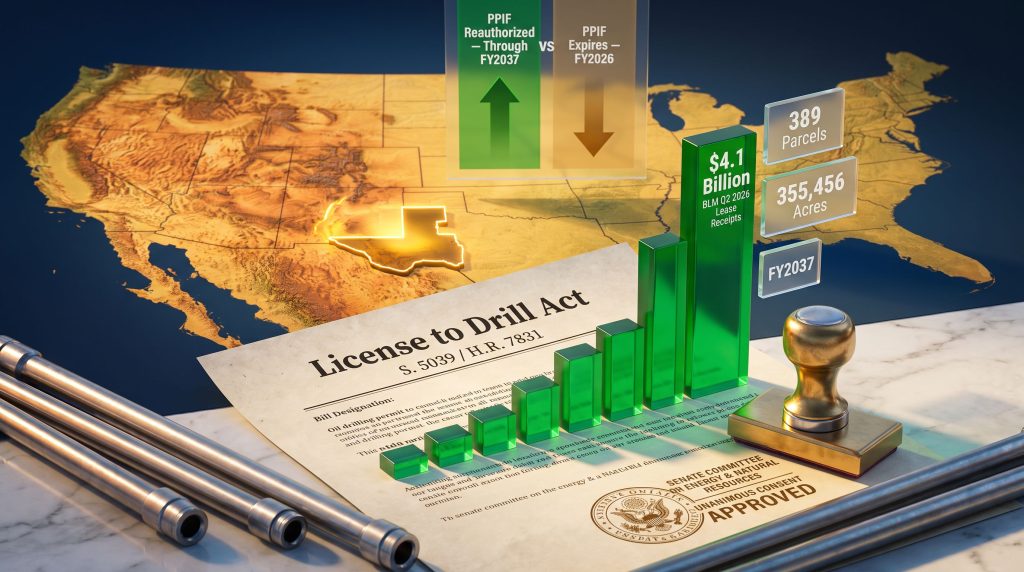
The fee structure is straightforward. For every Application for Permit to Drill submitted on federal lands, producers pay more than $12,500. That fee is transferred into the PPIF, which then allocates resources to BLM field offices based on operational need. Critically, the fee is indexed to inflation, meaning the programme's purchasing power does not erode over time without requiring Congressional intervention to adjust funding levels.
Key Features of the PPIF Fee Structure
| Fee Element | Detail |
|---|---|
| Per-application fee | More than $12,500 per Application for Permit to Drill |
| Fee payer | Oil and gas producers on federal lands |
| Revenue destination | BLM Permit Processing Improvement Fund |
| Inflation indexing | Built into the programme's design |
| Taxpayer contribution | Zero |
| Current authorisation expiry | End of FY2026 |
| Proposed extension | Through FY2037 under H.R. 7831 / S. 5039 |
After operating as a pilot for approximately a decade, Congress renewed and expanded the PPIF for a further ten-year term. That extended authorisation is now approaching its expiration point at the conclusion of FY2026, creating a defined legislative deadline and the urgency behind the current reauthorisation push.
Why BLM Field Office Resourcing Is a Real Bottleneck
BLM-managed federal lands account for roughly 10% of total U.S. oil and natural gas production, according to the joint statement issued by industry groups including the Independent Petroleum Association of America (IPAA) and Western Energy Alliance (WEA) (Rigzone, July 31, 2026). That is a significant share of domestic supply flowing through a permitting infrastructure that depends on adequately staffed field offices to function.
The core problem is structural rather than political. When field offices lack the resources to process applications at the rate they are submitted, permit backlogs accumulate. Those backlogs translate into delayed production timelines, which push capital planning horizons out further and introduce uncertainty into upstream investment decisions. The PPIF model was designed specifically to break this cycle by ensuring that the revenue generated from drilling activity flows back into the administrative capacity needed to support that activity.
Without a self-sustaining funding mechanism, federal permitting infrastructure can fall behind the pace of industry investment, creating a mismatch between capital committed to lease positions and the regulatory throughput available to convert those commitments into active production.
The practical implication is significant. A producer who has paid $4.1 billion across a portfolio of federal lease positions in a single quarter, as was the case across the industry in Q2 2026 (Bureau of Land Management, July 16, 2026), has a direct financial stake in the speed and reliability of the permitting system those investments depend on. Furthermore, understanding how tariffs work alongside permitting costs helps illustrate the cumulative regulatory pressures producers navigate when planning capital deployment on federal lands.
The Legislative Journey: From Pilot Programme to Reauthorisation
The path from the PPIF's creation to the current Senate committee vote spans more than two decades of federal energy policy evolution.
- 2005 – The PPIF is established as a pilot programme under the Energy Policy Act of 2005, supported by the IPAA from its inception.
- Approximately 2015 – Following a decade of operational success, Congress renews and expands the programme for an additional ten-year term.
- June 2026 – H.R. 7831, introduced by Republican Congressman Mike Kennedy, passes the U.S. House of Representatives with strong bipartisan support.
- Senate introduction – Republican Chairman Mike Lee introduces companion bill S. 5039 in the Senate.
- July 2026 – The Senate Energy and Natural Resources Committee approves S. 5039 with unanimous bipartisan support.
- Next required steps – A full Senate floor vote, followed by presidential signature, is needed before the act becomes law.
The September 2026 expiration deadline is not a bureaucratic technicality. If Congress fails to complete passage before that date, BLM field offices lose access to the dedicated industry-generated revenue stream that funds their permitting operations, with no guaranteed replacement mechanism in place.
Record Lease Sales and the Case for Reauthorisation
The timing of the Senate committee vote coincides with a moment of historic activity in federal land energy investment. BLM's second quarter 2026 lease sales generated $4.1 billion in total receipts, covering 389 parcels across 355,456 acres, with the majority of revenue originating from New Mexico (Bureau of Land Management, July 16, 2026).
These figures carry significant policy weight. Record investment in federal lease positions creates record demand for permit processing. The AXPC's CEO Anne Bradbury noted that at a time when federal land investment is reaching historic levels, ensuring BLM has adequate resources to process permits efficiently is directly tied to energy affordability outcomes (Rigzone, July 31, 2026). This point is reinforced by record-setting BLM lease sales that demonstrate the pivotal role of federal lands development in securing energy affordability.
The structural logic is straightforward: when lease investment hits record levels, permitting infrastructure that cannot keep pace becomes a direct constraint on the economic value those lease positions are designed to generate.
Allowing the PPIF to expire at precisely the moment when demand on BLM field offices is reaching its highest historical levels would create exactly the kind of administrative bottleneck the programme was designed to prevent.
Why Industry Groups Are Pushing Hard Before September
Three major industry organisations have publicly backed swift Senate passage of the License to Drill Act approval by Senate Energy and Natural Resources Committee, each framing the case through a distinct lens.
Advocacy Positions by Organisation
| Organisation | Key Representative | Core Argument |
|---|---|---|
| IPAA | Dan Naatz, EVP and Chief Policy Officer | Programme preserves an industry-funded permitting system with an inflation-indexed fee designed to reduce delays and improve agency resources |
| WEA | Melissa Simpson, President | PPIF ensures producer fees are reinvested into the permitting process; expiration would disrupt field office funding critical to energy development management |
| AXPC | Anne Bradbury, CEO | Efficient BLM permitting is essential to energy affordability; committee vote follows record-setting Q2 2026 lease sale results |
The IPAA has been involved with the PPIF concept since its origin in 2005 and testified in support of the bill during its committee hearing. The organisation's position emphasises that the programme's core design principle, which is that industry pays its own way, has historically attracted reauthorisation support across multiple Congresses and both parties (Rigzone, July 31, 2026).
The WEA's framing adds a workforce dimension that broadens the argument beyond producer interests alone. Allowing the programme to expire would not only slow permit processing; it would directly disrupt funding for the federal employees responsible for managing energy development on public lands, creating staffing uncertainty in BLM field offices that serve both industry and public land management functions.
The next major ASX story will hit our subscribers first
What Expiration Would Actually Mean
The difference between reauthorisation and expiration is not abstract. The table below illustrates the concrete operational divergence across key dimensions.
| Dimension | PPIF Reauthorised Through FY2037 | PPIF Expires at FY2026 |
|---|---|---|
| BLM field office funding | Stable and industry-funded | Disrupted; dependent on appropriations |
| Permit processing timelines | Maintained or improved | Risk of significant extension |
| Federal workforce continuity | Preserved | Uncertain; potential staffing gaps |
| Producer investment certainty | Enhanced | Reduced; elevated regulatory risk |
| Taxpayer exposure | Zero | Potential appropriations requirement |
| Programme duration | Extended 11 years | Terminated |
The scenario comparison highlights a point that tends to get lost in policy discussions: expiration does not simply pause the programme. It actively transfers the funding burden from a self-sustaining industry fee model to the unpredictable annual appropriations process, introducing exactly the fiscal uncertainty the PPIF was designed to eliminate. In addition, the knock-on effects for resource and energy exports at a global level demonstrate how domestic permitting bottlenecks can ripple outward into broader supply chain and trade dynamics.
The Bipartisan Design Feature That Enables Consensus
The PPIF's structural design is the primary reason it has attracted cross-party support across multiple reauthorisation cycles. The mechanism contains a built-in resolution to the most common objection to energy-related government spending: taxpayers bear no cost.
Republican support flows naturally from the programme's alignment with principles of reducing government reliance on appropriated funds and streamlining permitting through market-generated revenue. Democratic support is sustained by the programme's reinvestment into federal workforce capacity and the oversight infrastructure that responsible public land management requires.
The fee indexing feature adds another layer of political durability. Because the per-application fee adjusts with inflation automatically, the programme's purchasing power is maintained without requiring legislators to periodically revisit and update dollar amounts, removing a recurring friction point that has complicated other fee-based programmes.
Frequently Asked Questions
What does the License to Drill Act actually extend?
The act extends BLM's authority to collect per-application drilling permit fees and transfer those fees into the PPIF through FY2037, replacing the current authorisation that expires at the end of FY2026. The extension covers eleven fiscal years of operational continuity for BLM field office funding.
Does the PPIF cost taxpayers anything?
No. The programme is funded entirely through fees paid by oil and gas producers submitting drilling permit applications on federal lands. No taxpayer appropriations are involved in the programme's operation.
How much do producers pay per permit application?
Each Application for Permit to Drill on federal lands carries a fee exceeding $12,500, which is directed into the PPIF to fund BLM field office operations including permit review, inspections, and leasing administration.
What share of U.S. oil and gas production comes from BLM-managed lands?
Federal lands managed by the BLM account for approximately 10% of total U.S. oil and natural gas production, making the efficiency of the federal permitting system a meaningful variable in national energy supply.
What were BLM's Q2 2026 lease sale results?
From April through June 2026, BLM conducted lease sales covering 389 parcels and 355,456 acres, generating $4.1 billion in total receipts, with most revenue originating from New Mexico (Bureau of Land Management, July 16, 2026).
What must happen before the act becomes law?
Following the Senate Energy and Natural Resources Committee's approval, the bill requires a full Senate floor vote and presidential signature. The September 2026 expiration of the current PPIF authorisation creates the operative deadline. Consequently, the bill's full legislative history on Congress.gov provides a useful reference for tracking all required procedural steps toward enactment.
The Broader Significance of an Industry-Funded Permitting Model
The PPIF represents a policy architecture that sidesteps one of the most persistent obstacles in federal energy regulation: the annual appropriations cycle. By creating a dedicated, industry-funded revenue stream tied directly to drilling activity, the programme ensures that the administrative capacity needed to support energy development scales with the level of that development. This is, however, distinct from the broader Trump mining permits order approach, which pursued permit reform through executive action rather than legislatively embedded fee mechanisms.
This design principle has implications beyond the immediate reauthorisation question. If the License to Drill Act approval by Senate Energy and Natural Resources Committee translates into full enactment before the September deadline, it will reinforce the viability of the industry-funded permitting model as a template for future administrative reform proposals. Furthermore, considering the US mineral production order alongside this legislation reveals a consistent policy direction: ensuring that domestic resource development is not constrained by administrative underfunding.
The PPIF's track record across multiple reauthorisation cycles and consistent bipartisan support suggests the model has demonstrated sufficient operational credibility to serve as a reference point for other permitting contexts where administrative capacity and industry investment levels are structurally linked.
The unanimous Senate committee vote, combined with strong House passage in June 2026 and coordinated advocacy from the IPAA, WEA, and AXPC, positions the act favourably ahead of the September deadline. Whether that momentum translates into full enactment before the programme expires will determine whether BLM field offices enter FY2027 with a stable, self-sustaining funding base or face the administrative disruption that expiration would create at the worst possible moment, when federal land lease investment is at its highest recorded levels.
This article is informational in nature and does not constitute legal, financial, or investment advice. Legislative outcomes are subject to change and readers should consult primary sources including Congress.gov for current bill status. References: Rigzone, July 31, 2026; Bureau of Land Management, July 16, 2026; Congress.gov, H.R.7831 summary.
Want to Stay Ahead of Significant ASX Mineral Discoveries Before the Broader Market Reacts?
While federal permitting reform shapes the upstream conditions for energy and resource development, Discovery Alert's proprietary Discovery IQ model scans ASX announcements in real time, instantly identifying significant mineral discoveries across more than 30 commodities and delivering actionable alerts directly to subscribers. Explore historic discovery returns on Discovery Alert's dedicated discoveries page and begin your 14-day free trial to position yourself ahead of the market.