July 31, 2026
The Capital Markets Case for Nuclear: Why 2026 Is Different
For most of the past four decades, nuclear energy occupied an awkward position in the investment universe. It was too capital-intensive for growth investors, too politically uncertain for infrastructure funds, and too technically complex for generalist allocators. The result was a long period of capital starvation that left the industry reliant on state utilities and government balance sheets. The Westinghouse IPO plan, which became public knowledge in late July 2026, represents the most consequential signal yet that this era may finally be ending.
That dynamic is now shifting in ways that are structurally different from previous false dawns. The convergence of AI-driven electricity demand, decarbonisation policy, energy security trends, and a proven generation technology is creating the conditions for nuclear energy to re-enter mainstream capital markets — not as a niche bet, but as a credible infrastructure category.
When big ASX news breaks, our subscribers know first
What the Westinghouse IPO Plan Actually Involves
A Confidential Draft S-1: The First Step in a Long Process
Westinghouse Electric Company has submitted a confidential draft registration statement to the U.S. Securities and Exchange Commission, initiating what may become one of the most consequential public market debuts in the energy sector's recent history. This filing type, commonly referred to as a draft S-1, allows a company to engage with the SEC's review process before disclosing financial details to the public.
Critically, this means no share count has been set, no price range has been announced, and no listing exchange has been confirmed. The filing is a preparatory step, not an imminent event.
A confidential S-1 submission signals serious intent and begins the regulatory clock, but it does not guarantee a public offering will proceed. Market conditions, SEC review outcomes, and the company's internal readiness all remain variables that can alter the trajectory.
Key IPO Variables: Confirmed vs. Undetermined
| IPO Element | Current Status |
|---|---|
| SEC Filing Type | Confidential Draft S-1 Submitted |
| Share Count | Not Yet Determined |
| Price Range | Not Yet Determined |
| Listing Exchange | Not Yet Disclosed |
| Valuation Target | Potentially $30 Billion+ (conditional) |
| Government-Linked IPO Trigger | Active if conditions met by January 2029 |
The absence of pricing is not unusual at this stage. What matters more for investors watching from the outside is the structure of ownership and the mechanisms that may ultimately force or incentivise a public listing.
The Government-Linked IPO Trigger Mechanism
Embedded within partnership agreements connected to U.S. government nuclear deployment frameworks is a mechanism that could effectively compel a public offering. Specifically, the structure references a warrant tied to 20% of the IPO entity's public value above $17.5 billion, as well as a mechanism connected to 20% of certain cash distributions. These are not simple equity stakes.
If Westinghouse's valuation breaches the $30 billion threshold and specific conditions are satisfied by January 2029, an IPO obligation could be triggered. This is a distinctive structural feature that separates the Westinghouse IPO plan from a typical founder-driven or private equity exit float. Furthermore, it introduces a degree of institutional accountability that is rarely seen in pre-IPO nuclear investment structures.
Ownership Structure and Its Implications for Public Market Investors
Cameco and Brookfield: Two Very Different Motivations
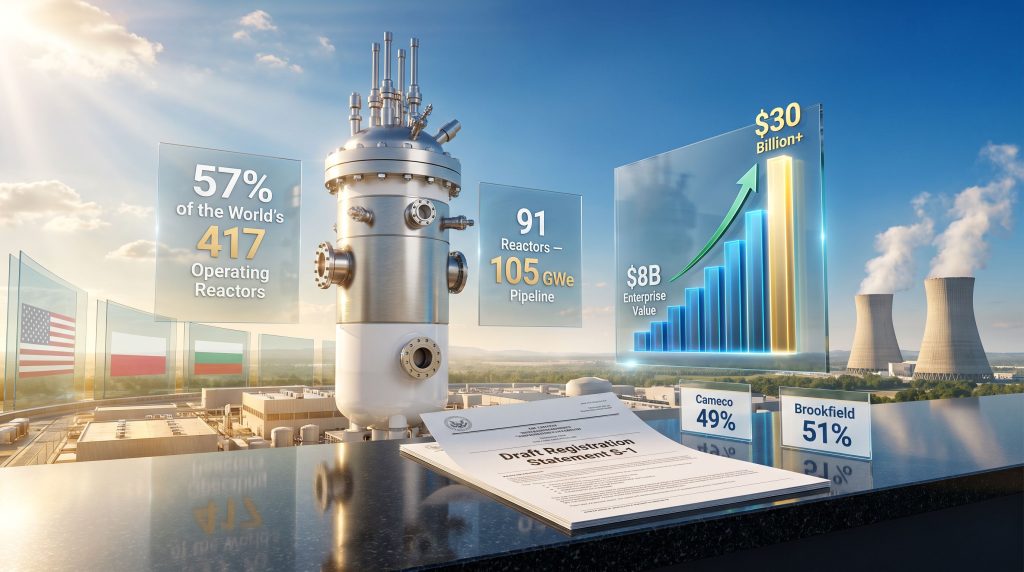
Westinghouse is currently owned by a consortium comprising Cameco Corporation with a 49% interest and Brookfield holding the remaining 51%. The two entities arrived at this co-ownership through an acquisition completed in 2023 at a total enterprise value of approximately USD $8 billion. Prior to that, Westinghouse had been held by Brookfield Business Partners following its 2018 exit from bankruptcy proceedings.
For Cameco, a uranium mining company with deep exposure to the nuclear fuel cycle, the Westinghouse stake represents strategic integration across the value chain. An IPO would establish a transparent public valuation for an asset that currently sits opaquely on Cameco's books, potentially triggering a re-rating of Cameco's own equity as the market prices in its proportional ownership of a listed nuclear technology platform.
For Brookfield, the calculus is more straightforward. Infrastructure-focused asset managers routinely use IPOs as capital recycling mechanisms, monetising mature investments to redeploy into new opportunities. A Westinghouse listing would be consistent with Brookfield's established playbook.
From Bankruptcy to Potential $30 Billion Giant: A Decade of Transformation
The arc of Westinghouse's institutional journey is worth understanding. The company's 2017 Chapter 11 bankruptcy filing was largely a consequence of cost overruns on U.S. new-build projects, particularly in the pressurised water reactor construction space. The financial losses were substantial. Yet the underlying technology, service contracts, and global installed base remained intact throughout.
What Brookfield recognised in 2018 was that the bankruptcy had impaired the balance sheet, not the business. The global fleet of reactors running on Westinghouse technology continued to generate recurring services revenue regardless of the corporate restructuring. That insight, combined with the subsequent recovery in nuclear sentiment, produced a remarkable transformation in the company's implied value over roughly eight years. Consequently, the nuclear growth investment case has evolved from a fringe thesis into a credible infrastructure proposition.
The Technology Moat: Why Westinghouse Is in a Category of Its Own
Global Fleet Dominance and the AP1000 Advantage
Westinghouse's technology underpins approximately 57% of the world's 417 operating reactors, giving it an unparalleled installed base. This matters for two reasons. First, it generates substantial recurring revenues through fuel, maintenance, and engineering services that are largely independent of new construction cycles. Second, it creates deep regulatory familiarity with nuclear authorities across dozens of jurisdictions, reducing licensing friction for new projects.
The company's flagship new-build product, the AP1000 pressurised water reactor, carries a competitive advantage that is difficult to overstate in the current market environment. Unlike the majority of advanced reactor designs currently attracting venture capital and media attention, the AP1000 is not a concept or a prototype. It is a fully certified, commercially operating technology with units generating electricity at Vogtle Units 3 and 4 in Georgia, United States.
The significance of having a reactor design that is already in commercial operation cannot be understated from an investment perspective. Technology risk, which is one of the largest discount factors applied to nuclear development companies, is substantially reduced for a proven, licensed design. The AP1000's operational track record changes the risk profile of the entire development pipeline.
A Legacy That Extends Back to 1957
Westinghouse supplied the world's first commercial pressurised water reactor at Shippingport, Pennsylvania in 1957. That seven-decade lineage of nuclear engineering is not merely historical context. It represents accumulated intellectual property, regulatory relationships, workforce expertise, and safety data that cannot be replicated on a short timeline by any competitor.
In an industry where trust and track record carry regulatory and commercial weight, Westinghouse's legacy is a genuine economic asset. In addition, this heritage provides a credibility floor that no emerging SMR developer can currently claim to match.
Mapping the 91-Reactor Global Pipeline
How to Interpret the Deployment Pipeline Correctly
Westinghouse has outlined a deployment pipeline of 91 potential AP1000 reactors totalling approximately 105 GWe of potential generation capacity. However, the way this pipeline is structured requires careful interpretation. Projects are ordered by their proximity to Final Investment Decision (FID), not by their probability of success. Projects appearing later in the list are characterised as being earlier in the FID process, not as lower-probability opportunities. This distinction matters significantly when assessing the pipeline's commercial credibility.
Near-Term Projects: Closest to Final Investment Decision
The following projects represent the leading edge of the AP1000 commercial pipeline:
- Up to 10 U.S. units supported through Department of Energy Nuclear Supply Chain Loans, targeting commercial operation by the mid-2030s
- Up to 10 additional U.S. units under a strategic partnership arrangement involving U.S. Department of Commerce, targeting the mid-to-late 2030s
- VC Summer restart (2 units, South Carolina), targeting the early-to-mid 2030s
- Lubiatowo-Kopalino, Poland (3 units), targeting mid-2030s operation
- Kozloduy Units 7 and 8, Bulgaria (2 units), targeting mid-to-late 2030s
- Khmelnitsky Units 5 and 6, Ukraine (2 units), targeting mid-to-late 2030s
FEED-Stage Projects: Active Engineering Development
| Country/Region | Development Stage | Target Timeline |
|---|---|---|
| Netherlands | Front-End Engineering and Design (FEED) | Late 2030s |
| Slovenia | FEED | Late 2030s |
| Finland/Sweden | FEED | Late 2030s |
| USA (additional sites) | FEED | Late 2030s |
Front-End Engineering and Design represents a meaningful commitment of resources and typically precedes formal project sanctioning. The presence of 11 units at FEED stage across multiple jurisdictions signals commercial seriousness beyond the near-term cohort.
Long-Horizon Pipeline: The 51-Unit Opportunity
Beyond the near-term and FEED-stage projects, Westinghouse's pipeline extends to up to 51 additional units across Canada, India, Saudi Arabia, Slovakia, and other European nations. These are characterised by a deployment timeframe spanning the late 2030s through the early 2040s.
While further from FID, these opportunities are not discounted by management as speculative. Several are described as regions where recognition of nuclear energy's role in baseload generation is accelerating strongly. For instance, the Indian and Saudi pipelines alone represent a substantial long-term revenue opportunity for the technology platform.
The Economics of AP1000 Deployment: Understanding the Cost Curve
Near-Term Costs vs. the Nth-of-a-Kind Efficiency Horizon
One of the most important and least understood aspects of the Westinghouse investment case is the distinction between first-of-a-kind and nth-of-a-kind construction economics. The nuclear industry has historically struggled with cost overruns on initial builds, but a standardised, repeatable deployment model fundamentally changes the financial trajectory.
| Deployment Phase | Construction Period | Overnight Capital Cost |
|---|---|---|
| Near-Term (Initial Units) | Approximately 66 months per unit | USD $20 to $26 billion |
| Nth-of-a-Kind (Post 10 units / 2+ units per year) | 20 to 30% reduction | USD $14 to $17 billion |
The nth-of-a-kind threshold is defined as achieving five deployments of two-reactor projects (totalling 10 units) combined with a sustained demand of at least two reactor units per year. Once that threshold is crossed, construction periods compress, supply chain costs fall, and workforce productivity improves as project teams develop institutional familiarity with the design.
How Standardisation Drives Down Cost and Risk
The path to nth-of-a-kind economics rests on three interconnected levers:
- Standardised reactor design that eliminates costly site-specific engineering changes
- Sequential construction projects that allow supply chain participants to invest in capacity with confidence
- Lessons-learned integration that progressively simplifies execution without altering the fundamental design certification
Securing long-lead items — components with the longest manufacturing timelines such as reactor pressure vessels and steam generators — is particularly critical. Early procurement of these items using available funding mechanisms can meaningfully reduce schedule risk on near-term projects, creating a compounding advantage that accelerates the timeline to nth-of-a-kind economics.
The next major ASX story will hit our subscribers first
How the Westinghouse IPO Compares to Other Nuclear Investment Options
Filling a Gap in the Listed Nuclear Universe
Until now, investors seeking nuclear exposure through public markets have been limited to a narrow and indirect set of options. The Westinghouse IPO plan, if executed, would introduce a genuinely new category to public market investors. Furthermore, understanding uranium investment strategies alongside equity-level nuclear exposure will become increasingly relevant as this market matures.
| Company Type | Revenue Model | Nuclear Exposure | Listed Status |
|---|---|---|---|
| Uranium Miners (e.g., Cameco) | Commodity sales | Indirect via fuel supply | Listed |
| Nuclear Utilities | Power generation | Operational fleet | Listed |
| SMR Developers | Technology licensing | Pre-revenue or development stage | Mixed |
| Westinghouse (proposed) | Technology, services, and new-build | Full nuclear value chain | Proposed |
No other listed company offers exposure to reactor technology at scale combined with recurring services revenue and a credible multi-decade new-build pipeline. That combination is likely to attract a distinct class of infrastructure investors and energy transition funds that currently have no direct way to access this part of the nuclear value chain.
Why SMR Developers Are Not a Direct Comparison
Small modular reactor developers have attracted significant capital and media attention, but they represent a fundamentally different risk profile. Most remain in pre-revenue phases, with reactor designs still progressing through national regulatory certification processes.
The AP1000, by contrast, is already certified in the United States, China, and the United Kingdom, and is generating commercial electricity. For investors drawing a comparison, the distinction is between an operating business with a proven product and an early-stage technology company with a promising but unproven concept. Consequently, the valuation frameworks applied to each category should differ substantially.
Key Risks Investors Should Evaluate
Construction Execution and Cost Overrun Risk
The history of nuclear new-build in Western markets includes significant cost overrun events. Vogtle Units 3 and 4, while now in operation, experienced substantial delays and budget increases relative to original estimates. Westinghouse's management characterises the current project environment as prudently assessed and not without risks, which is an accurate framing.
The gap between near-term construction economics and nth-of-a-kind efficiency represents a real execution challenge. In addition, shifts in uranium supply and demand dynamics can influence fuel cost assumptions embedded in long-term project economics.
Regulatory Complexity Across 91 Projects in Multiple Jurisdictions
A pipeline spanning the United States, Poland, Bulgaria, Ukraine, the Netherlands, Slovenia, Canada, India, and Saudi Arabia involves engagement with nuclear regulatory bodies in each of those countries. Licensing timelines, political conditions, and bilateral energy agreements all introduce variability that is difficult to model from the outside. Furthermore, the ongoing impact of the Russian uranium import ban adds another layer of supply chain complexity that project developers must navigate.
Additional Risk Considerations
- Market condition dependency: The IPO remains subject to conditions that could delay or prevent the offering entirely
- Geopolitical exposure: Projects in Ukraine and Eastern Europe carry elevated geopolitical risk that must be factored into any pipeline valuation
- Valuation transparency: Until a public S-1 is filed, investors lack audited financials and independent verification of the $30 billion valuation threshold
- Dilution uncertainty: The government warrant structure referencing 20% above $17.5 billion carries potential dilution implications that require careful analysis once formal terms are disclosed
- SEC quiet period constraints: Both Cameco and Brookfield face restrictions on what can be publicly discussed during the pre-IPO period, limiting the information available to outside investors
What Structural Demand Forces Are Supporting the Westinghouse Investment Case
AI Power Demand and the Baseload Problem
The proliferation of large-scale data centres driven by artificial intelligence workloads has introduced a new dimension to electricity planning. Unlike conventional industrial loads, AI data centres operate continuously and require extremely high reliability.
Intermittent renewable generation, even when paired with storage, struggles to provide the combination of scale, reliability, and low operational carbon intensity that nuclear baseload offers. This structural demand signal is validating nuclear economics in ways that were not anticipated even five years ago, and is one of the key forces underpinning the current wave of nuclear investment interest.
Grid Reliability as a Long-Term Structural Tailwind
As electricity grids incorporate increasing proportions of variable renewable generation, the value of dispatchable, always-on baseload capacity increases. Nuclear power plants operate at capacity factors routinely exceeding 90%, providing a level of grid reliability that no other low-carbon generation technology can currently match at scale.
This positions the Westinghouse technology platform at the intersection of two long-term trends: decarbonisation and grid reliability. However, realising that value at commercial scale remains contingent on executing the AP1000 pipeline within the cost and schedule parameters management has outlined.
What to Monitor as the Westinghouse IPO Progresses
Investors and industry observers tracking the Westinghouse IPO plan should focus on the following developments:
- Transition from confidential to public S-1: When Westinghouse files a public registration statement, it will contain audited financials, disclosed risk factors, pricing guidance, and the formal use of proceeds. This is the single most important information event in the process.
- Pipeline FID announcements: Any project that crosses the Final Investment Decision threshold materially strengthens the pre-IPO valuation case. Near-term U.S. projects and the Polish Lubiatowo-Kopalino development are the most likely candidates for near-term FID news.
- Valuation benchmarking: Whether independent assessments formally establish the $30 billion threshold will influence whether the government-linked trigger mechanism becomes relevant.
- Warrant structure clarification: Official SEC filings will provide definitive terms on the 20%-above-$17.5-billion warrant mechanism and its implications for post-IPO dilution.
- Cameco and Brookfield quarterly updates: Both companies provide regular investor communications that will contain the most reliable available signals on IPO timing and pipeline developments prior to any formal prospectus.
This article is intended for informational purposes only and does not constitute financial advice. The Westinghouse IPO plan remains at a preliminary stage, with no pricing, share count, or confirmed timeline established. All forward-looking statements regarding pipeline development, valuation thresholds, and cost trajectories involve material uncertainty. Investors should conduct their own due diligence and consult qualified financial advisers before making investment decisions related to any securities discussed.
Want to Stay Ahead of the Next Major Energy or Resource Discovery?
Discovery Alert's proprietary Discovery IQ model delivers real-time alerts on significant ASX mineral discoveries — instantly translating complex resource data into actionable investment insights for both short-term traders and long-term investors. Explore why historic mineral discoveries have generated extraordinary returns and begin your 14-day free trial today to ensure you're positioned ahead of the market.