May 21, 2026
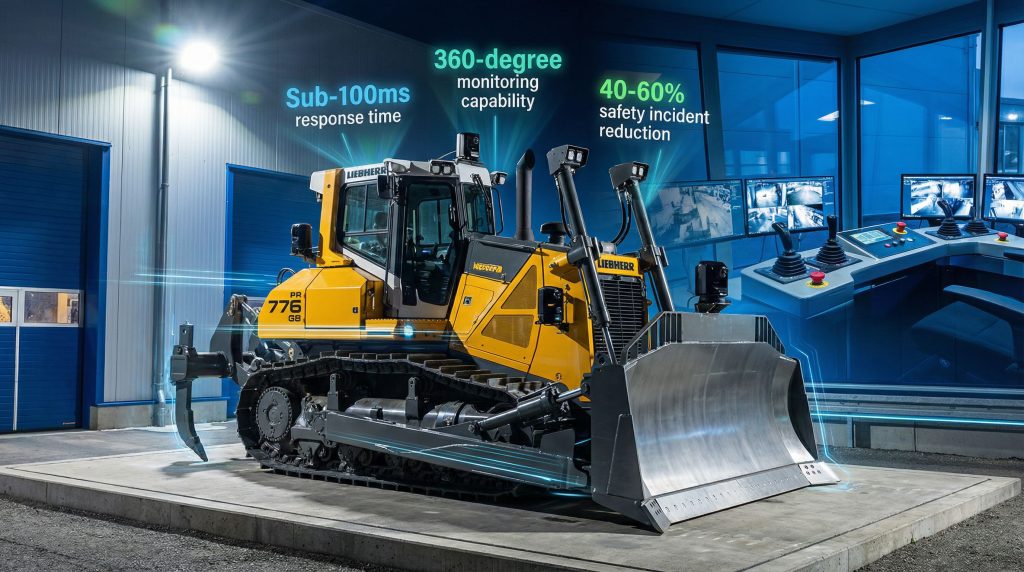
The Liebherr LiReCon teleoperation system represents a significant advancement in remote mining equipment control, revolutionising how operators manage heavy machinery in hazardous environments. Advanced sensor fusion technology has transformed industrial operations by combining multiple data streams including visual, audio, and telemetric information. Modern remote control systems deliver operational precision that often surpasses traditional direct operation methods, addressing fundamental challenges across dangerous mining environments worldwide.
Understanding Remote Mining Equipment Control Technology
Remote control technology transforms conventional equipment operation through sophisticated integration of multiple monitoring and control systems. The Liebherr LiReCon teleoperation system represents this technological advancement, enabling operators to manage heavy mining machinery from secure locations while maintaining operational accuracy and safety standards.
The core architecture combines high-resolution visual systems with precision control interfaces designed to replicate traditional cab-based operation. Multiple camera arrays positioned strategically around equipment provide comprehensive visual coverage, while audio feedback systems capture operational sounds that experienced operators rely on for performance assessment.
System Architecture Components
Modern teleoperation platforms integrate several critical elements to ensure reliable remote operation. The mining industry evolution has driven demand for increasingly sophisticated remote control capabilities across diverse operational environments.
- Multi-angle camera systems delivering high-definition visual coverage
- Precision joystick controls replicating traditional equipment operation feel
- Real-time audio feedback capturing machine operational characteristics
- Sensor networks monitoring equipment performance parameters
- Encrypted communication protocols ensuring secure data transmission
The modular design approach allows integration across diverse equipment types, from crawler dozers to wheel loaders and mining excavators. This flexibility enables mining operations to standardise remote control capabilities across their equipment fleets while maintaining operational consistency.
Communication Infrastructure Requirements
Successful teleoperation deployment depends on robust communication networks capable of handling multiple data streams simultaneously. Infrastructure options range from direct wireless systems for on-site operation to sophisticated relay networks enabling extended range control across large mining complexes.
Furthermore, 5G connectivity advancements promise ultra-low latency transmission capabilities that could significantly enhance remote control responsiveness across greater operational distances.
Network Configuration Options:
| Infrastructure Type | Range Capability | Primary Application |
|---|---|---|
| Direct wireless | Line-of-sight operation | Immediate hazard zones |
| Relay station networks | Extended site coverage | Large-scale mining operations |
| Internet-based systems | Off-site control capability | Emergency response scenarios |
| Hybrid configurations | Maximum flexibility | Complex operational environments |
When big ASX news breaks, our subscribers know first
Technical Specifications and Performance Capabilities
Remote control systems achieve operational fidelity through advanced sensor integration and precision control mechanisms. The Liebherr LiReCon teleoperation system demonstrates these capabilities through successful deployment at mining operations where traditional equipment operation presents significant safety challenges.
At SQM's Nueva Victoria iodine mine in Chile's Tarapacá region, PR 776 G8 dozers equipped with teleoperation capabilities have demonstrated strong operational performance. The 70-tonne capacity dozers showed excellent pushing power, smooth operation, good stability, and low diesel consumption during initial deployment phases.
Operational Performance Metrics
Real-world deployment data provides insight into teleoperation system capabilities across challenging mining environments. The Nueva Victoria implementation represents the first documented deployment of PR 776 G8 dozers with integrated teleoperation systems, delivered in December 2025 with operational commencement in March 2026.
Equipment Deployment Timeline:
- 2019: Initial R 9200 excavator deployment at Nueva Victoria
- Late 2024: First R 9300 excavator delivery to South America
- October 2025: Second R 9300 unit delivered
- March 2026: PR 776 G8 dozers with LiReCon capability operational
The phased activation approach demonstrates industry best practices for teleoperation implementation. Rather than immediate remote operation activation, operators initially work in traditional cab configuration to familiarise themselves with equipment characteristics before transitioning to remote control modes.
Control System Precision
Modern teleoperation maintains operational accuracy through sophisticated feedback mechanisms that can exceed traditional cab-based operation in certain scenarios. Multi-sensor data fusion provides operators with enhanced situational awareness, particularly valuable in dust-heavy environments or low-visibility conditions common in mining operations.
The system architecture enables operators to maintain full precision and performance standards even when operating equipment in high-risk areas. This capability addresses fundamental safety challenges while preserving operational productivity requirements critical to mining economics.
Safety Enhancement Through Remote Operation
Teleoperation technology addresses critical safety challenges inherent in heavy equipment operation within hazardous mining environments. By eliminating direct operator exposure to dangerous conditions, remote control systems significantly reduce injury risks while enabling continued operations in areas previously considered too dangerous for human presence.
The Nueva Victoria deployment specifically targets high-risk operational scenarios including zones with geotechnical instability, areas with proximity to highwalls or dumps, and environments characterised by increased dust or heat exposure. These conditions represent common safety challenges across mining operations globally.
Risk Mitigation Through Technology
Remote operation eliminates operator exposure to multiple hazard categories simultaneously. Beyond physical safety improvements, teleoperation systems provide operational comfort benefits that enhance overall worker welfare and job satisfaction.
Primary Safety Benefits:
- Elimination of operator exposure to unstable terrain conditions
- Reduced risk from proximity to highwalls and dump areas
- Protection from extreme temperature and dust environments
- Enhanced emergency response capabilities for crisis situations
- Improved operator comfort through controlled work environments
SQM's Operations Vice President Nelson Torres emphasised the dual benefits of safety risk reduction and operational comfort improvement, noting that operators can control dozers from the comfort of teleoperation stands, making their shift experience quieter and more pleasant while reducing risk exposure.
Implementation Safety Protocols
Successful teleoperation deployment requires comprehensive safety protocols addressing both technical system reliability and operational procedures. The phased activation approach adopted at Nueva Victoria demonstrates industry best practices for minimising transition risks.
The structured implementation process includes initial operator familiarisation with equipment in traditional cab configuration, comprehensive training on remote control systems, and gradual activation of teleoperation capabilities once operators achieve proficiency levels required for safe remote operation.
Integration with Modern Mining Equipment
The Liebherr LiReCon teleoperation system demonstrates compatibility across diverse heavy equipment categories, with documented deployments spanning crawler dozers, wheel loaders, and mining excavators. This versatility enables mining operations to standardise remote control capabilities across their equipment fleets.
SQM's equipment fleet expansion illustrates typical teleoperation integration patterns. The company's total Liebherr equipment inventory reached eight machines following the March 2026 delivery of teleoperation-equipped dozers and loaders, representing progressive fleet development since initial excavator deployment in 2019.
Compatible Equipment Categories
Modern data‑driven operations increasingly rely on integrated teleoperation capabilities to maximise equipment utilisation across challenging operational environments.
Documented Integration Examples:
| Equipment Type | Model Specification | Operational Capacity | Deployment Status |
|---|---|---|---|
| Crawler Dozer | PR 776 G8 | 70-tonne capacity | Active with teleoperation |
| Wheel Loader | L 586 XPower | Material handling spec | Active deployment |
| Mining Excavator | R 9200 series | Heavy-duty extraction | Operational since 2019 |
| Mining Excavator | R 9300 series | Advanced mining spec | Two units deployed |
System Scalability and Future Integration
The modular design architecture enables future integration with additional equipment types including excavators and cranes. This scalability provides mining operations with flexibility to expand remote control capabilities as operational requirements evolve or new equipment is added to their fleets.
Liebherr's collaborative implementation approach involves specialised expertise from multiple divisions: Liebherr Chile handles local implementation and delivery, Liebherr-Mining Equipment Colmar SAS provides regional technical support, and Liebherr-Werk Telfs GmbH supplies development centre expertise and specialist operator training.
Installation and Commissioning Methodology
Professional teleoperation system deployment follows structured phases designed to ensure successful integration with minimal operational disruption:
- Site Assessment Phase: Communication infrastructure evaluation and network capacity analysis
- Hardware Installation: Machine-side equipment integration and control station setup
- Operator Training: Comprehensive remote operation certification and familiarisation
- Gradual Implementation: Phased activation allowing operator skill development
- Full Operational Deployment: Complete remote control capability activation
This methodical approach reduces implementation risks while ensuring operators achieve proficiency levels required for safe and efficient remote operation before full system activation.
Operational Efficiency and Productivity Benefits
Teleoperation systems enhance mining operational efficiency through multiple mechanisms including reduced equipment downtime, faster operator transitions, and improved equipment utilisation in challenging environments. These benefits translate to measurable productivity improvements and operational cost reductions.
Remote control capabilities enable rapid operator shift changes at control stations, eliminating the time required for personnel to physically access equipment locations. This efficiency gain becomes particularly significant in large-scale mining operations where equipment may be positioned at considerable distances from personnel facilities.
Productivity Enhancement Factors
Modern mining operations increasingly leverage AI‑driven mining automation to complement teleoperation capabilities, creating integrated systems that maximise both safety and operational efficiency.
Key Efficiency Improvements:
- Reduced transition times: Rapid operator changes at centralised control stations
- Extended operational windows: Equipment operation in conditions unsafe for direct human presence
- Multi-equipment management: Potential for single operators to manage multiple machines
- Enhanced maintenance scheduling: Improved equipment monitoring enabling predictive maintenance
The ability to operate equipment in hazardous conditions extends effective operational hours by eliminating weather-related or safety-driven work stoppages that would otherwise halt production. This capability proves particularly valuable during emergency response situations requiring immediate equipment deployment.
Economic Impact Analysis
While specific productivity metrics vary by operation, teleoperation implementation generally demonstrates positive economic returns through multiple benefit categories. Safety-related cost reductions often represent the most significant financial impact, particularly in high-risk operational environments.
Cost-Benefit Categories:
- Insurance premium reductions through improved safety profiles
- Decreased healthcare costs related to operator exposure incidents
- Reduced equipment damage from hazardous environment operation
- Improved equipment availability through remote operation capabilities
The Nueva Victoria deployment demonstrates the strategic value mining companies place on teleoperation technology, with SQM positioning itself as a pioneer in implementation while emphasising both safety improvements and technological advancement objectives.
Industry Applications and Case Studies
Mining operations worldwide are implementing teleoperation technology to address specific operational challenges ranging from geotechnical hazards to environmental contamination. Early adopting companies report measurable improvements in safety metrics while maintaining or enhancing operational productivity.
The Nueva Victoria mine deployment represents a significant case study in teleoperation implementation within iodine mining operations. As the world's largest iodine producer, SQM's technology adoption demonstrates the strategic importance placed on remote operation capabilities by major mining companies.
Deployment Scenarios by Mining Type
Application Categories:
- Open-pit operations: High-wall stability maintenance and overburden removal in unstable areas
- Underground mining: Equipment operation in areas with ventilation or structural concerns
- Quarrying operations: Blast area cleanup and unstable slope remediation work
- Environmental rehabilitation: Equipment operation in contaminated or hazardous remediation sites
Each application category presents unique technical requirements and safety considerations that influence teleoperation system configuration and operational procedures. The versatility of Liebherr's LiReCon remote control system enables customisation for specific operational environments and risk profiles.
Performance Metrics from Active Deployments
Industry data suggests significant potential improvements across multiple operational metrics, though specific quantitative results vary based on operational environments and implementation approaches. Early adopters report positive trends in safety incident reduction and equipment utilisation improvement.
Typical Improvement Categories:
| Performance Area | Potential Improvement | Contributing Factors |
|---|---|---|
| Safety incidents | Substantial reduction potential | Eliminated operator exposure to hazards |
| Equipment utilisation | Moderate increase potential | Extended operational capability windows |
| Maintenance efficiency | Notable improvement potential | Enhanced monitoring and diagnostic capabilities |
The next major ASX story will hit our subscribers first
Future Development and Technology Evolution
The evolution of teleoperation technology points toward increased integration with artificial intelligence assistance, automated operational sequences, and expanded multi-machine control capabilities. These developments will likely enhance operational efficiency while further reducing human exposure to hazardous conditions.
Emerging technologies including 5G communication networks promise ultra-low latency transmission that could enable more responsive remote control across greater distances. Enhanced sensor networks and environmental monitoring systems will provide operators with increasingly sophisticated situational awareness capabilities.
Technology Integration Trends
Companies worldwide are showcasing innovations at events focused on global mining innovation, highlighting the industry's commitment to advancing remote operation technologies and safety systems.
Anticipated Developments:
- AI-assisted operation: Machine learning algorithms supporting operator decision-making processes
- Autonomous function integration: Hybrid systems combining remote control with automated sequences
- Advanced sensor networks: Enhanced environmental monitoring and obstacle detection capabilities
- Improved communication systems: Higher bandwidth, lower latency transmission technologies
Industry standardisation efforts are developing frameworks for teleoperation system certification, operator training requirements, and equipment interoperability standards. These developments will likely accelerate adoption by providing clearer implementation guidelines and regulatory compliance frameworks.
Regulatory and Standards Development
Standardisation Areas:
- International safety standards for remote operation systems
- Operator certification and training program standardisation
- Equipment interoperability and communication protocol requirements
- Cybersecurity standards for remote operation network security
Implementation Considerations for Mining Operations
Mining companies evaluating teleoperation adoption must assess operational requirements, infrastructure capabilities, and workforce readiness for technology integration. Successful implementation requires comprehensive planning addressing technical, operational, and organisational factors.
The Nueva Victoria deployment demonstrates effective implementation methodology through its phased activation approach. Rather than immediate full remote operation, the project includes initial operator familiarisation periods allowing personnel to develop proficiency with equipment characteristics before transitioning to remote control modes.
Pre-Implementation Assessment Framework
Critical Evaluation Areas:
- Operational risk analysis: Identification of high-risk scenarios benefiting from remote operation
- Infrastructure evaluation: Communication network capacity and reliability assessment
- Workforce impact analysis: Training requirements and organisational change management needs
- Financial modelling: Total cost of ownership versus anticipated safety and efficiency benefits
Comprehensive risk assessment helps prioritise teleoperation deployment areas where safety benefits and operational improvements provide maximum return on investment. This analytical approach ensures technology implementation focuses on scenarios with greatest potential impact.
Training and Change Management Requirements
Effective teleoperation implementation requires extensive operator development programmes combining traditional equipment operation skills with remote control system proficiency. The training approach must address both technical system operation and emergency response procedures specific to remote control scenarios.
Operator Development Components:
- Traditional equipment operation proficiency verification and certification
- Remote control system familiarisation and hands-on training programmes
- Emergency response procedure training specific to teleoperation scenarios
- Ongoing competency assessment and system update training requirements
Organisational change management becomes critical for successful technology adoption, particularly in operations where personnel may have concerns about technology displacing traditional job functions. Effective implementation emphasises technology as enhancing rather than replacing human expertise.
The collaborative approach demonstrated by Liebherr's complete remote control solution provides a model for comprehensive implementation support, combining local technical expertise with specialised development centre knowledge and ongoing training resources throughout equipment service life.
Disclaimer: This analysis is based on publicly available information and industry observations. Readers should conduct their own research and consult with qualified professionals before making investment or operational decisions related to teleoperation technology. Performance results may vary significantly based on specific operational conditions and implementation approaches.
Want to Capitalise on Mining Technology Breakthroughs?
Discovery Alert's proprietary Discovery IQ model instantly identifies significant ASX mineral discoveries, including technology-driven mining innovations that often precede major market movements. Explore how historic mining technology breakthroughs have generated substantial returns through major discoveries, then begin your 14-day free trial to position yourself ahead of the market.