
June 26, 2026
Why early works matter more than headlines in a lithium expansion
In hard-rock lithium, the most important signal often is not a headline share-price jump but where money starts moving before a board signs off on full expansion. That is because mining projects are shaped by critical-path equipment, underground access, ore sequencing, and contractor availability long before nameplate capacity ever changes.
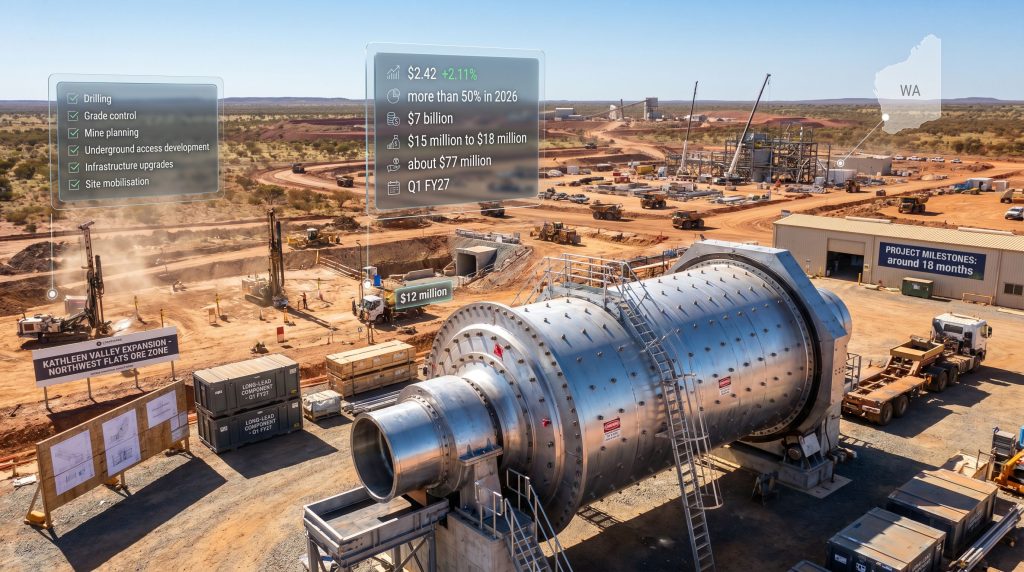
The Liontown Kathleen Valley expansion is a good example of this operating reality. Rather than waiting for a final investment decision, the company has begun early works and long-lead procurement intended to reduce schedule risk, manage costs, and improve readiness if full approval arrives on the expected timetable.
At the market level, Liontown shares were cited at $2.42, up 2.11% on the day, with a gain of more than 50% in 2026 and an approximate market value of $7 billion. Those figures reflect investor enthusiasm, but the deeper story is operational. Selective capital is being deployed ahead of FID to give the Kathleen Valley growth plan a faster runway once formal approval is made.
As a market reference point, recent coverage of Liontown stock performance helps explain why investors are tracking both execution progress and sentiment so closely.
Important note: Market prices, valuation, and project timelines can change quickly. This article is based on publicly referenced company update details and should not be treated as personal financial advice. Investors should review the latest ASX announcements, quarterly reports, and their own risk tolerance before making decisions.
What the Kathleen Valley expansion means in plain English
In simple terms, the Liontown Kathleen Valley expansion is a scale-up plan designed to increase future lithium production capacity by advancing procurement, mine development, and enabling site work before full board approval of the larger expansion programme.
This is not just another planning-stage update. It matters because real spending has already begun, which moves the project from concept work towards pre-build readiness.
Short definition
The expansion is a staged programme to lift Kathleen Valley’s future output by bringing forward mine preparation, long-lead equipment orders, and infrastructure work ahead of a final investment decision.
Why this is different from a routine project update
Several features make this stand out:
- Capital is being committed before FID, not merely studied on paper.
- Critical equipment is being ordered early, which can shorten later timelines.
- Mine planning has become more targeted, including work around the Northwest Flats orebody.
- Execution risk is being addressed upfront, rather than postponed until after board approval.
In mining terms, that suggests a shift from feasibility thinking to operational preparation. Furthermore, Liontown’s own Kathleen Valley project page provides useful context on how the asset is positioned within its broader growth strategy.
What hard numbers matter most
The headline figures help frame the scale and timing of what is happening.
Core figures to track
| Metric | Detail |
|---|---|
| Share price cited | $2.42 |
| One-day move cited | +2.11% |
| Year-to-date gain cited | More than 50% in 2026 |
| Approximate market value | $7 billion |
| Critical equipment | 5.5MW ball mill |
| Expected ball mill lead time | Around 18 months |
| Ball mill spend over next 12 months | About $12 million |
| Forecast early works spend in FY26 | $15 million to $18 million |
| Potential cumulative spend before FID | About $77 million |
| Expected FID timing | Q1 FY27 |
These numbers show that the project is not yet fully approved, but it has moved well beyond a passive watch-and-wait stage.
Why the 5.5MW ball mill is important
A ball mill is a core piece of processing equipment in hard-rock lithium operations. After ore is crushed, the mill grinds it into a finer product so downstream recovery circuits can separate valuable spodumene concentrate more effectively.
For readers less familiar with processing flows, the simplified path typically looks like this:
- Ore is mined from the deposit.
- Ore is crushed to reduce rock size.
- A ball mill grinds the crushed material into a finer slurry.
- Classification and flotation circuits help recover spodumene concentrate.
- Concentrate is filtered and shipped or sent onward in the battery-material supply chain.
Because the mill sits on the project’s critical path, a delayed order can hold up a much larger chain of work later on.
Why would a miner spend before final investment decision?
At first glance, spending before FID may seem aggressive. In practice, it is often a risk-management decision.
The logic behind pre-FID spending
A miner may bring forward spending for several reasons:
- Secure long-lead equipment before manufacturing queues lengthen.
- Reduce schedule slippage after approval is granted.
- Align mine access and planning earlier so production can ramp faster later.
- Lower procurement inflation exposure if supplier pricing is rising.
- Create optionality if commodity prices improve enough to support expansion economics.
This is particularly relevant in Western Australia, where competition for mining services, heavy equipment, and skilled labour can tighten project schedules across the sector.
Risk trade-off: wait or move early?
| Area | Wait Until FID | Start Early Works Before FID |
|---|---|---|
| Equipment ordering | Delayed | Brought forward |
| Schedule certainty | Lower | Higher |
| Capital exposure before approval | Minimal | Moderate |
| Supplier pricing risk | Higher | Potentially lower |
| Execution readiness | Slower | Faster ramp-up |
The trade-off is straightforward. Early works can de-risk timing and logistics, but they also put capital at risk if market conditions change and FID is delayed or reworked.
Key insight: In mining, missing an equipment window can be costlier than committing selective capital early. But that only holds if the underlying economics remain sound.
Which parts of the Kathleen Valley expansion are already moving?
The current work is not limited to procurement. Multiple operational streams are already underway.
Long-lead procurement
The most visible item is the 5.5MW ball mill, with an expected delivery timeline of around 18 months and roughly $12 million expected to be spent over the next year on that item alone.
That matters because mills of this scale are not off-the-shelf purchases. They usually involve engineering coordination, manufacturing slots, transport planning, installation sequencing, and commissioning integration with the broader process plant.
Mine-readiness work in progress
Liontown has indicated progress across several workstreams:
- Drilling to improve orebody definition and confidence
- Grade control to support ore selectivity and processing consistency
- Mine planning to refine extraction order and operational sequencing
- Underground access development to support future mining flow
- Infrastructure upgrades tied to expansion readiness
- Site mobilisation for people, equipment, and support functions
This focus on underground access is notable, especially given the strategic importance of an underground lithium mine in Australia’s evolving battery minerals sector.
Why Northwest Flats matters
The mention of Northwest Flats is significant because naming a specific ore zone usually indicates planning has become more detailed. In practical terms, that can imply:
- Better geological understanding of where future tonnes will come from
- More refined sequencing of underground development
- Improved visibility on ore characteristics affecting plant feed consistency
- More targeted infrastructure and access planning
For mining investors, this is one of the more useful signals in the update because it suggests work is being connected to real orebody execution rather than broad concept language. In addition, the company’s push into Liontown underground mining adds another layer of operational relevance.
How much capital is being committed before FID?
The spending profile is staged rather than all-at-once.
Pre-FID capital summary
| Spending item | Timing | Approximate value | Why it matters |
|---|---|---|---|
| Ball mill procurement | Next 12 months | $12 million | Critical-path equipment |
| Early works programme | FY26 | $15 million to $18 million | Site and mine preparation |
| Potential cumulative pre-FID spend | By expected Q1 FY27 FID window | ~$77 million | Accelerates post-approval execution |
This is an important distinction. The company has not announced that the full expansion is already approved. Instead, it has outlined staged spending intended to prepare the ground before the expected Q1 FY27 final investment decision.
What investors should infer, and what they should not
Reasonable interpretations include:
- Management is showing enough confidence to commit selective capital
- Procurement conditions are being treated as an operational constraint now
- The company wants to shorten the period between FID and active build-out
However, investors should be careful not to overread the move:
- Pre-FID spend does not equal guaranteed approval
- A larger capital commitment can still be delayed if economics soften
- Commodity prices still matter heavily in lithium project decision-making
Recent discussion around Liontown financial results also reinforces why balance-sheet discipline remains central to any expansion story.
How lithium prices influence the Kathleen Valley expansion
The economics of any lithium expansion are closely tied to commodity pricing, because higher prices improve projected margins and payback periods while lower prices can quickly compress returns.
Why pricing matters operationally, not just financially
Lithium prices affect more than valuation multiples. They influence whether boards are comfortable approving projects with:
- Longer payback periods
- Higher upfront capital intensity
- Greater tolerance for near-term execution risk
- More aggressive production growth assumptions
This is why the Liontown Kathleen Valley expansion should be viewed through both an engineering lens and a price-cycle lens. Consequently, efficiency gains in lithium extraction technology remain relevant across the broader sector, even though Kathleen Valley is a hard-rock operation.
Scenario framework
| Scenario | Lithium market backdrop | Likely impact on expansion |
|---|---|---|
| Bull | Price recovery continues | Faster approval confidence and tighter execution timetable |
| Base | Prices stabilise | Disciplined progress towards FID remains plausible |
| Bear | Prices weaken again | Delay, redesign, or slower capital commitment becomes more likely |
Watch closely: Strong engineering progress cannot fully offset a sharply weaker lithium price environment. A good project can still face slower timing if the market weakens enough.
Investor psychology in a lithium cycle
Mining equities often rerate before fundamentals are fully visible. That means rising share prices can reflect expectations of better lithium pricing, faster expansion, or improved project confidence well before a final decision lands.
This creates two common mistakes:
- Assuming a share-price rally guarantees project success
- Ignoring operational milestones because the market story looks strong
In reality, the better approach is to track both the commodity backdrop and the on-site delivery metrics.
What milestones should readers track next?
For anyone following the Liontown Kathleen Valley expansion, the next 12 to 18 months will likely be defined by operational checkpoints rather than market commentary alone.
Operational milestones
- Updates on ball mill procurement and whether delivery timing remains intact
- Progress on underground access development
- Further work from drilling and grade control at Northwest Flats
- Completion or advancement of infrastructure upgrades and mobilisation
Corporate milestones
- Confirmation that FY26 early works spending stays within the $15 million to $18 million range
- Any changes to the implied pre-FID spend ceiling of about $77 million
- A formal FID outcome targeted for Q1 FY27
Market milestones
- Lithium price direction
- Sentiment towards ASX lithium producers more broadly
- Availability of contractors, equipment, and mining services in WA
Biggest risks to the Kathleen Valley expansion
No expansion case is risk-free, especially in a cyclical commodity market.
Execution risks
- Procurement delays despite ordering early
- Underground development complexity
- Cost escalation in labour, logistics, or construction inputs
Market risks
- Renewed lithium price weakness
- Lower sector confidence affecting capital allocation discipline
- Timing mismatch between added supply and demand recovery
Strategic risks
- Spending too little, too late and losing schedule advantage
- Spending too early and carrying sunk-cost risk if FID slips
- Committing capital ahead of fully settled expansion economics
What success would look like over the next 12 to 18 months
A successful outcome would not simply mean more spending. It would mean useful spending that improves the odds of a smooth expansion decision and execution phase.
Operational success markers
- Ball mill procurement remains on track
- Mine development advances without major disruption
- Planning around Northwest Flats improves confidence in production uplift
Financial success markers
- Early works stay close to disclosed ranges
- No major pre-FID cost blowouts emerge
- Capital allocation remains disciplined relative to market conditions
Strategic success markers
- FID is reached in Q1 FY27
- Expansion is justified by returns, not just higher tonnage ambitions
- Kathleen Valley strengthens its role as a long-duration WA lithium asset
FAQ: Liontown Kathleen Valley expansion
When is the final investment decision expected?
Based on the referenced company update, the expected timing is Q1 FY27.
How much is being spent before FID?
Early works are estimated at $15 million to $18 million in FY26, while cumulative pre-FID commitments could rise to about $77 million.
What equipment has been prioritised?
A 5.5MW ball mill has been identified as a priority item, with an expected lead time of around 18 months.
Why is early procurement important?
It can reduce schedule pressure, improve contractor and supplier coordination, and potentially lower exposure to future equipment price increases.
What could derail the expansion?
The biggest threats include weaker lithium prices, procurement setbacks, cost escalation, underground development challenges, or a delayed or negative FID outcome.
Final take
The central point in the Liontown Kathleen Valley expansion is not simply that money is being spent. It is where that money is being directed: critical-path processing equipment, mine access, geological and grade-control work, infrastructure readiness, and mobilisation.
That makes this less of a headline-driven growth story and more of an operational de-risking exercise. If the pre-FID work genuinely improves execution speed and lowers later bottlenecks, today’s selective spending could translate into a faster and more controlled rollout after approval.
For investors and industry watchers alike, the real question is whether disciplined early action now can convert into lower-risk growth once the board reaches its Q1 FY27 decision point. That, more than short-term share price momentum, is what will define whether this expansion creates durable value.
Looking For The Next Major ASX Discovery?
While project milestones like Liontown’s early works can shape long-term value, Discovery Alert helps investors act faster by delivering real-time ASX mineral discovery alerts powered by Discovery Alert’s proprietary Discovery IQ model. To see why major discoveries can drive exceptional market returns, explore Discovery Alert’s discoveries page and start a 14-day free trial today.