
June 26, 2026
The Hidden Complexity Behind Hard Rock Lithium's Most Watched Ramp-Up
When a mine transitions from open-pit to full underground operations, it crosses one of the most technically demanding thresholds in the entire mining lifecycle. Ground conditions, equipment performance, ore access geometry, and processing consistency all converge at once. Most large-scale operations experience cost overruns, schedule delays, or grade surprises during this transition. The fact that Kathleen Valley completed this shift in December 2025 and did so on schedule is, in the context of modern mining development, a genuinely uncommon outcome.
That credibility now underpins something more consequential: Liontown's decision to move from expansion planning into active capital deployment. The Liontown Kathleen Valley lithium expansion is no longer a study-phase aspiration. It is an execution-phase program with real capital committed, real equipment on order, and a formal Final Investment Decision targeted for the end of Q1 FY27.
Understanding what this means requires more than a headline read. The strategy involves layered engineering decisions, deliberate capital sequencing, and a multi-orebody underground lithium mine being prepared to operate at a scale that will reshape Liontown's production profile for decades.
When big ASX news breaks, our subscribers know first
Why the Kathleen Valley Resource Is Structurally Differentiated
Scale, Grade, and Jurisdiction in a Single Asset
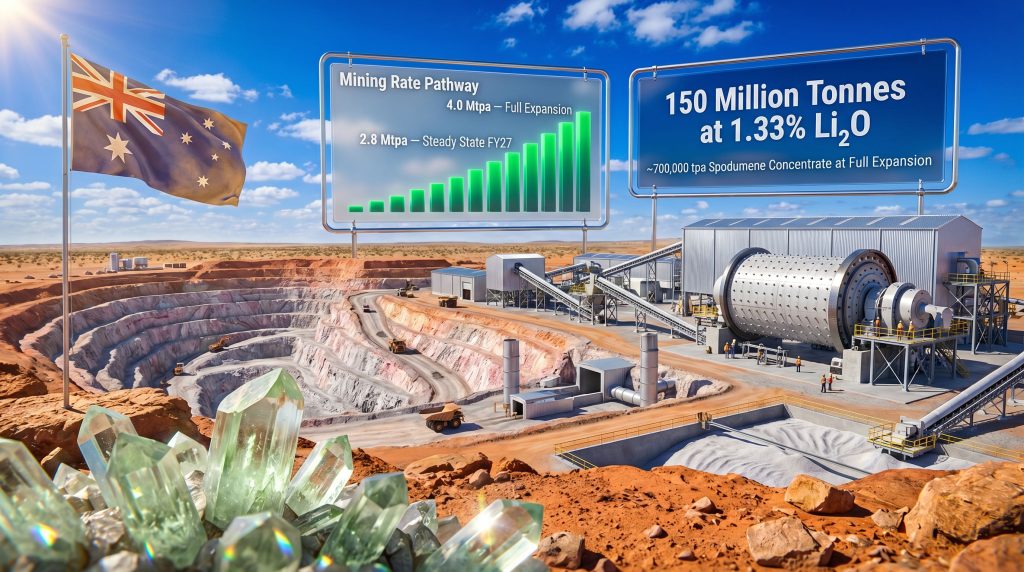
Kathleen Valley sits within Western Australia's premier hard rock lithium corridor, hosting a mineral resource base of approximately 150 million tonnes at 1.33% Li₂O. In hard rock lithium terms, this combination of tonnage and grade is relatively rare globally. Most large-scale spodumene producers operate with either higher grades over smaller resource footprints, or lower grades across vast tonnages that challenge processing economics.
The 1.33% Li₂O grade sits within a technically viable processing window for conventional spodumene flotation and dense media separation circuits. Importantly, the multi-decade resource life implied by this tonnage means infrastructure capital can be amortised over a far longer production horizon than shorter-life deposits, fundamentally improving project economics on a per-tonne basis.
Unlike exploration-stage lithium projects that populate much of the ASX, Kathleen Valley is a producing, cash-generating, ramping operation. This distinction carries material weight in a capital-constrained environment where investor patience for greenfield development has narrowed considerably.
The Open-Pit-to-Underground Transition: Why It Matters More Than It Looks
One detail that receives insufficient attention in conventional market commentary is the operational complexity of what Kathleen Valley has already achieved. The Kathleen's Corner open pit has been completed, meaning the operation's entire future production profile is now dependent on underground extraction. Furthermore, this is not simply a transition in equipment or access method. It represents a fundamental shift in:
- Ore dilution management, since underground mining introduces different grade control challenges compared to open-pit bench blasting
- Ground support requirements, which escalate significantly as mining depths increase
- Ventilation design, since diesel-powered underground equipment generates heat and emissions that must be actively managed through engineered airflow systems
- Backfill strategy, which becomes essential when multiple underground orebodies are mined simultaneously to maintain ground stability
Completing this transition on schedule, with equipment performance consistent with original feasibility assumptions, validates the mine's geological model and builds confidence in the expansion study's technical foundations. For a deeper look at Liontown underground mining operations, the technical achievements to date are particularly instructive.
What the CY26 Expansion Program Actually Involves
From Study Phase to Pre-Execution: The Capital Deployment Logic
The Liontown Kathleen Valley lithium expansion program initiated in CY26 reflects a deliberate sequencing philosophy that mining professionals call the critical path compression approach. Rather than deferring all capital until a formal investment decision is made, the strategy commits funds to long-lead items and preparatory works that would otherwise sit on the critical path between FID approval and first incremental production.
The pre-FID expenditure framework breaks down as follows:
| Expenditure Category | Estimated Cost |
|---|---|
| FY26 early works program | $15M to $18M |
| Ball mill procurement (next 12 months) | ~$12M |
| Total pre-FID forecast spend | Up to $77M |
This is not speculative capital. Each dollar committed ahead of FID is designed to either reduce schedule risk, improve cost certainty on major equipment items, or generate data that increases the quality of the formal investment decision itself. According to early works announcements, procurement activity is already underway across several critical equipment categories.
The 5.5MW Ball Mill: A Single Equipment Decision With Compounding Consequences
The procurement of a 5.5MW ball mill is the centrepiece of the current pre-FID capital program, and understanding why requires a brief technical detour into hard rock lithium processing.
In spodumene processing circuits, the ball mill performs secondary grinding after primary crushing, reducing ore particle size to a range that enables effective mineral liberation. Grind size is critical because:
- Under-grinding leaves spodumene crystals locked within gangue minerals, reducing flotation recovery rates and producing lower-grade concentrate
- Over-grinding produces ultrafines that are difficult to float and reduce overall plant efficiency
- Optimal grind size control directly lifts both concentrate grade (measured as percentage Li₂O in final product) and plant recovery (the proportion of lithium in feed ore that reports to final concentrate)
The 5.5MW rating indicates a substantial machine capable of handling the ore volumes associated with throughput rates well above current steady-state targets. Procurement lead times for ball mills of this specification typically extend between 18 and 24 months, meaning an order placed now compresses the schedule between FID (end of Q1 FY27) and first expanded production by the same margin.
Ball mill sizing in hard rock lithium circuits is one of the most consequential decisions in plant design. An undersized mill creates a permanent processing bottleneck, while an oversized mill introduces unnecessary capital cost. The 5.5MW specification signals Liontown's confidence in the 4.0 Mtpa expansion pathway.
Debottlenecking as a Near-Term Throughput Lever
Running parallel to the ball mill procurement, debottlenecking initiatives are targeting incremental throughput improvements from existing installed infrastructure. This approach is standard in the transition period between initial ramp-up and formal expansion, and it serves a dual purpose: it extracts value from sunk capital before new spend is layered in, and it generates real operating data that informs expansion study assumptions.
In practice, debottlenecking in a spodumene processing circuit typically focuses on areas such as crusher feed management, screen efficiency, flotation circuit retention time, and tailings handling capacity. Improvements in any of these areas can yield measurable throughput gains without requiring significant additional capital.
Underground Mine Preparation: The Technical Groundwork for Expansion
Northwest Flats Orebody Drilling Program
Pre-development drilling across the Northwest Flats orebody is targeting three distinct but interconnected outcomes:
- Resource definition – tightening the geological model to convert inferred resources to indicated and measured categories, which carry higher confidence weightings in mine scheduling
- Grade control modelling – building a block model with sufficient resolution to predict ore grade variability at the mining face, reducing dilution risk at higher extraction rates
- Mine scheduling support – establishing the ore availability framework that underpins production scheduling for the expanded operation
This drilling program is particularly important because grade variability in underground lithium mines can have outsized consequences. Unlike bulk commodity mines where blending moderates grade swings, a spodumene concentrator performing optimal flotation is calibrated to a relatively consistent feed grade. Significant deviations from expected feed grade require circuit adjustments that can temporarily reduce recovery rates.
Paste Backfill Plant and Multi-Orebody Extraction
The paste backfill strategy being advanced at Kathleen Valley deserves particular attention because it is the operational enabler for simultaneous extraction across multiple orebodies. Without effective backfill, the open voids left by underground mining accumulate and destabilise surrounding rock mass, eventually restricting access to adjacent ore zones.
Paste backfill works by mixing processing plant tailings with Portland cement and water to create a flowable, stiff mixture that is pumped underground and sets to provide structural support. At Kathleen Valley, the paste plant is designed with initial capacity targeting 3 Mtpa, providing the ground management infrastructure necessary for the expanded 4.0 Mtpa operation.
Critically, this is not simply a safety measure. It is a production enabler. Without robust backfill capacity, the mine cannot simultaneously develop and extract multiple ore zones, which is essential for sustaining the ore feed rates required at 4.0 Mtpa throughput.
New Infrastructure: Portals, Ventilation, and the Mine Services Area
With the completion of Kathleen's Corner open pit, all future ore access relies on underground portals and declines. New portal construction, ventilation raise installation, and power infrastructure upgrades are being progressed to expand underground access ahead of the formal expansion capital commitment.
Construction of Stage 1 of the permanent Mine Services Area (MSA) is underway, with the facility designed to support an expanded mining fleet and increased personnel headcount. The operation currently employs over 300 people, a figure expected to grow substantially as the mine scales toward 4.0 Mtpa throughput.
The 4.0 Mtpa Expansion: What Full Scale Looks Like
Production Architecture at Expanded Capacity
The expansion study, now being refreshed using nearly two years of real operating data rather than pre-production feasibility assumptions, evaluates a pathway to 4.0 million tonnes per annum of mining throughput. This represents a 43% step-up from the 2.8 Mtpa steady-state target currently being approached.
The production scenarios compare as follows:
| Production Scenario | Mining Rate | Spodumene Concentrate Output |
|---|---|---|
| Current ramp-up trajectory | 1.5 Mtpa (end Q1 FY26) | Partial steady-state |
| Steady-state target | 2.8 Mtpa | ~500,000 tpa |
| Full expansion (post-FID) | 4.0 Mtpa | ~700,000 tpa |
| Downstream refining potential | Processing only | Up to 86,000 tpa lithium hydroxide |
A critical but frequently overlooked aspect of the expansion study is that it is being built on real operational data rather than desktop assumptions. By refreshing the study after nearly two years of production, Liontown reduces the risk that the 4.0 Mtpa pathway is built on assumptions that diverge from operational reality. Consequently, the Liontown financial results from this period provide valuable context for assessing how closely early performance has tracked feasibility projections.
Alternative Underground Access Configurations Under Evaluation
The expansion study is also assessing alternative underground access configurations to optimise ore flow geometry at higher extraction rates. This type of analysis — examining portal locations, decline gradients, haulage loop designs, and level spacing — becomes increasingly important as production scale increases because haulage efficiency directly influences operating costs per tonne.
At 4.0 Mtpa, even a modest improvement in underground haulage efficiency translates to meaningful unit cost reduction across the mine's operating life.
The Downstream Refining Pathway
From Spodumene Concentrate to Battery-Grade Lithium Hydroxide
Kathleen Valley's resource scale supports a downstream refining pathway that could produce up to 86,000 tonnes per annum of battery-grade lithium hydroxide, depending on processing configuration and deployment timing. This would represent a transformation from raw concentrate supplier to vertically integrated battery materials producer. In addition, advances in lithium extraction technologies continue to open new processing pathways that may influence future downstream configuration decisions.
Converting spodumene concentrate to lithium hydroxide monohydrate (LiOH·H₂O) requires calcination of the spodumene to convert alpha-spodumene to the more reactive beta form, followed by sulphatisation, leaching, purification, and crystallisation. The multi-step nature of this process and the capital intensity of refinery construction make phased deployment the most capital-efficient approach for most project developers. Liontown's downstream expansion plans provide further detail on how this refining pathway is expected to be structured commercially.
Strategic Partnerships Anchoring the Commercial Framework
The binding offtake and partnership framework supporting Kathleen Valley reflects a deliberate strategy to secure demand across multiple end markets and geographies:
- LG Energy Solution: An extended 10-year offtake agreement combined with collaboration on an IRA-compliant lithium hydroxide refinery, targeting the United States battery supply chain
- Sumitomo: A partnership focused on lithium hydroxide production for the Japanese market, aligned with Japan's domestic critical minerals security agenda
- Tesla and Ford: Binding spodumene concentrate offtake agreements covering a portion of steady-state production
- Canmax Technologies: Additional offtake providing geographic diversification across the customer base
The IRA-compliance angle of the LG Energy Solution partnership is worth understanding in detail. The US Inflation Reduction Act contains domestic content requirements that affect eligibility for electric vehicle tax credits. Battery cells manufactured with materials sourced from IRA-compliant supply chains can qualify for credits that materially reduce the cost of EV ownership. This creates a structural demand premium for lithium hydroxide produced by supply chains that satisfy IRA sourcing rules, making an IRA-compliant refinery a commercially differentiated asset rather than simply a processing facility.
The next major ASX story will hit our subscribers first
Capital Discipline in a Volatile Lithium Market
Reading the Strategic Rationale Behind the Staged Approach
The decision to advance pre-FID works in CY26 while deferring the formal capital commitment until end of Q1 FY27 is a carefully constructed response to lithium market conditions. After a period of significant spodumene price compression from 2023 through 2025, the staged expansion model preserves what option theorists call real option value: the ability to accelerate, moderate, or pause expansion capital in response to real-time market signals.
For investors assessing the Liontown Kathleen Valley lithium expansion, understanding this framework is essential. The pre-FID spend of up to $77 million is not a sunk cost in the traditional sense. It is structured to:
- Compress the critical path between FID and first incremental production
- Provide cost certainty on major equipment in a market where supply chains for large grinding mills remain constrained
- Generate geological and operational data that reduces uncertainty in the formal investment decision
- Demonstrate operational competence and planning discipline to offtake partners and institutional capital
Investors monitoring this expansion should treat the pre-FID expenditure program as a capability-building exercise rather than a capital deployment event. The real capital decision, and the real production catalyst, comes when the FID is formally approved at end of Q1 FY27.
The NAIF Co-Investment Signal
The Northern Australia Infrastructure Facility (NAIF) committed $50 million in 2024 to support Kathleen Valley's production ramp-up and underground transition. Government co-investment at this scale functions as an independent due diligence signal for private capital markets, indicating that the project's infrastructure economics and long-term production viability have been assessed by a financing body operating under its own credit and risk standards. This is not project-specific government backing in any operational sense, but it does reflect institutional recognition of the project's multi-decade production horizon and infrastructure significance. However, Liontown stock performance in the period following this commitment illustrates how market sentiment has continued to weigh the broader lithium price environment against these positive operational signals.
Key Decision Gates and Investor Watchpoints
The Milestone Framework from Now to FID
| Milestone | Timing | Significance |
|---|---|---|
| Northwest Flats drilling results | Q3 FY26 | Resource definition updates informing expansion study |
| Updated 4.0 Mtpa expansion study | Q4 FY26 to Q1 FY27 | Built on real operating data rather than pre-production assumptions |
| Final Investment Decision | End Q1 FY27 | Formal capital commitment to 4.0 Mtpa pathway |
| Ball mill delivery and installation | Post-FID | Triggers incremental throughput ramp |
| First expanded production | Post-FID ramp | Confirmation of 4.0 Mtpa trajectory |
The FID represents the single most consequential near-term catalyst in the Liontown Kathleen Valley lithium expansion story. A positive FID would formally commit capital to the 4.0 Mtpa pathway, trigger underground infrastructure development across new ore zones, and validate management's confidence in both operational performance and market fundamentals.
Equally, investors should monitor the quality of Northwest Flats drilling results in the months preceding the FID. Unexpected grade variability, unfavourable geotechnical conditions, or resource estimate revisions could influence both the expansion study outcomes and the FID timeline.
Frequently Asked Questions
What is the current production capacity at Kathleen Valley?
Kathleen Valley achieved a 1.5 Mtpa run rate by the end of Q1 FY26 and is targeting 2.8 Mtpa as its steady-state mining rate by the end of FY27, which is expected to produce approximately 500,000 tonnes per annum of spodumene concentrate. The operation completed its transition to 100% underground mining in December 2025.
What does the 4.0 Mtpa expansion involve?
The expansion targets a 4.0 million tonne per annum mining rate, expected to yield approximately 700,000 tonnes per annum of spodumene concentrate. It requires new underground portals, expanded ventilation, a 5.5MW ball mill, debottlenecking of the processing plant, and a paste backfill plant capable of supporting simultaneous backfilling of multiple orebodies.
When is the Final Investment Decision expected?
The FID is targeted for the end of Q1 FY27, following completion of the refreshed expansion study.
How much is being spent before the FID?
Total pre-FID expenditure is forecast at up to $77 million, including $15 to $18 million in FY26 early works and approximately $12 million for ball mill procurement over the next 12 months.
Who are Kathleen Valley's major offtake partners?
Binding agreements are in place with LG Energy Solution, Tesla, Ford, and Canmax Technologies, providing commercial coverage across the battery and electric vehicle supply chain.
What is the downstream refining potential?
The resource base supports a pathway to producing up to 86,000 tonnes per annum of battery-grade lithium hydroxide, deployable in phased processing trains either domestically or co-located near key customer markets.
This article is intended for informational purposes only and does not constitute financial or investment advice. Forecasts, production targets, capital expenditure estimates, and expansion timelines discussed herein are forward-looking statements subject to risks, uncertainties, and material changes. Past operational performance does not guarantee future results. Readers should conduct their own independent research and consult a licensed financial adviser before making any investment decisions.
Want to Catch the Next Major Lithium Discovery Before the Market Does?
Discovery Alert's proprietary Discovery IQ model instantly identifies significant ASX mineral discoveries — turning complex geological data into actionable investment insights the moment they are announced — so explore the historic returns major discoveries have delivered and begin your 14-day free trial to position yourself ahead of the broader market.