Litchfield Minerals Ltd
- ASX Code: LMS
- Market Cap: $29,143,521
Litchfield Minerals Confirms Broad Copper-Zinc Mineralisation at Oonagalabi While Uncovering Rare Nickel-Molybdenum Discovery
Litchfield Minerals Limited (ASX: LMS) has released assay results from its Phase 3 drilling campaign at the Oonagalabi Project in the Northern Territory, and the Litchfield Minerals Oonagalabi copper zinc drilling results and nickel molybdenum discovery have simultaneously reinforced the project's base metal credentials while opening new questions about the scale and complexity of the underlying mineral system. The programme completed 11 RC holes totalling 1,772 metres and three diamond holes totalling 1,217.9 metres, targeting multiple zones across exploration licence EL32279, approximately 125km northeast of Alice Springs.
The headline drilling intercepts confirm continued lateral and vertical continuity of copper-zinc mineralisation in the Oonagalabi Main Zone. At the same time, the identification of an unusual nickel-molybdenum-bearing hydrothermal vein at the Bomb Diggity target adds a layer of geological intrigue that the company believes supports a multi-event, potentially district-scale mineral system.
"While this drilling campaign generated as many questions as answers, each result has contributed to a better understanding of the geological system. Collectively, these datasets are helping us build and refine the geological model, which we believe is critical to unlocking the full potential of the Oonagalabi region."
— Matthew Pustahya, Managing Director, Litchfield Minerals Limited
When big ASX news breaks, our subscribers know first
Drilling Highlights at a Glance
The Phase 3 campaign tested four distinct targets: the Oonagalabi Main Zone, Bomb Diggity, VT1, and VT2. The most significant mineralisation was returned from the Main Zone, with several holes delivering broad, stacked copper-zinc intercepts from near surface.
| Hole ID | Intercept | Cu % | Zn % | Ag g/t | From (m) |
|---|---|---|---|---|---|
| OGDD002 | 68.26m | 0.62 | 1.44 | 4.3 | 10m |
| OGRC029 | 120m | 0.35 | 0.92 | 4.1 | 52m |
| OGRC028 | 39m | 0.69 | 1.14 | 5.3 | 60m |
| OGRC031 | 21m | 0.38 | 1.85 | 4.1 | 18m |
| OGRC031 | 19m | 0.39 | 1.58 | 5.9 | 55m |
| OGRC022 | 50m | 0.47 | 1.36 | 4.2 | 2m |
All widths are downhole; true widths are not yet known.
Standout internal high-grade zones within the broader intercepts further illustrate the system's potential:
- Within OGDD002: 19.01m at 1.06% Cu, 0.70% Zn and 5.0 g/t Ag from 143.14m
- Within OGDD002: 19.66m at 0.66% Cu, 2.58% Zn and 5.6 g/t Ag from 10m
- Within OGRC029: 60m at 0.52% Cu, 1.26% Zn and 6.3 g/t Ag from 52m
- Within OGRC022: 37m at 0.53% Cu, 1.54% Zn and 4.9 g/t Ag from 2m
The near-surface nature of several of these intercepts — with mineralisation commencing from as shallow as 2m depth — is a logistically meaningful characteristic for any future development scenario.
Understanding the Geology: What Is a Stacked Mineralised Package?
One of the most important concepts in this announcement is the idea of a stacked mineralised package. For investors less familiar with exploration geology, however, it is worth unpacking what this means and why it matters.
What Is It?
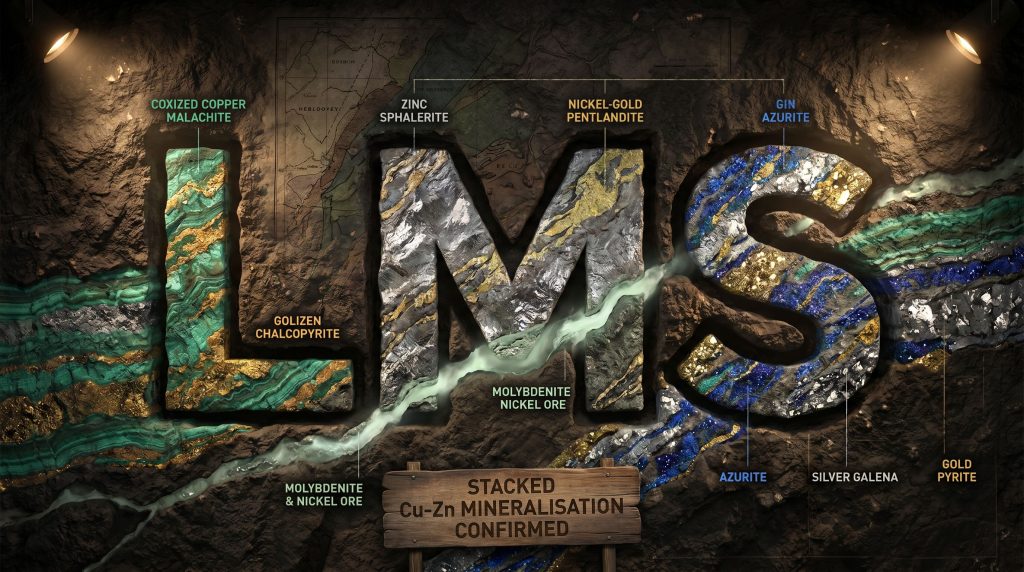
A stacked mineralised package refers to multiple layers or lenses of mineralisation sitting on top of or adjacent to one another within the same drill hole. Rather than a single thin seam of ore, the drill intersects several mineralised zones at different depths, often separated by thin intervals of lower-grade or unmineralised rock.
Why Does It Matter?
Stacked packages are significant because they suggest the mineralising system deposited metals across a broad vertical and lateral extent, rather than in isolated pockets. This increases the likelihood that a larger, potentially economic volume of mineralised rock exists within the deposit.
Furthermore, when these packages are encountered near surface — as they are at Oonagalabi — they can have practical implications for the economics of any future mining scenario, as shallow ore is generally cheaper to access.
How Does This Apply at Oonagalabi?
Drill hole OGRC029's 120m combined intercept at 0.35% Cu, 0.92% Zn and 4.1 g/t Ag from 52m is a clear example. It incorporates three distinct mineralised zones at different depths within the one hole, consequently confirming both vertical extent and the concept of stacking.
Glossary of Key Terms
- RC Drilling (Reverse Circulation): A drilling method where rock chips are returned to surface through the drill rods. Faster and more cost-effective than diamond drilling; used for broad sampling.
- Diamond Drilling: A method using a rotating diamond-tipped drill bit to recover continuous cylindrical core samples. Provides high-quality geological information on rock textures and structures.
- Chalcopyrite: The primary copper iron sulphide mineral, the most commonly mined source of copper.
- Sphalerite: Zinc iron sulphide, the main ore mineral for zinc.
- Molybdenite: A molybdenum disulphide mineral; the primary ore of molybdenum, a metal used in high-strength steel alloys.
- Pyrrhotite / Pyrite: Iron sulphide minerals; often associated with base metal mineralisation and relevant to geophysical electromagnetic (EM) responses.
- Magnetotelluric (MT) Survey: A geophysical technique that uses natural variations in Earth's electromagnetic field to map subsurface electrical conductivity, useful for identifying deep conductive bodies that may represent mineralised systems.
- Induced Polarisation (IP) Survey: A geophysical method that identifies subsurface chargeability anomalies, commonly used to detect sulphide mineralisation.
- Re-Os Chronology: Rhenium-Osmium radiometric dating; applied to molybdenite to determine the precise age of mineralising events.
The Bomb Diggity Discovery: Nickel and Molybdenum in an Unusual Hydrothermal Vein
Among the most geologically striking findings from Phase 3 was the identification at Bomb Diggity of a hydrothermal quartz-carbonate vein carrying molybdenite, iron sulphides, and what the company describes as either a nickel-bearing sulphide mineral (potentially pentlandite) or nickeliferous pyrite/pyrrhotite. This 10cm-wide vein was intersected at 617.2m depth in hole OGRD001.
The sampled 2m composite interval (617–619m) returned the following results:
| Metal | Concentration |
|---|---|
| Molybdenum (Mo) | 626 ppm |
| Nickel (Ni) | 206 ppm |
| Sulphur (S) | 7,150 ppm |
The company notes that because the assay interval is a 2m composite, the true grade of the narrow vein itself is likely substantially higher than reported figures suggest, as the vein material has been diluted across the full 2m sample.
The co-occurrence of nickel and molybdenum within a single hydrothermal vein crosscutting the main foliation fabric is considered geologically unusual. The company's initial interpretation is that this could represent a previously unrecognised mineralising event. Molybdenite from the vein has already been submitted for Re-Os chronology, which will provide a precise age for this event and help determine whether it is temporally distinct from the copper-zinc mineralisation in the Main Zone.
Confirmation of younger hydrothermal nickel-molybdenum mineralisation would, in addition, support an emerging model of multiple separate mineralising episodes occurring across the broader Oonagalabi district — a characteristic typically associated with larger, more complex mineral systems.
The Bomb Diggity magnetic anomaly itself, however, remains unexplained. Despite drilling intersecting sulphides and the unusual vein, neither geology nor assay results account for the strength of the anomaly. The company intends to integrate the new drilling data with updated geophysical models to refine the interpretation.
Geophysical Targets Remain Open: VT1 and VT2
The Phase 3 campaign also tested electromagnetic and IP targets at VT1 and VT2, with mixed outcomes that nevertheless leave these areas as live exploration targets.
VT1
Hole OGRC026 clipped the top of two modelled 200-siemen EM plates, logging trace pyrite and pyrrhotite with assay concentrations broadly correlating with the plate pierce points. Hole OGRC027 tested a modelled 3,000-siemen EM conductor and intersected disseminated pyrrhotite, pyrite and minor chalcopyrite in metamafic and felsic gneiss, returning a best result of 2m at 0.16% Cu from 27m.
Critically, a 3,000-siemen conductor requires a substantially larger volume of conductive material than what was observed. The company notes that limited drill rig availability during the campaign window meant it could not use preferred high-precision positioning equipment, which may have caused the drill holes to test the margins of modelled conductors rather than their core.
Furthermore, the copper and iron sulphides at VT1 appear to differ from the Main Zone mineralisation in both host rock (metamafic rather than calc-silicate/gneiss) and sulphide assemblage (lacking sphalerite), suggesting a potentially distinct mineralisation style.
VT2
Two holes at VT2 failed to intersect significant copper or zinc mineralisation. OGRC024 pierced the centre of a modelled EM plate without logging sulphides, while OGRC025 returned only trace pyrite associated with quartz-sericite veins.
A Maturing Regional Picture: The Aileron-Irindina Province Concept
Beyond the hole-by-hole results, the Phase 3 campaign has contributed to an emerging and potentially significant regional geological thesis. Litchfield's geological team is developing the view that Oonagalabi may sit within, or adjacent to, a large-scale mineral system associated with the interpreted boundary between the Aileron and Irindina geological provinces.
This concept is supported by publicly available AUSLAMP magnetotelluric data, which indicates conductivity anomalies beneath and immediately west of Oonagalabi at a 10km reading spacing. These features could represent deep crustal fluid pathways of the type associated with large base metal provinces.
To test this concept at higher resolution, Litchfield — in conjunction with the BHP Xplor programme — is progressing plans for two approximately 50km-long north-south MT survey lines at 1km spacing across granted and application tenure in the Harts Range region. These surveys are designed to determine whether large conductive bodies exist at depth beneath Oonagalabi and adjacent parts of the belt.
The BHP Xplor programme is a separate initiative and its involvement in co-funding or planning surveys does not imply any endorsement of specific mineralisation outcomes. The planned surveys require approval before commencement.
What Comes Next: The Path Forward for Oonagalabi
The Phase 3 results, while complex, have generated a clear and prioritised workplan. The company has outlined the following near-term activities:
-
Integration of assays, petrology and geophysics to refine 3D targeting models, with the next drilling campaign to focus on high-confidence, structurally constrained targets in the Main Zone.
-
Petrology work to establish the timing and nature of mineralisation at Oonagalabi — particularly whether sulphides crosscut, or have been subsequently deformed by, the main foliation fabric.
-
Re-Os molybdenite chronology and petrology on the unusual nickel-molybdenum-bearing quartz vein at Bomb Diggity — already underway.
-
Magnetotelluric and ground gravity surveys planned across EL32279 in conjunction with the BHP Xplor programme, pending approval.
-
Induced Polarisation (IP) survey at Silver Valley to identify sulphide-bearing extensions at depth to the high-grade silver-bearing quartz vein system identified at surface. Fieldwork is already underway at Silver Valley and the Brumby Bore area.
-
Drill testing at Mount Irene copper prospect within the Mount Doreen Project, targeting a large chargeability anomaly from previous geophysical surveys.
-
Further drilling at Oonagalabi following integration of drilling, geophysical and geological datasets, aimed at refining target definition across the broader mineral system.
The near-term pipeline consequently spans multiple projects and workstreams concurrently, giving the company multiple potential newsflow catalysts across the balance of 2025 and into 2026.
The next major ASX story will hit our subscribers first
Why Oonagalabi Deserves Continued Investor Attention
Several characteristics of the Oonagalabi Project distinguish it as a compelling exploration story worth monitoring closely, particularly in light of the Litchfield Minerals Oonagalabi copper zinc drilling results and nickel molybdenum discovery announced in Phase 3.
Consistent broad mineralisation from near surface. Multiple Phase 3 holes returned copper-zinc intercepts commencing within the first few metres of drilling. Shallow, broad mineralisation is inherently more amenable to economic extraction than deep, narrow zones.
Growing geological complexity suggests scale. The identification of multiple mineralisation styles — Main Zone copper-zinc, metamafic-hosted copper at VT1, and now a hydrothermal nickel-molybdenum vein at Bomb Diggity — points to a system with more components than initially modelled. Complex, multi-event systems in frontier terranes often signal proximity to much larger bodies of mineralisation.
Unresolved high-priority geophysical targets. The Bomb Diggity magnetic anomaly and the 3,000-siemen VT1 conductor both remain unexplained following Phase 3 drilling. Rather than being negative outcomes, these represent targets that require better-constrained drilling and remain open for further investigation.
Regional scale potential. The emerging Aileron-Irindina Province boundary concept, if supported by the planned high-resolution MT surveys, could reframe Oonagalabi from a standalone deposit into a component of a district-scale mineral system — a material step-change in the exploration story.
Active multi-project portfolio. Beyond Oonagalabi, Litchfield holds the Silver Valley silver project in the Davenport Ranges and the Mount Doreen Project, with active fieldwork and planned drill testing across multiple targets. This broadens the company's exposure to potential discovery catalysts.
Assay results pending from OGDD003. The mineralised zone in diamond hole OGDD003 is still awaiting laboratory results, representing an additional near-term catalyst that has not yet been factored into the current picture.
Key Takeaway:
Litchfield Minerals (ASX: LMS) has positioned itself as an active base metals explorer with a genuinely complex and evolving geological story at Oonagalabi. With broad copper-zinc mineralisation continuing to be confirmed at multiple drill holes, unresolved geophysical anomalies pointing to undiscovered sources, and the Litchfield Minerals Oonagalabi copper zinc drilling results and nickel molybdenum discovery opening new lines of geological inquiry, the coming 12 months could be transformative in defining what Oonagalabi truly represents. Investors with an appetite for early-stage discovery narratives backed by genuine geological data should keep a close eye on developments.
Ready to Dig Deeper Into Litchfield Minerals' Oonagalabi Discovery?
With broad copper-zinc mineralisation confirmed from near surface, an unusual nickel-molybdenum discovery at Bomb Diggity, and a pipeline of upcoming catalysts spanning multiple projects, Litchfield Minerals (ASX: LMS) is shaping up as one of the more compelling base metals exploration stories on the ASX. To learn more about the company, its projects, and the evolving geological story at Oonagalabi, visit www.litchfieldminerals.com.au.