July 8, 2026
The Lithium Americas Thacker Pass project represents a pivotal development in North America's transition toward domestic critical mineral security, combining federal partnership models with advanced processing technology to establish large-scale lithium production capacity. Furthermore, this ambitious undertaking demonstrates how strategic government involvement can catalyse private sector investment in essential energy transition infrastructure.
Clay-hosted lithium deposits present distinct advantages over traditional brine extraction methods, offering more predictable resource characterisation and potentially higher recovery rates through advanced acid leaching processes. This geological advantage, combined with strategic geographic positioning, has positioned certain Nevada projects at the forefront of North American lithium development.
The integration of government partnership models with automotive industry offtake agreements represents a novel risk mitigation approach in critical mineral development. This financial architecture reduces traditional mining project uncertainties whilst ensuring strategic supply chain alignment between domestic production capacity and end-user manufacturing requirements.
Understanding Nevada's Lithium Superproject Scale and Infrastructure Development
The McDermitt Caldera region spans approximately 18,000 acres of strategically positioned lithium resources, with active mining operations planned across less than one-third of this footprint. This extensive land base supports both current development phases and long-term expansion potential extending across multiple decades of production capacity.
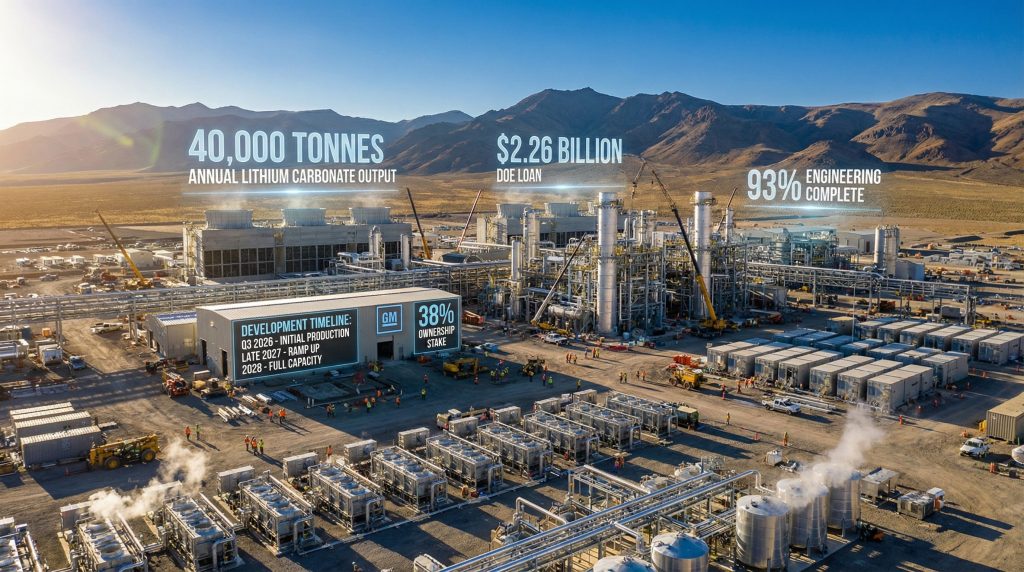
Phase 1 operations target 40,000 tonnes annual lithium carbonate output, sufficient to supply battery materials for approximately 800,000 electric vehicles annually. The modular development approach enables systematic expansion across five planned phases, ultimately targeting 160,000 tonnes total capacity over the project's 40-year operational timeline.
Advanced Processing Technology and Resource Optimisation
Clay-hosted lithium deposits offer distinct technical advantages through their accessible surface positioning and consistent ore characteristics. Advanced acid leaching systems designed specifically for these geological conditions enable higher recovery efficiency compared to conventional brine evaporation processes, which can require 18-24 months for concentration versus weeks for acid processing methods.
The modular construction approach reduces on-site labour complexity whilst improving quality control through off-site prefabrication. Nearly 100 pipe rack modules, complete with integrated piping and cable trays, demonstrate this approach's potential for accelerated construction timelines and enhanced safety performance.
Resource grade optimisation remains critical for long-term economic viability, with surface accessibility reducing typical mining infrastructure requirements. The absence of deep shaft development or extensive underground operations significantly lowers capital intensity compared to hard rock lithium extraction methods.
Construction Timeline and Development Milestones
Engineering progress achieved significant momentum through 2025, with detailed design reaching 93% completion by December 31, 2025, whilst procurement activities advanced to 60% completion during the same period. This execution pace positions mechanical completion for late 2027, followed by full production ramp-up through 2028.
| Development Phase | Completion Status | Target Timeline |
|---|---|---|
| Detailed Engineering | 93% Complete | Q3 2026 |
| Major Procurement | 60% Complete | Q2 2026 |
| Mechanical Completion | In Progress | Late 2027 |
| Production Ramp-up | Planned | 2028 |
Foundation and structural work progressed simultaneously across multiple processing facilities, including specialised buildings for filtration, magnesium sulfate processing, and warehouse operations. Long-lead equipment installation commenced during Q4 2025, demonstrating supply chain coordination supporting accelerated construction schedules.
When big ASX news breaks, our subscribers know first
Federal Partnership Architecture and Strategic Investment Framework
Government participation in critical mineral development reflects broader national security considerations surrounding supply chain independence. For instance, recent US mineral production policy developments highlight the strategic importance of domestic lithium capacity in reducing foreign dependence.
The Department of Energy's involvement represents the largest federal commitment to domestic mining infrastructure in recent decades, though specific loan terms and equity arrangements require verification through official government disclosures. This partnership model could establish precedent for future critical mineral developments across North American jurisdictions.
Corporate Partnership Integration and Market Validation
Automotive manufacturer involvement through both equity investment and long-term offtake agreements provides market validation extending beyond traditional commodity purchasing arrangements. This integrated approach ensures production capacity alignment with specific manufacturing requirements whilst sharing development risks between mining and automotive sectors.
Supply chain security considerations drive automaker participation in upstream lithium development, as battery material availability becomes increasingly critical for electric vehicle production scaling. Direct involvement in mining projects enables better production planning and reduces exposure to spot market volatility.
The 20-year offtake structure provides revenue certainty supporting project financing whilst guaranteeing supply availability for automotive production requirements. This extended commitment timeline reflects the strategic importance of domestic battery material sources for North American electric vehicle manufacturing.
Capital Deployment Strategy and Financial Risk Management
FY2026 capital expenditure guidance ranges from $1.3 billion to $1.6 billion for Phase 1 development, reflecting intensive construction and equipment procurement activities throughout the year. This investment level supports peak workforce deployment and major infrastructure completion milestones.
The multi-source financing structure combines federal loans, government equity, corporate partnerships, and project debt to minimise individual stakeholder risk exposure. This approach reduces traditional mining project financing challenges whilst maintaining appropriate return potential for private investors.
Financial risk mitigation extends beyond capital structure to include operational risk sharing through government partnership and market risk reduction via long-term offtake commitments. These mechanisms address primary uncertainties affecting mining project viability during development and early operational phases.
Construction Execution and Workforce Development Excellence
Construction workforce deployment reached approximately 950 personnel by December 31, 2025, with expansion targeting 1,800 skilled craftspeople by year-end 2026. This 89% workforce increase within twelve months requires comprehensive recruitment, training, and accommodation infrastructure.
Safety performance achieved 1.69 million work hours without serious injury or lost-time incidents through December 2025, demonstrating effective safety management systems during intensive construction activities. This performance record provides confidence in operational safety protocols as workforce levels increase significantly.
Infrastructure Development and Operational Readiness
The Workforce Hub became partially operational in September 2025, providing accommodation facilities for construction personnel and eventual operations staff. This infrastructure investment demonstrates comprehensive planning extending beyond processing facilities to human capital support systems.
Operations and Business Readiness (OBR) teams are developing transition protocols from construction through commissioning to full production operations. Multi-disciplinary training programs, emergency response procedures, and maintenance planning ensure operational readiness concurrent with facility completion.
Key Construction Achievements:
• Foundation and concrete work advancing across multiple processing buildings
• Structural steel installation progressing at filter and magnesium sulfate facilities
• Long-lead equipment installation commencing with steam turbine generators and sulfuric acid plant components
• Regional substation upgrades enhancing grid reliability for project power requirements
• Native plant hydroseeding across disturbed areas supporting environmental restoration
Supply Chain Coordination and Equipment Deployment
Modular construction components arriving throughout early 2026 include nearly 100 prefabricated pipe rack modules with integrated piping and electrical systems. Off-site fabrication reduces on-site labour hours whilst improving installation quality and safety performance.
Major equipment deliveries scheduled for the first half of 2026 include steam turbine generators, sulfuric acid plant components, and specialised heat exchangers. Supply chain coordination ensures equipment availability aligns with construction readiness and installation schedules.
Cable installation and electrical commissioning activities target spring 2026 commencement, with high-voltage power line commissioning planned for Q2 2026. These electrical systems enable equipment testing and commissioning activities supporting the late 2027 mechanical completion target.
Strategic Supply Chain Independence and Market Positioning
Domestic lithium production capacity addresses critical supply chain vulnerabilities in North American electric vehicle manufacturing. Current lithium imports primarily originate from Chile, Argentina, and China, creating geopolitical and logistical risks for automotive supply chains.
The 40,000 tonnes annual lithium carbonate output from Phase 1 operations provides sufficient battery materials for approximately 800,000 electric vehicles, representing meaningful contribution to domestic EV manufacturing capacity. This production level could support 15-20% of projected North American mining trends by 2030.
Processing Technology and Quality Standards
Advanced acid leaching systems designed for clay-hosted lithium deposits enable higher recovery rates and shorter processing cycles compared to traditional brine evaporation methods. Furthermore, technical specifications include closed-loop processing systems minimising environmental impact whilst maximising lithium extraction efficiency.
Battery-grade lithium carbonate production requires precise quality control and purification processes meeting automotive industry specifications. Processing technology integration ensures consistent product quality supporting long-term automotive supply agreements and market positioning.
The strategic location provides rail and highway transportation access to major North American automotive manufacturing centres, reducing logistics costs and delivery timeframes compared to international lithium sources. Geographic advantages extend to power infrastructure availability and regulatory certainty within established US jurisdiction.
Market Timing and Demand Convergence
Lithium market conditions show strengthening fundamentals approaching the late 2027 production timeline, with electric vehicle adoption accelerating across North American markets. Supply-demand dynamics favour new production capacity as existing sources face depletion or geopolitical constraints.
Automotive industry electrification timelines require significant lithium supply increases through 2030 and beyond, with domestic production becoming increasingly valuable for supply chain security. In addition, the growing emphasis on EVs transforming mining demonstrates the interconnected nature of these supply chains.
The 40-year mine life provides long-term supply security extending across multiple electric vehicle adoption cycles and potential battery technology evolution. Resource longevity supports sustained automotive partnerships and potential expansion phases based on market development.
Environmental Management and Sustainable Development Protocols
Environmental stewardship integrates throughout project development, with active restoration efforts including native plant hydroseeding across disturbed areas. Site management protocols minimise environmental impact whilst supporting long-term operational sustainability.
Closed-loop processing systems reduce water consumption and eliminate discharge into local water sources, addressing environmental concerns specific to lithium extraction operations. Processing technology selection prioritises environmental protection whilst maintaining production efficiency.
Land Use Optimisation and Resource Efficiency
Mining operations utilise less than 6,000 acres within the 18,000-acre site boundary, preserving significant portions of the land base for environmental protection and potential future development phases. This approach demonstrates responsible resource development balancing economic objectives with environmental stewardship.
Native species restoration across disturbed areas supports ecosystem recovery and demonstrates commitment to environmental responsibility throughout project development. Hydroseeding programs utilise locally sourced plant materials appropriate for regional climate and soil conditions.
Regulatory compliance includes comprehensive environmental monitoring and reporting systems ensuring adherence to federal and state environmental standards. Permitting processes address air quality, water protection, wildlife habitat, and land use considerations across all development phases.
Operational Sustainability and Long-term Environmental Planning
Water management systems incorporate recycling and conservation measures reducing freshwater consumption throughout processing operations. Closed-loop designs minimise environmental impact whilst supporting sustainable production over the project's multi-decade operational timeline.
Maintenance planning includes preventive environmental protection measures and emergency response protocols addressing potential operational incidents. Environmental management extends beyond regulatory compliance to include proactive protection measures and continuous improvement initiatives.
Long-term mine closure and reclamation planning ensures environmental restoration following production completion. Financial assurance mechanisms guarantee funding availability for comprehensive site restoration and long-term environmental monitoring requirements.
Regional Economic Impact and Community Development Benefits
Direct employment creation supports both construction and operational phases, with 1,800 peak construction workers transitioning to permanent operations staff supporting long-term regional employment. Skill development programs create specialised workforce capabilities extending beyond the immediate project.
Local procurement opportunities integrate regional suppliers where feasible, generating indirect economic activity supporting service industries and equipment providers. Economic multiplier effects extend throughout Humboldt County and broader Nevada economy.
Infrastructure Development and Regional Benefits
Regional electrical grid improvements include upgrades to six substations and switching stations, enhancing power reliability for both project operations and broader community needs. Infrastructure investments provide lasting benefits extending beyond project requirements.
Transportation infrastructure improvements support heavy equipment and material transportation whilst providing regional benefits for other economic activities. Road improvements and rail access enhancements create lasting infrastructure value for Humboldt County development.
Community investment initiatives support local services and infrastructure needs, demonstrating commitment to regional development beyond direct project requirements. Partnership approaches ensure community benefits extend throughout project development and operational phases.
State and Federal Revenue Generation
Property tax contributions provide significant revenue for Nevada state and local government operations, with production taxes generating additional revenue throughout the operational phase. Tax revenue supports public services and infrastructure development across the region.
Federal loan repayment and equity returns generate revenue for government stakeholders whilst demonstrating successful public-private partnership outcomes. Government financial participation creates aligned incentives supporting project success and taxpayer value.
Economic development extends beyond direct tax revenue to include indirect business activity, population growth, and regional economic diversification. Mining operations support service industries, housing development, and retail activity throughout the region.
The next major ASX story will hit our subscribers first
Technology Innovation and Competitive Advantages in Global Markets
Processing innovation optimises acid leaching systems specifically for clay-hosted lithium deposits, potentially achieving higher recovery rates than conventional brine extraction methods. Technical advantages include shorter processing cycles and more predictable resource characterisation.
Modular construction approaches reduce installation timeframes whilst improving quality control through off-site fabrication. Construction methodology innovations demonstrate potential applications for future lithium projects and broader mining industry development.
Global Market Positioning and Technology Transfer
Advanced processing techniques developed for Nevada clay deposits could provide technology transfer opportunities for similar geological formations globally. This innovation aligns with broader lithium industry innovations being developed across international markets.
Competitive advantages include resource quality, transportation access, regulatory stability, and integrated supply chain partnerships. These factors position the project favourably against international lithium sources facing increasing logistical and geopolitical challenges.
Automation integration and modern control systems support consistent production output whilst minimising operational complexity. Technology deployment ensures competitive cost structures and operational reliability supporting long-term market competitiveness.
How Does Scalability Support Future Development?
Phase-based expansion capability demonstrates systematic growth potential aligned with market demand development. Scalability design enables production capacity increases without major infrastructure reconstruction, supporting efficient capital deployment across expansion phases.
Processing technology scalability supports potential replication at other North American lithium deposits, creating technology platform value extending beyond the immediate project. Technical expertise and operational experience provide competitive advantages for future development opportunities.
Infrastructure investment supports both current operations and future expansion phases, maximising capital efficiency whilst maintaining flexibility for market-driven growth. Strategic planning enables rapid capacity increases responding to automotive industry demand evolution.
Risk Assessment and Strategic Mitigation Frameworks
Financial risk mitigation integrates government partnership, long-term offtake agreements, and diversified funding sources reducing individual stakeholder exposure. Multi-faceted risk management addresses construction, market, and operational uncertainties affecting project viability.
Construction risk management includes experienced contractor teams, proven technologies, and comprehensive safety protocols. Supply chain risk mitigation involves multiple supplier relationships and material pre-positioning supporting construction schedule adherence.
Market and Operational Risk Management
Long-term automotive supply agreements provide revenue certainty whilst government partnership offers strategic support during market volatility. Risk sharing mechanisms ensure project viability across various market scenarios and economic conditions.
Operational risk mitigation includes comprehensive training programs, preventive maintenance planning, and emergency response protocols. Technical risk management utilises proven processing technologies adapted specifically for local ore characteristics and operating conditions.
Critical Risk Factors and Mitigation Strategies:
• Construction delays: Modular fabrication and experienced contractor selection
• Equipment delivery: Multiple supplier relationships and advance procurement
• Workforce availability: Comprehensive training programs and competitive compensation
• Environmental compliance: Proactive monitoring and regulatory engagement
• Market volatility: Long-term supply agreements and government partnership support
Political and Regulatory Risk Considerations
US jurisdiction provides regulatory stability and predictable operating environment compared to international alternatives facing increasing political risks. Domestic operations benefit from established legal frameworks and consistent policy application.
Government equity participation creates aligned political incentives supporting project success and regulatory certainty. Federal involvement demonstrates policy commitment to domestic critical mineral development and supply chain independence objectives.
Regulatory risk management includes comprehensive permitting completion before construction commencement and ongoing compliance monitoring throughout operational phases. Proactive engagement ensures regulatory alignment whilst maintaining operational flexibility.
In conclusion, the Lithium Americas Thacker Pass project establishes a new paradigm for domestic critical mineral development through innovative partnership structures and advanced processing technology. However, the convergence of brine market insights from international markets and domestic production capabilities creates opportunities for strategic positioning across global lithium supply chains.
Consequently, successful execution of this ambitious project could catalyse additional domestic lithium developments whilst establishing technology platforms applicable to similar deposits across North America. The Lithium Americas Thacker Pass project thus represents more than mining infrastructure—it demonstrates how strategic government partnership can accelerate energy transition whilst building domestic supply chain resilience.
This analysis is based on publicly available information as of February 2026. Project timelines, financial arrangements, and technical specifications remain subject to change based on market conditions, regulatory requirements, and operational developments. Readers should consult official company disclosures and government announcements for the most current project information.
Ready to Capitalise on Major Mineral Discoveries?
Discovery Alert's proprietary Discovery IQ model delivers instant alerts when significant ASX mineral discoveries are announced, transforming complex geological data into actionable trading opportunities before the broader market responds. Explore historic examples of exceptional discovery returns and begin your 14-day free trial to position yourself ahead of the next major breakthrough.