July 13, 2026
The Industrial Cost Curve That Rewrote Energy Infrastructure
Few technological transformations in modern industrial history match the speed and scale of what has happened to battery storage economics over the past fifteen years. The cost of storing electricity, once so prohibitive that grid-scale batteries were considered a luxury reserved for niche applications, has collapsed to the point where lithium battery storage dominance is now reshaping how utilities, commercial operators, and grid planners worldwide make infrastructure decisions. Understanding how this happened, and what it means for competing technologies trying to enter the market, is essential context for anyone analysing the future of energy infrastructure, critical minerals, or clean energy investment.
When big ASX news breaks, our subscribers know first
The Economics Behind Lithium Battery Storage Dominance
A 93% Price Collapse and What It Actually Means
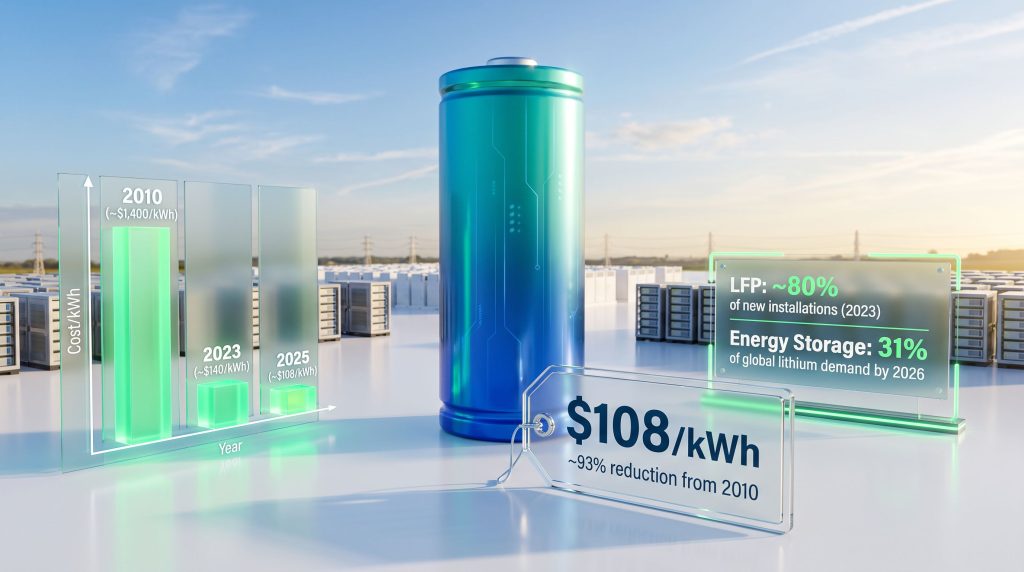
The headline figure is striking on its own: average lithium-ion battery pack prices fell to approximately $108/kWh in 2025, representing a reduction of roughly 93% from 2010 levels, when pack prices sat at approximately $1,400/kWh. For large stationary lithium iron phosphate (LFP) packs specifically, prices dropped even further, reaching around $70/kWh in 2025. (João Paulo Menezes, ESS News / pv magazine, July 2026.)
The table below illustrates how this trajectory unfolded:
| Year | Approximate Battery Pack Price ($/kWh) | Reduction vs. 2010 |
|---|---|---|
| 2010 | ~$1,400/kWh | Baseline |
| 2023 | ~$140/kWh | ~90% reduction |
| 2025 | ~$108/kWh | ~93% reduction |
| 2025 (LFP stationary) | ~$70/kWh | >95% reduction |
What this cost curve has done to project economics is just as significant as the numbers themselves. Commercial and industrial battery energy storage system (BESS) projects now routinely achieve payback periods of three to five years under favourable electricity pricing conditions, according to ESS News reporting. Applications previously dismissed as financially unworkable — including energy arbitrage, peak demand shaving, and grid frequency response — have become standard deployment models with established financing structures and revenue certainty.
The cost compression is also self-reinforcing. As LFP manufacturing scales, unit costs fall further. As costs fall, more projects are built. More projects create greater demand for cells, which justifies further investment in manufacturing capacity. This feedback loop has generated a competitive moat around lithium that alternative chemistries are finding extraordinarily difficult to breach. The battery storage-driven lithium boom is, in many respects, a direct product of this compounding industrial logic.
The 93% reduction in lithium battery costs over roughly fifteen years is comparable in its systemic impact to the decline of solar PV module prices, and carries similar implications for how energy infrastructure investment decisions are made at scale.
What Makes Lithium Technically Superior to Its Predecessors?
Physical Properties That Drive Performance Advantages
Lithium's dominance is not solely an economic story. It begins with fundamental electrochemistry. As the lightest metal and one of the most electropositive elements in the periodic table, lithium enables high cell voltage and exceptional energy density, meaning more kilowatt-hours can be stored per unit of weight and volume than most competing materials allow.
The contrast with lead-acid technology illustrates this clearly:
| Performance Metric | Lithium-Ion (LFP) | Lead-Acid |
|---|---|---|
| Relative Space Required | 1x | ~3x more |
| Charge-Discharge Cycles | Thousands | Hundreds |
| Round-Trip Efficiency | 90-95% | 70-80% |
| Primary Use Case | Grid-scale BESS, EVs | Vehicle starting, UPS |
Properly managed lithium cells can sustain thousands of charge-discharge cycles before experiencing meaningful capacity degradation, whereas lead-acid systems typically deteriorate significantly after a few hundred cycles. Combined with round-trip efficiencies of 90 to 95%, this translates directly into a lower levelised cost of storage (LCOS) across a system's operational lifetime — the metric that ultimately drives procurement decisions at utility scale.
The Full Architecture of a Modern BESS
It is worth clarifying that lithium battery storage dominance is not simply a story about cells. A complete BESS is a sophisticated integrated system, and understanding its components helps explain why scale and engineering maturity compound lithium's competitive position:
- Battery Management System (BMS): Continuously monitors individual cell health, balances charge distribution across the pack, and intervenes to prevent electrical faults before they escalate.
- Thermal Management Systems: Maintains safe operating temperatures across thousands of cells, a function that becomes increasingly complex at utility scale and where LFP chemistry's thermal stability offers a meaningful advantage.
- Bidirectional Inverters: Allow the system to both absorb electricity from the grid during low-price periods and inject it back during high-demand windows, enabling the revenue strategies that justify investment.
- Intelligent Software Layer: Optimises dispatch timing based on real-time electricity prices, demand forecasts, and grid operator signals, transforming a passive storage asset into an active revenue-generating infrastructure investment.
LFP vs. NMC: The Chemistry Split Defining Modern Grid Storage
Why Stationary Storage Chose a Different Chemistry Than Electric Vehicles
Not all lithium batteries operate on the same chemical principles. The energy storage industry has largely standardised around lithium iron phosphate (LFP) chemistry, while electric vehicle manufacturers frequently favour nickel manganese cobalt (NMC) chemistry. The reasoning behind this split is instructive.
| Chemistry | Energy Density | Thermal Safety | Primary Application | Cost Profile |
|---|---|---|---|---|
| LFP | Moderate | High (thermally stable) | Grid-scale BESS | Lower |
| NMC | High | Moderate | Electric vehicles | Higher |
NMC prioritises energy density above other characteristics, which is critical for EV range but less relevant for a ground-mounted grid storage installation where space constraints are minimal. LFP trades some energy density for significantly greater thermal stability, longer service life, and lower cost per kilowatt-hour. For stationary applications where safety, durability, and economics drive decisions, LFP has emerged as the industry standard, representing approximately 80% of new battery storage installations in recent years.
The thermal stability advantage of LFP is not a minor footnote. Thermal runaway — the condition in which battery cells overheat in an uncontrolled cascade — is considerably less likely with LFP chemistry than with NMC. In environments where large battery installations are sited near communities or critical infrastructure, this characteristic shapes both regulatory approvals and insurance costs. The IEA's analysis of batteries and secure energy transitions underscores how chemistry selection has become a central consideration in national energy security planning.
How Battery Storage Is Reshaping Lithium Demand Beyond Electric Vehicles
Stationary Storage as the Fastest-Growing Demand Driver
For years, the electric vehicle sector was understood to be the primary engine of long-term lithium demand growth. That assumption is now being revised. Stationary battery energy storage has emerged as an independently powerful demand driver, with its share of total global lithium consumption growing at a pace that is reshaping how supply chain planners and investors model the battery raw materials market.
Note: Specific percentage projections for lithium demand from energy storage circulating in some industry analyses have not been independently verified against a confirmed primary source for this article. Readers should treat forward-looking demand split estimates as indicative projections subject to revision, and consult current industry reporting from recognised statistical agencies before making investment decisions based on specific demand share figures.
What can be stated with confidence is that the directional trend is well-established. Utility-scale BESS deployment is accelerating across the United States, Europe, and key Asian markets simultaneously. The lithium content requirements of grid-scale storage projects are substantial — a single large BESS installation can require hundreds of tonnes of lithium carbonate equivalent — meaning that a meaningful pipeline of projects translates into significant incremental demand on supply chains previously modelled primarily around EV adoption curves.
The U.S. Market as a Structural Case Study
The United States provides a particularly clear illustration of how rapidly grid-scale lithium battery storage deployment is scaling. Lithium-ion systems currently account for over 90% of operating battery storage capacity in the country, and the pipeline of projects under development or construction continues to expand. According to the Solar Energy Industries Association, US demand for battery energy storage systems was projected to grow sixfold by 2030, contingent on sustained investment and supply chain coordination.
Real-world project activity reinforces this trajectory. Giga Storage's Green Turtle BESS project in Belgium reached financial close in July 2026, with construction scheduled to begin in September 2026. The project involves 2.8 GWh of battery storage capacity — representing the kind of scale that illustrates how individual projects are now measured in gigawatt-hours rather than megawatt-hours. (ESS News, July 2026.)
Revenue Models Making Lithium BESS Projects Financially Attractive
Four Core Commercial Strategies Driving Investment
The financial viability of battery storage investment rests on a multi-layered revenue architecture. Understanding these income streams clarifies why the three-to-five-year payback periods now achievable for well-structured projects are attracting serious institutional capital:
- Energy Arbitrage: The system charges during periods when wholesale electricity prices are low — typically overnight or during periods of high renewable generation — and discharges during peak-price windows. The spread between these prices generates revenue that compounds across thousands of cycles over the system's life.
- Peak Shaving: Commercial and industrial operators use on-site BESS to cap their maximum grid draw at critical moments, directly reducing demand charges that can constitute a significant portion of their electricity bills.
- Ancillary Grid Services: Grid operators in most developed markets pay a premium for services that help maintain grid stability, including frequency regulation, spinning reserve capacity, and voltage support. Fast-responding lithium systems are particularly well-suited to these applications.
- Backup Power and Resilience: For critical infrastructure, data centres, hospitals, and industrial facilities, the insurance value of reliable backup power is increasingly quantifiable, particularly in markets where grid reliability has deteriorated or where extreme weather events are becoming more frequent.
Lithium's modular architecture supports all four of these strategies across a deployment range that spans from residential 5-10 kWh installations to utility-scale projects exceeding hundreds of MWh — a scalability profile that no alternative chemistry currently matches at commercial scale.
The next major ASX story will hit our subscribers first
The Real Risks to Lithium Battery Storage Dominance
Supply Chain Concentration: The Geopolitical Vulnerability
The single most significant structural risk embedded in the global lithium battery storage supply chain is geographic concentration. China controls the majority of global lithium refining capacity, along with dominant shares of cathode material production and battery cell manufacturing. Over 80% of global battery cell manufacturing is currently concentrated in China, with large-scale factory expansions continuing to outpace near-term demand. (ESS News, July 2026.)
Supply chain concentration in a single geography is increasingly viewed as a systemic vulnerability by policymakers in the EU, US, and Australia, accelerating domestic battery manufacturing investment and critical minerals policy reform across multiple jurisdictions.
This concentration creates strategic exposure for markets pursuing domestic clean energy transitions. If geopolitical tensions disrupt trade flows, or if Chinese manufacturers curtail exports for commercial or political reasons, the entire BESS deployment pipeline in Western markets faces potential delays. Furthermore, this dynamic is now explicitly influencing industrial policy in the United States, European Union, and Australia, each of which has introduced policy frameworks aimed at building domestic battery manufacturing capacity and diversifying critical minerals demand responses.
Fire Risk and Thermal Management Challenges
High-profile BESS fire incidents have prompted stricter safety regulations and more demanding siting requirements globally. It is important to contextualise this risk accurately: LFP chemistry is considerably less susceptible to thermal runaway than NMC chemistry, which is why LFP has become the preferred choice for densely populated or environmentally sensitive deployment environments.
Ongoing improvements in BMS technology and thermal management systems are systematically reducing incident probabilities. The risk is real but manageable, and the industry's response has been to build more sophisticated thermal monitoring and suppression systems into standard project designs.
Structural Inertia and Its Effect on Competing Technologies
A less obvious but strategically important risk is that lithium's overwhelming industrial momentum may create structural barriers for long-duration energy storage (LDES) technologies that could better serve multi-day grid balancing requirements. Flow batteries, compressed air energy storage, gravity-based systems, and other LDES approaches face a steeper commercialisation path when competing against a lithium ecosystem with entrenched cost, financing, and supply chain advantages.
This is not a sign of weakness in lithium technology, but it raises legitimate questions about whether market forces alone will produce an optimal mix of storage technologies for a deeply decarbonised grid. Indeed, emerging technologies challenging lithium-ion dominance in long-duration applications are receiving growing attention from grid planners and policymakers who recognise that no single chemistry can optimally serve every storage duration requirement.
Sodium-Ion Batteries: Genuine Competitor or Complementary Technology?
Where Sodium-Ion Has a Legitimate Technical Edge
Sodium-ion technology has attracted serious attention as a potential challenger, and some of that attention is grounded in real technical advantages:
- Cold-weather performance: Sodium-ion chemistry maintains better capacity retention at low temperatures than LFP, which can be a decisive factor in northern climate deployments.
- Supply chain diversification: Sodium is abundant and geographically distributed across most continents, fundamentally reducing the geopolitical concentration risk that characterises lithium supply chains.
- Raw material cost potential: The intrinsic cost of sodium as a raw material is structurally lower than lithium, though manufacturing at scale has not yet translated this into a commercial price advantage that competes with mature LFP production economics.
The Current Commercial Reality
Despite these advantages, sodium-ion's near-term competitive position relative to LFP remains limited. Production volumes are still a fraction of lithium-ion output, energy density remains below that of comparable LFP cells, and the manufacturing ecosystem is in early-stage commercial development rather than the mature, high-volume state that drives LFP's cost structure.
A notable milestone in sodium-ion commercialisation: Peak Energy announced plans to build a $71 million sodium-ion BESS factory in California — described as the first US facility dedicated to grid-scale sodium-ion storage — with shipments expected to begin in Q1 2027. (ESS News, July 2026.) This represents a meaningful signal that sodium-ion is transitioning from laboratory promise to commercial deployment, even if the scale and economics remain well below the LFP baseline.
| Attribute | LFP (Lithium Iron Phosphate) | Sodium-Ion |
|---|---|---|
| Energy Density | Moderate-High | Lower |
| Cold Weather Performance | Moderate | Superior |
| Manufacturing Maturity | Highly mature | Early-stage commercial |
| Raw Material Availability | Lithium-dependent | Abundant, diversified |
| Current Cost | ~$70-$108/kWh | Higher (pre-scale) |
| Market Readiness | Dominant | Emerging |
Industry consensus points toward sodium-ion complementing rather than replacing LFP, capturing niche applications where energy density is less critical, cold-weather performance is prioritised, or supply chain independence carries a strategic premium.
The Multi-Chemistry Future of Energy Storage
A Segmented Market Rather Than a Single Winner
The long-term trajectory of energy storage is not a winner-takes-all chemistry race. The more accurate framing is a market segmentation model, where each technology occupies the deployment niche in which its characteristics deliver the best combination of economics and performance:
- LFP dominates 4-8 hour grid-scale storage, where cost, cycle life, and safety are the primary decision criteria.
- Sodium-ion is positioned to capture cold-climate deployments, remote off-grid systems, and applications where supply chain independence carries a meaningful premium.
- Flow batteries and long-duration technologies address 12-100+ hour storage requirements that lithium-ion is not economically optimised to serve.
- Solid-state batteries represent the next generation of high-density EV and premium applications, with commercialisation timelines extending into the late 2020s and beyond.
The emergence of Energy Dome's 23 MW / 200 MWh CO2 battery project in Ireland — which secured a 10-year capacity contract and is expected to come online in 2028 — is an example of how long-duration alternatives are beginning to establish commercial footholds in specific grid applications, even as LFP maintains dominance across the broader market. (ESS News, July 2026.)
Why LFP Retains Its Structural Advantage Through the 2030s
A mature global manufacturing base, continuing cost compression, established project financing structures, and deeply embedded deployment ecosystems give LFP an entrenched competitive position that no single alternative chemistry is positioned to displace within the current decade. However, the recent lithium market downturn has added complexity to supply chain economics, reminding investors that even dominant technologies are exposed to commodity price cycles.
The question facing investors, developers, and policymakers is not whether lithium will be replaced, but how to design procurement frameworks and market structures that allow complementary long-duration and alternative technologies to develop alongside it. Innovations in direct lithium extraction, for instance, are expected to improve supply-side efficiency and potentially moderate input cost volatility over the medium term.
The energy storage market of the 2030s will almost certainly be defined by chemistry pluralism, with LFP as the anchor technology and a growing ecosystem of specialised alternatives serving distinct applications across the grid. Investors and analysts who frame the competitive landscape as a binary choice between lithium and its challengers are likely misreading the market structure that is already taking shape.
Frequently Asked Questions: Lithium Battery Storage Dominance
Why does lithium dominate battery energy storage systems?
Lithium-ion technology, particularly LFP chemistry, combines high energy density, long cycle life spanning thousands of charge-discharge cycles, round-trip efficiency of 90-95%, and a cost structure that has declined by over 90% since 2010. This combination makes it the most economically and technically competitive option for grid-scale and commercial storage applications currently available at commercial scale.
How much has the cost of lithium batteries fallen?
Battery pack prices declined from approximately $1,400/kWh in 2010 to around $108/kWh in 2025, a reduction of approximately 93%. Large stationary LFP packs reached approximately $70/kWh in 2025. (ESS News / pv magazine, July 2026.)
Is sodium-ion a near-term threat to lithium's market position?
Not in the current decade. Sodium-ion offers genuine advantages in cold-weather performance and supply chain diversification, but its energy density and manufacturing scale remain well below LFP. Consequently, it is expected to serve complementary market segments rather than displace lithium as the dominant stationary storage chemistry.
What are the main risks to lithium's continued dominance?
The primary risks are supply chain concentration (with over 80% of battery cell manufacturing located in China), fire safety management (more relevant to NMC than LFP chemistry), and the structural possibility that lithium's industrial momentum may disadvantage long-duration storage alternatives that could better serve multi-day grid balancing needs.
What revenue models justify utility-scale BESS investment?
The four primary commercial strategies are energy arbitrage, peak shaving, ancillary grid services including frequency regulation and voltage support, and backup power resilience. Well-structured projects combining multiple revenue streams are achieving payback periods of three to five years under favourable electricity pricing conditions. (ESS News, July 2026.)
Disclaimer: This article contains forward-looking projections and analysis drawn from industry reporting. It does not constitute financial or investment advice. Demand forecasts, cost projections, and market share estimates are subject to change and should be independently verified before being used as the basis for investment decisions.
Want to Identify ASX Opportunities in the Critical Minerals Driving the Energy Storage Revolution?
Discovery Alert's proprietary Discovery IQ model delivers real-time alerts on significant ASX mineral discoveries — including lithium and other battery raw materials powering the global BESS deployment boom — transforming complex geological data into actionable investment insights. Explore historic mineral discovery returns on Discovery Alert's dedicated discoveries page and begin your 14-day free trial to position yourself ahead of the market.