May 22, 2026
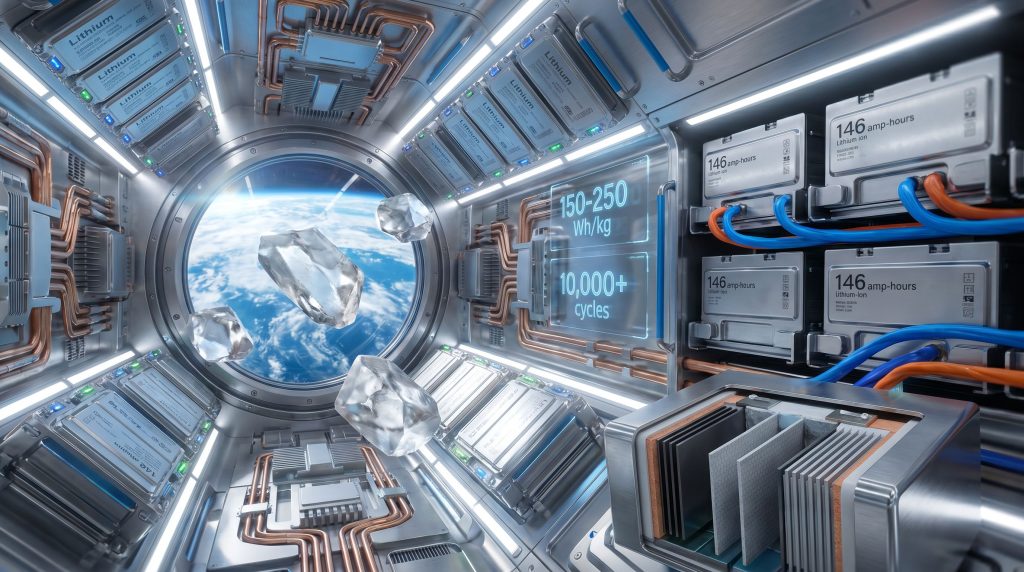
Advanced lithium-ion battery systems have revolutionised spacecraft energy storage through specialised thermal management architectures that operate reliably across temperature extremes spanning 270°C. These systems integrate sophisticated heating elements, heat distribution networks, and radiative cooling mechanisms to maintain optimal electrochemical performance during mission-critical phases lasting decades in the harsh vacuum environment.
Why Space Missions Depend on Lithium Technology
Modern spacecraft operations demand energy storage solutions capable of withstanding radiation bombardment, vacuum exposure, and thermal cycling that would destroy conventional battery technologies within hours. Lithium-the-secret-fuel-of-spaceflight has emerged as the fundamental enabler of extended space missions through its unique combination of energy density, cycle durability, and adaptability to extreme environmental conditions.
Critical Performance Requirements:
- Energy density capabilities: 150-250 Wh/kg operational range
- Temperature tolerance: -150°C to +120°C survival envelope
- Radiation resistance: 100+ krad total ionising dose tolerance
- Operational lifespan: 10-15 years minimum mission duration
- Cycle endurance: 10,000+ charge-discharge cycles at 80% depth
Launch economics fundamentally drive battery technology selection for space applications. Current launch costs range from $1,500 to $15,000 per kilogram depending on orbital destination and service provider, with SpaceX Falcon 9 achieving approximately $2,700 per kilogram to low Earth orbit as of 2026. This economic constraint makes lithium-ion systems essential, delivering 3-5 times the energy storage capacity per unit mass compared to previous nickel-hydrogen technologies.
Energy Density Advantages in Zero-Gravity Environments
Weight optimisation becomes critical when considering that a typical communications satellite requires 2-5 kWh of energy storage capacity. Using conventional nickel-hydrogen batteries would consume 50-125 kilograms of spacecraft mass, whereas lithium-ion systems achieve the same capacity in 10-25 kilograms. This mass reduction enables mission designers to allocate additional payload capacity for scientific instruments, extended operational capabilities, or enhanced redundancy systems.
Furthermore, the zero-gravity environment eliminates convective heat transfer mechanisms that terrestrial battery systems rely upon for thermal regulation. Space-qualified lithium-ion cells must therefore incorporate active thermal management through resistive heating elements, heat pipe networks, and radiative panels. These thermal control systems typically consume 5-15% of total spacecraft power budget during eclipse periods when battery temperatures approach operational limits.
Thermal Management Systems for Lithium Batteries
Spacecraft thermal control systems employ multilayered protection strategies to maintain lithium-ion cells within operational temperature windows. Primary thermal management components include:
- Resistive heater networks: Precisely controlled heating elements maintaining minimum cell temperatures above -20°C
- Heat pipe distribution: Copper-ammonia or water-based systems providing isothermal temperature distribution
- Radiative cooling panels: High-emissivity surfaces rejecting excess thermal energy to space
- Phase-change thermal buffers: Paraffin or salt-based materials absorbing temperature transients during orbital transitions
Advanced battery management systems monitor individual cell temperatures through distributed sensor networks, implementing predictive heating algorithms based on orbital mechanics and solar flux calculations. These systems typically maintain cell temperatures within ±5°C tolerance bands to optimise electrochemical performance and cycle life durability.
When big ASX news breaks, our subscribers know first
What Makes Space-Grade Lithium Batteries Different?
Commercial lithium-ion batteries undergo catastrophic failure within minutes of vacuum exposure due to electrolyte outgassing, pressure differential rupture, and thermal shock. Space-qualified cells require fundamental design modifications addressing vacuum compatibility, radiation shielding, and hermetic pressure containment that increase manufacturing costs by 500-1500% compared to terrestrial applications.
Hermetic Sealing and Pressure Containment
Standard commercial battery casings utilise polymer materials and pressure-relief mechanisms unsuitable for space environments. Aerospace lithium cells employ titanium Grade 2 or 5083 aluminium alloy housings with electron-beam welded seams achieving leak rates below 1 × 10⁻¹² mbar·L/sec. These hermetic seals prevent electrolyte loss while containing internal pressure generated by electrochemical reactions.
However, pressure containment specifications require space cells to withstand internal pressures exceeding 30 atmospheres without rupture, compared to 3-5 atmosphere tolerance in commercial designs. Terminal feedthroughs utilise ceramic-to-metal sealing technology preventing electrical leakage while maintaining pressure integrity throughout mission duration.
Vacuum Compatibility Testing Protocol:
- Thermal vacuum cycling: 100+ cycles between operational temperature extremes
- Pressure burst testing: 50+ atmosphere internal pressure validation
- Leak rate verification: Helium mass spectrometry testing to 10⁻¹² sensitivity
- Outgassing characterisation: Material vapour pressure measurement per ASTM E595 standards
Radiation-Hardened Cell Chemistry
Galactic cosmic radiation and solar particle events create ionising radiation environments that degrade battery performance through multiple mechanisms. Space-qualified lithium cells incorporate specialised materials and protective architectures to maintain capacity and performance throughout extended radiation exposure.
Radiation effects on lithium-ion batteries include:
- Electrolyte decomposition: High-energy particles breaking chemical bonds in organic solvents
- Electrode structural changes: Radiation-induced defects in graphite anodes and oxide cathodes
- Capacity fade acceleration: Enhanced ageing mechanisms reducing energy storage capability
- Internal resistance increases: Degraded ionic conductivity pathways affecting power delivery
Consequently, radiation-hardened cell designs employ lithium iron phosphate (LFP) cathode materials demonstrating superior radiation tolerance compared to lithium cobalt oxide alternatives. Specialised electrolyte formulations incorporate radiation-stabilising additives and enhanced purity levels eliminating trace contaminants that accelerate radiation-induced degradation.
How Do Spacecraft Manage Power During Eclipse Periods?
Orbital mechanics create regular eclipse cycles where solar power generation ceases completely, requiring battery systems to sustain full spacecraft operations for 30-70 minutes depending on orbital altitude and season. During these periods, lithium-the-secret-fuel-of-spaceflight must deliver precise power profiles while maintaining state-of-charge levels preventing over-discharge damage.
Low Earth Orbit Eclipse Characteristics:
- Orbital period: 90-100 minutes depending on altitude
- Sunlit duration: 55-65 minutes (varies with season and inclination)
- Eclipse duration: 30-40 minutes continuous darkness
- Daily eclipse events: 15-16 cycles per 24-hour period
The International Space Station demonstrates sophisticated eclipse power management, consuming 60-80 kW continuous power during eclipse periods. The station's 24 lithium-ion battery units (each rated at 146 Ah, 25.6V nominal) discharge at controlled rates maintaining individual cell voltages within ±50 mV tolerance to ensure uniform power delivery and prevent premature capacity fade.
Battery Management System Architecture
Advanced spacecraft employ distributed battery management systems monitoring individual cell parameters and implementing protective algorithms preventing damage from operational anomalies. Critical monitoring parameters include:
- Voltage measurement: Individual cell monitoring with ±10 mV accuracy
- Temperature sensing: Multiple thermal sensors per battery pack (typically 3-5 locations)
- Current regulation: Charge/discharge current limiting between 0.5C to 1.0C rates
- State-of-charge estimation: Coulomb counting with voltage-based adaptive correction algorithms
- Protection thresholds: Over-voltage (4.25V), under-voltage (2.5V), and thermal limits
In addition, battery management systems implement hierarchical load-shedding protocols as state-of-charge decreases during eclipse periods. Non-essential systems disconnect automatically at predetermined thresholds, maintaining critical life support, communication, and attitude control functions while preventing battery over-discharge that would terminate mission capability.
Which Space Missions Showcase Advanced Lithium Applications?
International Space Station Battery Upgrade Program
The ISS underwent comprehensive power system modernisation between February 2017 and January 2019, replacing 48 nickel-hydrogen batteries with 24 lithium-ion units through eight extravehicular activity missions. This upgrade demonstrated the operational advantages of lithium industry innovations in human-rated spacecraft applications.
Technical Transformation Results:
- System mass reduction: 2,500 kg removed from station configuration
- Capacity improvement: 146 Ah per lithium unit vs. 38 Ah per nickel-hydrogen unit
- Operational efficiency: 40-50% increased power availability margin
- Service life extension: 6.5+ years operational design vs. 4-5 years previous technology
- Total installed capacity: 3.7 MWh distributed across 24 battery assemblies
The lithium-ion upgrade eliminated routine battery replacement operations, reducing crew workload and extravehicular activity risk while providing enhanced power reliability for expanding scientific operations and commercial modules.
Mars Rover Power Systems
Mars exploration vehicles utilise lithium-ion batteries as energy buffers complementing radioisotope thermoelectric generators for peak power demands and night survival operations. The Perseverance rover demonstrates hybrid power architecture optimised for extended planetary surface operations through efficient lithium mining processes.
Perseverance Power Configuration:
- Primary generation: Multi-Mission Radioisotope Thermoelectric Generator (MRITG) providing 125W peak, 110W continuous
- Energy storage: Lithium-ion battery pack rated 42 Ah capacity
- Daily energy budget: 2.5-3.0 kWh total including night thermal protection
- Operating temperature: Battery heating maintains cells above -20°C during Martian nights
The rover's battery management system coordinates power allocation between continuous RTG output and stored energy, enabling high-power activities such as drilling operations, sample analysis, and communication sessions with Earth. Night survival requires significant battery capacity for thermal protection systems maintaining critical electronics above freezing temperatures during Martian nights reaching -90°C.
What Are the Next-Generation Lithium Technologies for Space?
Solid-State Battery Development
Solid-state lithium battery technology eliminates liquid electrolytes through ceramic or polymer solid conductors, offering significant advantages for space applications including enhanced safety, wider operating temperature ranges, and improved radiation tolerance. Current development programmes target 400+ Wh/kg energy density with operational temperature ranges from -40°C to +80°C.
Solid-State Advantages for Space Applications:
- Enhanced safety: Non-flammable solid electrolytes eliminating thermal runaway risk
- Temperature tolerance: Wider operational range reducing thermal management requirements
- Radiation resistance: Solid materials demonstrating superior radiation stability
- Energy density potential: Theoretical capabilities exceeding 500 Wh/kg
- Cycle durability: Reduced degradation mechanisms extending operational lifetime
Manufacturing challenges include interface stability between solid electrolyte and electrode materials, particularly at temperature extremes experienced in space environments. For instance, current research focuses on sulfide-based and oxide-based solid electrolyte systems demonstrating compatibility with lithium metal anodes.
Lithium-Carbon Dioxide Battery Systems
Revolutionary lithium-CO₂ battery concepts under development for Mars missions offer integrated atmospheric utilisation and energy storage capabilities. These systems capture atmospheric carbon dioxide during discharge cycles, potentially enabling in-situ resource utilisation for fuel production and life support applications.
Operational Advantages:
- Energy density: 7-10 times higher than conventional lithium-ion systems
- Atmospheric integration: CO₂ capture from planetary atmospheres during operation
- Fuel production: Stored CO₂ conversion to methane through Sabatier reaction processes
- Life support integration: Water byproducts supporting crew consumable requirements
- Thermal management: Exothermic reactions providing beneficial heating during cold periods
Current research challenges include catalyst development for efficient CO₂ reduction, cycle stability under repeated charge-discharge operations, and system integration with atmospheric processing equipment. Prototype systems demonstrate proof-of-concept operation but require significant engineering development for flight qualification.
How Does Lithium Support Spacecraft Structural Design?
Lithium-Aluminium Alloy Applications
Beyond energy storage applications, lithium serves as a critical alloying element in advanced aerospace structural materials. Lithium-aluminium alloys (typically 8090, 8091, and 2195 series) provide density reductions of 8-15% compared to conventional aluminium while maintaining or improving strength-to-weight ratios essential for spacecraft design.
Structural Performance Characteristics:
- Density reduction: 2.45-2.55 g/cm³ vs. 2.70 g/cm³ for standard aluminium alloys
- Stiffness improvement: 10-15% higher elastic modulus enhancing structural rigidity
- Fatigue resistance: Enhanced crack propagation resistance extending operational lifetime
- Thermal stability: Reduced thermal expansion coefficients improving dimensional stability
Primary aerospace applications include fuel tank construction (Falcon 9 upper stage, Space Launch System core stage), satellite chassis elements, and heat exchanger components where weight reduction directly improves mission performance. The Space Shuttle external tank utilised lithium-aluminium alloy 2195 achieving 3,400 kg mass reduction compared to conventional aluminium construction.
Manufacturing Considerations for Space Alloys
Lithium-aluminium alloy processing requires specialised techniques due to lithium's high chemical reactivity and low melting point. Manufacturing protocols include controlled atmosphere requirements (argon or helium), precise temperature management during casting and forming operations, and specialised welding procedures preventing lithium loss during fabrication.
Quality Assurance Protocols:
- Chemical composition control: Lithium content maintained within ±0.1% tolerance
- Microstructure verification: Grain size and precipitation particle distribution analysis
- Mechanical property testing: Tensile, fatigue, and fracture toughness validation
- Corrosion resistance evaluation: Environmental exposure testing for space applications
Moreover, welding lithium-aluminium alloys requires modified procedures including reduced heat input, specialised filler materials, and post-weld heat treatment cycles optimising joint properties. These manufacturing complexities increase production costs but provide essential performance advantages for weight-critical spacecraft structures.
The next major ASX story will hit our subscribers first
What Environmental Impacts Does Space Lithium Use Create?
Atmospheric Lithium Injection from Launches
Recent atmospheric research indicates rocket launches introduce significant lithium quantities into Earth's upper atmosphere through fuel combustion and vehicle component ablation. A single Falcon 9 launch releases approximately 30 kilograms of lithium compounds, representing roughly 10 times the daily natural accumulation from meteorite sources.
Environmental Assessment Concerns:
- Atmospheric chemistry disruption: Lithium injection potentially affecting stratospheric ozone chemistry
- Climate regulation impacts: Aerosol formation influencing radiative forcing mechanisms
- Accumulation effects: Long-term buildup with increasing launch frequency (projected 10,000+ annual launches by 2030)
- Global distribution: Stratospheric circulation spreading lithium compounds worldwide
Current atmospheric modelling studies examine lithium's role in noctilucent cloud formation and potential interactions with existing atmospheric chemistry cycles. The rapidly expanding commercial launch industry raises questions about cumulative environmental effects requiring comprehensive assessment and potential mitigation strategies through improved geothermal lithium extraction methods.
Space Debris and Battery Disposal
End-of-life spacecraft containing lithium batteries present unique challenges for orbital debris management and environmental protection. Current disposal protocols include controlled deorbit procedures for low Earth orbit missions and graveyard orbit placement for geosynchronous satellites, but these approaches may prove inadequate for future mission volumes.
Disposal Protocol Categories:
- Controlled reentry: Atmospheric burnup during controlled deorbit manoeuvres
- Graveyard orbits: 300+ km altitude placement above geosynchronous operational zones
- Battery discharge: Complete energy depletion reducing explosion risk
- Future recycling concepts: Orbital servicing missions recovering valuable materials
Space debris mitigation guidelines require spacecraft design enabling complete atmospheric disintegration during reentry, but lithium battery components may survive reentry creating ground impact hazards. Future space traffic management may require specialised disposal systems or orbital recycling infrastructure managing lithium-containing components.
How Will Lithium Shape Future Space Exploration?
Deep Space Mission Requirements
Planned missions to Jupiter's moons, Saturn system exploration, and eventual interstellar probes demand lithium-the-secret-fuel-of-spaceflight technologies operating reliably for 20+ years in extreme radiation environments. These requirements drive development of ultra-low temperature operation capabilities (-200°C), enhanced radiation tolerance (1,000+ krad total dose), and autonomous maintenance systems enabling extended operational periods without ground intervention.
Next-Generation Mission Profiles:
- Europa Clipper mission: 15+ year operational requirement in Jupiter's radiation environment
- Dragonfly Titan exploration: 2.7-year surface operations requiring reliable power cycling
- Interstellar precursor missions: 50+ year operational goals demanding unprecedented reliability
- Deep space communication networks: Autonomous relay stations enabling expanded exploration
Future deep space missions may employ nuclear-powered lithium battery charging systems combining radioisotope thermoelectric generators with advanced battery energy storage, enabling higher power scientific operations and extended communication capabilities across interplanetary distances.
Commercial Space Industry Growth
The expanding commercial space economy drives demand for cost-effective, reliable lithium battery systems supporting satellite constellations, space tourism, orbital manufacturing, and asteroid mining advances. Market projections indicate the space battery sector reaching $1.2 billion annually by 2030 with 8.5% compound annual growth.
Market Growth Drivers:
- Satellite constellation deployments: Starlink, Project Kuiper requiring 10,000+ satellites
- Space tourism expansion: Suborbital and orbital flight systems
- Orbital manufacturing facilities: Continuous power requirements for industrial operations
- Asteroid mining missions: Extended-duration autonomous operations
- Lunar surface operations: Permanent base power systems surviving 14-day night cycles
Commercial space applications emphasise cost reduction and rapid deployment over traditional aerospace quality requirements, creating opportunities for advanced lithium technologies achieving space-qualified performance at reduced manufacturing costs through economies of scale and simplified testing protocols.
Investment Implications for Lithium Space Applications
The convergence of expanding space economies and advanced lithium battery technologies creates significant investment opportunities across multiple market segments. Direct investment areas include aerospace-grade lithium processing facilities, space-qualified battery manufacturing capabilities, thermal management system development, and battery recycling technologies specifically designed for space applications.
Primary Investment Opportunities:
- Aerospace battery manufacturing: Companies developing space-qualified lithium-ion production capabilities
- Solid-state battery development: Next-generation technology providers targeting space applications
- Lithium mining operations: Suppliers emphasising high-purity, aerospace-grade lithium compounds
- Thermal management systems: Specialised equipment manufacturers for space battery applications
- Recycling and recovery: Technologies handling end-of-life space battery disposal and material recovery
Market Risk Considerations:
- Regulatory uncertainty: Evolving space debris mitigation requirements affecting battery design
- Technology disruption: Solid-state batteries potentially obsoleting current lithium-ion investments
- Launch cost volatility: Changing economics affecting overall space market growth
- Geopolitical factors: Space technology export controls and international competition
Indirect Investment Vectors:
- Launch service providers: Companies benefiting from reduced payload mass through advanced batteries
- Satellite constellation operators: Businesses requiring reliable power systems for orbital infrastructure
- Space manufacturing: Orbital facilities dependent on continuous power availability
- Deep space exploration: Government and commercial missions requiring extended-duration power systems
Investment strategies should consider the 10-15 year technology development cycles typical in aerospace applications, requiring patient capital and comprehensive risk assessment. However, successful space battery technologies often find terrestrial applications in extreme environment operations including arctic installations, subsea systems, and remote sensing networks, providing diversified market opportunities.
The lithium space economy represents a specialised but rapidly growing market segment where technological excellence and reliability command premium valuations. Companies establishing early leadership positions in space-qualified lithium technologies may capture significant market share as commercial space activities expand throughout the next decade.
Furthermore, lithium-the-secret-fuel-of-spaceflight represents a specialised but rapidly growing market segment where technological excellence and reliability command premium valuations. Companies establishing early leadership positions in space-qualified lithium technologies may capture significant market share as commercial space activities expand throughout the next decade.
Further Reading: Educational content exploring lithium's fundamental properties and advanced space applications can provide additional context for understanding this critical element's role in modern technological advancement and space exploration capabilities.
Looking to Capitalise on the Space Economy's Lithium Revolution?
Discovery Alert's proprietary Discovery IQ model delivers instant notifications about significant ASX mineral discoveries, including critical lithium projects powering the next generation of space exploration technologies. With the space battery market projected to reach $1.2 billion annually by 2030, positioning yourself ahead of major lithium discoveries could provide the market edge needed to capitalise on this expanding sector.