August 14, 2026
The Structural Trap Behind the World's Richest Lithium Region
The global energy transition runs on assumptions. One of the most consequential is that the world's largest lithium reserves, concentrated across a narrow band of South American territory, will translate reliably into the battery-grade material that electric vehicles, grid storage systems, and consumer electronics increasingly demand. That assumption is under serious pressure.
The lithium deficit in Latin America is not a story about empty salt flats or depleted aquifers. It is a story about the growing distance between what the ground holds and what markets can access. Reserves are abundant. Production-ready capacity is not. Furthermore, the gap between the two is widening at precisely the moment global demand is accelerating fastest.
Understanding why requires looking past the headline figures and into the structural mechanics of how lithium moves from geological deposit to battery cathode.
When big ASX news breaks, our subscribers know first
Why Resource Abundance Does Not Equal Supply Security
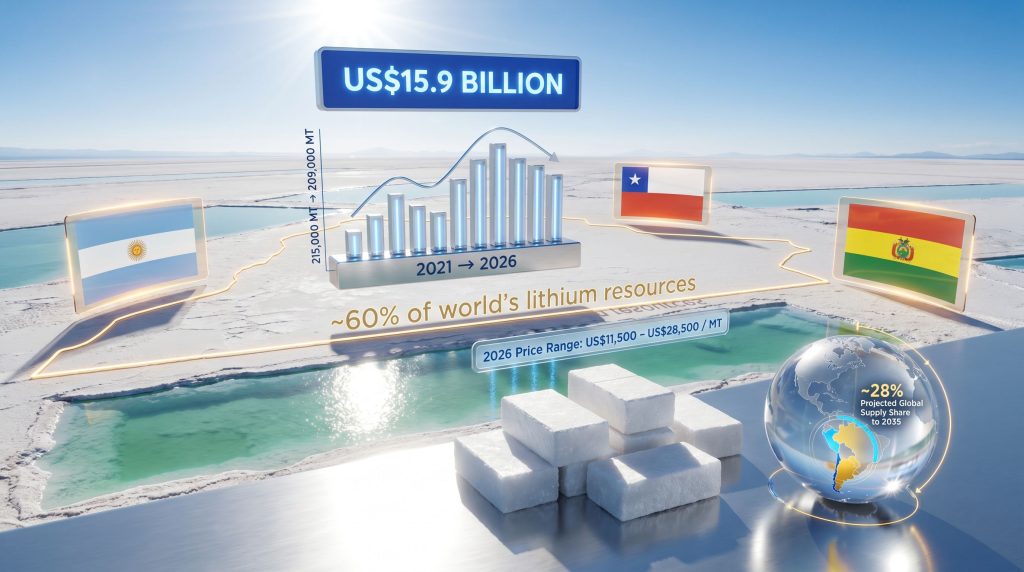
The Lithium Triangle, spanning the high-altitude salt flats of Argentina, Chile, and Bolivia, contains an estimated 56 to 64 million metric tons of lithium resources, representing roughly 60% of the world's known reserves. On paper, this concentration of geological wealth should position Latin America as the undisputed anchor of global battery supply chains for decades.
In practice, the conversion rate from identified resource to operational production has been chronically slow. The reasons are structural rather than geological:
- Permitting timelines in the region frequently extend beyond those seen in comparable mining jurisdictions, adding years to project development schedules
- Water rights disputes in the Atacama and Puna regions create legal and social licence barriers that delay or halt extraction activities
- Currency volatility and shifting fiscal regimes in Argentina and Bolivia create persistent uncertainty for long-duration capital commitments
- Divergent national lithium strategies create regulatory fragmentation that complicates cross-border investment planning
The cumulative effect is an investment pipeline that looks impressive on a spreadsheet but delivers production at a fraction of its theoretical pace. Across Argentina, Chile, Bolivia, and Brazil, more than 27 active and planned projects represent an aggregate investment exposure of approximately US$15.9 billion. That capital is under considerable strain, as detailed reporting on the Latin American lithium investment landscape confirms.
The Scale of the Investment Pipeline: Country by Country
The distribution of lithium investment across the region is neither uniform nor equally productive. Each jurisdiction carries a distinct risk-reward profile shaped by governance structures, resource characteristics, and infrastructure maturity.
| Country | Active/Planned Projects | Investment Profile | Primary Constraint |
|---|---|---|---|
| Argentina | 83 | Greenfield-heavy; mixed public-private | Water costs; currency risk; hard-rock competition |
| Chile | 23 | Established operators; US-linked capital | Water scarcity; regulatory evolution |
| Bolivia | Minimal active | State-controlled; foreign partnerships stalled | Political instability; resource impurity |
| Brazil | Growing | Export-oriented; debt-pressured | High costs; infrastructure gaps |
Argentina dominates the project count with 83 identified lithium developments, spanning everything from early-stage exploration to processing infrastructure. Nine of these are already in active operation, giving Argentina the broadest operational base within the Triangle. However, the pipeline is heavily skewed toward greenfield projects, which carry substantially higher execution risk and longer timelines to first production. The Argentina lithium brine market reflects this complexity, with significant potential constrained by structural headwinds.
Chile's 23 projects are fewer in number but larger in scale and operational sophistication. Chilean lithium operations benefit from decades of institutional knowledge and established export infrastructure. However, they face tightening constraints around water access and evolving national governance frameworks that are reshaping how foreign capital can participate in the sector.
Bolivia occupies a paradoxical position. It holds what may be the world's single largest lithium deposit at the Salar de Uyuni, yet its contribution to near-term regional supply is negligible. State control through Yacimientos de Litio Bolivianos (YLB), combined with political instability and the technical challenge of high magnesium impurity levels in its brine, have stalled partnership agreements with Chinese and Russian entities. Analysts tracking the sector broadly estimate that meaningful Bolivian production is unlikely before a seven-to-eight-year development horizon at the earliest.
Brazil's lithium sector is anchored by hard-rock deposits rather than brines, and spodumene extraction has attracted export-oriented investment. However, financial restructuring challenges facing key operators have constrained output, making Brazil a contributor that underperforms its geological potential.
What Is Driving Demand Beyond What the Region Can Currently Supply
The fundamental driver of the lithium deficit in Latin America is not a local production failure in isolation. It is the collision of structural supply constraints with a demand curve that is compounding faster than most project timelines can match.
Three demand vectors are converging simultaneously:
- Electric vehicle battery manufacturing remains the dominant consumption driver, with battery-grade lithium carbonate and lithium hydroxide both seeing sustained offtake pressure from Asian cathode producers
- Utility-scale energy storage deployments are adding a second structural demand layer that was not meaningfully present a decade ago
- Consumer electronics densification, while slower-growing than EVs, continues to add baseline consumption volume across lithium-ion battery formats
China's role deserves specific attention. As the world's dominant battery manufacturer and cathode processor, China effectively acts as a demand transmission mechanism for Latin American brine producers. When Chinese battery production cycles soften, as projected for portions of 2026, the downstream effect is a reduction in spot lithium purchasing that directly pressures brine producers' revenue assumptions.
This dynamic is central to a key near-term production scenario: regional output is forecast to experience a modest contraction from approximately 215,000 to 209,000 metric tons in 2026, with softening Chinese demand identified as the primary trigger. The broader lithium market downturn compounds against an already-constrained investment environment to suppress capital confidence in new project commitments.
Lithium price forecasts for 2026 reflect this uncertainty acutely, with estimates spanning a wide corridor from approximately US$11,500 to US$28,500 per metric ton. That range is not a forecast error. It is an accurate representation of the genuine uncertainty embedded in a market where Chinese demand cycles, new supply entries, and project delay dynamics can each independently shift pricing by thousands of dollars per tonne.
Investors and capital allocators should treat the 2026 price corridor as a risk signal rather than a planning assumption. Lithium markets have demonstrated boom-bust characteristics historically, and the current deficit environment does not guarantee sustained price support. Breakthroughs in Direct Lithium Extraction technology or accelerated hard-rock production from Australia or Africa could shift the supply-demand balance more rapidly than consensus forecasts suggest.
The Water Constraint: Lithium's Hidden Production Ceiling
Of all the structural barriers limiting production growth across the region, water scarcity is arguably the least visible to outside observers and the most intractable in practice.
Conventional brine evaporation, the dominant extraction method across the Atacama and Puna salt flats, is extraordinarily water-intensive. To understand how lithium brine mining works, it is important to note that approximately 500,000 gallons of water are consumed per metric ton of lithium produced through evaporation-based methods. Chile's lithium sector alone accounts for an estimated 65% of regional water usage attributable to lithium extraction.
The consequences extend beyond environmental metrics. Water rights in the Atacama are shared between lithium operators, indigenous Atacameno communities, and the agricultural sector. Cattle farming and quinoa cultivation in the region depend on the same aquifer systems that brine extraction draws from. Consequently, this creates a competition for a finite resource that is simultaneously an operational constraint, a social licence challenge, and a litigation risk.
Direct Lithium Extraction (DLE) technology represents the most credible technical pathway to decoupling production growth from water consumption. Unlike evaporation ponds, which take 12 to 18 months to concentrate brine and require continuous water input, direct lithium extraction technology extracts lithium directly from brine using adsorption, ion exchange, or membrane-based methods, returning the bulk of the water to the aquifer post-processing.
Several projects in Argentina and Chile are currently piloting DLE at various stages of commercial readiness. However, the gap between successful pilot-scale demonstration and full commercial deployment at nameplate capacity remains significant. The timeline to meaningful DLE contribution at the regional level is realistically measured in years rather than months, with optimistic scenarios pointing to material commercial-scale deployment by 2028 for the most advanced projects.
Political Risk Architecture: Why Capital Flows Around the Region's Largest Deposits
Bolivia's situation illustrates a dynamic that operates at different intensities across the entire region: the tendency of resource nationalism to deter the capital flows that resource development requires.
The Salar de Uyuni holds an extraordinary concentration of lithium. However, Bolivia's governance model reserves lithium development exclusively for YLB while requiring foreign partners to operate under highly constrained commercial terms. This has produced a cycle of announced partnerships and subsequent collapses, not due to lack of interest, but due to unfavourable commercial structures and the genuine technical challenge of Bolivia's high-impurity brine chemistry.
The magnesium impurity issue is worth understanding in technical terms. Bolivian brine at Uyuni carries a magnesium-to-lithium ratio that is significantly higher than the brines found in Chile's Atacama or Argentina's Salta and Jujuy provinces. High magnesium content complicates the processing chemistry required to produce battery-grade lithium carbonate or hydroxide, adding cost and complexity that reduces the resource's economic attractiveness relative to its theoretical size.
Argentina's regulatory environment is less exclusionary but introduces different risks. Fiscal policy unpredictability, currency controls, and the periodic restructuring of export royalty regimes create a planning environment where long-duration project finance is difficult to structure at commercially viable terms without substantial risk premiums built into return requirements.
Chile's regulatory evolution is perhaps the most constructive of the three Triangle nations, but it is also creating transition-period uncertainty. The national lithium strategy being developed through state-partnership frameworks seeks to capture more domestic value from lithium production while maintaining access to foreign capital and technical expertise. Navigating that balance requires operators to engage with a regulatory process that is still being defined.
The next major ASX story will hit our subscribers first
How Latin America's Supply Share Compares Globally
Despite its reserve dominance, Latin America's projected share of global lithium supply through 2035 is estimated at approximately 28%, a figure that substantially understates the region's geological endowment relative to its production contribution.
| Region | Estimated Supply Share to 2035 | Primary Extraction Method | Key Advantage |
|---|---|---|---|
| Latin America (Triangle) | ~28% | Brine evaporation / DLE | Largest reserves globally |
| Australia | ~35-40% | Hard-rock spodumene | Speed to market; lower water use |
| China (domestic) | ~15-20% | Mixed | Vertical integration |
| Rest of World | ~15-20% | Mixed | Diversification |
Australia's hard-rock spodumene operations demonstrate why geological endowment is not the only variable that matters. Spodumene mining operates on more conventional extraction timelines, requires less water, and benefits from established export infrastructure and permitting frameworks. Indeed, the IEA's analysis of Latin America's critical minerals opportunity highlights that Australia's projected 35 to 40% supply share reflects operational and regulatory advantages rather than superior resource quality.
Three Scenarios for Closing the Deficit Before 2030
The trajectory of the lithium deficit in Latin America is not predetermined. It will be shaped by the interaction of technology adoption, regulatory evolution, capital allocation decisions, and Chinese demand cycles. Three plausible scenarios frame the range of outcomes:
Scenario 1: Accelerated DLE Adoption (Optimistic)
DLE technology reaches commercial deployment scale in Argentina and Chile by 2028. Water constraints are materially reduced, permitting timelines compress as environmental objections diminish, and production timelines for mid-tier projects accelerate. Under this scenario, regional output closes an estimated 60 to 70% of the projected deficit gap before 2030.
Scenario 2: Regulatory Stagnation and Capital Flight (Pessimistic)
Bolivia remains effectively closed to productive foreign investment. Chile's permitting framework slows further under community opposition and regulatory transition uncertainty. Argentina faces renewed fiscal and currency pressures that deter greenfield capital commitments. Foreign capital redirects to Australian hard-rock projects and emerging African lithium jurisdictions. Latin America's supply share, consequently, falls below 25% by 2032.
Scenario 3: Managed Transition Through Public-Private Partnerships (Base Case)
Chile and Argentina leverage PPP frameworks to accelerate mid-tier project development while managing environmental obligations. Bolivia remains a long-horizon optionality play with no material 2026 to 2030 production contribution. Regional supply grows incrementally but the deficit persists through 2028 before gradual stabilisation as DLE pilots begin scaling and brownfield expansions add capacity.
Frequently Asked Questions: Lithium Deficit in Latin America
What is the lithium deficit in Latin America?
The lithium deficit refers to the gap between the region's current and near-term production capacity and the volume of battery-grade lithium that global markets require. Despite holding the majority of the world's known reserves, Latin American nations face structural, political, and environmental barriers that prevent rapid production scaling.
How much investment is at risk from the Latin American lithium supply gap?
Approximately US$15.9 billion in planned and active lithium projects across more than 27 developments in Argentina, Chile, Bolivia, and Brazil face timeline and funding pressure as a result of ongoing supply constraints and market price volatility.
Why is Bolivia not producing lithium despite enormous reserves?
State-controlled governance through YLB, political instability, indigenous community opposition, high magnesium impurity levels in brine, and the collapse of key foreign partnership agreements have collectively stalled development. Meaningful production is broadly considered unlikely before a seven-to-eight-year horizon.
What is Direct Lithium Extraction and can it resolve the deficit?
DLE extracts lithium directly from brine using adsorption, ion exchange, or membrane technologies without the water-intensive evaporation pond method. It has significant potential to reduce water consumption and compress production timelines, but remains in early commercial deployment stages across Latin American projects and faces validation challenges in high-impurity brine environments.
What is the lithium price forecast for 2026?
Lithium prices in 2026 are anticipated to trade within an approximate range of US$11,500 to US$28,500 per metric ton, reflecting ongoing uncertainty tied to Chinese battery demand cycles, new supply entries, and project delay dynamics across producing jurisdictions.
Strategic Takeaways for Capital Allocators and Supply Chain Planners
The structural picture emerging from this analysis carries concrete implications for any stakeholder with exposure to lithium supply chains, whether as an investor, operator, battery manufacturer, or policy participant:
- The lithium deficit in Latin America is a structural and political problem, not a geological one. The reserves exist in abundance; the production infrastructure, regulatory clarity, and capital conditions do not yet support full-scale development
- Argentina offers the most credible near-term production upside given its operational diversity and relatively open investment framework, but greenfield risk remains elevated
- Chile brings scale and sophistication but faces compounding water and regulatory headwinds that constrain expansion velocity
- Bolivia should be treated as a long-duration optionality position with no material supply contribution before the early 2030s at the earliest
- DLE technology and PPP financing structures represent the most viable pathways to closing the deficit before 2030, but both require sustained commitment that is not yet fully evident across the project pipeline
- Global supply chain participants, from automakers to cathode producers, should incorporate Latin American production risk as a base-case assumption rather than a tail risk in long-term sourcing strategies
This article is intended for informational purposes only and does not constitute financial or investment advice. Lithium market forecasts and project timelines involve significant uncertainty. Readers should conduct independent due diligence before making any investment or sourcing decisions.
Want To Stay Ahead of the Next Major Mineral Discovery?
Discovery Alert's proprietary Discovery IQ model delivers real-time alerts on significant ASX mineral discoveries, transforming complex commodity data into actionable investment insights for both short-term traders and long-term investors. Explore how historic discoveries have generated substantial returns by visiting Discovery Alert's dedicated discoveries page — and begin your 14-day free trial today to position yourself ahead of the broader market.