May 14, 2026
Critical mineral supply chains across South America face unprecedented transformation as technological innovation converges with favorable regulatory frameworks to reshape regional lithium production capacity. The intersection of direct lithium extraction technologies, strategic partnerships, and government incentive programs creates new pathways for scaling operations in the world's most lithium-rich geological formations. Furthermore, the lithium expansion in Cauchari-Olaroz exemplifies how strategic positioning and advanced technology can drive sustainable growth in this critical sector.
Understanding Argentina's Strategic Position in Global Lithium Supply Chains
Argentina's position within the lithium triangle represents more than geographical advantage. The country controls approximately 21% of global lithium reserves while benefiting from unique geological conditions that accelerate natural brine concentration processes. This natural endowment, combined with evolving extraction technologies, positions Argentina as a critical node in global battery supply chains.
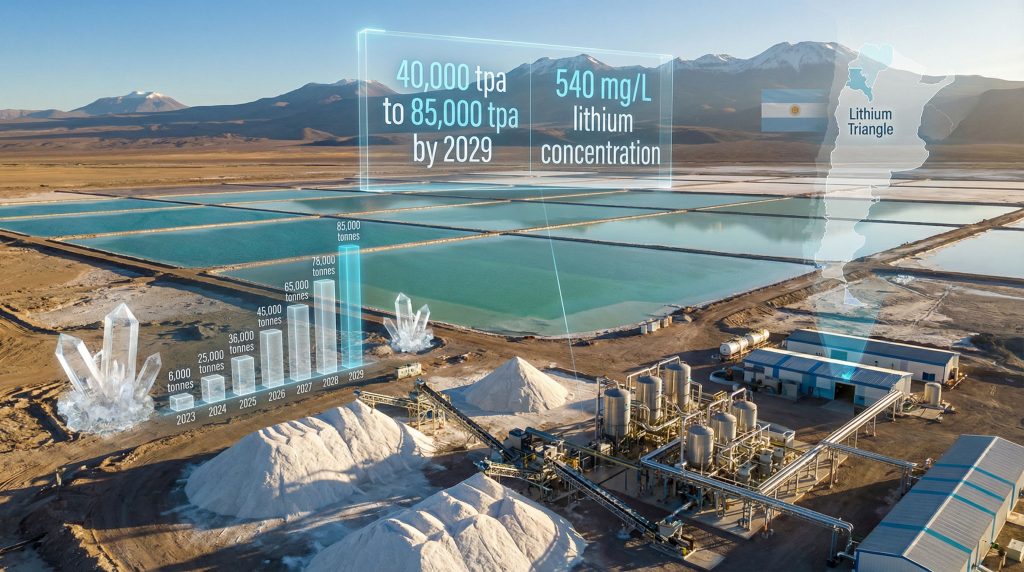
The Cauchari-Olaroz operation exemplifies this strategic positioning through its remarkable production trajectory. Starting from 6,000 tonnes LCE in 2023, the facility achieved 25,400 tonnes in 2024 before reaching 34,100 tonnes in 2025. This represents a 468% cumulative growth over three years, demonstrating the scalability potential inherent in Argentina's lithium deposits.
Market fundamentals support continued expansion, with industry projections indicating demand for approximately 1 million tonnes of additional lithium carbonate equivalent by 2035. This demand surge stems primarily from electric vehicle adoption acceleration and grid-scale energy storage deployment across major economies. However, the industry faces significant lithium market challenges that require careful navigation.
Regional Production Context:
• Argentina's 2025 lithium production: 34,100 tonnes LCE (Cauchari-Olaroz alone)
• Year-over-year growth rate: 34.2% (2024-2025)
• Projected capacity expansion: From 40,000 tpa to 200,000+ tpa by 2029
• Global demand increase requirement: 1 million tonnes LCE by 2035
The strategic importance extends beyond production volumes to encompass technological leadership in extraction methodologies. Argentina's adoption of direct lithium extraction represents a fundamental shift from traditional evaporation-dependent processes, addressing both environmental concerns and operational efficiency requirements.
When big ASX news breaks, our subscribers know first
Geographic and Resource Advantages of the Lithium Triangle
Cauchari-Olaroz benefits from exceptional natural conditions that optimise lithium extraction efficiency. Located at 3,900 meters above sea level in Jujuy province, the salar experiences intense solar radiation and low humidity levels that accelerate brine evaporation rates naturally.
The deposit's lithium concentration of 540 mg/L positions it favourably compared to other regional operations. This grade, combined with favourable magnesium-to-lithium ratios, reduces processing complexity and improves economic returns per tonne of brine processed. For instance, innovative approaches like geothermal lithium extraction are being explored globally to enhance efficiency.
Technical Specifications:
| Parameter | Cauchari-Olaroz | Industry Average |
|---|---|---|
| Altitude | 3,900m | 2,300-4,000m |
| Lithium Concentration | 540 mg/L | 200-800 mg/L |
| Evaporation Rate | High | Variable |
| Processing Efficiency | 85-90% | 50-70% |
Climate conditions at this altitude create optimal processing environments with minimal seasonal variation. Average temperatures, combined with consistent wind patterns, enable year-round operations without the weather-dependent constraints affecting lower-altitude facilities.
The geological structure underlying the salar provides extensive brine reserves with consistent lithium grades across different extraction zones. Hydrological studies indicate sustainable extraction rates that support long-term production planning without aquifer depletion concerns.
Direct Lithium Extraction Technology Revolution
The lithium expansion in Cauchari-Olaroz incorporates cutting-edge direct lithium extraction technology that fundamentally transforms production economics. Traditional evaporation processes require 18 months from brine extraction to final product, while DLE systems achieve equivalent results in 6-8 hours.
Performance Improvements:
• Water consumption reduction: 90% versus traditional methods
• Processing timeline: 6-8 hours (DLE) vs 18 months (evaporation)
• Recovery rates: 80-90% (DLE) vs 50-60% (traditional)
• Weather independence: 100% operational consistency
This technological advancement addresses three critical constraints in traditional lithium production. First, water scarcity regulations increasingly restrict evaporation pond operations in arid regions. Second, extended processing cycles create working capital inefficiencies and inventory management complexities. Third, suboptimal recovery rates waste valuable lithium resources and increase per-unit extraction costs.
DLE systems employ selective ion absorption or precipitation mechanisms to separate lithium from complex brine solutions. The modular design enables phased implementation, allowing operators to maintain production continuity while integrating new technology incrementally.
Capital Investment Analysis:
The lithium expansion in Cauchari-Olaroz benefits from existing infrastructure that reduces DLE implementation costs. Industry benchmarks suggest $400-600 million for a 45,000 tpa DLE facility when built as an expansion, compared to $800-1,200 million for equivalent greenfield capacity.
This cost advantage stems from shared infrastructure utilisation, including power systems, transportation networks, and processing facilities. The expansion approach also leverages operational expertise and regulatory approvals already established at the site.
Argentina's RIGI Framework and Investment Incentives
Argentina's Investment Incentive Regime (RIGI) provides unprecedented stability for large-scale mining projects through comprehensive tax and regulatory benefits. The framework targets investments exceeding $200 million with 30-year stability guarantees that insulate projects from policy volatility.
Tax Benefit Structure:
• Corporate income tax: 25% (versus 35% standard rate)
• Import duty exemptions: 100% on capital goods
• Accelerated depreciation: Enhanced schedules
• Foreign exchange guarantees: Stabilised export rates
The 10-percentage-point corporate tax reduction directly improves project economics by approximately 250-300 basis points on after-tax returns. On a hypothetical $1 billion investment generating $250 million annual EBITDA, the annual tax savings reach $25 million, creating $750 million in cumulative benefits over 30 years (undiscounted).
RIGI applications require detailed technical and financial documentation demonstrating project viability and economic contribution. Lithium Argentina announced that the Cauchari-Olaroz Stage 2 expansion submitted its application in December 2025 through subsidiary Exar, targeting approval within the first quarter of 2026.
Strategic Timing Advantages:
The application timing aligns with Argentina's economic stabilisation efforts under the Milei administration, which took office in December 2023. This political momentum creates favourable conditions for RIGI approvals while positioning approved projects ahead of anticipated lithium demand acceleration in 2026-2027.
Foreign exchange stability provisions address historical currency volatility concerns that deterred institutional investment in Argentine mining projects. These guarantees enable project financing based on dollar-denominated revenue streams without peso devaluation risk.
Joint Venture Structure and Risk Distribution
The lithium expansion in Cauchari-Olaroz operates through a tri-party ownership structure that strategically distributes operational, financial, and political risks across complementary partners.
Ownership Distribution:
| Partner | Stake | Primary Contribution |
|---|---|---|
| Ganfeng Lithium | 46.7% | Technology, Asian markets |
| Lithium Argentina | 44.8% | Operations, local expertise |
| JEMSE | 8.5% | Provincial alignment |
Ganfeng Lithium brings proprietary DLE technology and established relationships with Chinese battery manufacturers representing approximately 50% of global electric vehicle demand. Their stake provides leverage for technology transfer agreements while aligning profitability incentives with operational success.
Lithium Argentina contributes operational management expertise and deep understanding of Argentine regulatory processes. Their local presence enables efficient permitting navigation and community relations management critical for sustained operations.
JEMSE (Jujuy Energia y Mineria Sociedad del Estado) represents Jujuy provincial government interests, ensuring stakeholder alignment and policy coordination. This governmental participation facilitates infrastructure development support and regulatory stability.
Risk Mitigation Framework:
The balanced ownership structure prevents excessive concentration of decision-making power while ensuring each partner maintains sufficient influence to protect their strategic interests. This arrangement reduces dependency on any single partner while creating accountability mechanisms for project execution.
Technology transfer occurs through the joint venture structure rather than licensing arrangements, eliminating ongoing royalty obligations and ensuring full operational control over DLE systems once implemented.
Market Dynamics Driving Expansion Strategy
Global lithium demand projections indicate structural supply deficits emerging across multiple end-use sectors. Electric vehicle adoption acceleration, particularly in China and Europe, drives primary demand growth while utility-scale energy storage creates secondary demand streams. Moreover, argentina lithium insights reveal significant opportunities within the regional market dynamics.
Demand Scenario Modelling:
• China: 50% of global EV sales by 2030
• Europe: 30 million EVs by 2030 (vs 3 million in 2025)
• North America: 20 million EVs by 2030
• Grid-scale storage: 400 GWh annual installations by 2030
The lithium expansion in Cauchari-Olaroz positions the operation to capture premium pricing opportunities as supply tightens. Current production costs of $6,000 per tonne with targeted reductions to $5,500 per tonne by 2029 maintain competitive advantages across various price scenarios.
Market intelligence suggests that cost reduction through technology integration and infrastructure sharing represents the primary competitive strategy given lithium price volatility. Operations achieving sub-$6,000 per tonne production costs maintain profitability even during commodity cycle downturns.
Competitive Positioning Analysis:
Argentina's neutral geopolitical stance creates opportunities for diversified customer base development across competing trade blocs. Western governments increasingly prioritise supply chain diversification away from Chinese-dominated processing, creating premium pricing opportunities for producers willing to establish non-Chinese processing partnerships.
This geopolitical dynamic enables Argentine producers to negotiate favourable long-term offtake agreements with both Asian and Western battery manufacturers, reducing sales concentration risk while maximising revenue optimisation opportunities.
The next major ASX story will hit our subscribers first
What Makes Pozuelos-Pastos Grandes Development Pipeline Unique?
The $3.3 billion Pozuelos-Pastos Grandes project represents the next phase in capacity expansion strategy, targeting 150,000 tpa across 8,664 hectares in Salta province. The project's scale enables significant economies of scale through shared infrastructure utilisation with existing operations.
Project Development Framework:
• Initial phase capacity: 50,000 tpa LCE
• Full development target: 150,000 tpa LCE
• Total investment commitment: $3.3 billion
• Expected employment generation: 2,500 direct, 7,500 indirect positions
The joint venture structure differs from Cauchari-Olaroz, with Lithium Argentina holding 33% and Ganfeng Lithium controlling 67%. This asymmetric arrangement reflects Ganfeng's increased operational control interest in greenfield development versus expansion of existing facilities.
Timeline coordination between Cauchari-Olaroz expansion and PPG development enables optimised resource allocation and risk management. The phased approach prevents excessive capital deployment while maintaining growth momentum aligned with market demand acceleration.
Infrastructure Synergies:
PPG development benefits from transportation network enhancements supporting Cauchari-Olaroz operations, including highway upgrades reducing transport costs by 15-20% and direct rail connections to Pacific ports. These shared infrastructure investments improve returns across both projects while reducing per-unit logistics expenses. Furthermore, mining innovation trends continue to shape operational efficiency across the sector.
Financial Performance and Investment Returns
Recent operational metrics demonstrate strong fundamental performance supporting expansion economics. Q4 2025 achievements include 97% capacity utilisation, production costs of $6,000 per tonne, and $26 million net debt reduction.
Return Projections:
| Scenario | NPV (10% discount) | IRR | Payback Period |
|---|---|---|---|
| Base Case | $1.2 billion | 22% | 6.5 years |
| Upside Case | $1.8 billion | 28% | 5.2 years |
| Downside Case | $800 million | 16% | 8.1 years |
These projections incorporate lithium price volatility ranges from $8,000-$15,000 per tonne while assuming gradual production cost reductions through technology optimisation and operational scaling.
The liquidity position of $150 million available provides financial flexibility for expansion funding while maintaining operational continuity during commodity price fluctuations. Debt reduction achievements demonstrate cash flow generation capability supporting future capital requirements.
Operational Cash Flow Analysis:
Production cost reduction from $6,285 per tonne in Q3 2025 to $6,000 per tonne in Q4 2025 indicates ongoing efficiency improvements. This trajectory supports targeted cost reductions to $5,500 per tonne by 2029 through DLE technology integration and operational optimisation.
How Will Technology Integration Shape Competitive Positioning?
The phased DLE implementation approach minimises operational disruption while maximising learning curve benefits and technology absorption. The lithium expansion in Cauchari-Olaroz follows a three-phase integration timeline designed to achieve full DLE capacity by 2029.
Implementation Timeline:
• Phase 1 (2026): Pilot DLE facility processing 20% of brine
• Phase 2 (2027): Scale to 60% DLE processing
• Phase 3 (2028-2029): Full DLE integration achieving 85,000 tpa capacity
This gradual approach enables operational teams to develop expertise with DLE systems while maintaining production consistency from traditional processing methods. The parallel operation strategy reduces technology risk while ensuring continuous revenue generation throughout the transition period.
Competitive Advantage Development:
DLE technology adoption positions Cauchari-Olaroz ahead of traditional evaporation-based competitors through multiple dimensions:
• Environmental compliance: Reduced water usage aligns with tightening regulations
• Production flexibility: Weather-independent processing enables consistent output
• Cost structure optimisation: Lower operating expenses improve margin resilience
• Capacity scalability: Modular systems support rapid expansion capability
Infrastructure Development and Regional Impact
The lithium expansion in Cauchari-Olaroz benefits from ongoing infrastructure improvements that reduce operational costs while supporting broader regional development objectives. Transportation network enhancements directly impact project economics through reduced logistics expenses.
Infrastructure Enhancement Programme:
• Jujuy-Salta highway upgrades: 15-20% transport cost reduction
• Port access optimisation: Direct rail connections to Pacific ports
• Power grid reinforcement: Renewable energy integration
• Telecommunications improvements: Enhanced operational connectivity
These infrastructure investments create positive spillover effects extending beyond the immediate project boundaries. Regional economic multiplier effects generate significant employment opportunities and supplier development programmes supporting local economic diversification. Additionally, insights from the global lithium podcast provide valuable perspectives on industry development patterns.
Regional Economic Contribution:
• Direct employment: 2,500 positions
• Indirect employment: 7,500 positions
• Local procurement opportunities: $200 million annually
• Provincial tax contributions: $150 million annually
The combined impact of Cauchari-Olaroz expansion and PPG development creates sustainable economic foundations for remote provincial communities while supporting Argentina's broader export diversification objectives.
Investment Considerations and Risk Assessment
The lithium expansion in Cauchari-Olaroz presents multiple upside catalysts balanced against identifiable risk factors that investors must evaluate when assessing project viability and return potential.
Upside Catalysts:
• Accelerated EV adoption exceeding current projections
• DLE technology breakthroughs improving efficiency beyond baseline assumptions
• Geopolitical premiums from supply chain diversification initiatives
• Infrastructure synergies reducing costs below projected levels
Risk Factors:
• Lithium price volatility affecting project economics during commodity downturns
• Regulatory changes at provincial or national levels impacting operational stability
• Technology implementation challenges with DLE systems
• Water availability constraints in arid regional environments
Market Psychology Considerations:
Lithium markets exhibit cyclical volatility driven by supply-demand imbalances and speculative trading activity. Projects with production costs below $7,000 per tonne typically maintain operational viability across market cycles, positioning Cauchari-Olaroz favourably for sustained profitability.
The neutral geopolitical positioning of Argentina enables market access diversification reducing dependency on single-country demand patterns. This strategic flexibility becomes increasingly valuable as trade tensions influence global supply chain configurations. Furthermore, reports indicate that Lithium Argentina seeks financing to support its expansion objectives.
Strategic Implications for Argentina's Lithium Future
The lithium expansion in Cauchari-Olaroz represents more than capacity enhancement. It demonstrates Argentina's evolution from raw material extraction toward value-added processing incorporating advanced technologies and sustainable operating practices.
Success metrics encompass production volumes, environmental stewardship, community engagement, and technological leadership. The integration of DLE systems, favourable regulatory frameworks, and strategic international partnerships creates a development template applicable across Argentina's broader lithium resource base.
Long-term Strategic Positioning:
Argentina's ability to scale operations while maintaining competitive cost structures will determine its position in evolving critical mineral supply chains. The Cauchari-Olaroz expansion serves as a crucial test case influencing regional development patterns and global supply chain configurations.
The project's progression through 2029 will establish operational benchmarks for subsequent developments while demonstrating Argentina's capacity to balance economic development objectives with environmental sustainability requirements.
As global lithium demand accelerates, Argentina's technological adoption leadership positions the country advantageously for capturing premium market segments while maintaining production cost competitiveness essential for long-term market participation.
Disclaimer: This analysis contains forward-looking statements based on current market conditions and publicly available information. Actual results may vary significantly due to commodity price volatility, regulatory changes, and technological implementation challenges. Investors should conduct independent due diligence before making investment decisions.
Ready to Capitalise on Argentina's Lithium Expansion Opportunities?
Discovery Alert's proprietary Discovery IQ model delivers real-time alerts on significant lithium and critical mineral discoveries across the ASX, instantly empowering subscribers to identify actionable opportunities ahead of the broader market. Explore how historic mineral discoveries have generated substantial returns by examining Discovery Alert's comprehensive analysis of past market successes, then begin your 30-day free trial today to position yourself strategically for the next major breakthrough in the critical minerals sector.