May 14, 2026
The Future of Lithium Extraction in South America
The lithium extraction industry stands at a transformative crossroads, where traditional single-deposit mining operations are giving way to integrated multi-site development strategies. This evolution reflects broader shifts in global critical mineral supply chains, where scale, efficiency, and risk management have become paramount considerations for investors and mining companies alike. Furthermore, these changes are driving mining industry innovation trends that will define the sector's future.
Argentina's lithium triangle, encompassing portions of Salta, Jujuy, and Catamarca provinces, contains approximately 19 million tonnes of lithium metal content according to the U.S. Geological Survey, representing the world's second-largest lithium reserves. Within this geological treasure trove, a groundbreaking approach to resource extraction is emerging that challenges conventional mining wisdom.
When big ASX news breaks, our subscribers know first
Multi-Salar Development: Redefining Lithium Extraction Strategy
Unlike traditional operations that focus on individual salt flat deposits, multi-salar lithium projects coordinate extraction across multiple brine formations simultaneously. This approach represents a fundamental departure from the single-site model that has dominated lithium mining for decades.
Power Minerals and Summit Explore Corp have pioneered this concept through their development of what industry sources describe as the world's first multi-salar lithium project in Argentina. The initiative encompasses five distinct salars: Incahausi, Rincon, Pocitos, Pular, and Arizaro, all located within Argentina's lithium triangle. For investors seeking to understand broader regional dynamics, Argentina lithium brine insights provide valuable context for market opportunities.
Technical Integration Across Multiple Sites
The technical framework enabling multi-salar operations relies on several key innovations:
Coordinated Brine Management Systems
- Integrated pumping and extraction infrastructure across multiple sites
- Centralised monitoring of aquifer pressure and brine quality
- Optimised extraction scheduling to maintain geological stability
Shared Processing Infrastructure
- Single Direct Lithium Extraction (DLE) facility serving multiple salars
- Reduced capital expenditure through economies of scale
- Enhanced processing efficiency through brine blending capabilities
Integrated Environmental Monitoring
- Regional approach to water resource management
- Coordinated environmental impact assessments
- Shared community engagement and regulatory compliance frameworks
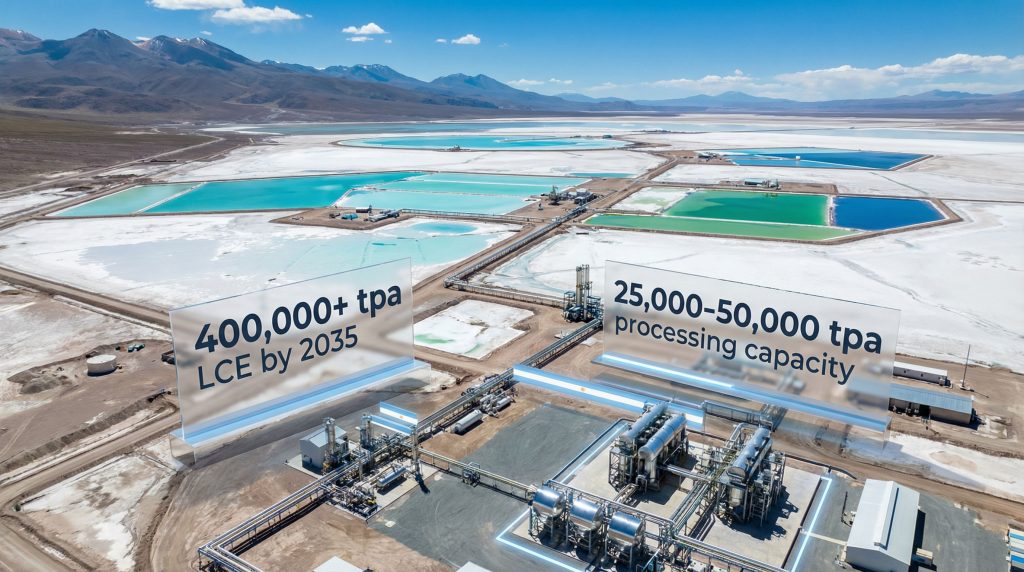
The Summit Explore arrangement includes construction of a 5,000-tonne annual capacity DLE processing plant, with technical validation conducted through the company's existing Alpaca DLE demonstration facility in Chile. This approach demonstrates how international technology transfer partnerships are driving innovation in South American lithium extraction.
Argentina's Geographic Advantages for Consolidation
Unique Geological Concentration
Argentina's lithium triangle presents an extraordinary geological phenomenon where multiple high-grade lithium deposits exist within relatively close proximity. This concentration creates opportunities for coordinated development that would be impossible in other global lithium regions.
Regional Reserve Distribution:
- Salta Province: Major deposits including Rincon and Pocitos salars
- Jujuy Province: Home to operational Olaroz-Cauchari basin
- Catamarca Province: Additional brine deposits including Arizaro
The spatial proximity of these deposits, typically within a 500-kilometer radius, enables shared infrastructure deployment and coordinated resource management strategies that significantly reduce operational costs compared to isolated single-salar operations.
Established Mining Infrastructure
The region benefits from existing lithium extraction operations, including Livent Corporation's Olaroz-Cauchari facility, which produces approximately 42,500 tonnes of lithium carbonate equivalent annually. This operational precedent has established supply chain logistics, regulatory frameworks, and skilled workforce availability that new multi-salar projects can leverage.
Technical Innovation: Direct Lithium Extraction Technology
DLE Advantages Over Traditional Methods
Direct Lithium Extraction technology represents a significant advancement over traditional solar evaporation pond methods, offering several key advantages. Moreover, these innovations align with broader lithium industry innovations being developed globally:
Water Consumption Efficiency:
- Traditional evaporation: 500,000+ litres per tonne LCE
- DLE technology: 500-1,000 litres per tonne LCE
- Water recovery rates: Up to 95% through integrated systems
Processing Timeline:
- Traditional methods: 12-24 months from brine to lithium carbonate
- DLE systems: 24-48 hours processing cycle
- Consistent quality output regardless of weather conditions
Brine Optimisation Through Multi-Salar Blending
Multi-salar operations enable sophisticated brine management strategies that optimise extraction efficiency:
| Brine Grade Category | Lithium Concentration | Strategic Use |
|---|---|---|
| High-grade sources | >400 mg/L Li | Primary extraction feedstock |
| Medium-grade sources | 200-400 mg/L Li | Blending for processing optimisation |
| Processing outcome | Variable blend | Reduced chemical consumption, improved efficiency |
This blending approach allows operators to maintain consistent processing conditions while maximising lithium recovery from deposits with varying characteristics.
Investment Economics and Risk Management
Capital Efficiency Through Scale
Multi-salar development offers significant capital efficiency advantages compared to traditional single-site operations. The ability to share processing infrastructure across multiple deposits reduces per-tonne capital intensity while maintaining operational flexibility.
Infrastructure Investment Distribution:
- Single-salar processing plant: $200-400 million per facility
- Multi-salar shared facility: $500 million serving multiple deposits
- Capital intensity reduction: Approximately 25-30% per annual tonne of capacity
The Power Minerals-Summit Explore arrangement demonstrates this capital efficiency model, with Summit committing up to US$6 million in strategic investment covering:
- Water drilling and pumping well infrastructure development
- Mineral resource drilling programmes across all five salars
- Preliminary Feasibility Study development compliant with Canadian NI 43-101 standards
- Brine compatibility and extraction efficiency testing
Risk Diversification Benefits
Multi-salar operations provide inherent risk diversification across several critical factors:
Geological Risk Mitigation:
- Spread operational exposure across multiple geological formations
- Reduced dependence on single-deposit resource estimates
- Enhanced reserve confidence through portfolio approach
Operational Risk Reduction:
- Multiple water sources reducing aquifer dependency
- Varied elevation and climate zones minimising weather impact
- Diversified regulatory exposure across provincial jurisdictions
Market Risk Management:
- Flexible production scheduling based on market conditions
- Ability to optimise grade and quality for specific customer requirements
- Enhanced negotiating position with downstream partners
Environmental and Social Considerations
Water Resource Management
Effective water management represents perhaps the most critical environmental challenge for lithium extraction in Argentina's semi-arid climate. The region receives only 100-400mm of annual precipitation, making sustainable water use paramount for long-term operations.
Integrated Water Management Benefits:
- Coordinated aquifer monitoring across all extraction sites
- Regional water balance optimisation
- Enhanced environmental impact assessment through comprehensive approach
- Reduced cumulative environmental footprint per tonne of lithium produced
Community Engagement Framework
Multi-salar projects require sophisticated community engagement strategies that address multiple stakeholder groups across different provincial jurisdictions:
- Coordinated employment and training programmes serving multiple communities
- Regional economic development initiatives beyond single-mine impact
- Enhanced social licence through broader stakeholder participation
- Shared infrastructure benefits extending to local communities
The next major ASX story will hit our subscribers first
Global Market Implications
Supply Chain Integration
The emergence of large-scale multi-salar operations is reshaping global lithium supply chains in several important ways. However, these developments must be considered within the broader context of surging critical minerals demand globally:
Production Scale Impact:
- Current global lithium production: Approximately 1.2 million tonnes LCE annually
- Argentina's contribution: 14,000 tonnes LCE in 2023
- Projected growth: 100,000+ tonnes LCE by 2030 through capacity expansion
Multi-salar projects could potentially contribute 15-20% of global lithium supply by 2035, fundamentally altering market dynamics and pricing structures.
Quality and Consistency Advantages
Large-scale operations with blended brine sources offer downstream customers several advantages:
- Consistent product quality through optimised processing conditions
- Supply reliability from multiple extraction sources
- Cost competitiveness through economies of scale
- Enhanced ESG compliance through integrated environmental management
Investment Strategy Considerations
Partnership Structure Analysis
The multi-salar development model typically requires sophisticated partnership arrangements combining international technology expertise with local regulatory knowledge. Furthermore, these arrangements must address energy security in critical minerals supply chains:
Typical Joint Venture Framework:
- International technology partner: 51-70% equity, DLE technology, funding
- Local resource partner: 30-49% equity, concession rights, regulatory management
- Government participation: Royalty structures and infrastructure support
The Power Minerals-Summit Explore arrangement exemplifies this model, with Summit acquiring a 59% interest while Power Minerals retains 41%, combining Summit's proprietary DLE technology with Power's established concession portfolio.
Due Diligence Framework
Investors evaluating multi-salar opportunities should focus on several critical assessment areas:
Technical Feasibility Assessment:
- DLE technology compatibility across different brine compositions
- Infrastructure integration capabilities and costs
- Processing efficiency optimisation potential
- Environmental compliance and permitting status
Regulatory and Social Risk Evaluation:
- Provincial regulatory approval status across multiple jurisdictions
- Community acceptance and social licence maintenance
- Water rights security and environmental impact assessments
- Partnership stability and technology access agreements
Future Technology Trends
Next-Generation Capabilities
The evolution toward multi-salar operations is driving several technological innovations:
Advanced Process Control Systems:
- AI-optimised brine blending for maximum lithium recovery
- Automated quality control across multiple extraction points
- Predictive maintenance for shared infrastructure systems
- Real-time environmental monitoring integration
Enhanced Extraction Technologies:
- Improved DLE selectivity and recovery rates
- Reduced chemical consumption through process optimisation
- Enhanced water recovery and recycling capabilities
- Integrated byproduct recovery for potassium and boron
Market Outlook and Investment Pipeline
Development Timeline Projections
Multiple multi-salar projects are advancing through various development phases across Argentina's lithium triangle. Additionally, companies like Rio Tinto with their Rincon project demonstrate the growing international interest in the region:
Near-term Milestones (2027-2029):
- First production from pioneer multi-salar projects
- Technology validation and optimisation phases
- Initial market penetration and customer relationship development
Medium-term Expansion (2030-2035):
- Scaled production capacity across multiple operations
- Enhanced processing efficiency through operational experience
- Broader adoption of multi-salar development model
Investment Capital Requirements
The multi-salar development model requires substantial capital investment but offers superior returns through enhanced efficiency and scale:
Total Investment Pipeline:
- 12+ multi-salar projects in various development stages
- Combined potential production capacity: 400,000+ tonnes LCE annually by 2035
- Total investment requirement: $8-12 billion USD
- Expected average project IRR: 25-35% based on current lithium pricing
Strategic Investment Implications
The emergence of multi-salar lithium development in Argentina represents a paradigm shift toward larger-scale, more efficient critical mineral extraction. This approach offers investors exposure to several compelling investment themes:
Scale and Efficiency Advantages:
Multi-salar operations leverage shared infrastructure to achieve superior unit economics compared to traditional single-deposit mines. The ability to blend brine sources optimises processing conditions while reducing capital intensity per tonne of production capacity.
Risk Management Benefits:
Geographic and geological diversification across multiple deposits reduces operational risks whilst maintaining exposure to Argentina's world-class lithium resources. This portfolio approach enhances project resilience against individual deposit challenges.
Technology Integration Opportunities:
The multi-salar model creates compelling opportunities for international technology companies to establish significant market positions in South America's lithium sector through strategic partnerships with local resource companies.
Market Positioning Advantages:
Large-scale operations enable direct relationships with automotive and battery manufacturers, potentially capturing higher margins through vertical integration and quality consistency premiums.
Please note: This analysis contains forward-looking statements and projections that involve inherent risks and uncertainties. Lithium market conditions, regulatory environments, and technology development timelines may vary significantly from current projections. Investors should conduct thorough due diligence and consult qualified professionals before making investment decisions.
The world's first multi-salar lithium project in Argentina demonstrates how innovative approaches to resource development can unlock value through operational scale, technical integration, and strategic risk management. As global lithium demand continues expanding, this development model may well establish the template for future critical mineral extraction projects worldwide.
Ready to Capitalise on the Next Major Lithium Discovery?
Discovery Alert's proprietary Discovery IQ model delivers real-time alerts on significant lithium and critical mineral discoveries across the ASX, instantly empowering subscribers to identify actionable opportunities ahead of the broader market. Understand why major mineral discoveries can lead to substantial returns by exploring Discovery Alert's dedicated discoveries page, showcasing historic examples of exceptional outcomes, then begin your 14-day free trial today to position yourself ahead of the market.