May 19, 2026
Market Timing and Portfolio Positioning in Lithium Investment Strategy
Strategic asset allocation within volatile commodity markets requires careful consideration of both macroeconomic cycles and individual company fundamentals. The lithium sector exemplifies this challenge, where traditional investment approaches must adapt to rapidly evolving demand structures and supply chain dynamics across multiple applications beyond electric vehicles.
Energy storage systems now represent a parallel demand pillar alongside automotive applications, creating new market dynamics that extend beyond traditional cyclical patterns. This diversification fundamentally alters risk assessment frameworks for investors evaluating which ASX lithium share is a smarter buy within current market conditions.
When big ASX news breaks, our subscribers know first
Understanding the Current ASX Lithium Investment Landscape
Market Recovery Dynamics and Timing Considerations
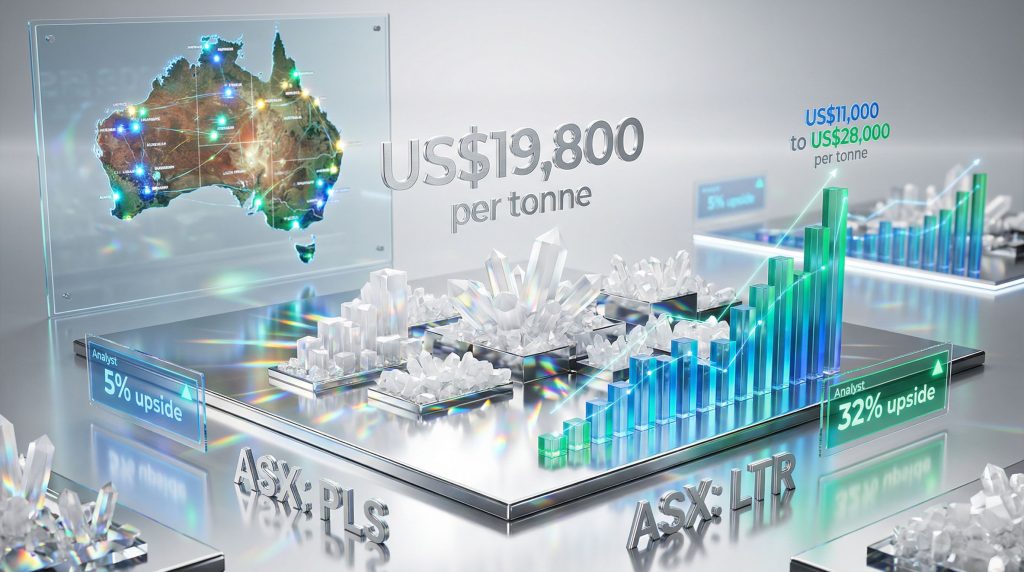
The Australian lithium sector has experienced substantial price volatility, with lithium carbonate spot prices recovering to approximately US$19,800 per tonne. This recovery represents the strongest pricing environment witnessed in over two years, following an extended downturn that challenged investor confidence across the sector.
Market participants have responded decisively to this commodity price recovery. PLS Group shares have surged 158% over the past six months, while Liontown Resources has gained 113% during the same period. These performance metrics substantially exceed broader market returns, indicating heightened investor enthusiasm for lithium exposure.
The recovery coincides with renewed optimism surrounding electric vehicle adoption and energy storage deployment. However, the sustainability of current pricing levels depends on supply-demand balance dynamics that remain subject to global economic conditions and production capacity expansion timelines. Furthermore, Australian lithium tax breaks continue to support the sector's growth prospects.
Structural Demand Drivers Beyond Electric Vehicles
Battery Energy Storage Systems have emerged as lithium's second major demand pillar, creating additional market depth beyond traditional automotive applications. This diversification reduces dependency on automotive sector fluctuations while expanding total addressable market opportunities for lithium producers.
The BESS market segment provides greater stability compared to automotive demand, which remains sensitive to consumer discretionary spending patterns and government policy changes. Industrial and utility-scale storage applications demonstrate different cyclical characteristics, offering producers more balanced revenue streams across multiple end markets.
This demand structure evolution particularly benefits companies with flexible production capacity and established relationships across diverse customer segments. In addition, the ability to allocate output between automotive and storage applications provides operational flexibility during market transitions. Meanwhile, innovations in battery-grade lithium refinery processes enhance supply chain efficiency.
What Makes a Smart ASX Lithium Investment in 2026?
Production Scale vs Development Optionality Trade-offs
Investors face a fundamental choice between established producers offering immediate cash flow generation and development-stage companies providing higher growth leverage to commodity price recovery. Each approach carries distinct risk-return profiles suited to different portfolio strategies and investment timelines.
Established producers bring operational certainty and immediate revenue generation capabilities. These companies typically maintain:
• Proven production infrastructure and established operational processes
• Existing customer relationships and offtake agreements
• Demonstrated ability to generate cash flow across commodity price cycles
• Greater financial resources to weather market downturns
Development companies offer higher leverage to commodity price movements but require greater execution capability. Their characteristics include:
• Substantial upside potential during favorable market conditions
• Higher sensitivity to commodity price fluctuations
• Execution risks during transition to commercial production
• Greater capital requirements for operational scale-up
Balance Sheet Resilience During Commodity Cycles
Companies with stronger financial positions can weather extended downturns while maintaining operational flexibility. Cash reserves, debt levels, and working capital management become critical differentiators during volatile market conditions, enabling companies to continue operations and pursue growth opportunities while competitors face financial constraints.
The importance of balance sheet strength becomes particularly evident during commodity price downturns. Companies with adequate liquidity can maintain production levels, invest in operational improvements, and potentially acquire assets from distressed competitors at attractive valuations. However, even resilient companies must navigate the broader lithium market downturn challenges.
| Factor | Established Producers | Development Companies |
|---|---|---|
| Cash Flow Timing | Immediate | 2-4 years |
| Price Sensitivity | High operational leverage | Extreme valuation leverage |
| Execution Risk | Lower | Significantly higher |
| Upside Potential | Limited by scale | Substantial if successful |
How Do Major ASX Lithium Players Stack Up Strategically?
Large-Cap Production Leaders Analysis
PLS Group (ASX: PLS) represents the established producer category with its Pilgangoora operation ranking among global spodumene production leaders. The company's $14 billion market capitalisation reflects its position as Australia's lithium sector flagship, offering investors exposure to proven operations and established export relationships.
The company has demonstrated operational excellence through consistent production delivery and strong quarterly results. Management has pursued downstream integration through processing partnerships, providing additional value chain capture opportunities beyond raw spodumene concentrate sales.
However, this scale creates heightened sensitivity to global spodumene pricing cycles, with revenue fluctuations directly correlating to commodity market movements. When lithium prices strengthen, the company converts this pricing power into substantial cash flow generation. During weaker market conditions, earnings face corresponding pressure from reduced pricing and margin compression.
The company's strategic positioning benefits from:
• Proven production capability at industrial scale
• Established customer relationships with major lithium processors
• Strong balance sheet providing financial flexibility
• Downstream integration opportunities through strategic partnerships
Mid-Cap Growth Stories and Execution Themes
Liontown Resources (ASX: LTR) exemplifies the development-to-production transition story, having advanced its Kathleen Valley project from open-pit to underground operations. The company's progression through operational milestones has driven significant share price appreciation, reflecting market confidence in execution capabilities.
Strategic offtake agreements provide revenue visibility while the wholly-owned asset structure offers clearer economic transparency compared to joint venture arrangements. The company has demonstrated strategic flexibility through supply agreement amendments with major automotive manufacturers, indicating management's ability to optimise commercial terms.
However, the transition from development to sustained production presents ongoing execution challenges requiring careful capital allocation and operational management. Cash burn during ramp-up periods necessitates disciplined balance sheet management to ensure adequate liquidity through production stabilisation.
Key strategic advantages include:
• Higher growth leverage to commodity price recovery
• Flexible asset base enabling operational optimisation
• Strategic offtake relationships providing revenue certainty
• Management team with demonstrated execution capability
For investors evaluating these opportunities, consulting analysis on top ASX lithium shares can provide additional market context.
Which Investment Approach Suits Different Market Scenarios?
Defensive Positioning During Market Uncertainty
For investors prioritising capital preservation during volatile periods, established producers with proven cash flow generation offer more predictable returns. These companies typically maintain stronger balance sheets and operational flexibility to navigate commodity downturns while continuing to generate returns for shareholders.
PLS Group's established production profile provides immediate exposure to current lithium pricing without execution risk associated with development projects. The company's scale and operational experience enable consistent performance delivery across varying market conditions.
Growth-Oriented Strategies for Market Recovery
Development-stage companies provide higher leverage to lithium price recovery scenarios but require greater risk tolerance from investors. Successful execution during favourable market conditions can generate substantial returns, though timing and operational delivery remain critical variables affecting investment outcomes.
Liontown Resources offers significant upside potential during continued commodity price strength. The company's smaller production base creates higher percentage sensitivity to price movements, potentially delivering superior returns during favourable market cycles. Furthermore, emerging opportunities in Argentina lithium brine insights demonstrate the global expansion of lithium production methods.
Strategic positioning within commodity markets requires balancing immediate cash flow needs against future growth potential while considering individual risk tolerance and market timing capabilities. Successful lithium investors must evaluate company fundamentals alongside broader sector dynamics to optimise risk-adjusted returns.
What Are the Key Risk Factors to Consider?
Commodity Price Volatility Impact Analysis
Lithium prices are projected to range between US$11,000 to US$28,000 per tonne through 2026, representing significant volatility that directly impacts company valuations. This $17,000 per tonne range creates both opportunity and risk, depending on individual company cost structures and operational efficiency levels.
Current pricing at approximately US$19,800 per tonne sits within the middle-to-upper portion of this projected range, suggesting potential for both upside and downside movement. Companies with lower all-in sustaining costs benefit disproportionately from higher price scenarios, while those with higher cost structures face margin compression during weaker pricing environments.
The substantial price range reflects ongoing uncertainty regarding:
• Global supply chain capacity expansion timelines
• Electric vehicle adoption rates across major markets
• Energy storage deployment acceleration
• Macroeconomic conditions affecting industrial demand
Operational Execution and Capital Allocation Risks
Development companies face heightened execution risks during the transition to production, including cost overruns, timeline delays, and operational challenges. These risks become particularly acute during commodity price volatility when financing conditions may tighten and operational flexibility becomes constrained.
Established producers encounter different risks related to maintaining production efficiency and managing capital allocation during expansion phases. While operational risks are generally lower, these companies must optimise production levels and capital investment timing to maximise returns across commodity cycles.
Additionally, innovative extraction methods such as lithium geothermal extraction present new technological opportunities while introducing implementation risks for early adopters.
Disclaimer: Commodity price projections involve significant uncertainty and should not be relied upon as definitive forecasts. Actual pricing may vary substantially from projected ranges due to unforeseen market developments, supply disruptions, or changes in global demand patterns.
The next major ASX story will hit our subscribers first
How Do Broker Valuations Reflect Market Expectations?
Analyst Price Target Analysis and Market Sentiment
Current broker consensus reveals mixed sentiment across the sector, reflecting differing views on valuation levels and growth prospects. PLS Group receives a modest 5% upside target from Morgans, suggesting limited near-term appreciation potential despite strong operational performance. This conservative outlook reflects the premium valuation already embedded in the current share price following substantial recent gains.
Liontown Resources commands a 32% upside target from Bell Potter, indicating greater perceived value despite recent share price appreciation. This differential suggests market efficiency gaps that may present investment opportunities for discerning investors willing to accept higher execution risk in exchange for potential returns.
The valuation disparity reflects fundamental differences in business models and growth stages. Established producers trade on current earnings multiples, while development companies receive valuations based on production potential and commodity price assumptions. For comprehensive sector analysis, reviewing lithium stock performance provides additional market perspective.
Valuation Methodology Considerations
Traditional mining valuation metrics become challenging during volatile commodity cycles, as net present value calculations depend heavily on long-term price assumptions. Investors should consider multiple valuation approaches, including asset-based, cash flow, and comparative market methodologies to develop comprehensive investment perspectives.
Asset-based valuations focus on resource quality, reserve life, and replacement cost considerations. Cash flow models emphasise production capacity, cost structures, and commodity price sensitivity. Market-based comparisons examine relative valuations across peer companies and historical trading multiples.
The complexity of lithium market dynamics requires investors to consider multiple scenarios when evaluating investment opportunities. Sensitivity analysis across different commodity price environments helps identify companies best positioned for various market outcomes.
What Investment Strategy Should You Consider?
Portfolio Allocation Framework for Lithium Exposure
Diversified lithium exposure across development stages and operational profiles can help balance risk-return characteristics. Portfolio construction should consider individual risk tolerance, investment timeline, and overall portfolio diversification objectives when determining appropriate allocation levels.
Conservative investors may prefer higher allocation to established producers for stability and dividend potential. Growth-oriented investors might emphasise development companies for higher upside leverage. Balanced approaches combine both categories to optimise risk-adjusted returns while maintaining exposure to sector recovery potential.
| Investment Style | Recommended Allocation | Risk Level | Time Horizon |
|---|---|---|---|
| Conservative | 70% producers, 30% developers | Moderate | 3-5 years |
| Balanced | 50% producers, 50% developers | Moderate-High | 2-4 years |
| Growth-Oriented | 30% producers, 70% developers | High | 1-3 years |
Timing Considerations and Market Entry Points
The current market recovery phase presents both opportunities and risks for new investors. While prices have recovered significantly from recent lows, the structural demand growth from BESS and EV markets supports the long-term investment thesis, though near-term volatility remains likely.
Entry timing strategies should consider:
• Current commodity pricing relative to historical ranges
• Individual company production schedules and milestone achievements
• Broader market sentiment and capital flows into commodity sectors
• Macroeconomic conditions affecting industrial demand patterns
Dollar-cost averaging approaches may help mitigate timing risk while building positions over extended periods. This strategy allows investors to benefit from volatility while avoiding concentration of entry risk at potentially unfavourable market levels.
Strategic Positioning for Long-Term Success
The ASX lithium sector offers compelling investment opportunities across different risk-return profiles, with each approach suited to specific investor objectives and risk tolerance levels. When considering which ASX lithium share is a smarter buy, investors must evaluate their individual circumstances alongside company fundamentals and market dynamics.
Established producers like PLS Group provide stability and immediate cash flow exposure to current lithium pricing. The company's proven operational track record and strong balance sheet position it well for sustained performance across various market conditions. However, limited growth optionality may constrain returns during significant commodity price appreciation.
Development companies like Liontown Resources offer higher growth leverage to commodity price recovery scenarios. The company's strategic progress and asset quality provide substantial upside potential, though execution risks and capital requirements create higher volatility profiles requiring appropriate risk management.
Successful lithium investing requires careful consideration of market timing, company fundamentals, and individual risk tolerance. The sector's structural growth drivers remain intact through expanding electric vehicle adoption and energy storage deployment, but volatility will continue characterising short-term performance across all participants.
Key success factors for lithium investment include:
• Focus on companies with strong balance sheets and proven management teams
• Strategic positioning within the global lithium supply chain
• Diversification across development stages and operational profiles
• Understanding of commodity cycle dynamics and price sensitivity
• Alignment of investment approach with risk tolerance and timeline
The question of which ASX lithium share is a smarter buy ultimately depends on individual investor circumstances and portfolio objectives. Conservative investors seeking stability may prefer PLS Group's established production profile, while growth-oriented investors might find Liontown Resources' development potential more compelling.
Regardless of specific company selection, maintaining exposure to this critical energy transition commodity through carefully constructed positions can help optimise risk-adjusted returns while participating in the sector's long-term growth trajectory. Diversification across multiple approaches and regular portfolio rebalancing ensure alignment with evolving market conditions and investment objectives.
Ready to Invest in the Next Major Lithium Discovery?
Discovery Alert instantly alerts investors to significant ASX mineral discoveries using its proprietary Discovery IQ model, turning complex mineral data into actionable insights for the lithium sector and beyond. Begin your 14-day free trial today at Discovery Alert to position yourself ahead of the market and capitalise on emerging opportunities before they become widely recognised.