August 21, 2026
The global lithium market is witnessing a significant transformation as Lithium Ionic supply contract with Chinese companies demonstrates how integrated procurement strategies are reshaping supply chain dynamics. This development reflects the strategic positioning of Chinese processors who combine technical expertise, financial backing, and guaranteed market access to secure upstream resources. Furthermore, these arrangements extend beyond traditional commodity trading to encompass comprehensive project development partnerships.
Understanding Modern Lithium Offtake Mechanisms
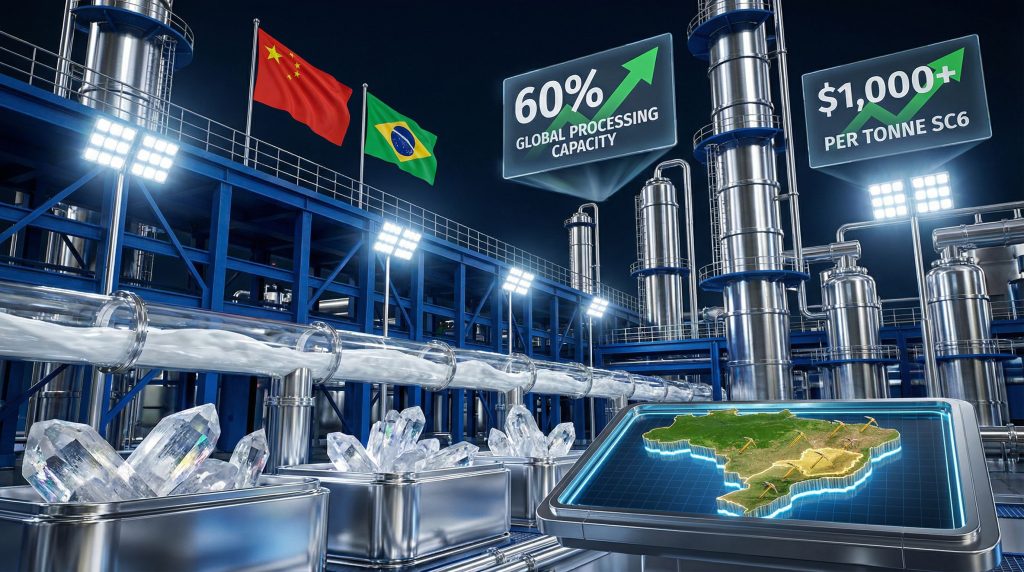
Contemporary lithium procurement strategies showcase how vertical integration creates competitive advantages in securing upstream resources. Chinese processors leverage their established relationships with battery manufacturers to offer mining companies guaranteed offtake combined with technical support and project financing. This integrated approach has become particularly evident in Brazil's emerging lithium sector, where Chinese companies are establishing long-term supply relationships with high-quality spodumene projects.
Pricing Architecture in Contemporary Agreements
Current lithium offtake agreements typically establish comprehensive pricing frameworks that provide downside protection while maintaining full exposure to market appreciation. These structures commonly feature:
- Floor price guarantees establishing minimum payment levels
- Market indexation providing full participation in price increases
- Quality premiums for higher-grade concentrates exceeding baseline specifications
- No ceiling limitations allowing unlimited upside participation
The Lithium Ionic supply contract with Chinese companies exemplifies this approach, establishing a US$1,000 per tonne minimum for SC6 concentrate while maintaining complete exposure to prevailing market prices without discount to applicable reference pricing. This structure reflects growing Chinese processor confidence in long-term lithium demand growth while providing mining companies with financing certainty for project development.
Financial Integration Beyond Simple Offtake
Modern agreements extend beyond commodity purchase commitments to encompass integrated project development support. Chinese processors increasingly provide pre-payment facilities tied to construction milestones, creating alignment between offtaker financial interests and project advancement timelines.
The Lithium Ionic arrangement includes a US$20 million pre-paid credit facility aligned with project progression toward construction decisions. This financial structure demonstrates how offtake agreements function as project financing mechanisms rather than purely commercial arrangements. In addition, these arrangements reduce both execution risk and capital requirements for mining companies.
Technical Specification Standards
Contemporary offtake agreements establish detailed technical parameters that reflect processor requirements for consistent concentrate quality. The SC6 standard (6% spodumene concentrate) represents industry baseline specifications, with many agreements incorporating provisions for higher-grade materials commanding premium pricing.
These technical requirements create operational incentives for mining companies to optimise processing efficiency and concentrate quality. Achievement of higher grades directly impacts project economics through premium pricing mechanisms, while Chinese processors' technical expertise in concentrate conversion often extends to providing optimisation support during operational ramp-up phases.
When big ASX news breaks, our subscribers know first
Chinese Processor Strategic Advantages
The attractiveness of Chinese companies as offtake partners stems from their integrated positioning across multiple value chain segments. Consequently, they create comprehensive value propositions for mining project developers spanning resource acquisition, concentrate processing, chemical conversion, and direct relationships with battery manufacturers.
Vertical Integration Capabilities
Leading Chinese lithium processors maintain sophisticated vertical integration spanning upstream resource development through downstream battery supply relationships. Sichuan Yahua Industrial Group exemplifies this approach, operating as one of the world's largest lithium hydroxide producers while maintaining diversified international resource bases across China, Africa, and Australia.
| Integration Level | Capability | Strategic Advantage |
|---|---|---|
| Upstream | Resource acquisition and development | Direct supply security |
| Midstream | Concentrate processing and chemical conversion | Technical optimisation |
| Downstream | Battery manufacturer relationships | Guaranteed market access |
| Geographic | Multi-continent operations | Risk diversification |
Yahua's customer base includes first-tier manufacturers such as Tesla, CATL, LG Energy Solutions, BMW, and BYD, providing direct market access for concentrate supplied through offtake agreements. This downstream integration creates compelling value propositions for mining companies seeking guaranteed market placement for their production.
Processing Infrastructure Development
Chinese processors are expanding processing capabilities beyond China to serve regional markets while managing regulatory and supply chain complexity. For instance, Yahua's partnership with LG Energy Solutions to develop a 50,000-tonne annual lithium hydroxide conversion facility in Morocco demonstrates strategic geographic diversification of processing infrastructure.
This approach addresses potential trade barriers, tariff considerations, and supply chain localisation requirements while maintaining Chinese technical expertise and operational control. The Morocco facility specifically targets European and North American markets, creating processing capabilities closer to end-user battery manufacturers.
Capital Deployment Strategies
Chinese companies demonstrate superior capital deployment capabilities through their ability to provide development funding, pre-payment facilities, and technical assistance to mining projects simultaneously. This integrated approach reduces execution risk for mining companies while securing upstream supply for Chinese processors.
Grand Chen Resources, founded in 2013, illustrates systematic international expansion supported by strategic partnerships with state-owned enterprises and industrial groups. The company's presence across Africa and Asia, combined with established commercial relationships including BYD, demonstrates how Chinese companies leverage both government relationships and private sector partnerships to secure resource access.
Brazil's Emerging Position in Global Lithium Markets
Brazil's Minas Gerais region has rapidly developed into a globally significant lithium district, attracting substantial Chinese investment and offtake commitments. This development reflects both geological advantages and favourable regulatory conditions that position Brazilian projects as attractive alternatives to traditional Australian supply sources.
"Lithium Valley" Development
Minas Gerais has consolidated as what industry participants term Brazil's "Lithium Valley," representing a world-class hard-rock lithium district with multiple development-stage projects. This concentration creates infrastructure advantages and operational synergies that reduce individual project development costs and timeline risks.
The region's geological characteristics support high-quality spodumene concentrate production meeting international specifications required by Chinese processors. Moreover, Brazilian projects typically achieve SC6 concentrate grades with potential for higher-grade production commanding premium pricing in offtake agreements.
Regulatory and Infrastructure Advantages
Brazil's established mining jurisdiction provides regulatory predictability that Chinese companies value when making long-term supply commitments. The country's mining code, environmental permitting processes, and established legal framework create lower sovereign risk compared to frontier jurisdictions.
Key Brazilian Lithium Sector Advantages:
- Established mining jurisdiction with predictable regulatory frameworks
- Existing transportation infrastructure reducing logistics costs
- Political stability supporting long-term commercial relationships
- High-quality hard-rock deposits meeting processor specifications
- Geographic diversification from Australian supply concentration
Infrastructure advantages include established transportation networks connecting mining regions to export facilities. Consequently, this reduces logistics complexity and costs compared to greenfield jurisdictions while accelerating project development timelines and improving operational economics.
Global Supply Chain Security Implications
The integration of Brazilian lithium projects into Chinese-controlled supply chains represents a significant shift in global lithium procurement patterns. This development affects supply chain concentration, geographic risk distribution, and competitive dynamics across the battery materials ecosystem, while australia lithium innovations continue to influence market dynamics.
Geographic Diversification Effects
Chinese procurement strategies increasingly emphasise geographic diversification to reduce dependence on Australian hard-rock supplies. Brazilian project development creates alternative supply sources while maintaining Chinese processing control, balancing supply security with operational efficiency. Furthermore, this approach complements insights from argentina lithium insights regarding regional development patterns.
Processing Concentration Dynamics
Despite upstream source diversification, lithium processing remains concentrated in Chinese facilities. This concentration provides Chinese companies with strategic control over supply chain bottlenecks while creating potential vulnerability for consuming markets seeking supply security.
Development of regional processing capabilities, such as Yahua's Morocco facility, represents limited geographic diversification of processing capacity. However, these facilities typically maintain Chinese technical control and ownership, preserving strategic influence over conversion capabilities. Projects like the battery-grade lithium refinery in India represent alternative processing developments.
Market Structure Evolution
Long-term offtake agreements between Chinese processors and international mining projects create structured supply relationships that may reduce spot market liquidity and price transparency. These arrangements benefit contract participants through price stability and supply certainty while potentially affecting broader market price discovery mechanisms.
Investment Capital Flow Patterns:
- Pre-payment facilities providing development capital to mining projects
- Technical assistance reducing operational risk during production ramp-up
- Guaranteed offtake eliminating marketing risk for project developers
- Integration support optimising concentrate quality and processing efficiency
This trend aligns with broader critical minerals & energy security considerations affecting global energy transition strategies.
Competitive Dynamics in Lithium Procurement
The lithium offtake market demonstrates increasing competition among Chinese processors seeking to secure upstream supply sources. This competition creates favourable conditions for mining companies while highlighting the strategic importance of secure concentrate supply for Chinese battery materials companies.
Processor Competitive Positioning
Different categories of Chinese lithium companies offer distinct value propositions to mining project developers, reflecting their respective capabilities and strategic priorities:
| Company Type | Market Position | Key Advantages | Strategic Focus |
|---|---|---|---|
| Large Integrated Groups | 40-50% processing share | Financial strength, downstream relationships | Long-term supply security |
| Specialised Processors | 25-35% processing share | Technical expertise, quality optimisation | Operational excellence |
| Trading Entities | 15-25% processing share | Commercial flexibility, rapid deployment | Market arbitrage |
Large integrated groups like Sichuan Yahua leverage comprehensive supply chain control and established customer relationships to offer attractive commercial terms. Their financial resources enable substantial pre-payment facilities and development support that smaller processors cannot match.
Mining Company Negotiation Leverage
Mining companies with high-quality projects in favourable jurisdictions increasingly enjoy competitive tension among Chinese buyers. This dynamic improves commercial terms and provides optionality in selecting offtake partners based on strategic fit rather than purely financial considerations.
Factors Strengthening Producer Position:
- Multiple Chinese buyer interest creating competitive dynamics
- High-quality concentrate commanding premium pricing
- Favourable jurisdiction location reducing political risk
- Advanced development stage minimising execution uncertainty
Quality differentiation becomes increasingly important as Chinese processors seek consistent, high-grade concentrates that optimise their conversion processes. Projects capable of producing SC8 or higher-grade concentrates command significantly better commercial terms due to reduced processing costs and improved yields.
Risk Management and Compliance Considerations
Chinese lithium procurement strategies increasingly incorporate comprehensive risk management frameworks addressing environmental, social, governance, and geopolitical considerations. These frameworks reflect growing scrutiny from downstream customers and regulatory authorities in key consuming markets.
Environmental and Social Governance Integration
Chinese processors face increasing pressure from battery manufacturer customers to demonstrate sustainable and responsible sourcing practices. This pressure drives enhanced due diligence requirements for mining partners and operational oversight throughout supply relationships.
Modern offtake agreements often include environmental performance standards, community engagement requirements, and social licence compliance provisions. However, these requirements reflect downstream customer expectations and regulatory frameworks in consuming markets. Advanced techniques such as lithium extraction in italy demonstrate emerging extraction technologies that may influence compliance standards.
Geopolitical Risk Mitigation Strategies
Chinese companies employ systematic approaches to managing political and regulatory risks across their international supply portfolios:
- Source Diversification: Reducing dependence on individual countries or regions
- Political Risk Assessment: Ongoing evaluation of regulatory stability and policy changes
- Local Partnership Development: Establishing relationships with domestic stakeholders
- Force Majeure Planning: Comprehensive contingency arrangements for supply disruptions
The expansion into Brazilian lithium specifically addresses concentration risk associated with Australian supply dependence while maintaining favourable regulatory conditions and established mining infrastructure.
Financial Risk Management
Currency hedging strategies become critical components of long-term offtake agreements spanning multiple years and involving substantial financial commitments. Chinese companies typically employ sophisticated financial instruments to manage foreign exchange exposure while maintaining commercial attractiveness for mining partners.
Pre-payment facilities and milestone-based funding create additional financial complexity requiring careful structuring to align Chinese processor interests with mining company development objectives. Consequently, these arrangements demand comprehensive financial planning and risk assessment.
The next major ASX story will hit our subscribers first
Future Evolution of Chinese Lithium Procurement
The trajectory of Chinese lithium procurement strategies will significantly influence global supply chain architecture over the next decade. Emerging trends suggest continued vertical integration combined with geographic expansion and technological innovation across the value chain.
Technology Integration and Innovation
Chinese processors are investing heavily in processing technology advancement to improve conversion efficiency, reduce waste generation, and optimise concentrate utilisation. These investments create competitive advantages while supporting improved environmental performance.
Processing Technology Development Areas:
- Direct Lithium Extraction (DLE) technology for brine operations
- Advanced spodumene conversion processes improving yields
- Waste heat recovery and energy efficiency optimisation
- Automated quality control and real-time optimisation systems
DLE technology development represents potential disruption to traditional hard-rock processing. However, Chinese companies maintain technological leadership across both processing approaches while investment in DLE capabilities provides optionality for future brine project development.
Market Structure Transformation
Long-term trends suggest continued consolidation of Chinese processing capacity combined with selective geographic expansion of conversion facilities. This evolution balances operational efficiency with supply chain resilience requirements from consuming markets.
Battery recycling integration represents another significant development area, as Chinese companies establish closed-loop systems incorporating secondary lithium recovery. Furthermore, these capabilities reduce primary material requirements while creating additional revenue streams from waste material processing.
Strategic Investment Priorities
Chinese lithium companies are systematically expanding their upstream exposure through direct mining investments, joint ventures, and comprehensive offtake portfolios. This upstream integration provides greater supply control while reducing exposure to spot market volatility.
The evolution of Chinese lithium procurement from transactional purchasing to integrated value chain control represents a fundamental shift in global battery materials markets, with implications extending across the entire electrification ecosystem.
The systematic nature of Chinese investment across the lithium value chain suggests continued expansion of their strategic influence over global battery supply chains. This influence will likely determine competitive dynamics, pricing mechanisms, and supply security considerations for consuming markets worldwide.
What Does This Mean for Global Markets?
The Lithium Ionic supply contract with Chinese companies demonstrates broader trends in lithium procurement that will shape market dynamics for years to come. Sophisticated market intelligence capabilities enable Chinese companies to anticipate supply and demand imbalances, identifying acquisition opportunities and optimal timing for capacity investments.
Investment Allocation Patterns:
- Upstream resource acquisition and development funding
- Processing capacity expansion and technology upgrading
- Geographic diversification of processing infrastructure
- Research and development for next-generation technologies
- Vertical integration extending into battery manufacturing
The integration of Brazilian projects like Lithium Ionic's Bandeira development into Chinese supply networks demonstrates systematic approach to global resource access. These arrangements provide insights into Chinese strategic thinking regarding long-term lithium demand growth and preferred supply chain architecture.
Understanding these dynamics becomes essential for market participants seeking to navigate the evolving lithium sector successfully. The combination of Chinese processing dominance, systematic upstream integration, and geographic expansion creates both opportunities and challenges for producing and consuming markets worldwide. For instance, developments in lithium market analysis provide detailed insights into specific project arrangements, while Chinese battery supply chains continue to influence global market structures.
The Lithium Ionic supply contract with Chinese companies ultimately represents a microcosm of larger market forces that will determine the future of global lithium supply chains and battery material security.
Ready to Capitalise on the Next Major Lithium Discovery?
Discovery Alert's proprietary Discovery IQ model delivers real-time notifications on significant ASX mineral discoveries, instantly identifying actionable lithium and battery metal opportunities before broader market awareness develops. Explore how major mineral discoveries can generate substantial returns and begin your 14-day free trial today to position yourself ahead of evolving battery materials markets.