June 12, 2026
The lithium sector stands at a critical juncture where traditional cyclical patterns are being reshaped by fundamental structural changes in global energy systems. Battery Energy Storage Systems (BESS) deployment has accelerated dramatically as renewable energy integration requires massive grid-scale storage solutions, creating a secondary demand pillar that reduces the industry's historic dependence on electric vehicle adoption cycles alone.
This diversification represents more than incremental growth. Industrial electrification programs across manufacturing sectors, combined with utility-scale battery installations supporting wind and solar projects, have established demand foundations that operate independently of consumer automotive trends. The result is a more resilient lithium market structure that can withstand temporary slowdowns in any single application sector.
Supply-side dynamics have simultaneously tightened as marginal producers implement strategic production cuts in response to previous price weakness. Unlike speculative rallies driven by investor sentiment, current price movements reflect genuine supply-demand imbalances where production capacity struggles to meet expanding industrial requirements.
What's Driving the Current Lithium Market Recovery?
Global Battery Storage Demand Creates New Growth Pillars
The lithium market has evolved beyond electric vehicle dependency through the rapid expansion of Battery Energy Storage Systems across multiple industrial applications. Grid-scale renewable energy projects now require massive battery installations to manage intermittent solar and wind generation, creating steady demand that operates independently of automotive cycles.
This diversification fundamentally alters market dynamics by reducing cyclical volatility compared to single-sector exposure. Manufacturing electrification, backup power systems for critical infrastructure, and residential storage solutions contribute additional demand streams that provide stability during automotive market fluctuations.
Current BESS deployment rates suggest exponential growth trajectories as utilities worldwide implement grid modernization programs requiring large-scale battery integration. Industrial facilities increasingly adopt battery systems for peak shaving, load balancing, and emergency power applications, further expanding lithium consumption beyond traditional automotive applications.
Supply-Side Constraints Tighten Market Fundamentals
Benchmark spodumene concentrate prices have reached multi-year highs as production cuts from marginal operators create supply deficits across key producing regions. Australian mining operations have demonstrated supply discipline by maintaining reduced output levels despite improving price signals, reflecting lessons learned from previous boom-bust cycles.
Current price movements reflect genuine supply-demand imbalances rather than speculative trading patterns that characterised previous lithium rallies. Production economics favour established operations with proven reserves and efficient processing capabilities, while marginal projects remain economically unviable despite improved pricing conditions.
The supply constraint environment has strengthened pricing power for quality producers operating in stable jurisdictions. Western Australian spodumene operations benefit from established infrastructure, skilled workforce availability, and proximity to processing facilities that provide cost advantages over emerging production regions.
When big ASX news breaks, our subscribers know first
How Are Major ASX Lithium Players Positioned for 2026?
Production-Stage Operations vs. Development Projects
| Company Category | Key Advantages | Primary Risks |
|---|---|---|
| Established Producers | Cash flow generation, proven reserves | Operational cost inflation |
| Development Projects | Leverage to price upside | Execution and funding risks |
| Diversified Miners | Revenue stability | Lower lithium exposure |
Strategic Positioning Analysis
Liontown Resources Strategic Profile:
The Kathleen Valley project represents operational excellence in lithium extraction, generating positive cash flows through strategic offtake agreements that provide price floor protection during market volatility. The operation has demonstrated consistent production performance while maintaining cost discipline through efficient mining and processing techniques.
Long-term offtake agreements with established battery manufacturers provide revenue certainty that reduces exposure to spot price fluctuations. These contracts typically include pricing mechanisms that capture upside during favourable market conditions while protecting downside risk through minimum price provisions.
A substantial cash position approaching AU$420 million supports operational flexibility and enables strategic investments in processing capacity expansion or additional resource development. Bell Potter maintains a $2.42 target representing 34% upside potential, reflecting confidence in operational execution and market positioning.
IGO's Diversification Strategy:
Multi-commodity exposure across nickel, copper, and lithium reduces volatility compared to pure-play lithium investments while maintaining meaningful exposure to battery material demand growth. The diversified portfolio provides stability during single-commodity price cycles that can severely impact specialised miners.
The Greenbushes stake provides downstream processing optionality that captures additional value beyond mining operations. Processing capabilities enable participation in battery supply chain margins while reducing dependence on third-party processing arrangements that can limit profitability.
Recent EBITDA improvements demonstrate operational resilience across the commodity portfolio, with management successfully navigating challenging market conditions through cost optimisation and operational efficiency programs. Analyst consensus remains neutral at $8.32, reflecting balanced risk-reward expectations.
Core Lithium's Turnaround Narrative:
The Finniss project restart capitalises on improved market conditions through redesigned operations targeting sustainable cost structures and enhanced production efficiency. Previous operational challenges have been addressed through engineering modifications and updated processing methodologies.
Lower-cost production plans focus on maximising resource extraction efficiency while minimising processing complexity that previously impacted project economics. The restart strategy emphasises operational simplicity and proven extraction techniques rather than experimental processing approaches.
Canaccord Genuity's 40-cent target suggests 65% upside potential, though execution risk requires careful monitoring of restart progress and production ramp-up performance. Funding requirements and operational complexity remain primary risk factors for the turnaround strategy.
What Market Scenarios Could Impact Lithium Stocks?
Bull Case Scenario Analysis
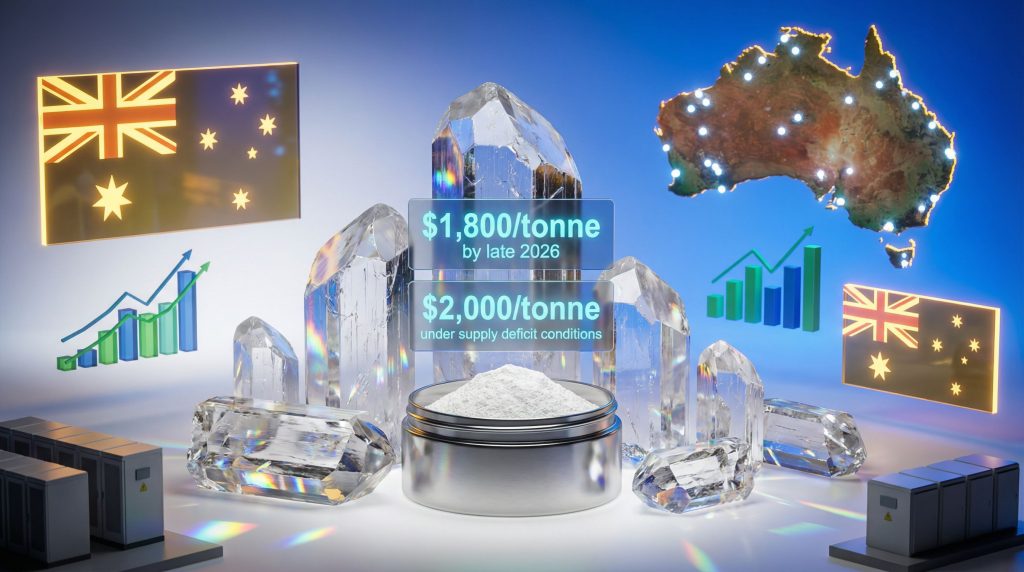
Industry forecasting suggests spodumene prices reaching $1,800 per tonne by late 2026 under base case supply-demand projections, with potential for $2,000 per tonne pricing under supply deficit conditions. These projections reflect continued BESS deployment acceleration combined with sustained EV adoption growth across major automotive markets.
Chinese production discipline appears likely to continue as domestic producers maintain supply restraint policies that support global pricing stability. Government policies supporting domestic battery manufacturing create incentives for production optimisation rather than volume maximisation at unsustainable price levels.
Grid-scale storage deployment continues expanding as renewable energy penetration accelerates, driven by government mandates and improving economic competitiveness of battery storage systems. Furthermore, with australia lithium innovations demonstrating significant technological advances, the sector shows promising long-term fundamentals.
Bear Case Risk Factors
Potential demand slowdown scenarios include electric vehicle market saturation in early-adopter regions, though emerging markets provide continued growth opportunities. Automotive industry transitions toward alternative battery chemistries could reduce lithium intensity per vehicle, though overall vehicle electrification growth likely offsets chemistry changes.
New supply sources entering production ahead of schedule represent significant downside risk, particularly if multiple large-scale projects achieve commercial production simultaneously. However, the lithium market downturn in previous years has led to more disciplined supply management across the industry.
Macroeconomic headwinds affecting industrial demand include manufacturing slowdowns, reduced capital investment in renewable energy infrastructure, and currency fluctuations impacting Australian producer competitiveness. Economic recession scenarios could significantly reduce battery demand across all application sectors.
Which Investment Strategies Suit Different Risk Profiles?
Conservative Approach: Diversified Exposure
Investors seeking lithium exposure with reduced volatility should prioritise companies with established operations, proven cash generation capabilities, and strategic partnerships that provide revenue stability. Multi-commodity miners with lithium divisions offer sector exposure while maintaining diversification benefits.
Established producers with long-term contracts provide predictable cash flows and reduced exposure to spot price volatility. These operations typically maintain stronger balance sheets and proven management capabilities that support consistent performance through commodity cycles.
Companies with strong balance sheets and substantial cash reserves can navigate market downturns while capitalising on growth opportunities during favourable conditions. In addition, understanding global market dynamics, including argentina lithium insights, helps investors assess competitive positioning across major producing regions.
Growth-Oriented Strategy: Pure-Play Opportunities
Higher-risk investors may target development projects with near-term production timelines that provide maximum leverage to commodity price appreciation. These investments require careful due diligence regarding project economics, management execution capability, and funding requirements.
Companies with significant resource expansion potential offer long-term growth opportunities beyond initial production phases. For instance, the thacker pass lithium mine demonstrates how strategic resource development can create substantial value through proven reserves and efficient extraction capabilities.
Operations positioned in favourable jurisdictions benefit from political stability, established mining regulations, and infrastructure advantages that reduce operational risk compared to frontier mining regions. Jurisdictional considerations become increasingly important as geopolitical tensions affect global supply chains.
Timing Considerations for Market Entry
Key Insight: Current market conditions suggest selective opportunities rather than broad-based exposure. Companies with proven operations and strategic partnerships offer better risk-adjusted returns than speculative development plays requiring significant execution and funding milestones.
Market timing strategies should consider commodity cycle positioning, company-specific operational milestones, and broader economic conditions affecting battery demand growth. Entry point optimisation requires balancing price appreciation potential against downside protection during market volatility.
Portfolio construction benefits from staged entry approaches that capture price appreciation while managing concentration risk. Consequently, dollar-cost averaging strategies can reduce timing risk while building positions during market uncertainty periods.
What Are the Long-Term Structural Drivers?
Energy Transition Fundamentals
Global renewable energy deployment mandates require massive grid-scale storage installations that represent the largest long-term driver of lithium demand growth. Government policies supporting clean energy infrastructure create sustained demand that operates independently of consumer adoption cycles.
Electric vehicle adoption continues expanding despite short-term market volatility, supported by regulatory requirements, improving cost competitiveness, and expanding charging infrastructure. Automotive electrification represents irreversible technological transition rather than cyclical trend dependent on consumer preferences.
Industrial electrification creates new lithium applications across manufacturing sectors seeking to reduce carbon emissions and improve operational efficiency. Heavy machinery, marine applications, and aviation electrification represent emerging demand sources with substantial long-term potential.
Supply Chain Localisation Trends
Western nations increasingly prioritise domestic battery supply chain development to reduce dependence on geopolitically sensitive regions. Strategic partnerships between mining companies and battery manufacturers create competitive advantages through integrated supply arrangements.
Australian producers benefit from geopolitical considerations as Western governments seek reliable lithium sources from allied nations. Political stability and established mining expertise provide strategic value beyond pure economic considerations for battery supply chain development.
Processing capacity expansion opportunities enable value-added activities beyond mining operations. Furthermore, developments such as the battery-grade lithium refinery initiatives worldwide demonstrate growing emphasis on downstream processing capabilities that capture additional margins while supporting domestic battery manufacturing initiatives.
How Should Investors Navigate Current Market Conditions?
Due Diligence Framework
Financial Health Indicators:
-
Cash flow generation capability demonstrates operational viability and provides financial flexibility during market volatility
-
Debt levels and funding requirements affect financial stability and growth investment capability
-
Capital expenditure plans and implementation timelines determine future production capacity and competitive positioning
-
Working capital management efficiency indicates operational excellence and cash optimisation capabilities
Operational Risk Assessment:
-
Production track record and consistency provide insight into management execution capability and operational reliability
-
Cost structure analysis reveals competitive positioning and margin sustainability during price cycles
-
Environmental and regulatory compliance history indicates operational risk and potential disruption factors
-
Management execution capability assessment through previous project delivery and strategic decision making
Portfolio Construction Considerations
| Risk Level | Allocation Strategy | Suitable Vehicles |
|---|---|---|
| Conservative | 5-10% sector exposure | Diversified miners, ETFs |
| Moderate | 10-20% allocation | Mix of producers and developers |
| Aggressive | 20%+ concentration | Pure-play lithium companies |
Risk management strategies should incorporate position sizing appropriate to individual risk tolerance and portfolio diversification requirements. Concentration limits prevent excessive exposure to single-company or sector-specific risks that could significantly impact overall portfolio performance.
However, rebalancing protocols should account for commodity cycle volatility and company-specific performance variations. Regular portfolio reviews enable tactical adjustments based on changing market conditions and company operational developments.
The next major ASX story will hit our subscribers first
What's the Outlook for ASX Lithium Shares?
Short-Term Market Dynamics (6-12 months)
Current momentum appears sustainable based on fundamental supply-demand metrics supporting continued price strength through 2026. However, investors should prepare for continued volatility as market participants adjust expectations to new price levels and production schedules.
Earnings season results will provide critical insights into operational performance and cost management effectiveness during the current price environment. Companies demonstrating consistent production growth and cost discipline should outperform peers experiencing operational challenges.
Market sentiment indicators suggest cautious optimism rather than speculative euphoria, indicating potential for sustained price appreciation without bubble dynamics that characterised previous lithium rallies. Lithium's comeback and market dynamics show professional investor participation supporting market stability compared to retail-driven speculation.
Medium-Term Growth Trajectory (2-3 years)
The sector's evolution toward a more mature, demand-driven market suggests reduced boom-bust cycle severity compared to previous lithium price cycles. Industrial demand growth provides stability that reduces dependence on automotive sector performance alone.
Companies with operational excellence and strategic positioning should significantly outperform speculative development plays lacking proven management capabilities or secure funding arrangements. Market differentiation will increasingly favour quality operations over resource size alone.
Are ASX lithium shares running out of steam? The evidence suggests transformation rather than exhaustion, with the sector transitioning from speculative cycles toward sustainable growth patterns driven by industrial demand fundamentals.
Strategic Investment Thesis
Are ASX lithium shares running out of steam is the key question facing investors today. The answer appears to be no – they are transitioning to a more sustainable growth phase characterised by operational execution rather than commodity price speculation alone. This evolution favours established producers with proven capabilities over development projects requiring successful execution across multiple risk factors.
Investment success will increasingly depend on company-specific factors including operational efficiency, cost management, strategic partnerships, and balance sheet strength. Pure commodity exposure strategies may underperform selective approaches focused on quality operations and management capabilities.
Are ASX lithium shares running out of steam? Long-term structural demand drivers support sector growth potential while supply discipline and operational complexity create barriers to entry that protect established producers from excessive competition. The combination suggests favourable risk-adjusted return potential for well-selected lithium investments.
Finally, considering whether are ASX lithium shares running out of steam, market analysis from ASX lithium stock performance suggests the sector remains positioned for continued growth despite short-term volatility concerns.
Further Exploration:
Readers interested in detailed lithium market analysis can explore additional educational resources, including industry reports from major investment banks and commodity research firms that provide comprehensive market forecasting and company-specific analysis.
Ready to Capitalise on Major Mineral Discoveries?
Discovery Alert offers real-time, significant ASX mineral discovery notifications using its proprietary Discovery IQ model, transforming data into actionable insights. Discover the potential of historic discoveries by visiting Discovery Alert’s dedicated discoveries page, and start your 14-day free trial for a market-leading advantage.