June 22, 2026
The global lithium market stands at a crossroads where traditional supply chains face unprecedented pressure from accelerating battery demand and geopolitical fragmentation. While established producers have dominated through concentrated extraction models, emerging market dynamics reveal fundamental shifts in how critical mineral resources are accessed, processed, and distributed across international supply networks.
Chile's strategic positioning within this evolving landscape demonstrates how resource-rich nations can leverage regulatory innovation to capture greater value from domestic mineral endowments while addressing indigenous rights and environmental stewardship concerns that have historically complicated extraction projects. The Wealth Minerals lithium project approval in Chile exemplifies this transformation approach.
The Strategic Context Behind Chile's Accelerated Lithium Development Framework
Chile's lithium sector transformation reflects broader trends in critical mineral governance, where nations holding significant reserves increasingly implement selective development strategies rather than open-access concession models. With confirmed lithium carbonate equivalent reserves of approximately 9.2 million tonnes, representing roughly 27-30% of global reserves according to the U.S. Geological Survey's 2025 Mineral Commodity Summaries, Chile maintains substantial leverage over global supply chain security.
Global lithium demand projections indicate exponential growth from current consumption levels of approximately 130,000 tonnes LCE in 2024 to over 1.2 million tonnes LCE by 2035, based on the International Energy Agency's Net Zero by 2050 scenario. Battery applications are expected to account for 85-90% of total lithium consumption by 2030, according to BloombergNEF analysis, creating unprecedented pressure on extraction capacity expansion.
Chile's current production of approximately 380,000 tonnes LCE annually represents 28% of global output, positioning the nation as a critical supplier whose policy decisions directly impact international battery metal availability. The government's target of doubling production within a decade would require reaching 700,000-800,000 tonnes LCE by 2034, necessitating massive capital deployment and technological innovation across newly accessible salt flat territories.
Furthermore, the September 2024 prioritisation of six strategic salt flats represents a calculated departure from the duopoly structure that previously limited large-scale lithium extraction to SQM and Albemarle operations in the Atacama region. This regulatory shift addresses supply concentration risks while creating opportunities for mid-tier mining companies to establish meaningful market positions through enhanced mining permitting framework procedures.
Resource nationalism trends across Latin America have influenced Chile's approach, with Argentina implementing similar selective development frameworks under Law 27,541 and Peru establishing enhanced consultation requirements for critical minerals projects. However, Chile's model distinguishes itself through structured indigenous partnership requirements and environmental performance bonding mechanisms that attempt to balance development acceleration with sustainability objectives.
When big ASX news breaks, our subscribers know first
What Makes Chile's New Lithium Approval Process Different from Traditional Mining Permits?
The introduction of Special Lithium Operation Contracts (CEOLs) represents a fundamental departure from conventional mining concession frameworks that grant indefinite usufruct rights. CEOLs function as time-bounded performance contracts with renewal contingent upon meeting specified environmental, production, and community benefit targets, creating different risk profiles for investors and communities compared to traditional property-rights models.
Revolutionary Partnership Models with Indigenous Communities
Indigenous community integration under the CEOL framework moves beyond consultative engagement toward genuine power-sharing architecture. Communities like the Quechua Indigenous Community of Ollagüe hold structural equity positions and veto power over operational modifications, representing operationalisation of free, prior, and informed consent principles established under ILO Convention 169, ratified by Chile in 2008.
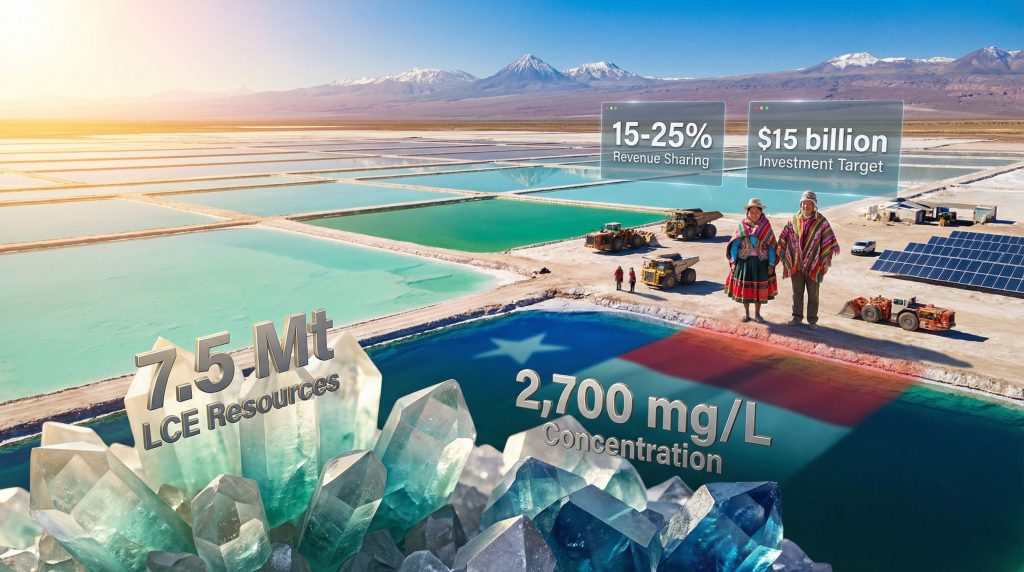
Revenue-sharing arrangements typically allocate 15-25% of net revenues to indigenous community development funds, while employment guarantees require minimum 40% local hiring for operational positions. Environmental monitoring responsibilities include community-appointed oversight of water usage and ecosystem preservation, creating accountability mechanisms that extend beyond traditional regulatory compliance.
The Wealth Minerals lithium project approval in Chile demonstrates this partnership model in practice, with the Vancouver-based company operating in direct collaboration with indigenous communities in the Ollagüe salt flat near the Bolivian border. This approval followed the government's September 2024 decision to simplify CEOL procedures for qualified applicants with established community partnerships.
Streamlined Regulatory Pathways for Priority Projects
CEOL approval timelines target 12-24 months for priority projects, compared to the 3-5 years typically required for standard mining concession environmental and regulatory review processes. This acceleration reflects structured evaluation criteria and pre-approved environmental frameworks for the six prioritised salt flats.
Environmental performance bonds for new operations are estimated at $50-100 million per project, primarily covering water management infrastructure requirements. These bonds ensure closed-loop water systems to prevent groundwater depletion in fragile desert ecosystems, adding substantial capital requirements but ensuring long-term operational sustainability.
Consequently, comptroller authorisation requirements add governmental oversight layers beyond initial ministry approval, with contract modifications subject to performance verification and community consent procedures. This multi-layer authorisation process balances investor security with sovereign regulatory authority while maintaining community participation in operational changes.
How Do Chile's Lithium Reserve Concentrations Compare Globally?
Chile's lithium reserves demonstrate significant quality stratification that directly impacts extraction economics and development sequencing. The concentration advantage of established operations creates operational tiering opportunities across the country's salt flat portfolio.
| Salt Flat Region | Estimated LCE Resources (Mt) | Average Lithium Concentration (mg/L) | Development Status | Key Characteristics |
|---|---|---|---|---|
| Atacama (SQM/Albemarle) | 7.5 | 2,700 | Active Production | Highest concentration globally; established infrastructure |
| Maricunga | 1.8 | 890 | Exploration Phase | Mid-tier concentration; requires advanced processing |
| Pedernales | 1.2 | 320 | Government Tender | Lower concentration; technology-dependent viability |
| Ollagüe Complex | 2.1 | 175-400 | CEOL Applications | Variable concentration; community partnership model |
Atacama's 2,700 mg/L concentration represents among the highest globally, reducing extraction costs and enabling lower operating thresholds compared to hard-rock spodumene operations that require ore grades of 1.0-2.0% lithium oxide for economic viability. This concentration advantage translates to approximately 40-60% lower extraction capital intensity compared to hard-rock operations, similar to advantages seen in australia lithium innovations.
Brine lithium concentration directly determines operational parameters including evaporation efficiency, extraction chemistry requirements, and water consumption ratios. Extracting one tonne of lithium carbonate from 2,700 mg/L brine requires approximately 500,000 litres of water, while extraction from 300 mg/L requires proportionally more brine processing and water cycling, increasing operational complexity and costs by 15-35% per unit production.
Global Reserve Context and Competitive Positioning
Chile's reserve portfolio competes globally with Australia's 6.2 million tonnes LCE equivalent in spodumene hard-rock deposits, Argentina's 2.4 million tonnes LCE in Atacama Desert puna region salt lakes, and Bolivia's 9.4 million tonnes LCE in Salar de Uyuni, though Bolivian development faces ongoing political and technical challenges.
In addition, China holds approximately 1.9 million tonnes LCE in Tibetan plateau salt lake deposits, while maintaining downstream processing dominance that Chile's strategy seeks to counterbalance through selective partnership formation with international battery manufacturers and processing companies. These dynamics mirror insights from argentina lithium brine insights regarding regional competition.
What Economic Models Are Driving International Investment in Chilean Lithium Projects?
International capital allocation toward Chilean lithium opportunities reflects recognition that successful CEOL acquisitions could deliver exponential returns as battery demand accelerates. The risk-adjusted returns from Chilean lithium projects significantly outweigh traditional base metal exploration in politically unstable jurisdictions, creating portfolio rebalancing opportunities for mid-tier mining companies.
Capital Allocation Strategies for Mid-Tier Mining Companies
Junior miners are restructuring portfolios to prioritise Chilean lithium opportunities, recognising first-mover advantages in newly accessible salt flat territories. Companies like London-listed CleanTech Lithium and Chile's Errazuriz group have submitted competing applications for additional salt flat territories, demonstrating international investor confidence in the revised approval framework.
Investment models typically incorporate multiple risk mitigation strategies:
- Geological Risk Reduction: Focus on salt flats with established lithium presence through government geological surveys
- Regulatory Risk Management: Partnership with experienced local operators familiar with Chilean mining regulations
- Community Risk Mitigation: Early engagement with indigenous communities to establish collaborative frameworks before formal CEOL applications
- Technical Risk Assessment: Evaluation of water availability, concentration gradients, and existing infrastructure proximity
Public-Private Partnership Revenue Projections
Chile's target of doubling lithium output within a decade requires approximately $15 billion in combined public and private investment, creating opportunities for strategic partnerships between international mining companies and state-backed development funds. This capital requirement encompasses infrastructure development, processing facility construction, and environmental compliance systems across newly accessible territories.
Revenue projections for successful CEOL projects vary significantly based on concentration levels and operational efficiency achievements. Higher-concentration deposits like Maricunga at 890 mg/L support cash-generative operations with moderate capital requirements, while lower-concentration deposits such as Ollagüe at 175-400 mg/L require advanced processing technologies and extended payback periods.
For instance, similar considerations apply to battery-grade lithium refining operations that must balance technical requirements with economic viability.
"Investment Consideration: CEOL contracts create different investment risk profiles compared to traditional mining concessions, with performance-based renewal requirements that link operational success to long-term asset security, necessitating sustained technical and community relationship management capabilities."
Why Are Indigenous Community Partnerships Becoming Central to Lithium Project Viability?
The CEOL framework's emphasis on indigenous community partnerships reflects both regulatory requirements and practical operational necessities in remote salt flat environments. Communities possess traditional ecological knowledge, territorial access rights, and local workforce capabilities that prove essential for successful project implementation and long-term sustainability.
Long-term Sustainability Metrics for Community-Integrated Projects
Community partnership models establish measurable sustainability frameworks that extend beyond environmental compliance toward social and economic development objectives:
- Revenue Sharing Implementation: 15-25% of net revenues allocated through transparent community development fund management
- Environmental Stewardship: Community-appointed monitoring of water usage with traditional ecological knowledge integration
- Cultural Preservation: Mandatory protection zones around sacred sites and traditional grazing areas with community oversight
- Workforce Development: Skills training programmes for local employment with career advancement pathways
- Infrastructure Development: Community benefit projects including healthcare facilities, educational resources, and transportation improvements
These metrics create accountability frameworks that align company operations with community priorities while establishing performance benchmarks for CEOL contract renewal evaluations. Moreover, the Wealth Minerals lithium project approval in Chile specifically demonstrates successful implementation of these partnership principles.
Traditional Ecological Knowledge Integration
Indigenous communities possess detailed understanding of local hydrological cycles, seasonal climate variations, and ecosystem interdependencies that prove invaluable for sustainable extraction planning. This knowledge integration helps companies optimise water management, minimise environmental disruption, and develop extraction schedules that respect natural seasonal patterns.
Community oversight mechanisms include traditional authority participation in operational decision-making, environmental impact assessment validation, and dispute resolution procedures that incorporate customary law principles alongside Chilean regulatory frameworks. This approach has been recognised by organisations monitoring business and human rights developments.
How Will Chile's Lithium Strategy Impact Global Battery Metal Supply Security?
Chile's expansion strategy directly addresses supply chain vulnerabilities that have created pricing volatility and geopolitical risks for battery manufacturers dependent on concentrated production sources. By diversifying extraction capabilities while maintaining processing partnerships with established refiners, Chile positions itself as a strategic buffer against supply disruptions.
Geopolitical Risk Mitigation for Battery Manufacturers
The transition from duopoly-dominated production toward a diversified ecosystem of mid-tier producers increases price competition while improving supply security for international battery manufacturers. This structural shift reduces single-point-of-failure risks that currently characterise lithium supply chains concentrated in few geographic regions and controlled by limited numbers of operators.
Battery manufacturers are establishing direct offtake agreements with Chilean lithium developers to secure long-term supply at predictable prices, bypassing traditional commodity trading mechanisms that amplify price volatility during demand surges or supply constraints. This mirrors supply security concerns driving projects like the thacker pass lithium mine in the United States.
Market Share Redistribution Scenarios Through 2030
Chile's production expansion creates multiple potential market share evolution pathways based on CEOL implementation success rates and global demand growth trajectories:
Conservative Scenario (25% Global Market Share):
- Gradual CEOL project development with 2-3 new operations online by 2030
- Production increases to approximately 500,000 tonnes LCE annually
- Maintained cost competitiveness through concentration advantages
Aggressive Scenario (35% Global Market Share):
- Accelerated CEOL implementations with 5-6 major projects operational by 2030
- Production scaling to 700,000+ tonnes LCE annually
- Enhanced processing capability partnerships with international refiners
Market Leadership Scenario (40% Global Market Share):
- Full CEOL potential realisation with processing infrastructure development
- Strategic control over refined lithium carbonate supply through vertical integration partnerships
- Establishment as dominant global supplier with pricing influence capabilities
The next major ASX story will hit our subscribers first
What Technical Challenges Must New Chilean Lithium Projects Overcome?
Salt flats outside the established Atacama region present distinct technical challenges that require advanced extraction technologies and modified operational approaches compared to conventional high-concentration brine processing methods.
Brine Concentration and Processing Efficiency Optimisation
Projects targeting lower concentration deposits must demonstrate economic viability through technological innovation or operational efficiency improvements. Ollagüe's 175-400 mg/L concentrations require either extended evaporation periods (24-36 months compared to Atacama's 12-18 months) or advanced direct lithium extraction technologies that can process lower-grade brines cost-effectively.
Evaporation efficiency directly impacts capital requirements, with lower concentrations necessitating larger evaporation pond systems and extended processing cycles. This creates higher working capital requirements and increased exposure to weather-related operational disruptions during extended processing periods.
Processing chemistry modifications for lower-concentration brines include:
- Enhanced Reagent Utilisation: Higher chemical contact times and optimised reagent ratios for lithium recovery
- Multi-Stage Concentration: Sequential evaporation and chemical treatment processes to achieve commercial-grade lithium carbonate production
- Selective Extraction Technologies: Implementation of membrane filtration or ion exchange systems to improve lithium recovery rates
- By-Product Recovery: Economic optimisation through potassium, magnesium, and other mineral recovery to supplement lithium revenues
Water Management in Arid Ecosystem Preservation
New lithium projects must implement closed-loop water systems to prevent groundwater depletion in fragile desert ecosystems, requirements that add $50-100 million to initial capital requirements but ensure long-term operational sustainability and community acceptance.
Water management complexity increases significantly in remote salt flat locations lacking established infrastructure. Projects must develop comprehensive hydrological models that account for:
- Seasonal Recharge Variations: Annual precipitation patterns and groundwater replenishment cycles
- Ecosystem Water Dependencies: Flora and fauna water requirements and traditional community water usage patterns
- Operational Water Efficiency: Minimised consumption through recycling systems and process optimisation
- Emergency Water Security: Backup water supplies and drought contingency planning
"Technical Insight: Advanced water management systems can reduce operational water consumption by 60-80% compared to traditional evaporation-only methods, though requiring substantial upfront capital investment in recycling infrastructure and monitoring systems."
How Are Global Battery Manufacturers Responding to Chile's Lithium Expansion?
Major battery producers are restructuring supply chain strategies to incorporate Chilean lithium diversity as a hedge against concentration risks and price volatility associated with limited supplier bases. These strategic relationships often extend beyond commodity purchase agreements toward technical collaboration and financing partnership arrangements.
Strategic Offtake Agreement Structures
Contemporary offtake agreements between battery manufacturers and Chilean lithium developers incorporate multiple risk mitigation and value creation mechanisms:
Volume and Pricing Frameworks:
- Contract Duration: 5-10 year agreements covering 50-80% of planned production capacity
- Pricing Mechanisms: Hybrid structures combining fixed price floors with market participation upside
- Volume Flexibility: Seasonal demand adjustment capabilities and force majeure protection
- Quality Specifications: Technical grade requirements and processing standard compliance
Partnership Integration Elements:
- Technical Assistance: Processing technology transfer and operational optimisation support
- Financing Support: Development loan guarantees and prepayment facility provision
- Infrastructure Collaboration: Shared logistics and transportation system development
- Innovation Partnerships: Joint development of extraction efficiency improvements and environmental impact reduction technologies
These partnership structures create mutual dependency relationships that provide Chilean projects with development capital and operational expertise while securing battery manufacturers' long-term supply requirements at predictable costs.
Supply Chain Diversification Strategies
Battery manufacturers are implementing geographic and supplier diversification policies that reduce dependency on single-country sources or monopolistic supplier relationships. Chilean lithium expansion enables portfolio balancing between Australian hard-rock spodumene, Argentine salt lake brines, and Chilean salt flat operations.
This diversification approach provides operational flexibility during supply disruptions, price negotiation leverage with suppliers, and reduced exposure to country-specific political or regulatory changes that could affect mineral extraction operations.
What Are the Long-term Implications for Global Lithium Market Dynamics?
Chile's strategic lithium expansion will fundamentally reshape global pricing mechanisms, supply chain logistics, and geopolitical influence distribution over critical battery materials. The success of community-integrated mining models establishes precedents that could influence resource extraction standards in indigenous territories worldwide.
Market Structure Evolution Through 2035
The transition from concentrated supplier control toward diversified production ecosystems creates multiple structural changes in lithium market operations:
Price Discovery Mechanisms:
- Shift from bilateral negotiated pricing toward more transparent spot market development
- Increased price competition as production capacity exceeds immediate demand requirements
- Regional price differentiation based on transportation costs and processing proximity
Supply Chain Architecture:
- Geographic diversification reducing single-point-of-failure supply risks
- Enhanced storage and logistics infrastructure development to manage increased production volumes
- Processing facility geographic distribution reflecting proximity to both extraction sites and end-user manufacturing
Investment Capital Allocation:
- Venture capital and private equity increased participation in lithium project development
- Strategic investor direct participation through joint ventures and partnership structures
- Government development finance institution involvement in critical mineral supply security initiatives
Regulatory Framework Influence Beyond Chile
Chile's CEOL model demonstrates practical implementation of indigenous rights integration with commercial mineral extraction, creating templates that other Latin American nations may adapt for their own critical mineral development strategies. This could establish international best practice standards for community-integrated resource extraction projects.
Environmental stewardship requirements embedded in CEOL contracts may influence international environmental, social, and governance investment criteria, particularly as institutional investors increasingly evaluate mining investments through sustainability performance metrics.
Strategic Implications for Global Energy Transition Economics
Chile's accelerated lithium development framework transcends domestic resource policy to constitute strategic intervention in global energy transition economics. The integration of previously restricted territories through community partnerships and environmental stewardship mandates pioneers sustainable resource extraction models that balance commercial viability with social licence maintenance.
The success of the Wealth Minerals lithium project approval in Chile represents the first major validation of this regulatory innovation, demonstrating that international mining companies can successfully navigate community partnership requirements while advancing project development timelines. This approval follows London-listed CleanTech Lithium and Chile's Errazuriz group applications, indicating sustained investor confidence in the CEOL framework's commercial viability.
Projects emerging from Chile's new regulatory environment will determine whether the nation achieves ambitious production targets while maintaining environmental integrity and indigenous community support. For international investors and battery manufacturers, Chile's evolving lithium sector presents unprecedented opportunities alongside complex risk-reward calculations that will influence global energy storage industry development for decades.
The transformation of lithium market structure from duopoly dominance toward competitive diversification supports broader electrification transition objectives by reducing supply chain vulnerabilities and creating pricing competition that benefits downstream battery manufacturers and ultimately, consumer adoption of electric vehicle and energy storage technologies.
Market participants seeking exposure to Chile's lithium expansion should evaluate opportunities through comprehensive frameworks that account for geological risk, community relationship management capabilities, technical processing requirements, and long-term supply agreement potential with international battery manufacturers positioned to benefit from secure, sustainable lithium supply chains.
Looking to Capitalise on Chilean Lithium Development Opportunities?
Discovery Alert's proprietary Discovery IQ model delivers instant notifications on significant ASX mineral discoveries, including critical battery metal opportunities that could mirror Chile's transformative lithium projects. Explore why major mineral discoveries can generate substantial returns by visiting Discovery Alert's dedicated discoveries page, then begin your 30-day free trial to position yourself ahead of the market as global lithium dynamics continue evolving.