August 24, 2026
The transformation of global energy infrastructure presents one of the most complex economic challenges of the modern era. As traditional fossil fuel dependencies face mounting pressure from climate policies and technological advancement, the strategic importance of battery metals has reached unprecedented levels. Within this landscape, lithium market trends have emerged as perhaps the most critical indicators for enabling the transition to sustainable energy systems across transportation, industrial, and grid storage applications.
Industrial adoption patterns reveal fundamental shifts in how economies approach energy security and technological sovereignty. Major economic powers have restructured their mineral classification systems, elevating lithium from a specialty chemical to a strategic resource requiring dedicated policy frameworks and supply chain protection mechanisms.
Understanding the Lithium Market's Strategic Position in Global Energy Infrastructure
What Makes Lithium Critical to Modern Economic Systems?
The economic significance of lithium extends far beyond its role in consumer electronics or electric vehicles. Battery applications account for approximately 70-75% of global lithium demand, whilst non-battery industrial uses comprise the remaining 25-30% of consumption. These applications include ceramics and glass manufacturing (8%), specialised lubricants (5%), pharmaceutical and cosmetic formulations (3%), metallurgical processes (3%), and various other industrial applications (6%).
World lithium production reached approximately 1,400,000 tonnes of lithium carbonate equivalent in 2024, representing roughly 15-18% growth from 2023 figures. This expansion reflects both increasing demand and the maturation of extraction projects that began development nearly a decade ago, highlighting the extended timelines required for lithium supply responses.
The processing bottleneck presents perhaps the most significant strategic vulnerability in lithium markets. China controls approximately 60% of global lithium processing capacity for battery-grade materials, whilst Chile, China, and Australia collectively control approximately 75% of global lithium production capacity. This concentration creates systemic dependencies that extend throughout the global battery manufacturing ecosystem.
Strategic Resource Classification by Major Economies:
Multiple major economies have formally elevated lithium to critical mineral status:
• The United States designated lithium as a Critical Mineral under the Energy Act of 2020, establishing domestic production and supply chain resilience as national priorities
• The European Union included lithium in its Critical Raw Materials Act (2023), mandating strategic reserves and supply diversification targets
• Australia's government identified lithium as a critical resource requiring strategic planning for domestic value-chain development
These classifications reflect understanding that lithium supply disruptions could compromise broader economic and security objectives across multiple sectors simultaneously.
Supply Chain Vulnerabilities and National Security Implications
The technical specifications required for battery-grade lithium create additional layers of supply chain complexity. Lithium carbonate for LFP batteries requires ≥99.5% purity with specific moisture content specifications (≤0.5% H₂O), whilst lithium hydroxide monohydrate for NMC/NCA batteries requires ≥56.5% Li₂O equivalent with strict impurity thresholds.
Processing bottlenecks in Chinese facilities create dependency risks for global battery manufacturers seeking these refined materials. Moreover, geographic concentration of reserves in politically volatile regions, including Argentina's Jujuy Province, Chile's Atacama Region, and Tibet autonomous region, compounds these supply security concerns.
Long development timelines for new projects, typically ranging from 7-15 years from exploration to production, limit supply elasticity and create structural constraints that cannot be quickly resolved during demand surges. Consequently, understanding Argentina lithium brine insights becomes increasingly important for supply chain planning.
When big ASX news breaks, our subscribers know first
How Do Macroeconomic Forces Shape Lithium Pricing Cycles?
Central Bank Policies and Commodity Investment Flows
Interest rate movements create cascading effects throughout lithium markets via multiple transmission mechanisms. Higher interest rates increase the cost of capital for lithium mining projects with 10-20 year development horizons, effectively raising project hurdle rates and delaying marginal supply additions. Conversely, lower rates reduce discount rates for long-dated lithium supply projects, accelerating capital deployment decisions.
Lithium carbonate spot prices demonstrated extreme volatility between 2020-2024, ranging from $7,700/tonne in April 2023 to peaks exceeding $20,000/tonne in November 2021, representing 160%+ volatility over a three-year period. The 2024-2025 pricing environment has stabilised somewhat, with battery-grade lithium carbonate trading in the $8,500-$12,500/tonne range.
Global commodity index funds allocated approximately $180-220 billion to battery metals in 2024, with lithium receiving 12-15% of battery metals allocations. Central bank policy shifts correlate with 15-20% swings in commodity investment flows toward or away from defensive hedges.
Currency Fluctuations Impacting International Trade Dynamics
Currency movements create significant valuation differences that affect producer competitiveness independent of underlying supply and demand fundamentals. Chilean lithium exports experienced approximately 8-12% valuation swings correlating with USD/CLP exchange rate movements, directly affecting project economics when measured in local currency terms.
A USD lithium price of $10,000/tonne translates to approximately 8.5 million Chilean Pesos and roughly 15,500 Chinese Yuan, creating export competitiveness variations as exchange rates fluctuate. These currency effects compound the complexity of long-term contract negotiations and project financing decisions.
Inflation Hedging Characteristics of Battery Metals
Financial analysis reveals lithium demonstrates approximately 0.6-0.8 correlation with the CRB Commodity Index during inflationary periods exceeding 4% annual inflation. Real returns (inflation-adjusted) on lithium investments averaged approximately 5-8% annually during high-inflation periods from 2021-2023.
Battery metals including lithium show structural upside during stagflationary scenarios due to demand inelasticity and supply constraints. This positions lithium as both a growth commodity tied to technological transition and a potential inflation hedge for diversified portfolios.
Why Is Lithium Demand Experiencing Structural Transformation in 2025?
Electric Vehicle Penetration Across Major Economies
Global EV sales reached approximately 13.6 million units in 2024, representing roughly 16% of total global vehicle sales. Regional adoption patterns demonstrate varying levels of market penetration and policy support:
| Region | 2024 EV Sales | Market Share | Policy Framework |
|---|---|---|---|
| United States | 1.55M units | 10.1% | Inflation Reduction Act incentives |
| European Union | 3.64M units | 24.3% | Green Deal mandates |
| China | 7.75M units | 32% | Industrial policy coordination |
China's EV market continues to lead global adoption, with approximately 32% market share in 2024 and continued acceleration projected for 2025-2026. European markets maintain the highest penetration rates relative to total vehicle sales, whilst the United States shows steady growth from a lower baseline.
Grid-Scale Energy Storage Deployment Acceleration
Global battery energy storage system capacity additions reached approximately 160-180 GWh in 2024, reflecting 40-45% year-over-year growth. Projected BESS deployments for 2025 anticipate 210-240 GWh additions, with cumulative installed capacity exceeding 500 GWh globally by year-end.
Lithium-ion BESS represents approximately 95% of new grid storage deployments, with LFP chemistry dominating new installations at roughly 70% of 2024-2025 additions. This preference reflects cost optimisation and safety considerations for utility-scale applications.
Grid decarbonisation creates baseload replacement requirements where battery storage substitutes for natural gas peaking capacity, establishing minimum storage deployment rates that transcend typical commodity cycles. Furthermore, battery metals investment patterns reflect this structural shift in energy infrastructure priorities.
Industrial Electrification Beyond Transportation
Industrial sector electrification drives approximately 8-12% of incremental lithium demand growth through multiple applications:
• Industrial electric vehicle adoption (forklifts, mining equipment, construction machinery): approximately 2.5-3 million units annually
• Stationary energy storage for industrial operations: approximately 30-40 GWh annually
• Process electrification (heat pumps, electric furnaces): emerging segment with approximately 5-8% annual growth
These industrial applications often require different battery chemistry specifications compared to consumer applications, creating market segmentation that supports price differentiation across lithium chemical forms.
How Are Supply Chain Economics Evolving Beyond Traditional Models?
Vertical Integration Strategies by Automakers
Automotive manufacturers have fundamentally altered their approach to battery supply chain management, moving beyond traditional supplier relationships toward direct lithium securing strategies. Ford's recent $4.5 billion commitment to long-term lithium supply agreements exemplifies this transformation, representing strategic recognition that battery raw materials constitute critical production inputs requiring dedicated supply arrangements.
These vertical integration moves reflect understanding that traditional spot market procurement cannot support the volume requirements and price stability needed for mass EV production targets. Automakers are essentially transforming from manufacturing companies to integrated commodity-to-consumer organisations.
Direct Lithium Extraction Technology Deployment
Technological advancement in direct lithium extraction (DLE) presents potential disruption to traditional brine evaporation processing methods. DLE technologies enable extraction from previously uneconomical brine sources and significantly reduce extraction timelines from 12-24 months (evaporation ponds) to several hours (DLE processing).
These technological improvements could reduce geographic concentration of viable lithium resources and accelerate supply response capabilities, potentially altering long-term supply chain economics and reducing strategic dependencies on current production centres. Additionally, Australia lithium tax innovations could further support domestic processing development.
Recycling Infrastructure as Secondary Supply Source
Battery recycling capacity represents an emerging secondary supply source that could substantially alter primary lithium demand projections. Current recycling technologies can recover approximately 90-95% of lithium content from end-of-life batteries, though economic viability depends on feedstock volumes and commodity pricing.
As first-generation EV batteries reach end-of-life status (typically 8-15 years), recycling infrastructure deployment becomes increasingly critical for supply chain resilience and cost management across the battery ecosystem.
What Price Recovery Patterns Signal About Market Maturity?
Current Price Movements and Underlying Economics
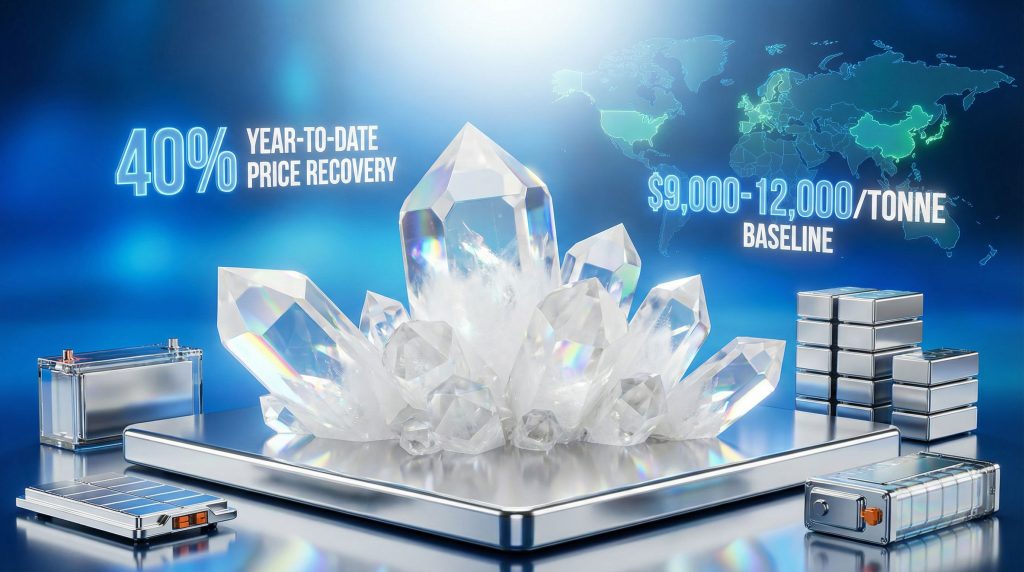
The 2024-2025 lithium price recovery reflects multiple converging factors that distinguish current market dynamics from previous commodity cycles. Battery-grade lithium carbonate has established a trading range between $9,000-12,000/tonne, representing approximately 40% year-to-date price recovery in Chinese markets from 2023 lows.
This price stabilisation suggests market maturation where structural demand growth provides price floor support, whilst increased supply pipeline development caps extreme upside potential. Unlike previous commodity cycles driven primarily by speculation, current lithium market trends reflect underlying industrial consumption patterns.
However, challenges remain as the lithium market downturn demonstrates the sector's ongoing volatility concerns.
Market Segmentation by Battery Chemistry Requirements
Different battery chemistries create distinct market segments with varying price discovery mechanisms:
Lithium Carbonate Markets (52%+ revenue share):
• Primary demand from LFP battery expansion
• Industrial and grid storage applications
• Price sensitivity due to cost-optimisation focus
Lithium Hydroxide Markets:
• High-nickel NMC applications requiring specialised processing
• Premium automotive applications
• Higher price tolerance due to performance requirements
Price premium differentials between chemical forms typically range from 10-25%, reflecting processing complexity and application-specific quality requirements.
What Investment Patterns Are Reshaping Industry Capital Allocation?
ESG Investment Criteria Driving Capital Flows
Environmental, social, and governance considerations have become primary determinants of lithium project financing availability. ESG investment criteria emphasise water usage efficiency (critical for brine operations), community engagement protocols (especially in South American operations), and environmental impact mitigation measures.
These criteria effectively screen project development opportunities and favour technically advanced extraction methods over traditional approaches, potentially accelerating DLE technology adoption and higher-cost but more sustainable operations.
Infrastructure Finance for Processing Facilities
Processing capacity expansion requires substantial capital commitments, with battery-grade lithium processing facilities typically requiring $500 million to $2 billion investments depending on scale and integration level. Infrastructure finance for these facilities increasingly involves strategic partnerships between equipment suppliers, technology providers, and end-users.
Regional economic advantages in processing operations reflect labour cost differentials, energy cost advantages for extraction processes, and regulatory efficiency impacts on project timelines. These factors create competitive positioning differences that influence global processing capacity distribution.
For instance, India's lithium supply strategy exemplifies how nations are developing comprehensive approaches to secure processing capabilities alongside raw material access.
The next major ASX story will hit our subscribers first
Economic Outlook: Strategic Implications for Market Evolution
Long-Term Market Value Projections
Market value projections reflect exponential growth trajectories supported by multiple demand vectors:
| Timeframe | Market Value | Volume Projections | Key Economic Drivers |
|---|---|---|---|
| 2025 | $16.46-32.38B | 1.8M tonnes LCE | EV adoption acceleration |
| 2030 | $78-96B | 3.7M tonnes LCE | Grid storage deployment |
| 2035 | Exponential growth | 3.5-4.2x current levels | Full electrification transition |
These projections assume continued policy support for electrification across major economies and technological advancement in battery chemistry efficiency. However, significant uncertainty remains regarding supply chain development timelines and potential technology substitution effects.
Structural Economic Changes and Disruption Potential
Alternative battery technology breakthroughs could significantly alter lithium demand projections. Solid-state batteries, sodium-ion technologies, and advanced lithium-metal chemistries present both opportunities and threats to current market assumptions.
Circular economy maturation could reduce primary lithium demand growth rates as recycling capacity scales with battery waste streams. Economic policy evolution, including carbon pricing mechanisms and trade policy changes, will continue influencing market dynamics through altered competitiveness calculations.
The strategic implications suggest that lithium market trends will continue reflecting broader technological and policy transitions rather than traditional commodity cycle patterns. Stakeholders must consider both the growth potential and structural risks inherent in this transformation as they position for long-term market evolution.
Ready to Capitalise on the Next Major Lithium Discovery?
Discovery Alert's proprietary Discovery IQ model delivers real-time alerts on significant ASX mineral discoveries, instantly empowering subscribers to identify actionable lithium opportunities ahead of the broader market. Understand why historic discoveries can generate substantial returns by visiting Discovery Alert's dedicated discoveries page, showcasing examples of exceptional market outcomes.