June 12, 2026
The Hidden Value Problem in Australia's Lithium Supply Chain
For decades, Australia has operated as the world's most prolific producer of hard-rock lithium, extracting spodumene concentrate from some of the planet's richest pegmatite deposits and shipping the bulk of it overseas for further processing. The structural consequence of this model is well understood within the industry: Australia captures the mining margin, but the far larger refining and chemical conversion margins flow predominantly to processors in China and elsewhere. Understanding why this happens, and what it takes to change it, requires a clear-eyed look at the technical and commercial architecture of the lithium supply chain itself.
Spodumene extraction, the primary output of hard-rock lithium mining, typically grades at around 5–6% lithium oxide (Li₂O) and must undergo a series of energy-intensive conversion steps before it becomes a usable battery material. The first of these steps, calcination, transforms the crystal structure of spodumene from its alpha phase to a more chemically reactive beta phase, enabling downstream acid roasting and eventual production of lithium hydroxide or lithium carbonate. This calcination step has historically been performed using gas-fired or coal-fired rotary kilns, most of which are located in China. The value addition that occurs at and beyond this stage is substantial, and Australia has, until recently, largely exported this opportunity along with its ore.
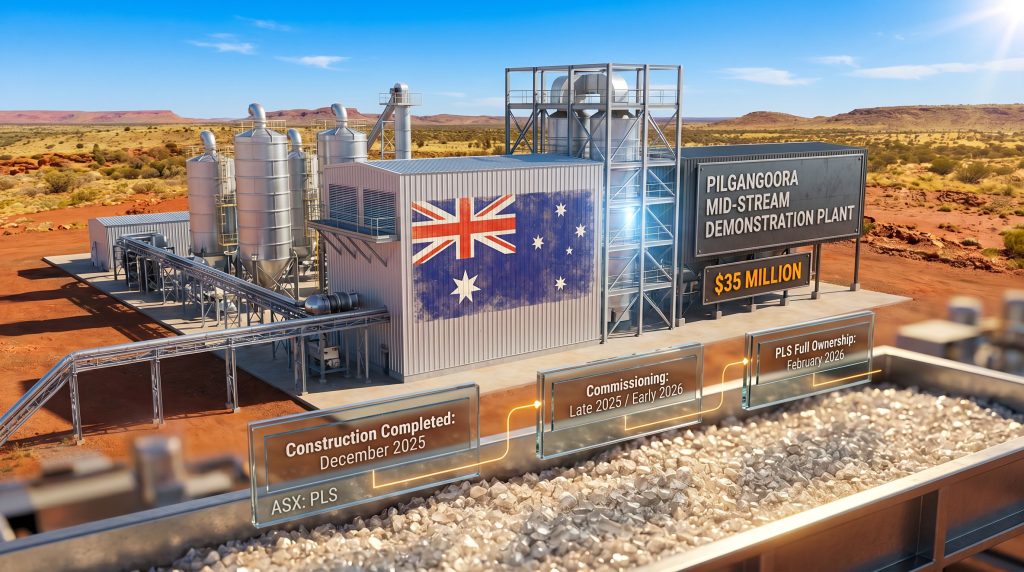
The PLS Pilgangoora mid-stream demonstration plant represents the most advanced attempt yet to interrupt this value leakage at the source, using a fundamentally different approach to calcination technology developed in collaboration with Australian industrial technology company Calix Limited.
When big ASX news breaks, our subscribers know first
Understanding the Pilgangoora Operation and Its Global Standing
Pilbara Minerals' (ASX: PLS) Pilgangoora operation in Western Australia's Pilbara region sits among the largest and highest-quality hard-rock lithium deposits in the world. The project hosts significant measured, indicated, and inferred resources, and its concentrator infrastructure is capable of processing spodumene ore to produce both chemical-grade spodumene concentrate and tantalite byproduct. The Pilbara region itself has emerged as one of the world's most strategically significant lithium supply zones, with multiple large-scale operations concentrated in a geologically favourable belt of lithium-bearing pegmatites.
The scale and quality of the Pilgangoora resource base provides the feedstock foundation necessary to justify investment in on-site processing innovation. Without a consistent, high-volume supply of spodumene ore, a mid-stream demonstration facility would lack the economic rationale to operate. The operation's concentrator capacity, which processes ore into spodumene concentrate grading around 5.5–6% Li₂O, provides the raw material platform on which the mid-stream plant depends.
Pilgangoora's position as a tier-one asset is also relevant to the investment thesis for technology development. Large, long-life deposits justify higher capital expenditure on processing innovation because the technology, once proven, can be deployed over an extended operational horizon, spreading fixed development costs across a much larger production base.
How the Electric Spodumene Calciner Actually Works
The Calcination Step: Why Is It the Critical Conversion Point?
Spodumene as it comes out of the ground exists in a monoclinic crystal structure known as alpha-spodumene. In this form, lithium is tightly bound within the mineral lattice and is highly resistant to extraction by chemical means. To become useful for lithium chemical production, alpha-spodumene must be heated to temperatures typically in the range of 1,000 to 1,100 degrees Celsius, causing an irreversible phase transformation to beta-spodumene. Beta-spodumene has a more open crystal structure that allows acids or other reagents to react with and liberate the lithium content.
Conventionally, this transformation is achieved in large rotary kilns fuelled by natural gas or, in some Asian operations, coal. These kilns are effective but carry significant carbon footprints, consume large volumes of fossil fuel, and represent a processing step that has typically been located far from the mine site.
Calix's Patented Electric Kiln Technology
Calix Limited developed a patented electric kiln design that replaces combustion-based heating with electrically generated heat. The technology applies electrical energy directly to the processing environment, achieving the temperatures necessary for the alpha-to-beta phase transformation without burning fossil fuels. When the electricity supply is sourced from renewable generation, this architecture eliminates the direct carbon emissions associated with the calcination step entirely.
The PLS Pilgangoora mid-stream demonstration plant incorporates this technology at what is understood to be the first industrial-scale deployment of an electric spodumene calciner anywhere in the world. The demonstration plant does not simply calcine spodumene and stop there. It is designed to produce lithium-enriched intermediate products that sit between raw spodumene concentrate and fully refined battery-grade lithium chemicals on the value chain. These intermediates carry higher lithium content per unit of mass, reduce the physical volume of material that needs to be shipped overseas for further refining, and command price premiums relative to standard spodumene concentrate in downstream supply chains.
The Decarbonisation Engineering Advantage
The emissions profile of the electric calciner model compares favourably to conventional approaches across several dimensions:
- Conventional gas-fired rotary kilns emit significant quantities of carbon dioxide per tonne of spodumene processed, with emissions intensity directly tied to the energy content of the fuel consumed
- Coal-fired calcination, prevalent in parts of China, carries an even higher carbon intensity per unit of energy input
- The electric calciner, when powered by renewable energy, reduces direct process emissions from calcination toward zero
- The production of higher-value, lower-mass intermediates also reduces transport emissions per unit of lithium content shipped
- The sealed processing design of the electric kiln reduces particulate matter and fugitive emissions compared to open rotary kiln designs
The relevance of this emissions profile extends beyond environmental compliance. Battery supply chains are under increasing ESG scrutiny from automotive manufacturers, particularly in Europe and North America, where original equipment manufacturers face regulatory and investor pressure to document the carbon footprint of their supply chains from mine to cell. A demonstrably lower-carbon lithium intermediate, produced using renewable-powered electric calcination, represents a genuine commercial differentiator in these markets.
Project Timeline: From Joint Venture to Commissioning
The development history of the PLS Pilgangoora mid-stream demonstration plant reflects both the potential and the vulnerability of advanced processing technology projects during periods of commodity price volatility.
| Milestone | Date / Period |
|---|---|
| Joint venture established between PLS and Calix | Pre-2024 |
| Construction suspended | October 2024 |
| Government grant funding confirmed | Early 2025 |
| Construction recommenced | February 2025 |
| WA Government grant contribution | $15 million |
| Australian Federal Government contribution | $20 million |
| Construction completed on budget | December 2025 |
| PLS acquires full ownership from Calix | February 2026 |
| Commissioning commenced | Late 2025 / Early 2026 |
Why Was the Project Paused and What Restarted It?
The decision to suspend construction in October 2024 was driven primarily by the significant deterioration in lithium market conditions that characterised the 2023 to 2025 period. Spodumene concentrate prices fell sharply from the extraordinary highs of 2022, compressing margins across the lithium mining sector and forcing capital discipline on development projects that could not demonstrate near-term returns.
This episode illustrates a structural vulnerability in demonstration-scale technology projects: they are often most needed during market downturns to develop capabilities for the next price cycle, yet they are most vulnerable to cancellation during exactly those periods because capital becomes constrained. The $35 million in combined government funding, comprising $15 million from the Western Australian Government and $20 million from the Australian Federal Government, provided the financial certainty necessary to resume construction in February 2025. This public co-investment reflected the assessment by both levels of government that the strategic value of proving the technology justified public participation in the development risk.
Furthermore, Australia's lithium industry has benefited from a broader policy environment increasingly focused on retaining value onshore, and this project sits squarely within that ambition.
The project completed construction on budget in December 2025, a milestone that carries particular significance given the stop-start nature of its development and the broader cost inflation environment that has affected mining construction projects across Australia in recent years.
PLS Takes Full Ownership: Strategic Logic and Commercial Upside
From Co-Development to Sole Control
The original development structure brought PLS and Calix together as co-developers, sharing both the financial burden and the commercialisation risk of proving the technology at industrial scale. This arrangement made practical sense during the development phase, when Calix's technological expertise and PLS's operational infrastructure and feedstock supply were both essential ingredients.
Following construction completion, PLS acquired full ownership of the demonstration plant in February 2026. This transition gives Pilbara Minerals direct operational control over commissioning pace, product development priorities, and the pathway toward commercial-scale deployment decisions. Calix retains an ongoing relationship with the project and both companies remain committed to the broader objective of advancing mid-stream lithium processing technology internationally.
Technology Licensing: The Revenue Diversification Angle
One of the less-discussed but commercially significant aspects of PLS's ownership position is the rights the company has secured to license the electric calciner technology for future commercial-scale plants. This licensing pathway creates a potential revenue stream that extends beyond Pilbara Minerals' direct lithium production operations.
The commercialisation of proprietary processing technology through licensing is an established model in the mining industry. High-Pressure Grinding Rolls (HPGR) technology, for example, was developed and licensed across multiple iron ore and base metals operations globally, generating substantial technology royalty income for developers. Weir Group's HPGR service centre infrastructure in the Pilbara, including the $28 million Port Hedland facility opened in June 2024, illustrates how technology licensing models can generate sustained regional economic activity well beyond the initial innovation phase.
If the PLS Pilgangoora mid-stream demonstration plant validates the electric calciner technology at industrial scale, the addressable market for licensing to other hard-rock spodumene operations globally is substantial. Australia alone hosts multiple large-scale spodumene operations that could potentially adopt the technology, and the global pipeline of hard-rock lithium projects extends across Africa, Canada, and Europe.
Economic and Workforce Contributions
Jobs and Regional Economic Impact
Beyond the technology validation story, the demonstration plant has generated tangible economic benefits for the Pilbara region:
- Approximately 80 construction jobs were created during the build phase
- Approximately 35 ongoing operational roles have been established for plant operations
- Skilled workforce development in advanced processing technology creates capabilities that benefit the broader regional economy
- Multiplier effects flow through to regional suppliers, logistics providers, and service businesses
The operational workforce requirement of 35 positions may appear modest in isolation, but it represents the kind of higher-skilled, higher-wage employment that processing operations generate compared to raw mining roles. At commercial scale, the workforce and economic multiplier implications would be substantially larger.
The Public Investment Rationale
The Western Australian Government's $15 million contribution reflects its critical minerals strategy and the state's ambition to shift its lithium industry up the value chain. Western Australia produces the dominant share of Australia's lithium output, and the state government has identified downstream processing as a priority for economic diversification and industrial development.
The Australian Federal Government's $20 million contribution reflects national policy interest in developing onshore processing capacity for critical minerals. Australia currently exports the vast majority of its lithium as spodumene concentrate, with the value-adding refining and chemical conversion step occurring predominantly in China. The demonstration plant represents a tangible proof-of-concept investment in changing this dynamic, and the federal contribution signals that both levels of government view the technology as sufficiently strategic to warrant public co-investment in the development risk.
It is important to note that the government contributions described above represent grants confirmed for this project. Policy frameworks and critical minerals strategies provide the broader context for these funding decisions but do not in themselves constitute project-specific support or endorsement beyond what has been publicly confirmed.
The next major ASX story will hit our subscribers first
Value Chain Economics: What Mid-Stream Processing Changes
The Price Differential That Drives the Business Case
The commercial case for mid-stream processing rests on a fundamental arithmetic: lithium intermediate products command higher prices per unit of lithium content than standard spodumene concentrate, while the volume of material requiring international shipping is reduced because impurities and non-lithium minerals are removed on-site.
Consider the layered economics at play:
- Raw spodumene concentrate (typically 5.5–6% Li₂O) is a bulky commodity product with limited end-use flexibility and pricing largely determined by benchmark markets
- Lithium intermediates produced through on-site calcination and partial processing carry higher Li₂O equivalent content, greater chemical reactivity, and alignment with specific downstream refinery input specifications
- Shipping cost reduction occurs because a higher proportion of the shipped mass is useful lithium content rather than gangue minerals and moisture
- Quality premiums are available in supply chains where battery manufacturers or chemical refiners pay above-benchmark prices for materials that reduce their own processing burden
The margin capture opportunity is real, though its exact magnitude depends on prevailing market conditions for both spodumene concentrate and lithium intermediate products, which are subject to significant cyclical variation.
What Could Commercial Scale Eventually Look Like?
The demonstration plant is precisely that: a demonstration. Its purpose is to validate the technology, prove the product quality, and generate the operational data necessary to design a commercial-scale successor. If commissioning proceeds successfully and the intermediate product specifications are validated against battery supply chain requirements, the pathway toward a full commercial-scale electric calciner facility at Pilgangoora becomes substantially de-risked.
Key variables that will determine commercial viability at scale include:
- Renewable energy availability and cost in the Pilbara region for full decarbonisation of the calcination step
- Market acceptance and pricing of the specific intermediate product grades produced
- Capital cost estimates for commercial-scale plant construction, informed by demonstration plant learnings
- Lithium market pricing cycles and their impact on investment timing decisions
- Offtake market development and the willingness of downstream refiners to enter supply agreements for a new intermediate product category
Benchmarking the Technology Against Global Alternatives
Where Does the Electric Calciner Fit in the Lithium Processing Innovation Landscape?
| Initiative | Technology Approach | Location | Development Stage |
|---|---|---|---|
| PLS Pilgangoora mid-stream plant | Electric spodumene calciner (Calix) | Pilbara, WA | Commissioning 2025/26 |
| Conventional spodumene processing | Gas-fired rotary kilns | Multiple global | Commercially established |
| Direct lithium extraction | Various chemical/membrane processes | Brine deposits globally | Pilot to early commercial |
| Lepidico L-Max process | Proprietary alkaline leaching | WA and Namibia | Development stage |
| Integrated hydroxide refining | Roasting and leaching | China predominantly | Commercial at scale |
Direct lithium extraction technology, for instance, is designed specifically for lithium brine deposits and therefore addresses a different segment of the market entirely. The electric calciner approach, however, occupies a distinct niche that is directly applicable to spodumene hard-rock operations. This specificity is commercially important because Australia's lithium production is overwhelmingly hard-rock in character. The technology therefore addresses the processing challenge faced by the country's existing and planned lithium operations in a way that brine-focused innovations do not.
The first-mover advantage embedded in the Pilgangoora demonstration plant is also worth examining carefully. Industrial-scale demonstration of a novel processing technology generates proprietary operational knowledge, performance data, and engineering learnings that cannot be replicated from a laboratory or pilot-scale basis. This body of knowledge becomes a competitive moat if the technology is successfully commercialised and licensed to other operations.
Key Risks Investors and Industry Observers Should Understand
Technical and Operational Risks
- Commissioning complexity: The transition from construction completion to stable, consistent production operations is rarely linear. Novel processing technologies frequently encounter unexpected challenges during commissioning that require engineering modifications and extended timelines
- Renewable energy integration: Realising the full decarbonisation potential of the electric calciner requires sufficient renewable electricity supply, which in the Pilbara context depends on grid development, on-site generation capacity, and energy procurement arrangements that are still evolving
- Product quality validation: Battery supply chains operate to exacting specification requirements. Demonstrating that the intermediate products meet the input specifications demanded by downstream refiners and ultimately battery manufacturers is a non-trivial technical and commercial task
- Scale-up translation: Performance characteristics observed at demonstration scale do not automatically translate to commercial scale. Thermal dynamics, material handling behaviour, and product consistency can behave differently as plant dimensions increase
Market and Commercial Risks
- Lithium price cyclicality: The same market conditions that forced the October 2024 construction pause remain a structural feature of the lithium market. Future price downturns could delay commercial-scale investment decisions even if the demonstration phase is technically successful
- Offtake market development: There is currently no established market for the specific lithium intermediate product category that the Pilgangoora demonstration plant aims to produce. Creating this market requires engaging and educating potential buyers, negotiating novel supply agreements, and potentially adjusting product specifications to match downstream requirements
- Competing pathways: The lithium processing innovation landscape is active, and alternative technologies could emerge or mature in ways that alter the competitive context before commercial deployment is achieved
- Energy cost exposure: If renewable energy costs in the Pilbara are higher than projected, or if renewable supply proves insufficient, the economic case for the electric calciner model may be partially undermined even if the technology itself performs as expected
Frequently Asked Questions
What Is the PLS Pilgangoora Mid-Stream Demonstration Plant?
It is an advanced processing facility at Pilbara Minerals' Pilgangoora lithium operation in Western Australia, designed to convert spodumene concentrate into higher-value lithium intermediate products using Calix's patented electric kiln calcination technology at what is understood to be the first industrial-scale deployment of this specific approach globally.
Who Currently Owns the Demonstration Plant?
Pilbara Minerals (ASX: PLS) acquired full ownership of the facility in February 2026, having previously co-developed it as a joint venture with Calix Limited.
How Much Public Funding Did the Project Receive?
The project received $15 million from the Western Australian Government and $20 million from the Australian Federal Government, totalling $35 million in confirmed public grant co-investment.
Why Was Construction Halted in 2024?
Construction was suspended in October 2024 due to deteriorating lithium market conditions and pricing pressures across the sector, before recommencing in February 2025 after government grant funding was confirmed.
What Makes the Technology Environmentally Different From Conventional Approaches?
The electric spodumene calciner eliminates the need for gas or coal combustion to generate process heat, substantially reducing the carbon emissions intensity of the calcination step, particularly when powered by renewable electricity sources.
What Employment Has the Project Generated?
The demonstration plant created approximately 80 construction roles during the build phase and approximately 35 ongoing operational positions.
What Happens if the Demonstration Phase Is Successful?
PLS holds licensing rights to deploy the technology at commercial scale, opening a pathway for broader adoption across Pilgangoora and potentially other hard-rock spodumene operations globally, with meaningful implications for Australia's ability to capture greater value from its lithium resource base.
What This Means for Australia's Lithium Industry Trajectory
The Structural Challenge of a Raw Material Export Economy
Australia's position in the global lithium supply chain has long been characterised by a fundamental tension: the country holds approximately half of the world's economically significant hard-rock lithium resources yet captures a disproportionately small share of the battery supply chain's total economic value. The processing, chemical conversion, cathode precursor manufacturing, and cell production stages that follow spodumene mining collectively generate multiples of the value created at the mining and concentration stage, and the majority of this value creation occurs outside Australia.
Changing this structural dynamic requires more than policy aspiration. It requires demonstrated technology capable of performing value-adding processing at competitive cost and quality, a proven commercial model for marketing higher-value intermediate products, and sufficient investor confidence to commit capital to commercial-scale processing infrastructure. The PLS Pilgangoora mid-stream demonstration plant is designed to contribute to all three of these requirements simultaneously. In addition, Australia's broader critical minerals strategy reinforces why projects like this one are considered nationally significant beyond their immediate commercial scope.
The Commissioning Phase as a Critical Inflection Point
As commissioning proceeds through 2026, the demonstration plant will generate operational data that no modelling exercise or laboratory study can replicate. Actual energy consumption figures, product quality consistency metrics, maintenance requirements, and throughput performance under real operating conditions will either confirm or challenge the assumptions underpinning the commercial-scale business case.
For investors in Pilbara Minerals and for the broader Australian lithium industry, the commissioning phase represents a genuine value inflection point. A technically successful demonstration does not guarantee commercial deployment, but it substantially de-risks the investment case and provides the evidential foundation for capital allocation decisions at a much larger scale.
Pilgangoora's record production performance in recent periods strengthens the feedstock security argument for on-site processing investment. Consequently, a concentrator operating at high throughput rates provides the volume of spodumene intermediate necessary to keep a mid-stream processing facility running at optimal utilisation, which is essential for demonstrating the economics of the technology under representative conditions.
Furthermore, the wider context of lithium demand growth driven by battery storage expansion makes the timing of this technology validation increasingly important for Australia's long-term industrial positioning.
The broader significance of the commissioning milestone extends beyond any single company's operational development. It represents a tangible test of whether Australia can translate its extraordinary endowment of hard-rock lithium resources into a more sophisticated and economically rewarding industrial role in the global battery supply chain.
Disclaimer: This article contains forward-looking statements, project timelines, and financial figures drawn from publicly available information and outline materials. Readers should conduct their own due diligence and seek independent financial advice before making investment decisions. Lithium market conditions are subject to significant cyclical volatility, and project outcomes, production timelines, and commercial results may differ materially from those described or implied herein.
Want to Know Which ASX Lithium Discoveries Could Reshape Australia's Battery Supply Chain?
Discovery Alert's proprietary Discovery IQ model delivers real-time alerts on significant ASX mineral discoveries — including lithium — instantly converting complex geological data into actionable investment insights for both short-term traders and long-term investors. Explore why historic ASX discoveries have generated substantial returns by visiting Discovery Alert's dedicated discoveries page, and begin your 14-day free trial today to position yourself ahead of the market.