July 30, 2026
What Factors Drive Lithium Mining Stock Performance in 2026?
The lithium mining sector operates within an intricate framework where multiple forces converge to determine stock valuations. Understanding these dynamics requires examining both macro-level industry trends and company-specific operational metrics that create value for investors, particularly as the PLS share price surge due to lithium demand continues to capture investor attention.
Global Supply Chain Fundamentals
Lithium market performance hinges on a complex supply-demand equation that extends far beyond simple production numbers. The sector's foundation rests on three critical pillars: production capacity utilisation, processing infrastructure development, and geographic distribution of economically viable reserves.
Recent market data demonstrates this complexity in action. Pilbara Minerals achieved a remarkable 109.3% share price increase compared to the previous year, with the stock trading 16.47% higher year-to-date as of January 2026. This performance reflects the amplified impact of favourable supply-demand dynamics on equity valuations.
The geographic concentration of processing capabilities creates additional complexity. Over 60% of global lithium processing capacity remains concentrated in China, creating both opportunities and vulnerabilities for upstream mining companies. This concentration affects pricing power, customer relationships, and long-term strategic positioning for producers worldwide.
Furthermore, australian lithium innovations are playing a crucial role in driving sector advancement. However, understanding global context remains essential, as argentina lithium market insights demonstrate the diverse regional dynamics affecting worldwide supply chains.
Market Timing and Commodity Price Sensitivity
Mining companies exhibit extraordinary sensitivity to underlying commodity cycles, with lithium miners demonstrating some of the highest operational leverage in the resources sector. When lithium carbonate equivalent prices experience moderate shifts, mining stock valuations typically respond with amplified movements due to fixed cost structures and margin expansion dynamics.
UBS analysts recently upgraded their lithium price forecasts by 64% for 2026, projecting prices to reach USD$1,800 per tonne, with potential increases to USD$2,625 per tonne by 2028. This dramatic revision reflects improving demand fundamentals, with analysts forecasting an 11% increase in lithium demand that could push markets into deficit conditions from 2026 onward.
The operational leverage mechanism becomes evident when examining recent performance data. Pilbara Minerals demonstrated this principle through Q3 2025 results, where a 2% increase in spodumene production combined with a 20% improvement in realised pricing generated a 30% increase in quarterly revenue to AUD$251 million.
Infrastructure and Processing Advantages
Companies with integrated processing facilities and established customer networks maintain structural advantages that translate into premium valuations during market recovery phases. These advantages become particularly pronounced when examining Australian hard rock lithium operations, which benefit from mature mining infrastructure and regulatory frameworks.
Pilbara Minerals operates one of the world's largest independent hard rock lithium mines at Pilgangoora in Western Australia. This scale provides inherent advantages in operational efficiency, customer diversification, and cost management that smaller producers cannot easily replicate.
Processing technology advancement represents another critical differentiator. Modern operations utilising lithium mining techniques can achieve recovery rates above 75%, with leading facilities reaching 80%+ efficiency levels. Each 1% improvement in recovery rates can generate $2-5 million in additional annual revenue for large-scale operations, demonstrating the significant economic impact of technological optimisation.
Moreover, the development of battery-grade lithium refinery infrastructure globally is creating new opportunities for value creation within the supply chain.
When big ASX news breaks, our subscribers know first
How Do Lithium Price Cycles Impact Mining Company Valuations?
Lithium pricing operates through a complex mechanism that creates both opportunities and challenges for mining companies. Understanding these cycles requires examining regional price variations, contract structures, and the lag effects between spot market movements and realised company revenues.
Understanding Spodumene Pricing Mechanisms
Spodumene concentrate pricing operates through quarterly negotiation cycles between producers and converters, creating inherent lag effects between spot market movements and realised company revenues. This mechanism significantly impacts how mining companies capture value from commodity price improvements.
The quarterly settlement structure typically follows established industry patterns, with major negotiations occurring at regular intervals throughout the year. During these negotiations, producers and converters establish pricing based on prevailing market conditions, demand visibility, and supply availability.
Pilbara Minerals' Q3 2025 results demonstrated this lag mechanism in practice, with the company achieving a 20% increase in realised pricing during a period when global spot prices had already moved higher in preceding quarters. This illustrates how concentrate producers experience delayed but sustainable price improvements compared to more volatile spot market movements.
Regional Price Variations and Their Impact
Global lithium markets exhibit significant regional pricing disparities that directly affect mining company profitability based on their customer geographic distribution. These variations reflect different market structures, quality specifications, and supply-demand dynamics across major consumption regions.
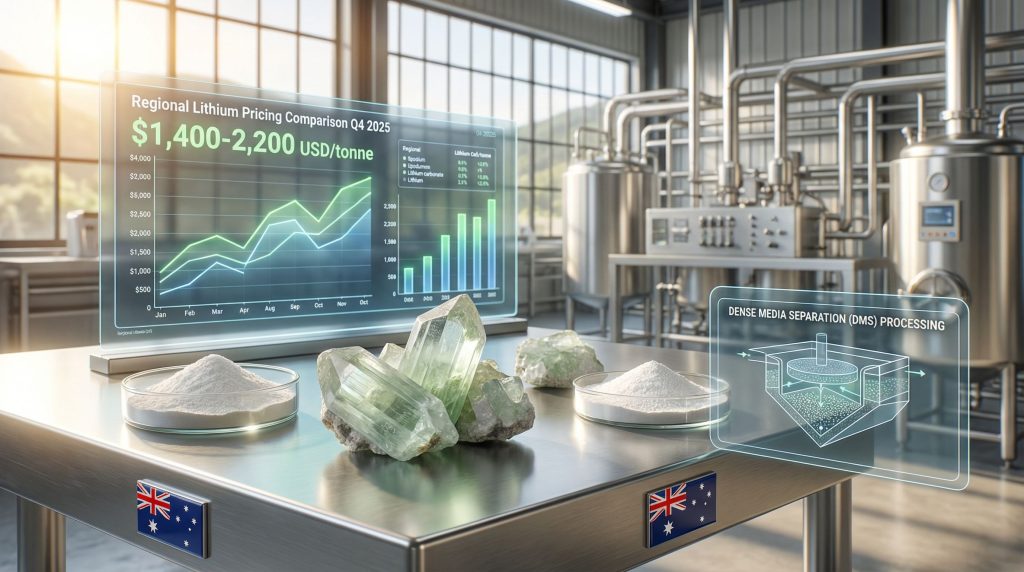
Regional Lithium Pricing Structure (2025-2026 Period)
| Region | Price Range (USD/tonne) | Market Characteristics |
|---|---|---|
| China Domestic | $1,400-1,600 | High volume, competitive pricing |
| European Battery Grade | $1,800-2,200 | Premium quality specifications |
| North American Contracts | $1,600-1,900 | Long-term agreement focus |
Chinese domestic pricing typically reflects the largest volume market with competitive dynamics driven by local electric vehicle production demand. Recent modifications to China's value-added tax export rebate structure for battery materials have created additional pricing pressures, demonstrating the interconnected nature of global supply chains.
European markets command premium pricing due to stringent battery-grade specifications, including purity requirements and moisture content standards. This premium typically ranges 25-35% above Chinese domestic pricing, creating significant value for producers with established European customer relationships.
Forward Curve Analysis and Investment Implications
Investment bank forward price curves provide crucial insights into expected profitability trajectories for mining operations. Current analyst projections suggest sustained higher pricing compared to the 2023-2024 cyclical lows, supporting improved operational economics for the sector.
UBS forward curve projections indicate a structural improvement in lithium market fundamentals, with their 64% upward revision for 2026 pricing reflecting improved demand visibility. The progression from USD$1,800 per tonne in 2026 to potentially USD$2,625 per tonne by 2028 suggests sustained margin expansion opportunities for efficient producers.
This pricing trajectory supports higher net present value calculations for mining projects and justifies expanded capital allocation toward production capacity increases. The forward curve also indicates reduced cyclical volatility compared to historical patterns, providing greater visibility for long-term planning and investment decisions.
Consequently, understanding where the largest lithium reserves are located becomes increasingly important for strategic positioning within this evolving market landscape.
What Makes Australian Hard Rock Lithium Operations Strategically Important?
Australian hard rock lithium operations possess unique geological and infrastructure advantages that position them favourably within global supply chains. These advantages become particularly valuable during periods of increased demand and supply chain optimisation efforts by battery manufacturers and automotive companies.
Geological Advantages of Australian Deposits
Australian pegmatite deposits offer several technical and economic advantages over alternative lithium sources worldwide. These deposits typically feature higher lithium grades, established geological understanding, and proximity to existing mining infrastructure that reduces development risks and capital requirements.
The Western Australia lithium province contains some of the world's most significant hard rock lithium resources, with established mining districts providing operational synergies through shared infrastructure, skilled labour availability, and regulatory familiarity. This concentration creates economies of scale across multiple operations within the region.
Pilbara Minerals' Pilgangoora operation exemplifies these advantages, operating as one of the world's largest independent hard rock lithium mines. The scale and established infrastructure provide cost advantages and operational stability that smaller or more remote operations cannot easily achieve.
Processing and Logistics Infrastructure
Western Australia's mature mining services sector provides comprehensive support for lithium operations through established supply chains, specialised service providers, and efficient logistics networks. This infrastructure ecosystem reduces operational complexity and supports cost-effective production scaling.
Port facilities infrastructure enables direct access to key Asian markets while maintaining flexibility for European and North American shipments. This geographic positioning allows Australian producers to optimise customer diversification and capture regional price premiums based on market conditions.
The regulatory framework in Western Australia provides operational certainty through established permitting processes, environmental compliance standards, and mining taxation structures. This predictability supports long-term investment planning and reduces political risk premiums compared to less stable jurisdictions.
Customer Diversification Opportunities
Australian producers benefit from strategic geographic positioning that enables access to multiple end markets, reducing dependence on single-region demand fluctuations. This diversification capability becomes particularly valuable during periods of regional market volatility or trade policy changes.
"Modern lithium operations must balance customer diversification with operational efficiency, as different markets require varying product specifications and logistics arrangements. Australian producers' proximity to major Asian markets while maintaining access to Western customers provides unique flexibility in market optimisation."
The customer diversification advantage extends beyond simple geography to include relationship development with different types of customers. Australian producers can serve Chinese converters for volume-based contracts while developing premium relationships with Western battery manufacturers seeking supply chain security and sustainability credentials.
How Do Production Scale and Operational Efficiency Drive Competitive Advantages?
Scale economics in lithium mining create substantial competitive advantages through fixed cost absorption, operational optimisation opportunities, and enhanced customer negotiating power. Understanding these dynamics helps explain why larger operations consistently achieve superior financial performance during both favourable and challenging market conditions.
Economies of Scale in Lithium Mining
Large-scale lithium operations achieve meaningful cost advantages once annual production exceeds 500,000 tonnes, creating natural barriers to entry for smaller competitors. These advantages manifest through multiple operational and financial mechanisms that compound over time.
Fixed cost absorption represents the most immediate scale benefit, as mining infrastructure, processing facilities, and administrative overhead can be spread across higher production volumes. This creates lower unit costs and improved profit margins, particularly during periods of stable or rising commodity prices.
Bulk purchasing power provides additional advantages for large operations, enabling better pricing on consumables, capital equipment, and service contracts. These savings typically range from 15-25% compared to smaller operations on major cost categories including reagents, replacement parts, and specialised services.
Pilbara Minerals demonstrated effective scale utilisation through its Q3 2025 performance, achieving 2% production growth while maintaining operational discipline and cost control. This modest production increase, combined with pricing improvements, generated 30% revenue growth, illustrating the margin expansion potential of scale operations and contributing to the PLS share price surge due to lithium demand.
Processing Technology and Recovery Rates
Advanced processing technologies enable significant improvements in lithium recovery rates, directly impacting project economics and competitive positioning. The progression from standard recovery rates to optimised processing can create substantial value for operations willing to invest in technological advancement.
Processing Technology Performance Benchmarks
- Standard operations: 65-70% recovery rates
- Advanced operations: 75-80% recovery rates
- Leading operations: 80%+ recovery rates
- Revenue impact: $2-5 million annually per 1% improvement
Dense media separation and flotation technologies represent established methodologies for hard rock lithium processing, with continuous refinements enabling higher recovery rates and improved product quality. These technological improvements require capital investment but generate long-term competitive advantages.
The economic impact of recovery rate improvements becomes substantial at scale. For operations producing 500,000+ tonnes annually, each 1% recovery improvement can generate $2-5 million in additional annual revenue, assuming current forward pricing curves and typical product specifications.
Capital Allocation and Expansion Strategies
Disciplined capital allocation during commodity downturns positions companies for asymmetric upside potential when market conditions improve. This strategic approach requires maintaining financial flexibility while investing selectively in operational improvements and expansion capabilities.
Pilbara Minerals' 2026 strategic focus centres on production growth and cost reduction initiatives designed to enhance operational efficiency and investor confidence. This balanced approach addresses both volume expansion and margin optimisation opportunities.
Companies that maintain strong balance sheets during cyclical downturns can accelerate expansion when market conditions improve, capturing market share from competitors facing financial constraints. This counter-cyclical investment approach often generates superior long-term returns for patient investors.
What Role Does China's Policy Framework Play in Global Lithium Markets?
China's dominant position in lithium processing and electric vehicle manufacturing creates significant policy influence over global lithium markets. Understanding these policy dynamics becomes essential for evaluating investment opportunities and risk factors within the lithium mining sector.
Export Policy Changes and Market Impact
Recent modifications to China's value-added tax export rebate structure for battery materials have created immediate market adjustments, demonstrating the interconnected nature of global lithium supply chains. These policy changes affect pricing dynamics and competitive positioning across the entire supply chain.
The VAT rebate adjustments influence Chinese processors' cost structures and export competitiveness, creating ripple effects for upstream mining companies and downstream battery manufacturers. These changes can alter regional price relationships and affect long-term supply chain optimisation decisions.
In addition, policy modifications reflect China's strategic focus on domestic market development and value-added manufacturing retention. This approach seeks to maximise domestic economic benefits from the lithium supply chain while maintaining competitive positioning in global markets.
Domestic Demand Growth Projections
China's electric vehicle production targets and grid-scale energy storage deployment plans create baseline demand growth that supports long-term lithium pricing stability. These domestic demand projections provide fundamental support for global lithium consumption growth.
Global EV sales growth has been rising faster than carmaker production capacity, creating sustained demand pressure for battery materials including lithium. This demand growth extends beyond transportation applications to include grid-scale energy storage deployment supporting renewable energy integration.
Chinese domestic policy support for electric vehicle adoption includes purchase subsidies, infrastructure development funding, and manufacturing capacity incentives. These policies create predictable demand growth that supports long-term lithium market fundamentals and contribute to the PLS share price surge due to lithium demand.
Processing Capacity Concentration Risks
The concentration of over 60% of global lithium processing capacity in China creates both opportunities and risks for upstream mining companies. This concentration affects pricing power, supply chain security, and long-term strategic positioning for producers worldwide.
Processing capacity concentration enables Chinese converters to maintain significant influence over pricing negotiations with hard rock producers. However, this concentration also creates supply chain vulnerabilities for Western battery manufacturers and automotive companies seeking supply security.
Recent geopolitical developments have accelerated Western investment in domestic processing capabilities, potentially reducing Chinese concentration over time. This trend creates opportunities for mining companies with strategic positioning in Western markets or partnerships with emerging processing facilities.
How Should Investors Evaluate Lithium Mining Stock Valuations in Current Market Conditions?
Valuing lithium mining stocks requires balancing traditional mining valuation methodologies with the unique characteristics of lithium market cycles and demand growth trajectories. Current market conditions present both opportunities and risks that demand careful analytical consideration.
Fundamental Valuation Metrics
Traditional mining valuation approaches using net present value calculations require careful consideration of long-term lithium price assumptions and sensitivity analysis across multiple pricing scenarios. Current analyst forecasts provide guidance, but investors must evaluate the sustainability of projected pricing levels.
Key Valuation Metrics for Lithium Mining Stocks
| Metric | Healthy Range | Warning Signals |
|---|---|---|
| P/E Ratio | 8-15x | >25x or negative |
| EV/EBITDA | 4-8x | >12x |
| Price/Book | 1.5-3.0x | >5x |
| Debt/Equity | <0.3 | >0.6 |
Net present value calculations should incorporate sensitivity analysis across lithium price ranges from $1,200-2,500 per tonne to evaluate project robustness under different market scenarios. This analysis helps identify companies with strong operational leverage while maintaining downside protection.
Current broker consensus data shows mixed signals, with Bell Potter upgrading to Hold with a $4.55 price target (increased from $2.65) and Macquarie maintaining Hold with a $4.50 target (up from $3.80). The average analyst target price of $4.12 suggests 18.09% downside from current levels, while the maximum target of $6.50 implies 28.97% upside potential.
Meanwhile, recent analysis indicates that hedge funds face challenges following unexpected market movements, highlighting the volatility inherent in lithium investing.
Technical Analysis and Market Sentiment Indicators
Stock price momentum in lithium miners often precedes fundamental improvements by 3-6 months, making technical analysis valuable for timing entry and exit points. Current market sentiment reflects optimism about demand growth balanced against concerns about valuation levels following recent price appreciation.
Pilbara Minerals' recent performance demonstrates strong momentum, with the stock breaking above the $5.00 barrier for the first time since August 2023. This technical breakthrough suggests renewed investor confidence in sector fundamentals and company-specific prospects.
Market sentiment indicators suggest cautious optimism, with most analysts maintaining Hold ratings while acknowledging improved fundamentals. This balanced positioning reflects recognition of better operating conditions while acknowledging potential volatility following significant price appreciation.
Furthermore, market commentary suggests that the recent surge represents broader bullish sentiment across the lithium sector, supporting the PLS share price surge due to lithium demand.
Risk Assessment Framework
Comprehensive risk evaluation must consider operational risks (mining, processing, environmental), market risks (price volatility, demand fluctuations), and financial risks (leverage, capital requirements). Current market conditions present unique risk-reward dynamics requiring careful assessment.
Operational risks include mine life expectations, processing efficiency, and environmental compliance requirements. Australian operations generally present lower operational risk due to established infrastructure and regulatory frameworks, though individual company execution remains critical.
Market risks centre on lithium price volatility and demand growth sustainability. While current analyst projections suggest favourable conditions through 2028, investors must consider potential scenarios including slower EV adoption, alternative battery chemistry development, or economic downturn impacts on automotive demand.
Financial risks vary significantly among lithium miners based on capital structure, development stage, and operational cash flow generation. Companies with strong balance sheets and positive cash flow generation demonstrate greater resilience during market volatility periods.
The next major ASX story will hit our subscribers first
What Are the Long-Term Demand Drivers Supporting Lithium Market Growth?
Long-term lithium demand growth rests on fundamental technology and policy trends that extend well beyond current market cycles. Understanding these structural drivers provides essential context for evaluating investment opportunities and market sustainability.
Electric Vehicle Adoption Trajectories
Global electric vehicle sales projections indicate 15-20% annual growth through 2030, with each vehicle requiring 50-80kg of lithium carbonate equivalent. This demand growth creates substantial incremental lithium consumption that exceeds current production capacity expansion plans.
Electric vehicle sales growth is occurring faster than carmaker production capacity expansion, creating sustained pressure on battery supply chains and raw material procurement. This dynamic supports pricing stability and encourages continued investment in lithium production capacity.
Automotive industry electrification extends beyond passenger vehicles to include commercial vehicles, buses, and specialised transportation applications. These segments require larger battery systems and create additional lithium demand growth beyond consumer vehicle adoption rates.
Grid-Scale Energy Storage Expansion
Renewable energy integration requires massive battery storage deployment, with utility-scale projects representing a growing share of total lithium demand beyond transportation applications. This demand segment provides diversification and additional growth momentum for lithium consumption.
Grid-scale energy storage demand is accelerating rapidly as renewable energy deployment accelerates globally. Storage systems require substantially larger battery installations than automotive applications, creating significant lithium consumption per project.
Government policies supporting renewable energy development include storage requirements and incentives that accelerate deployment timelines. These policies create predictable demand growth that complements automotive sector consumption patterns.
Technology Evolution and Substitution Risks
While alternative battery chemistries exist, lithium-ion technology continues advancing in energy density and cost reduction, maintaining its dominant position across most applications. Ongoing technological development supports long-term demand sustainability while addressing potential substitution concerns.
Lithium-ion battery improvements focus on energy density enhancement, charging speed optimisation, and cost reduction through manufacturing scale. These improvements reinforce lithium-ion technology advantages over alternative approaches for most commercial applications.
Alternative battery technologies including solid-state batteries and advanced lithium chemistries typically require higher lithium content rather than substitution, supporting continued demand growth even as technology evolves. This trend provides additional confidence in long-term consumption projections.
How Do Regulatory and ESG Factors Impact Lithium Mining Operations?
Environmental, social, and governance considerations increasingly influence lithium mining operations through regulatory requirements, customer due diligence, and investor evaluation criteria. These factors create both operational constraints and competitive advantages for companies demonstrating superior performance.
Environmental Compliance and Social Licence
Modern lithium operations must demonstrate comprehensive water management, biodiversity protection, and community engagement standards that add operational complexity while ensuring long-term sustainability and social acceptance. These requirements are becoming increasingly stringent across all major mining jurisdictions.
Water management represents a critical consideration for lithium operations, particularly in arid regions where brine extraction occurs. Hard rock operations typically require less water than brine processing but still must demonstrate sustainable water use and environmental protection measures.
Community engagement and social licence maintenance require ongoing investment in local relationships, economic development contributions, and transparent communication about operational impacts. Companies with strong community relationships experience fewer operational disruptions and regulatory challenges.
Critical Minerals Policy Support
Government recognition of lithium as a critical mineral has resulted in policy support initiatives, streamlined permitting processes, and strategic stockpiling programmes that benefit domestic producers. These supportive policies create competitive advantages for operations in favourable jurisdictions.
Australian government critical minerals initiatives include export finance support, research and development funding, and infrastructure development assistance that reduces operational costs and development risks for domestic producers.
Strategic stockpiling programmes and supply chain security initiatives create additional demand sources while providing price stability during market downturns. These government programmes demonstrate long-term commitment to domestic lithium production capabilities.
Supply Chain Due Diligence Requirements
Automotive and battery manufacturers increasingly require comprehensive ESG compliance verification from lithium suppliers, creating competitive advantages for operations with strong sustainability credentials and transparent reporting practices.
Supply chain traceability requirements demand detailed documentation of material sourcing, processing methods, and labour practices throughout the production chain. Companies with established ESG programmes can more easily meet these requirements and access premium customer relationships.
Sustainable mining practices including renewable energy use, waste minimisation, and ecosystem restoration create differentiation opportunities with environmentally conscious customers and investors. These practices may require additional investment but generate long-term competitive advantages.
What Investment Strategies Work Best for Lithium Sector Exposure?
Successful lithium sector investing requires understanding cyclical dynamics, company-specific risk factors, and optimal timing strategies. Different approaches suit various investor risk tolerances and return objectives within this volatile but growth-oriented sector.
Direct Mining Company Investment Approach
Investing directly in lithium mining companies provides maximum leverage to commodity price movements while requiring careful company selection based on operational quality, financial strength, and management execution capabilities. This approach offers the highest potential returns but demands active portfolio management.
Company selection criteria should emphasise operational scale, cost position, reserve quality, and balance sheet strength. Large-scale producers with established customer relationships and low-cost operations typically demonstrate greater resilience during market volatility periods.
Pilbara Minerals exemplifies the characteristics sought in direct mining investments, with its position as one of the world's largest independent hard rock lithium operations providing scale advantages and operational stability. The company's recent performance demonstrates the potential for significant returns during favourable market conditions and validates the PLS share price surge due to lithium demand.
Diversified Materials Sector Allocation
Broader materials sector exposure through exchange-traded funds or diversified mining companies reduces single-commodity risk while maintaining exposure to lithium market growth. This approach provides more stable returns with lower volatility than direct lithium mining investments.
Diversified materials portfolios can include lithium miners alongside other battery materials companies, rare earth producers, and copper miners that benefit from electrification trends. This diversification reduces concentration risk while maintaining thematic exposure to energy transition investments.
ETF approaches enable exposure to multiple lithium companies while reducing individual company risk. However, investors should evaluate fund holdings, expense ratios, and geographic concentration when selecting materials sector ETFs.
Timing and Position Sizing Considerations
Given lithium's cyclical nature, dollar-cost averaging during market downturns and profit-taking during euphoric periods typically generate superior long-term returns compared to lump-sum investments. This approach requires patience and disciplined execution.
Current market conditions present mixed signals, with strong fundamental demand growth balanced against significant recent price appreciation. The majority of analysts maintaining Hold ratings suggests cautious positioning may be appropriate for new investors.
Position sizing should reflect individual risk tolerance and overall portfolio diversification. Lithium mining stocks can provide substantial returns during favourable periods but may experience significant volatility during market corrections or commodity price declines.
Market timing indicators include commodity price momentum, inventory levels, and forward curve positioning. UBS's 64% upward price revision for 2026 suggests continued optimism about market fundamentals, though investors should remain alert to changing conditions and maintain appropriate risk management practices.
Ready to Capitalise on the Next Significant Lithium Discovery?
Discovery Alert's proprietary Discovery IQ model delivers instant notifications when major ASX lithium discoveries are announced, transforming complex geological data into actionable trading opportunities. Explore why historic mineral discoveries can generate substantial returns by visiting Discovery Alert's dedicated discoveries page, then begin your 30-day free trial to position yourself ahead of the broader market.