May 21, 2026
Understanding Lithium-Bearing Pegmatite System Development
The identification and evaluation of spodumene-bearing pegmatite systems represents one of the most technically challenging aspects of lithium resource development. These geological formations result from highly differentiated granitic melts that concentrate lithium and other rare elements during crystallization processes occurring deep within the Earth's crust. Furthermore, understanding how these systems form, extend, and interconnect provides critical insights into their economic potential and mining feasibility.
Spodumene (LiAlSi₂O₆), the primary lithium-bearing mineral in hard-rock deposits, exhibits distinctive characteristics that allow for visual identification in drill core samples. This mineral typically displays characteristic white to pale gray coloration with two-directional cleavage occurring at approximately 67-68 degrees. Consequently, the ability to identify spodumene visually provides exploration teams with immediate feedback during drilling programs insight, enabling rapid decision-making for subsequent drill hole placement and program expansion.
When big ASX news breaks, our subscribers know first
What Makes Pegmatite System Connectivity Critical for Resource Development?
Structural Geology and Mineralization Continuity
Recent developments in the WA resources sector demonstrate how system connectivity fundamentally alters project economics and development strategies. For instance, when Wildcat grows Bolt Cutter as drilling extends lithium system, this recognition that previously separate pegmatite swarms actually represent components of larger, continuous systems transforms resource modeling approaches and mining methodologies.
Pegmatite swarm connectivity patterns typically follow regional structural controls, including pre-existing fracture systems, fault networks, and lithological boundaries. When pegmatites demonstrate strike continuity exceeding 2 kilometres with consistent mineralization characteristics, this suggests a unified emplacement mechanism and increased confidence in resource continuity.
Key Connectivity Indicators:
• Consistent pegmatite orientation and dip characteristics
• Similar mineralogical assemblages across different zones
• Continuous or stepped lithium grade distributions
• Structural alignment with regional geological trends
The implications of system consolidation extend beyond simple resource addition. However, connected pegmatite systems allow for integrated mine planning, where extraction sequences can be optimised across the entire system rather than individual zones. This integration typically reduces waste rock handling requirements and improves overall strip ratios.
How Do Advanced Drilling Techniques Validate System Extension?
Diamond Drilling Methodology and Core Quality Advantages
Diamond drilling maintains supremacy over alternative drilling methods for lithium pegmatite exploration due to superior core recovery and structural preservation. Unlike reverse circulation drilling, which produces representative samples but destroys geological relationships, diamond drilling provides intact rock samples allowing precise measurement of pegmatite orientation, thickness variations, and structural controls.
The core recovery process involves several critical stages optimised for lithium exploration. After extraction, core samples undergo systematic logging procedures where geologists document lithology, mineralogy, alteration patterns, and structural features. In addition, high-resolution digital photography creates permanent records before core cutting and sample preparation.
Visual Identification vs. Laboratory Confirmation
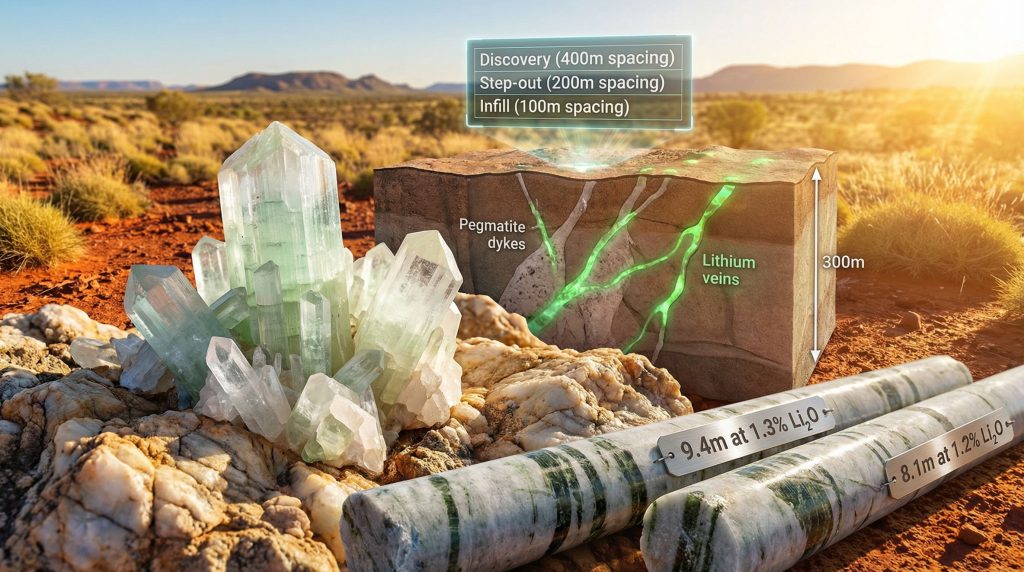
Visual spodumene identification provides immediate exploration feedback, but commercial viability requires precise grade determination through laboratory analysis. Recent intercepts demonstrating 9.4 metres at 1.3% lithium oxide and 8.1 metres at 1.2% lithium oxide represent commercially significant grades for spodumene-hosted deposits. These grade levels typically support economic development scenarios when combined with sufficient tonnage and favourable metallurgical characteristics.
| Drilling Phase | Typical Spacing | Primary Objective | Resource Confidence |
|---|---|---|---|
| Discovery | 200-400m | Prove concept | Inferred |
| Step-out | 100-200m | Extend system | Indicated |
| Infill | 25-50m | Define grade | Measured |
Laboratory Processing and Assay Timelines
Standard lithium oxide determination involves crushing, splitting, and analysis via inductively coupled plasma mass spectrometry (ICP-MS) or atomic absorption spectroscopy (AAS). Processing timelines range from 10-30 days depending on laboratory capacity and sample complexity. The 300-metre northerly extension confirmation through recent drilling demonstrates systematic step-out methodology designed to prove system continuity whilst managing exploration costs.
What Economic Factors Drive Continuous System Value Creation?
Mining Economics and Infrastructure Optimisation
Continuous pegmatite systems deliver substantial economic advantages through operational consolidation and infrastructure sharing. A unified 2.3-kilometre strike length system with demonstrated mineralisation continuity supports larger-scale operations with improved economies of scale compared to multiple separate deposits.
Processing plant optimisation represents a primary value driver for continuous systems. Furthermore, facilities designed for higher throughput rates achieve significant per-unit cost reductions through fixed cost distribution. Industry benchmarks suggest processing cost improvements of 15-25% when increasing plant capacity from 2 million tonnes annually to 5 million tonnes annually.
Capital Expenditure Distribution Analysis
| Infrastructure Component | Separate Deposits | Continuous System | Cost Reduction |
|---|---|---|---|
| Processing facilities | Duplicated | Centralised | 20-30% |
| Mine planning | Complex | Integrated | 15-25% |
| Transportation | Multiple routes | Single corridor | 10-20% |
| Environmental management | Separate permits | Unified approach | 25-35% |
Resource Classification and JORC Compliance
System connectivity directly impacts resource classification under JORC (Australasian Code for Reporting of Exploration Results, Mineral Resources and Ore Reserves) guidelines. Individual pegmatite zones with limited drilling might qualify only as Inferred Resources due to sparse data density. However, demonstrated connectivity between zones allows application of geological continuity principles, potentially upgrading resource classifications to Indicated categories with reduced drilling requirements.
The $48.5 million cash position provides substantial exploration and development funding capacity. This financial position supports comprehensive drilling programmes necessary for resource definition and preliminary economic assessments required for project advancement.
How Does Regional Infrastructure Support Development Economics?
Pilbara Regional Context and Proximity Advantages
The Pilbara region's established mining infrastructure provides significant development advantages for emerging lithium projects. Historical iron ore development has created extensive road networks, port facilities, and skilled labour pools that support lithium sector expansion. The 10-kilometre proximity to existing operations creates opportunities for shared services, contractor availability, and reduced recruitment costs.
Port facilities at Dampier and Port Hedland offer established export logistics for lithium concentrate, typically located 250-350 kilometres from deposit tiers guide areas depending on specific location. This existing infrastructure reduces capital requirements for new operations compared to greenfield regions requiring complete infrastructure development.
Hub-and-Spoke Development Models
Regional lithium development increasingly follows hub-and-spoke models where multiple mining operations feed centralised processing and export infrastructure. This approach can reduce development costs by 20-35% compared to standalone operations through shared infrastructure utilisation.
Critical Infrastructure Considerations:
• Water availability and management systems
• Power generation and distribution networks
• Transportation corridor capacity
• Environmental permitting frameworks
• Community engagement and social licence requirements
What Metallurgical Characteristics Determine Processing Viability?
Spodumene Concentrate Quality Specifications
Commercial lithium operations require spodumene concentrates meeting specific quality parameters for downstream processing. Typical specifications include lithium oxide grades exceeding 5.5-6.0% in concentrate form, with iron and phosphorus impurity levels below defined thresholds. Consequently, recovery rates from pegmatite ores through flotation or dense media separation typically range from 60-75%.
The multiple intercepts exceeding 1% lithium oxide provide strong indicators of system-wide mineralisation consistency. This grade consistency suggests uniform metallurgical characteristics across the pegmatite system, reducing testwork requirements and processing risk related to lithium extraction techniques.
Processing Pathway Selection
Spodumene recovery typically employs dense media separation followed by flotation circuits designed to achieve concentrate specifications. Processing plant design considerations include:
• Crushing and grinding circuit optimisation
• Dense media separation efficiency
• Flotation chemistry and recovery rates
• Concentrate dewatering and handling systems
Processing cost structure analysis indicates that mining costs typically represent 40-50% of total operating expenses, with processing accounting for 25-35% and transportation/logistics comprising 15-25%. For instance, continuous systems allow optimisation across all cost categories through integrated planning and shared infrastructure.
The next major ASX story will hit our subscribers first
How Do Environmental and Regulatory Frameworks Influence Development?
Mining Lease Application Processes
Lithium project development requires comprehensive environmental impact assessments addressing flora, fauna, water resources, and heritage considerations. The consolidated system approach potentially simplifies permitting through unified mining lease applications covering the entire resource area rather than multiple separate applications.
Pilbara-Specific Environmental Considerations
The arid Pilbara environment presents specific challenges including:
• Seasonal access limitations during cyclone seasons
• Dust management in low-humidity conditions
• Water conservation and recycling requirements
• Flora and fauna protection protocols
Native title and heritage clearance protocols require extensive consultation with traditional owners and archaeological assessments. Furthermore, continuous systems may facilitate these processes through consolidated consultation frameworks covering larger areas under unified agreements.
What Financial Metrics Drive Project Advancement Decisions?
Capital and Operating Cost Estimation
Preliminary economic assessments for lithium pegmatite operations typically evaluate capital expenditures including open-pit mining equipment, processing plant construction, and infrastructure development. Operating cost structures encompass mining costs per tonne of ore, processing costs per tonne of concentrate, and transportation expenses.
Development Timeline and Funding Requirements
Lithium project development from discovery to production typically requires 5-8 years including exploration, resource definition, environmental approvals, and construction phases. The current cash position provides funding for extensive exploration and preliminary studies, though full development would likely require additional capital raising or project financing.
Economic Sensitivity Factors:
• Lithium carbonate and spodumene concentrate pricing
• Mining and processing cost inflation
• Exchange rate fluctuations (AUD/USD)
• Permitting and regulatory timeline risks
How Does Market Positioning Affect Strategic Value?
Australian Lithium Sector Context
Australia maintains a dominant position in global lithium supply, accounting for approximately 55% of worldwide production from hard-rock sources. Domestic production capacity continues expanding to meet growing demand from electric vehicle and energy storage applications, particularly as lithium industry innovations continue to evolve.
Supply chain security considerations increasingly favour Australian lithium sources due to political stability and established trade relationships. This positioning provides market access advantages and potential premium pricing for high-quality spodumene concentrates.
Technology Integration Opportunities
Modern lithium operations increasingly incorporate automated mining systems, real-time ore sorting technology, and digital twin modelling for operational optimisation. However, continuous pegmatite systems provide ideal conditions for these technologies through consistent geological conditions and integrated mine planning approaches.
What Strategic Development Priorities Shape Future Growth?
Immediate Exploration Objectives
Near-term exploration priorities focus on resource definition drilling programmes designed to achieve JORC-compliant resource estimates. Reverse circulation drilling provides cost-effective methods for resource delineation following diamond drilling confirmation of system continuity, as recent announcements about Wildcat grows Bolt Cutter as drilling extends lithium system demonstrate.
Medium-Term Development Milestones
Pre-feasibility study initiation typically requires defined resources of sufficient confidence and scale to support economic evaluation. In addition, environmental baseline studies must commence early in development timelines to support permitting processes within acceptable timeframes.
Long-Term Strategic Integration
Hub-and-spoke operational models offer significant advantages for regional lithium development. Processing facility centralisation reduces capital requirements whilst improving operational efficiency through economies of scale and shared infrastructure utilisation.
Investment Consideration: The combination of demonstrated system continuity, favourable regional infrastructure, and substantial cash resources positions projects for potential advancement through development phases, though lithium market volatility and development risks require careful evaluation.
Next Phase Priorities:
• Comprehensive resource definition drilling
• Metallurgical testwork advancement
• Environmental and heritage assessments
• Community engagement programmes
• Preliminary economic assessments
The evolution of lithium pegmatite exploration from individual deposit identification toward recognition of continuous systems represents a fundamental shift in resource development approaches. Furthermore, when Wildcat grows Bolt Cutter as drilling extends lithium system, this development provides essential context for understanding these geological, economic, and operational factors that drive evaluation of emerging lithium opportunities. Consequently, the recent extension of the Bolt Cutter discovery demonstrates how systematic exploration can transform individual prospects into significant resource systems, highlighting the importance of Australia's evolving critical minerals sector.
Could Your Next Investment Be the Next Major Lithium Discovery?
Discovery Alert's proprietary Discovery IQ model delivers real-time alerts on significant lithium and critical mineral discoveries across the ASX, instantly empowering subscribers to identify actionable opportunities ahead of the broader market. Understand why major mineral discoveries can lead to significant market returns by exploring Discovery Alert's dedicated discoveries page, showcasing historic examples of exceptional outcomes, and begin your 14-day free trial today to position yourself ahead of the market.