August 6, 2026
The Hidden Cost of Cheap Lithium: How Two Years of Oversupply Created the Seeds of a Structural Crisis
When commodity markets experience prolonged price collapses, capital retreats. Exploration budgets are slashed, development timelines stretch, and processing plants are idled. The lithium market endured exactly this sequence across 2024 and 2025, as prices that had once touched extraordinary highs fell back to levels that made many projects economically unviable. BMI revises lithium price forecast upwards amid tightening supply concerns, and what analysts and investors are now beginning to grapple with is a less obvious consequence of that downturn: the decisions made during the trough will shape the ceiling of future supply for years, possibly decades, to come.
That dynamic sits at the heart of why BMI, the Fitch Solutions research division, has revised its lithium price forecast upwards for the second time in a single forecast cycle, a relatively uncommon move that signals genuine reassessment of market fundamentals rather than a routine update. The lithium market downturn of 2024 to 2025 set the conditions for precisely this kind of supply shock.
When big ASX news breaks, our subscribers know first
The Structural Shift Driving Lithium's Price Recovery in 2026
From Oversupply Hangover to Tightening Fundamentals: What Changed?
The lithium market entered 2026 carrying the weight of a two-year surplus cycle. Yet within the first weeks of the year, something shifted. Prices did not merely stabilise; they surged with unexpected conviction. Lithium carbonate pushed above $24,000 per tonne in January 2026, while lithium hydroxide crossed $23,000 per tonne, levels unseen since 2023. The catalyst was not a sudden explosion in demand but a convergence of supply-side shocks arriving faster than models had anticipated.
The continued suspension of Contemporary Amperex Technology's (CATL) Jianxiawo mine in China during the early part of the year contributed directly to that January price surge. When the world's largest battery manufacturer curtails output at one of its own lithium operations, the market takes notice. Combined with genuine uncertainty over when other Chinese mines would resume full production following the Lunar New Year period, the supply picture darkened quickly.
How Supply Disruptions Are Rewriting the Lithium Market Narrative
Zimbabwe's decision in late February 2026 to suspend lithium exports added a second, compounding shock. The timing was particularly significant because it arrived precisely when markets had begun assuming a measured return to supply normalcy. African lithium production had been growing steadily, with Zimbabwe positioning itself as the continent's leading lithium mining jurisdiction. A sudden regulatory reversal therefore carried outsized psychological weight beyond the physical tonnage involved.
Early April 2026 reports pointed to a potential softening of Zimbabwe's export restrictions, introducing a degree of optimism into the market, but also highlighting just how exposed global lithium supply chains have become to single-country regulatory risk. This is a structural vulnerability that the industry had arguably underweighted for years.
Key Price Benchmarks: Where Lithium Carbonate and Hydroxide Stand Today
As of April 20, 2026, spot prices have remained elevated well above BMI's revised full-year average forecasts, reflecting how strongly near-term sentiment has moved relative to the underlying demand picture. Understanding the lithium carbonate dynamics at play is essential to interpreting the gap between current spot prices and BMI's full-year averages.
| Lithium Chemical | Year-to-Date Average | April 2026 Spot Price | BMI Revised Forecast (2026) |
|---|---|---|---|
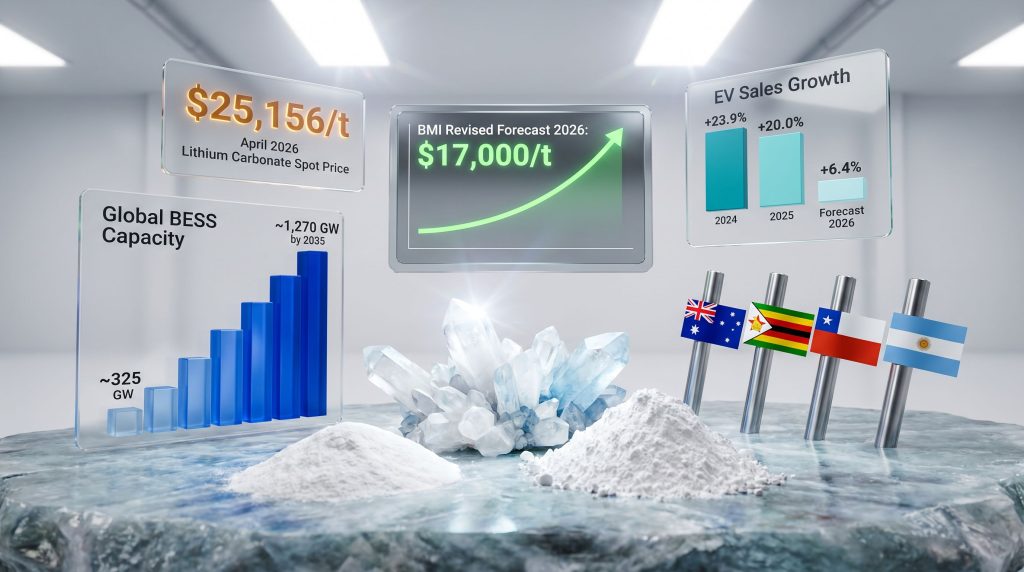
| Lithium Carbonate (99.5%) | $21,892/t | $25,156/t | $17,000/t |
| Lithium Hydroxide Monohydrate (56.5%) | $21,736/t | $24,569/t | $16,700/t |
Source: BMI (Fitch Solutions), April 2026 Lithium Price Outlook
The gap between current spot prices and full-year average forecasts implies BMI expects a meaningful price retreat in the second half of 2026, contingent primarily on Chinese supply restarts materialising. That the restart has already been delayed relative to earlier expectations explains why this constitutes the second upward revision in the current forecast cycle.
What Geopolitical and Regulatory Shocks Are Reshaping Lithium Supply Chains?
Zimbabwe's Export Restrictions: A Catalyst for Structural Market Tightness
Zimbabwe's export suspension introduced a variable that purely demand-driven models are poorly equipped to price. The country had been advancing rapidly up the ranks of global lithium producers, attracting significant investment as hard-rock lithium mining expanded across its geology-rich deposits. The abrupt halt to exports demonstrated that emerging producer nations, however geologically endowed, carry a different risk profile than established jurisdictions with decades of regulatory predictability.
For the global market, the episode reinforced the importance of supply chain diversification, a theme that has become central to battery industry strategy but has proven far harder to execute in practice than in policy documents. According to BMI's latest analysis, these regulatory disruptions are now a central factor in the revised price outlook.
The US-Iran Conflict's Cascading Effects on Battery Metal Economics
The conflict between the United States and Iran that erupted in late February 2026 introduced an entirely separate vector of market disruption. Its effects on the battery raw materials market are indirect but meaningful across two distinct channels.
The first is a demand impulse: elevated energy prices improve the running-cost economics of electric vehicles relative to internal combustion alternatives. In markets across Asia where fuel costs represent a material share of household budgets, the price differential between EVs and conventional vehicles becomes more compelling during periods of sustained oil price elevation.
The second is a supply cost pressure. Concerns over the Strait of Hormuz, through which substantial volumes of sulphur-bearing energy commodities transit, have raised the prospect of sulphur shortages. This matters directly to lithium producers because sulphur is a key input in hydrometallurgical processing, particularly in the conversion of lithium concentrates to battery-grade chemicals. Margin compression for producers operating outside the most cost-efficient tier of the industry could delay capacity restarts even as prices recover.
Strait of Hormuz Pressure: Sulphur Shortages and Margin Compression for Producers
The sulphur supply concern is one of the less widely understood dimensions of Middle East geopolitical risk as it applies to critical minerals. Most market commentary focuses on oil prices and shipping costs. The potential disruption to sulphur availability, which affects the reagent inputs for lithium processing operations, represents a secondary mechanism that could simultaneously constrain supply while demand expectations are rising.
The combination of Zimbabwe's export curbs, uncertainty over Chinese mine restarts, and the Strait of Hormuz supply cost pressures created a compounding shock that amplified upside price risks well beyond what demand fundamentals alone would have justified.
BMI notes that prices are likely to remain range-bound in the near term and highly sensitive to geopolitical developments in the Middle East, while the restart of Chinese supply remains the pivotal catalyst for a price retreat, an event now expected to materialise later than previously anticipated.
How Does Demand From Electric Vehicles and Energy Storage Shape the Lithium Price Outlook?
Global EV Sales Forecasts and Their Direct Implications for Lithium Consumption
One of the most important distinctions in interpreting the current lithium market is the difference between slowing growth and declining demand. BMI's Autos team forecasts show global passenger EV sales growth decelerating meaningfully in 2026, but the absolute trajectory remains firmly upward.
| Year | Global Passenger EV Sales Growth (YoY) |
|---|---|
| 2024 | +23.9% |
| 2025 | +20.0% |
| 2026 (Forecast) | +6.4% |
Source: BMI Autos Team Forecasts, 2026
Total global lithium demand is projected to grow approximately 4.8% year-on-year in 2026, a notable deceleration from 18.5% in 2025, but still representing meaningful incremental consumption of a commodity whose supply response requires years to develop.
Why Lithium Demand Growth Is Decelerating and Why That Doesn't Signal a Bear Market
Several factors underlie the slower growth rate in 2026 without indicating structural demand destruction:
- EV sales growth is moderating from exceptionally high base effects rather than reversing direction
- Battery swap station infrastructure means the number of battery packs manufactured exceeds vehicle unit sales, adding a layer of demand not fully captured in headline EV sales statistics
- Utility-scale battery storage, portable electronics, and e-mobility devices collectively contribute incremental demand that sits outside the automotive segment entirely
- The energy economics argument for EV adoption is strengthening, not weakening, in emerging Asian markets where oil price exposure is highest
China's Anti-Involution Campaign: How Policy Is Reshaping EV Market Dynamics
China's domestic EV market presents a more nuanced picture. The China Passenger Car Association reported that retail sales of new-energy vehicles fell 14.4% year-on-year in March 2026, the third consecutive month of year-on-year decline. This is a significant data point that contributed to cautious sentiment through the first quarter.
However, the underlying reason matters enormously for interpretation. China's anti-involution campaign is deliberately restructuring the competitive dynamics of its EV sector by:
- Amending the national Pricing Law to restrict below-cost selling practices
- Enforcing capacity reductions to address excess supply conditions
- Applying institutional pressure to limit price wars that were eroding manufacturer margins to unsustainable levels
The short-term effect is volume reduction. The medium-term objective is an industry capable of generating the margins needed to fund the next generation of technology and geographic expansion. Chinese EV manufacturers are aggressively targeting export markets, particularly across Asia and developing economies, where their cost competitiveness and model breadth create structural advantages, especially in environments where affordability constrains EV adoption.
Battery Energy Storage Systems: The Next Major Pillar of Lithium Demand
BESS Capacity Expansion Forecasts: A Near-Fourfold Growth by 2035
While the EV narrative dominates lithium market coverage, battery storage expansion is emerging as a structural demand pillar that warrants independent analysis. BMI's Power and Renewables team forecasts that global installed BESS capacity will expand from approximately 325 GW in 2026 to around 1,270 GW by 2035, a near fourfold increase representing a compound annual growth rate of approximately 14.7%.
| Region | 2026 Installed Capacity | 2035 Projected Capacity | CAGR |
|---|---|---|---|
| Global Total | ~325 GW | ~1,270 GW | ~14.7% |
| Mainland China | 193.5 GW | ~609 GW | 13.6% |
| United States | ~61 GW | ~271 GW | ~16.1% |
| Combined Share (China + US) | ~78% of global | ~69% of global | — |
Source: BMI Power & Renewables Team, 2026
The projected decline in the combined China-US share from 78% to 69% of global capacity is itself informative. It suggests that BESS deployment will broaden geographically through the 2030s, distributing demand more widely and potentially creating new lithium consumption centres outside the current duopoly.
What Is Driving US Battery Storage Growth?
The US trajectory toward 271 GW by 2035 is being propelled by several converging forces that are distinct from the Chinese growth story:
- Grid reliability requirements are intensifying as extreme weather events strain existing transmission and generation infrastructure
- Artificial intelligence data centre buildout is generating extraordinary electricity demand growth that conventional grid planning did not anticipate at current scale
- Population growth in historically underserved grid regions is adding structural load pressure
- The extension of investment tax credits for BESS through to 2032 under the One Big Beautiful Bill Act provides near-term policy visibility for project financing decisions
China's Transition From Mandate-Driven to Market-Driven Storage Deployment
China's BESS growth story is qualitatively different from the US experience. The introduction of capacity payments for standalone storage from January 2026 represents a fundamental structural shift: storage is transitioning from a mandated component of renewable energy development to a commercially viable, standalone asset class. This change in investment logic, from compliance-driven to market-driven, typically unlocks a broader and more durable deployment wave than mandate-based mechanisms alone.
What Does the Global Lithium Supply Landscape Look Like Through 2035?
Production Growth Forecasts and the Dominance of the Top Three Producers
BMI projects global lithium mine production will grow at 13.2% year-on-year in 2026, led primarily by Australia and Mainland China. Australia is expected to retain its position as the world's largest lithium producer, supported by an active project pipeline, while China continues to expand domestic production capacity alongside overseas project investment.
| Producer | Current Role | Forecast Trend to 2035 |
|---|---|---|
| Australia | World's largest producer | Remains top producer; domestic refining capacity expanding |
| Mainland China | Major producer and importer of concentrates | Expanding domestic capacity alongside overseas project investment |
| Chile | Significant brine-based producer | Declining share as expansion lags peers |
| Argentina | Emerging producer | Strong growth as pivotal projects come online |
| Zimbabwe | Emerging African producer | Positioned as Africa's leading lithium mining jurisdiction |
Source: BMI, 2026 Lithium Market Outlook
The combined market share of the top three producers, Australia, China, and Chile, is forecast to decline between 2026 and 2035 as Argentina and Zimbabwe scale their respective output. This gradual diversification of supply geography is a structural positive for supply chain resilience, though it introduces different sets of political and regulatory risk factors.
The Refining Bottleneck: Why Processing Capacity Is as Critical as Mine Output
A dimension of the lithium supply chain frequently underweighted in headline production forecasts is the refining step. Mining lithium is only the first stage in a multi-step process before a battery-grade chemical reaches a cell manufacturer. Furthermore, innovations in direct lithium extraction technology may eventually alter this processing calculus, though widespread commercial deployment remains some years away.
The processing pathway differs depending on the source material:
- Hard-rock lithium (predominantly spodumene from Australia) is crushed and concentrated into spodumene concentrate, typically at around 6% lithium oxide (Li₂O), before being shipped to conversion facilities
- The concentrate is then processed through either a sulphate or hydroxide conversion route to produce battery-grade lithium hydroxide or lithium carbonate
- Brine-based lithium (from Chile and Argentina) is typically processed more directly into lithium carbonate, which can subsequently be converted to hydroxide through an additional processing step
According to IEA data, the conversion of lithium carbonate to hydroxide accounts for approximately 20% of current global hydroxide supply, with China holding a dominant position in this processing capability. This gives Chinese refiners a structural advantage that extends beyond their mining operations.
Australia's Refining Ambitions and the Challenges Facing Ex-China Processors
Australia's ambition to capture a greater share of lithium chemical value, rather than exporting raw concentrate, faces genuine commercial headwinds. The Australian Office of the Chief Economist projects that Australia could hold 9% of global lithium hydroxide production by 2027, a meaningful share if realised.
However, Albemarle's decision in February 2026 to idle the remaining operating Train 1 at its Kemerton lithium hydroxide processing plant in Western Australia illustrates the economic pressures facing ex-China hard-rock conversion operations. The Kemerton experience is not an isolated case but rather reflects a structural cost disadvantage that Western lithium processors have struggled to overcome relative to their Chinese counterparts.
The repeated idling of Western Australian processing capacity reinforces the structural advantage Chinese refiners hold in the lithium chemicals market, a risk factor that complicates Western supply chain diversification strategies regardless of how much upstream mining capacity is developed outside China.
The next major ASX story will hit our subscribers first
Is the Lithium Market in Surplus or Deficit, and When Does the Balance Tip?
Near-Term Surplus, Long-Term Deficit: Understanding the Market Cycle
The lithium market's trajectory through the remainder of the decade follows a pattern that is well understood in cyclical commodity markets but often misread by investors focused on near-term price signals.
| Period | Market Condition | Key Driver |
|---|---|---|
| 2026 to 2029 | Surplus | Robust project pipeline; slower demand growth |
| 2030 to 2035 | Deficit | Underinvestment during 2024 to 2025 downturn; demand acceleration |
Source: BMI, 2026 Lithium Price Outlook
The mechanism is straightforward but the timing is not. Capital decisions made during the 2024 to 2025 price trough, when many projects were deferred, scaled back, or cancelled entirely, will constrain the industry's ability to respond rapidly when the market transitions toward deficit. Mining projects typically require five to ten years from discovery through permitting, construction, and commissioning before reaching commercial output. Decisions not made in 2024 translate directly into supply gaps in 2030 and beyond.
The Wildcard Scenario: Could the Surplus Narrow Faster Than Expected?
BMI does not dismiss the possibility of the surplus narrowing more rapidly than the base-case scenario suggests. A combination of lagging supply restarts in China alongside a stronger-than-anticipated EV demand impulse driven by elevated energy prices could tip the market toward deficit earlier than the 2030 horizon. The Middle East energy shock provides an additional demand variable not fully embedded in consensus forecasts, creating genuine upside risk to the demand side of the equation. Fitch Solutions' broader industrial metals upgrade reflects this same reassessment of upside risk across the critical minerals complex.
How Battery Chemistry Evolution Is Reshaping Demand for Lithium Carbonate vs. Hydroxide
LFP vs. NMC: Why the Chemistry Battle Has Pricing Consequences
One of the most consequential but underappreciated dimensions of the lithium market is that not all lithium demand is equivalent. The two primary battery chemistries used in electric vehicles draw on different lithium chemicals, creating bifurcated demand dynamics within what is often discussed as a single commodity market.
| Battery Type | 2022 EV Market Share | 2023 EV Market Share | 2024 EV Market Share |
|---|---|---|---|
| Lithium Iron Phosphate (LFP) | 38% | 41% | 50% |
| Nickel Manganese Cobalt (NMC) | Majority remainder | Declining | Declining |
Source: International Energy Agency (IEA), 2024
LFP batteries reached 50% of global EV sales in 2024, driven overwhelmingly by Chinese adoption. This chemical uses lithium carbonate as its primary input. NMC batteries, which require lithium hydroxide for their high-nickel cathodes, are progressively losing market share. The implication is that demand growth for lithium carbonate is structurally better supported than demand for lithium hydroxide over the medium term.
Why Rising LFP Adoption Applies Downward Pressure on Lithium Hydroxide Prices
The chemistry divergence creates a scenario where two products that trade within the same general lithium market could experience materially different price trajectories. Producers with high proportions of lithium hydroxide output face a structurally more challenging demand environment as LFP adoption continues to expand. This bifurcation is already visible in current price spreads and is likely to widen as battery technology preferences consolidate.
Sodium-Ion Batteries: A Long-Term Threat to Lithium Demand?
Beyond the intra-lithium chemistry competition, sodium-ion battery technology represents a longer-horizon risk that prudent market analysis should acknowledge. Sodium-ion cells use no lithium whatsoever, drawing instead on sodium, a far more abundant and geographically distributed element. Current adoption remains nascent, and the energy density limitations of sodium-ion technology make it unsuitable for many of the applications where lithium-ion excels.
However, sodium-ion batteries are gaining traction in stationary storage applications and short-range urban mobility, precisely the segments where energy density is less critical than cost and cycle life. If sodium-ion technology progresses further along the cost reduction curve, it could progressively displace lithium demand in lower-specification applications, representing a genuine downside scenario for long-term lithium price forecasts.
Frequently Asked Questions: BMI's Lithium Price Forecast Revision
What Are BMI's Revised Lithium Price Forecasts for 2026?
BMI has revised its 2026 annual average price forecasts upward to $17,000 per tonne for Mainland Chinese lithium carbonate (99.5%) and $16,700 per tonne for Mainland Chinese lithium hydroxide monohydrate (56.5%). This is the second upward revision within the current forecast cycle, reflecting a more sustained supply tightness than earlier models anticipated.
What Is Driving Lithium Prices Higher in 2026?
The primary drivers include Zimbabwe's export restrictions introduced in late February 2026, persistent uncertainty over Chinese mine restart timelines, sustained underlying demand from EV and energy storage applications, and the indirect effects of the US-Iran conflict on energy market dynamics and supply chain cost pressures.
Will Lithium Prices Stay Elevated Throughout 2026?
BMI anticipates prices will remain sensitive to geopolitical developments in the near term. The restart of Chinese lithium supply amid continued demand growth is identified as the pivotal catalyst for a price retreat, a development now expected later than previously forecast. Swift restarts of previously idled higher-cost operations could prompt rapid production increases, though a sustained disruption environment could support prices for longer than the base case assumes.
When Is the Lithium Market Expected to Move Into Deficit?
Based on current supply and demand modelling, BMI projects the lithium market will remain in surplus through to 2029, before transitioning toward deficit across the 2030 to 2035 period. The root cause of that longer-term deficit is accumulated underinvestment during the 2024 to 2025 downturn, which has already reduced the future supply pipeline in ways that cannot be quickly reversed as prices recover.
How Does Battery Chemistry Affect Long-Term Lithium Price Forecasts?
The growing dominance of LFP batteries over NMC chemistries creates divergent medium to long-term pricing dynamics between lithium carbonate and lithium hydroxide. Carbonate demand is better supported by the LFP growth trajectory, while hydroxide faces incremental headwinds as NMC market share contracts. This distinction matters significantly for producers, project developers, and investors assessing which segment of the lithium value chain offers the more durable demand profile.
Key Takeaways: What the BMI Forecast Revision Signals for the Lithium Market
- Supply disruptions are the dominant near-term price driver, with Zimbabwe's export curbs and Chinese project uncertainty creating structural tightness that demand fundamentals alone cannot fully explain
- Demand deceleration is real but not bearish, with EV sales growth moderating from exceptional rates rather than reversing, while BESS deployment is emerging as a powerful and growing secondary demand pillar
- The long-term supply deficit is structural, rooted in years of underinvestment that cannot be rapidly reversed even as prices recover
- Battery chemistry evolution introduces bifurcation risk between lithium carbonate and hydroxide pricing trajectories, with LFP's rise creating divergent demand outlooks for the two chemicals
- Geopolitical risk premiums are now embedded in lithium pricing, with Middle East instability simultaneously amplifying demand expectations through higher oil prices and supply cost pressures through potential sulphur shortages
- The refining bottleneck remains underappreciated, with China's dominance in lithium chemical conversion representing a structural constraint on Western supply chain diversification efforts regardless of upstream mining investment
Disclaimer: This article is for informational purposes only and does not constitute financial or investment advice. Forecasts and price projections cited are sourced from BMI (Fitch Solutions) and reflect modelled scenarios that are subject to revision. Readers should conduct their own due diligence before making investment decisions.
Want to Position Ahead of the Next Major ASX Lithium Discovery?
Discovery Alert's proprietary Discovery IQ model delivers real-time alerts the moment significant mineral discoveries hit the ASX, transforming complex commodity data into actionable insights for both traders and long-term investors — explore historic discoveries and their returns to understand the opportunity, then begin your 14-day free trial at Discovery Alert to secure your edge as the lithium market tightens toward structural deficit.