May 14, 2026
The Cauchari-Olaroz lithium project demonstrates remarkable potential within Argentina's expanding battery materials sector, where lithium production in Cauchari-Olaroz represents a cornerstone of South American resource development. Furthermore, this operation benefits from exceptional geological conditions that facilitate efficient extraction processes and long-term operational sustainability.
Argentina's Puna plateau represents one of Earth's most concentrated lithium brine formations, where geological processes spanning millions of years have created ideal conditions for large-scale extraction operations. The high-altitude desert environment, combined with specific mineral compositions and climatic factors, enables efficient solar evaporation techniques that form the backbone of modern brine-based operations. Additionally, insights from Argentina lithium insights highlight the strategic importance of these formations.
This unique geological setting within the broader Lithium Triangle has attracted significant international investment, with Chinese battery materials giant Ganfeng Lithium leading a consortium that has transformed what was once an exploration project into a major production facility. The operation's strategic positioning offers access to established transportation networks connecting to Pacific ports, while proximity to natural gas infrastructure supports processing operations during periods when solar energy proves insufficient.
Resource Quality and Reserve Assessment
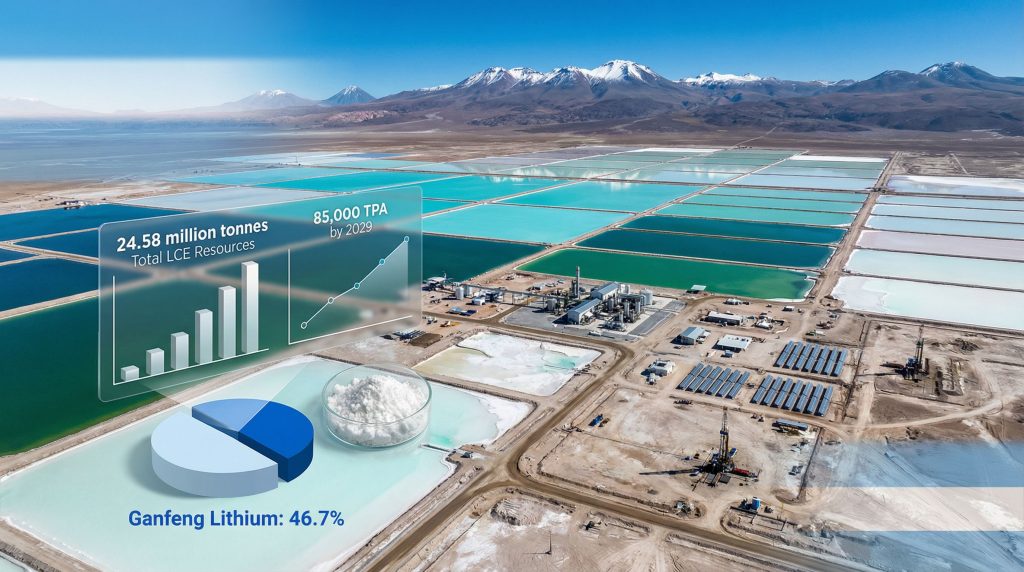
The Cauchari-Olaroz deposit contains 24.58 million tonnes of lithium carbonate equivalent resources, positioning it among the world's top five lithium reserves by total contained metal. This massive resource base supports a projected mine life exceeding 40 years at full production capacity, significantly above industry averages for comparable operations.
| Resource Metric | Cauchari-Olaroz Value | Industry Benchmark |
|---|---|---|
| Total LCE Resources | 24.58 million tonnes | Top 5 globally |
| Estimated Mine Life | 40+ years | 20-30 years average |
| Brine Grade | High concentration | Premium category |
| Processing Recovery | 85-90% efficiency | 70-85% typical |
The brine quality at Cauchari-Olaroz demonstrates favorable chemistry for lithium extraction, with relatively low magnesium-to-lithium ratios that facilitate more efficient processing compared to many competing deposits. Consequently, this geological advantage translates directly into lower operating costs and higher recovery rates during the evaporation and chemical precipitation phases.
Infrastructure Integration and Energy Systems
Cauchari-Olaroz benefits from integration with Argentina's expanding renewable energy grid through a dedicated 300 MW solar power facility that provides sustainable electricity for processing operations. This solar integration reduces dependence on fossil fuels while lowering long-term operating costs, creating a competitive advantage in an increasingly ESG-focused marketplace.
The operation's location within established mining regions provides access to skilled labor pools, maintenance services, and supply chain networks that support efficient operations. Transportation links to the Port of Antofagasta in Chile enable cost-effective export logistics, particularly important given that approximately 80% of production targets Chinese markets through Ganfeng's distribution networks.
When big ASX news breaks, our subscribers know first
Current Production Performance and Capacity Utilization
Lithium production in Cauchari-Olaroz has demonstrated steady improvement throughout 2024 and into 2025, with actual output reaching approximately 25,000 tonnes of lithium carbonate equivalent during 2024 against a nameplate capacity of 40,000 tonnes per annum. This 62.5% capacity utilization reflects typical ramp-up patterns for large-scale brine operations, where achieving full nameplate capacity often requires 2-3 years of operational optimization.
Production targets for 2025 anticipate output levels between 30,000-35,000 tonnes LCE, representing a significant improvement in capacity utilization as operational teams refine evaporation pond management. However, global lithium market challenges continue to influence pricing dynamics and strategic planning decisions.
Quarterly Performance Trends
The third quarter of 2025 achieved production levels of 8,300-8,500 tonnes LCE, indicating annualized run rates approaching 33,000-34,000 tonnes if sustained throughout the year. This quarterly performance suggests that operational teams have successfully addressed earlier challenges related to:
• Evaporation pond efficiency during varying weather conditions
• Chemical precipitation timing optimization for battery-grade specifications
• Quality control consistency meeting international buyer requirements
• Processing throughput maximization within existing infrastructure
Technology and Processing Infrastructure
Cauchari-Olaroz employs traditional solar evaporation methodology enhanced with modern monitoring and control systems that optimize brine concentration rates based on weather patterns and seasonal variations. The evaporation pond system covers several square kilometers, with carefully engineered gradients that facilitate natural brine flow while maximizing solar exposure.
The processing facility incorporates state-of-the-art purification systems designed to produce battery-grade lithium carbonate meeting specifications for electric vehicle battery manufacturers and energy storage system producers. Moreover, exploring direct lithium extraction benefits could potentially enhance future operational efficiency.
Advanced automation systems monitor brine chemistry, evaporation rates, and processing parameters in real-time, enabling operators to make rapid adjustments that optimize recovery rates while maintaining product quality standards. This technological integration has contributed significantly to the improved capacity utilization rates observed throughout 2024 and 2025.
RIGI Framework and Expansion Investment Structure
Argentina's Large Investment Incentive Regime (RIGI) represents a transformative policy framework designed to attract major industrial investments exceeding $200 million through substantial tax benefits and regulatory streamlining. Minera Exar's application for RIGI qualification to support the Cauchari-Olaroz expansion demonstrates the project's scale and strategic importance within Argentina's mining development priorities.
The proposed expansion to 85,000 tonnes per annum by 2029 would more than double current nameplate capacity, requiring substantial infrastructure investments in additional evaporation ponds, processing equipment, power systems, and support facilities. Similarly, Australia lithium tax benefits demonstrate how government incentives can accelerate industry development.
RIGI qualification could provide crucial financial advantages including:
• Accelerated depreciation schedules for capital equipment investments
• Reduced corporate income tax rates during initial production phases
• Import duty exemptions for specialized mining equipment and technology
• Foreign exchange stability mechanisms protecting against currency devaluation risks
Global Supply Chain Impact Analysis
The completion of Cauchari-Olaroz expansion would position the operation among the world's top five lithium producers by annual output, contributing approximately 3-4% of global lithium supply based on current market projections. This production scale carries significant implications for battery metal market dynamics, particularly given the operation's focus on battery-grade lithium carbonate for electric vehicle applications.
Industry analysts project that operations achieving 85,000 tonnes annual capacity gain substantial negotiating power in long-term offtake agreements while contributing meaningfully to regional supply stability.
Market modeling suggests that the additional 45,000 tonnes of annual capacity could help moderate lithium price volatility by providing reliable supply volumes during periods of tight market conditions. However, the expansion timeline coincides with multiple competing projects reaching production, including Thacker Pass lithium production, potentially creating oversupply scenarios that could pressure pricing throughout the late 2020s.
Joint Venture Structure and Ownership Dynamics
The Cauchari-Olaroz operation functions through a sophisticated joint venture structure that balances international expertise, local development capabilities, and regional government participation. Ganfeng Lithium's 46.7% stake provides technical knowledge and market access, while Lithium Argentina's 44.8% ownership contributes local operational expertise and regulatory relationships.
JEMSE's 8.5% participation represents the Jujuy provincial government's strategic interest in lithium development, ensuring local communities benefit from resource extraction while providing regulatory stability for long-term operations. This ownership structure has proven effective in managing complex permitting processes and community relations that can significantly impact mining operations in Argentina.
Market Distribution and Offtake Strategy
Ganfeng Lithium's controlling influence facilitates direct access to Chinese battery manufacturers and electric vehicle producers, with approximately 80% of production targeting Chinese markets through established distribution networks. This offtake arrangement provides pricing stability and guaranteed sales volumes, reducing market risk for the joint venture partners.
The remaining 20% of production capacity serves diverse markets including:
• Thailand operations through Bangchak Corporation partnerships
• Spot market sales during favorable pricing conditions
• Strategic customer relationships with non-Chinese battery manufacturers
• Future expansion opportunities in North American and European markets
Contract structures typically include floor pricing mechanisms that protect against extreme market downturns while allowing participation in commodity price upside during tight market conditions. These arrangements have proven particularly valuable during the lithium price volatility experienced throughout 2022-2024.
Operational Cost Structure and Economic Analysis
Lithium production in Cauchari-Olaroz benefits from relatively low cash operating costs due to favorable geological conditions, efficient processing technology, and integrated renewable energy systems. Solar evaporation requires minimal energy inputs compared to hard rock lithium processing, while the high-grade brine composition reduces chemical consumption during purification stages.
Direct operating costs encompass several key categories:
• Brine extraction and pumping operations requiring minimal energy consumption
• Solar evaporation pond maintenance and monitoring systems
• Chemical processing inputs for lithium carbonate precipitation and purification
• Quality control and laboratory testing throughout production processes
• Packaging and logistics for export shipments to international customers
Capital Investment Requirements for Expansion
The proposed expansion to 85,000 tonnes annual capacity requires substantial capital investments estimated at several hundred million dollars, encompassing infrastructure development, equipment procurement, and working capital during construction and ramp-up phases.
Major capital expenditure categories include:
• Additional evaporation pond construction covering expanded surface areas
• Processing plant capacity increases for purification and finishing operations
• Power infrastructure expansion supporting increased electrical demands
• Transportation and storage facilities accommodating higher production volumes
• Environmental monitoring and mitigation systems ensuring regulatory compliance
Financial modeling suggests payback periods of 6-8 years based on current lithium carbonate pricing assumptions and expected operating cost improvements from economies of scale. However, these projections remain sensitive to lithium price volatility and potential increases in input costs or regulatory requirements.
Environmental Management and Sustainability Considerations
Brine-based lithium extraction in arid environments presents unique environmental challenges that require careful management of water resources and local ecosystem impacts. Cauchari-Olaroz operations implement comprehensive water management strategies designed to minimize freshwater consumption while protecting local aquifer systems that support regional communities and wildlife.
The operation's environmental management framework includes:
• Brine aquifer monitoring programs tracking extraction rates and chemistry changes
• Groundwater protection measures preventing contamination of freshwater sources
• Dust control systems managing particulate emissions from evaporation ponds
• Wildlife habitat preservation maintaining migration corridors for local species
• Community water access protection ensuring local needs remain prioritized
Processing Technology Evolution and Innovation
Traditional evaporation pond methodology at Cauchari-Olaroz demonstrates proven effectiveness but faces potential enhancement through emerging direct lithium extraction technologies that could accelerate processing timeframes and reduce land requirements. Current evaporation cycles require 12-18 months from initial brine pumping to finished lithium carbonate production.
DLE technology pilot programs under evaluation could potentially:
• Reduce processing timeframes to 6-8 months through chemical acceleration
• Increase recovery rates beyond current 85-90% efficiency levels
• Minimize land use requirements compared to extensive evaporation pond systems
• Improve processing consistency during adverse weather conditions
• Enable modular capacity additions supporting phased expansion strategies
However, DLE implementation requires significant capital investment and may increase operating costs due to higher chemical and energy consumption compared to solar evaporation methods.
The next major ASX story will hit our subscribers first
Regional Competitive Landscape and Market Positioning
Argentina's Lithium Triangle hosts numerous development projects competing for market share and investment capital, with lithium production in Cauchari-Olaroz positioned among the most advanced operations approaching full production capacity. Comparative analysis reveals significant differences in development timelines, ownership structures, and market strategies across major regional projects.
| Project | Current Capacity | Expansion Targets | Primary Ownership | Market Focus |
|---|---|---|---|---|
| Cauchari-Olaroz | 40,000 TPA | 85,000 TPA by 2029 | Ganfeng/LAC/JEMSE | China/Asia |
| Sal de Vida | Development | 45,000 TPA planned | Galaxy/POSCO | Asia/global |
| Olaroz | 42,500 TPA | Stable operations | Orocobre/Toyota | Japan/Asia |
| Rincon | Development | 50,000 TPA target | Rio Tinto | Global markets |
Cauchari-Olaroz maintains competitive advantages through proven operational capacity, established market relationships, and ongoing production revenue that supports expansion financing. Many competing projects remain in development phases requiring substantial capital raising and permitting completion before achieving commercial production.
Global Market Position and Cost Competitiveness
International benchmarking positions Cauchari-Olaroz among the lowest-cost lithium producers globally when comparing cash operating expenses per tonne of lithium carbonate equivalent. This cost advantage stems from favorable brine chemistry, efficient processing methods, and integrated renewable energy systems that minimize ongoing operational expenses.
Compared to Australian hard rock lithium operations, brine-based production typically demonstrates 30-40% lower cash costs while offering longer reserve lives and reduced environmental impact from mining activities. However, brine operations face longer development timelines and greater weather-related production variability.
Quality specifications for battery-grade lithium carbonate from Cauchari-Olaroz meet or exceed requirements for major electric vehicle manufacturers and energy storage system producers, ensuring market access across diverse end-use applications. Product consistency and reliable supply volumes provide competitive advantages in long-term contract negotiations with strategic customers.
Future Expansion Scenarios and Development Timeline
The pathway from current 40,000 tonnes annual capacity to the targeted 85,000 tonnes by 2029 requires carefully phased implementation addressing infrastructure development, regulatory approvals, and market demand alignment. Minera Exar's development strategy emphasizes modular capacity additions that enable production increases without disrupting ongoing operations.
Proposed expansion phases include:
• Phase 1 (2025-2026): Optimization to achieve full 40,000 tonne nameplate capacity
• Phase 2 (2026-2027): Additional 20,000 tonnes capacity through expanded evaporation systems
• Phase 3 (2027-2029): Final 25,000 tonnes capacity completing 85,000 tonne target
• Infrastructure development: Power, processing, and logistics improvements throughout all phases
Critical Success Factors and Risk Assessment
Expansion timeline achievement depends on several critical factors that could accelerate or delay capacity addition milestones. Regulatory and permitting processes require provincial and federal approvals for expanded operations, including environmental impact assessments and community consultation programs.
Market demand sustainability must support increased production volumes without creating oversupply conditions that pressure pricing. Electric vehicle adoption rates and energy storage deployment will significantly influence lithium demand growth throughout the expansion period.
Technology implementation success affects both timeline and cost parameters, particularly if direct lithium extraction pilots prove successful and warrant large-scale implementation during expansion phases. Capital market access enables expansion financing at reasonable costs, with RIGI qualification potentially improving investment terms and reducing project financing expenses.
Investment Analysis and Financial Projections
The Cauchari-Olaroz project expansion represents a multi-hundred million dollar investment opportunity that could generate substantial returns based on current lithium market fundamentals and long-term demand projections. Financial analysis requires careful consideration of capital requirements, operating leverage, and commodity price sensitivity throughout the investment horizon.
Key financial metrics include:
• Total capital investment: $400-600 million estimated for full expansion
• Expected payback period: 6-8 years based on current pricing assumptions
• Operating leverage: Significant margin improvements at higher production volumes
• Cash generation potential: $200-400 million annually at full capacity and current prices
Disclaimer: These financial projections are based on current market conditions and company guidance. Actual results may vary significantly due to commodity price volatility, operational challenges, regulatory changes, or other factors beyond company control. Investors should conduct independent due diligence before making investment decisions.
Market Demand Alignment and Long-term Outlook
Global lithium demand projections support expanded production capacity through electric vehicle growth, energy storage deployment, and emerging applications in grid stability and industrial processes. However, multiple projects worldwide are targeting similar production timelines, potentially creating supply surpluses during the early 2030s.
Cauchari-Olaroz benefits from established customer relationships and proven operational capabilities that provide competitive advantages in securing long-term offtake agreements during potentially challenging market conditions. The operation's cost position and product quality enable profitable operations across diverse pricing scenarios.
Market analysis suggests that China's continued electric vehicle expansion will support strong demand for lithium carbonate throughout the expansion period, while emerging markets in Southeast Asia and India provide additional growth opportunities for Argentine lithium exports.
Understanding lithium production in Cauchari-Olaroz requires appreciation of the complex interplay between geological advantages, technological capabilities, market positioning, and investment fundamentals that position this operation among South America's most significant battery materials projects. The successful expansion to 85,000 tonnes annual capacity would establish Cauchari-Olaroz as a major force in global lithium supply chains supporting the ongoing transition to electric transportation and renewable energy storage systems.
Ready to Capitalise on the Next Major Mineral Discovery?
Discovery Alert instantly alerts investors to significant ASX mineral discoveries using its proprietary Discovery IQ model, turning complex mineral data into actionable insights. Understand why major mineral discoveries can lead to substantial market returns by exploring Discovery Alert's dedicated discoveries page, showcasing historic examples of exceptional outcomes, and begin your 30-day free trial today to position yourself ahead of the market.