June 17, 2026
What Makes Minas Gerais Brazil's Critical Lithium Refining Hub?
Brazil's lithium processing sector has emerged as a strategic alternative to Asian-dominated supply chains, with investment in lithium refining Minas Gerais representing a pivotal opportunity for international partners seeking vertically integrated battery material production. The region's unique combination of resource endowment, infrastructure capabilities, and government support creates compelling investment fundamentals for chemical processing expansion projects. Furthermore, the state's renewable energy access and established mining services ecosystem provide operational advantages that distinguish Minas Gerais from alternative processing locations globally.
Geographic and Resource Advantages Driving Investment Flows
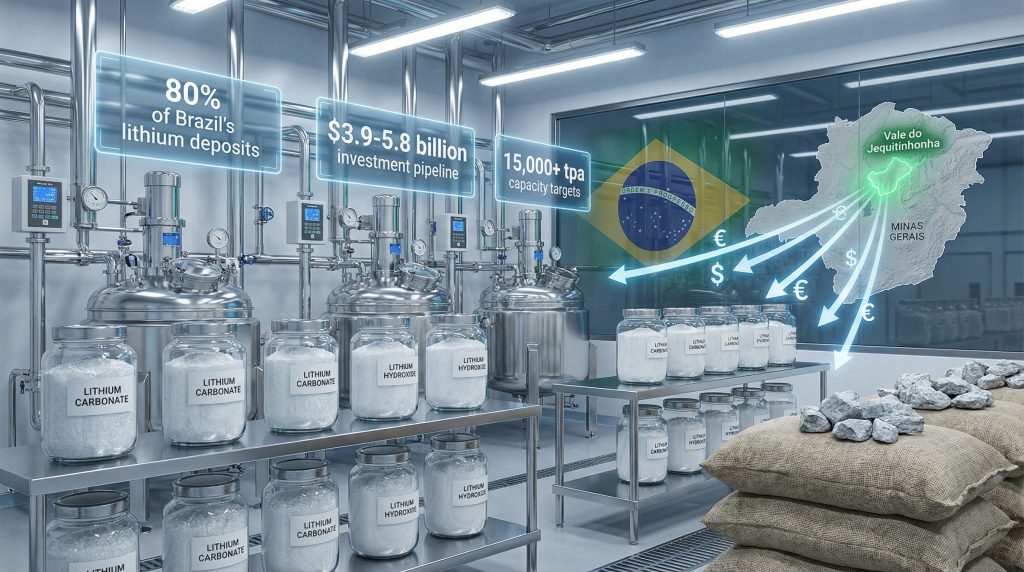
The Vale do Jequitinhonha region represents Brazil's most concentrated lithium resource base, containing approximately 70% of the nation's identified lithium reserves. This geographic concentration provides significant advantages for downstream processing operations, particularly for companies pursuing joint venture investments in integrated production facilities.
The area's mineral endowment supports integrated operations spanning from extraction through chemical processing. This positioning reduces logistics costs and supply chain complexity for producers seeking vertical integration opportunities within the rapidly expanding battery materials sector.
Infrastructure connectivity within Minas Gerais enables efficient material flows from mining operations to processing facilities and export terminals. The region's established transportation networks, including connections to Santos Port via BR-116 and BR-101 highways, provide cost-effective access to international markets. This logistical positioning becomes increasingly valuable as global battery manufacturers seek reliable supply chains for critical materials.
The state's renewable energy infrastructure offers operational advantages for energy-intensive chemical processing operations. Minas Gerais benefits from substantial hydroelectric capacity through the São Francisco River complex and complementary solar generation facilities. This renewable energy access supports ESG-compliant production strategies increasingly demanded by automotive and energy storage customers seeking sustainable supply chains.
Economic Fundamentals Supporting Refining Expansion
Investment in lithium refining Minas Gerais demonstrates compelling economics compared to alternative processing locations. The February 2026 Altmin-CBL transaction provides concrete evidence of capital efficiency, with US$40 million enabling expansion from 2,000 tonnes per annum (tpa) to 6,000 tpa capacity. This represents approximately US$10,000 per annual tonne of refining capacity, establishing a benchmark for similar facility expansions throughout the region.
The established mining services ecosystem reduces operational complexity for new processing facilities. Minas Gerais hosts numerous equipment suppliers, contract mining operators, and technical service providers with decades of experience supporting mineral processing operations. However, this existing infrastructure eliminates the need for extensive workforce development or supplier network establishment that characterizes greenfield processing regions.
Government incentives through the Invest Minas program provide additional economic advantages for international partners. The state investment promotion agency facilitates regulatory coordination, infrastructure development support, and investment facilitation services that reduce project development timelines and regulatory uncertainty. As noted by Ronaldo Barquette, Director of Investment Attraction at Invest Minas, structured government support creates environments where international partnerships can efficiently execute business development objectives.
When big ASX news breaks, our subscribers know first
Why Are International Partners Targeting Brazilian Lithium Refining Assets?
Supply Chain Security Considerations
The strategic imperative to diversify processing capacity beyond Chinese-controlled facilities drives significant international interest in Brazilian refining assets. Current global lithium chemical production remains heavily concentrated in Asian facilities, creating supply chain vulnerabilities for Western battery manufacturers and automotive producers. Consequently, Brazilian processing capabilities offer geographically diversified alternatives that reduce exposure to geopolitical risks and trade disruptions.
Companhia Brasileira de Lítio (CBL) exemplifies this strategic positioning as the only producer outside China capable of manufacturing battery-grade lithium carbonate with purity superior to 99.8%. This technical capability addresses specific quality requirements for cathode material production while providing supply chain alternatives to Asian processors. Furthermore, developing a battery-grade lithium refinery outside traditional processing centres becomes increasingly critical as battery manufacturers implement stringent quality standards for automotive applications.
ESG compliance considerations further enhance the attractiveness of Brazilian processing assets. International partners recognise growing customer demands for sustainable sourcing across battery supply chains. For instance, Brazilian operations can leverage renewable energy access and established environmental compliance frameworks to meet sustainability requirements that align with corporate ESG objectives and regulatory mandates in target markets.
Investment Economics and Return Profiles
Vertical integration opportunities create compelling value propositions for strategic investors in Brazilian refining assets. The Altmin investment structure demonstrates how technology companies can secure access to critical battery materials through minority equity partnerships rather than costly greenfield development. This approach provides immediate access to qualified production capacity while sharing technical expertise and market access capabilities.
Premium pricing for high-purity lithium compounds justifies the capital commitments required for refining expansion projects. Battery-grade specifications command significant price premiums over commodity lithium carbonate, particularly when coupled with supply chain security and sustainability credentials. In addition, international partners recognise these premium capture opportunities as sustainable competitive advantages in increasingly sophisticated battery markets.
Long-term supply agreements support project financing and risk mitigation for capacity expansion investments. The predictable revenue streams from multi-year customer contracts enable debt financing structures that enhance overall investment returns. Strategic partnerships with automotive OEMs and battery manufacturers provide revenue visibility that supports aggressive capacity scaling objectives.
Which Investment Models Are Driving Refining Capacity Growth?
Joint Venture Structures and Equity Partnerships
The Altmin-CBL transaction exemplifies the minority equity partnership model gaining prominence throughout the region. This structure provides international partners with exposure to Brazilian processing capabilities while maintaining local operational control and expertise. The 33% ownership stake acquired for US$40 million demonstrates how strategic investors can secure meaningful participation in high-growth refining operations without assuming full project development risks.
Recent International Investment Patterns in Minas Gerais Lithium Refining
| Investment Type | Capital Commitment | Capacity Impact | Strategic Rationale |
|---|---|---|---|
| Minority Equity Stakes | $40-100M range | 2,000-6,000 tpa expansion | Technology transfer + market access |
| Strategic Partnerships | $200-500M range | Greenfield development | Full value chain integration |
| Acquisition Financing | $100-300M range | Operational optimization | Immediate production capacity |
Strategic partnerships enable knowledge transfer between international technology companies and established Brazilian producers. Altmin's investment in CBL facilitates consolidation of production chains linked to electric mobility and energy storage applications. Moreover, this collaboration model allows both parties to leverage complementary capabilities while sharing development costs and market risks across multiple processing facilities.
Technology Transfer and Know-How Agreements
Battery-grade chemical production expertise represents a critical component of international partnership agreements. CBL's proprietary know-how in achieving purities superior to 99.8% attracts technology partners seeking access to qualified processing capabilities. As noted by CBL CEO Vinícius Alvarenga, "this technical competence was developed through research and internal talent development," creating intellectual property assets that enhance partnership value propositions.
Process optimisation initiatives reduce conversion costs while improving product quality consistency. International partners contribute advanced processing technologies, quality control methodologies, and operational efficiency improvements that enhance facility productivity. These knowledge transfer agreements often include training programs, equipment upgrades, and technical support services that strengthen operational capabilities.
Quality certification for automotive industry standards requires ongoing collaboration between international partners and local producers. Meeting stringent battery manufacturer specifications demands continuous process improvement and quality assurance capabilities. Consequently, partnership structures facilitate access to international certification programs and customer qualification processes that enable market access for Brazilian-produced materials.
How Do Refining Investments Compare to Mining-Focused Capital Allocation?
Value Addition Economics in the Lithium Supply Chain
Processing margins between spodumene concentrate and lithium carbonate demonstrate significant value addition opportunities within the refining sector. The transformation from hard-rock concentrate to battery-grade chemicals typically generates margins substantially higher than upstream mining operations. However, specific percentage differentials vary with commodity pricing cycles and processing costs across different lithium industry innovations.
Capital requirements for chemical refining facilities differ substantially from mining operations in terms of scale, technology intensity, and development timelines. The Altmin-CBL expansion demonstrates refining capex of approximately US$10,000 per annual tonne of capacity. In contrast, comparable hard-rock mining projects typically require US$3,000-8,000 per annual tonne of lithium carbonate equivalent capacity. These capital efficiency differences reflect the specialised nature of chemical processing versus bulk material extraction.
Revenue multiples across different processing stages justify higher valuations for integrated producers compared to mining-only operations. Companies capable of producing battery-grade chemicals capture premium pricing unavailable to concentrate producers. Furthermore, they maintain greater customer diversification and market positioning, which becomes increasingly important as battery manufacturers implement direct sourcing strategies for critical materials.
Infrastructure Requirements and Development Timelines
Chemical processing plant construction typically requires 18-24 month development cycles for capacity expansion projects, compared to longer timelines for greenfield mining operations. The Altmin-CBL expansion demonstrates how existing facility infrastructure can be scaled efficiently with focused capital investment and engineering optimisation. This timeline advantage enables faster response to market demand growth and capacity constraints.
Environmental permitting considerations for refining operations involve different regulatory pathways compared to mining project development. Chemical processing facilities must address water usage permits, air quality standards, and waste management protocols specific to lithium carbonate production. These requirements often involve federal oversight of strategic mineral processing facilities, particularly for battery-grade production capabilities.
Utility infrastructure needs for high-temperature processing create ongoing operational considerations that differ from mining operations. Chemical refining requires consistent power supply, process water availability, and waste treatment capabilities that may necessitate infrastructure investments beyond the immediate processing facility. These utility requirements often influence facility location decisions and long-term operational costs.
What Are the Key Risk Factors Affecting Refining Investment Returns?
Regulatory and Community Relations Challenges
Indigenous and traditional community consultation requirements create ongoing compliance obligations for refining operations in Minas Gerais. Processing facilities must navigate complex stakeholder relationships involving local communities, environmental groups, and regulatory authorities. These consultation processes can influence operational permits, expansion approvals, and long-term social licence considerations.
Water usage permits for chemical processing operations represent significant regulatory considerations given the water-intensive nature of lithium carbonate production. Refining facilities must demonstrate sustainable water management practices while meeting production capacity objectives. Regulatory approval processes for water rights can affect project timelines and operational flexibility, particularly in regions where lithium brine market insights demonstrate increasing scrutiny of water resource allocation.
Federal oversight of strategic mineral processing facilities creates additional compliance layers for battery-grade production capabilities. Government authorities maintain oversight of facilities producing materials critical to national security and economic competitiveness. This regulatory environment requires ongoing coordination with federal agencies and compliance with evolving strategic mineral policies.
Market and Operational Risk Assessment
Environmental compliance costs represent substantial ongoing operational expenses for refining facilities. Typically comprising 15-20% of total project capital expenditure for new facilities, these costs reflect increasing regulatory requirements. Community relations programs require dedicated operational budgets of US$2-5 million annually for major projects, reflecting the importance of stakeholder management throughout facility lifecycles. Consequently, these costs must be factored into long-term financial projections and investment return calculations.
Currency volatility between Brazilian Real and US Dollar pricing creates ongoing hedging requirements for international investors. Refining operations typically sell products in USD-denominated markets while incurring local currency operational costs. This currency exposure requires active risk management strategies to protect investment returns from exchange rate fluctuations.
Technology obsolescence risks affect long-term competitive positioning as battery chemistry evolution and processing innovations emerge. Refining facilities must maintain technological relevance through ongoing equipment upgrades and process improvements. Investment structures should accommodate technology refresh cycles and capacity modification requirements associated with mining industry innovation.
Currency and Political Risk Mitigation Strategies
USD-denominated revenue contracts provide natural hedging against Real volatility while aligning with international customer pricing expectations. Long-term supply agreements typically specify USD pricing mechanisms that protect both producers and customers from currency fluctuations. These contractual structures reduce financial exposure while providing revenue predictability for investment planning.
Government stability and mining policy continuity represent fundamental considerations for long-term investment commitments in Brazilian refining assets. Political transitions and policy changes can affect regulatory frameworks, taxation policies, and investment incentives. Furthermore, international partners often require political risk insurance and government guarantee mechanisms to mitigate these exposures.
International arbitration clauses in joint venture agreements provide dispute resolution mechanisms that protect foreign investor interests. These legal protections become particularly important for minority equity partnerships where governance disputes could affect operational decision-making. Arbitration frameworks must address both commercial disputes and regulatory compliance conflicts.
How Will Future Investment Flows Shape Regional Development?
Projected Capital Requirements Through 2030
Industry forecasts indicate total investment requirements of US$3.9-5.8 billion for comprehensive lithium refining capacity development across Minas Gerais through 2030. This capital allocation reflects anticipated demand growth from battery manufacturers and energy storage applications requiring Brazilian-sourced materials. Investment flows of this magnitude will require diverse funding sources including international partnerships, development finance, and strategic corporate investments.
Refining capacity targets anticipate scaling from current levels around 2,000 tpa to exceed 15,000 tpa by 2030. This represents more than 7x capacity expansion across the region. Consequently, this growth trajectory requires coordinated infrastructure development, workforce expansion, and supply chain optimisation to support multiple facility development projects simultaneously.
Employment generation projections estimate 10,000+ direct and indirect jobs from planned refining capacity expansion projects. This employment impact includes high-skill technical positions, support services, and ancillary industries supporting chemical processing operations. The economic development implications extend beyond immediate facility employment to encompass broader regional economic growth, according to Brazil's lithium investment outlook.
Competitive Positioning vs. Global Lithium Processing Hubs
Cost competitiveness against Chinese processing facilities represents a critical factor in long-term market positioning for Brazilian refining operations. Labour costs, energy pricing, regulatory compliance expenses, and logistics costs must collectively enable competitive pricing while maintaining acceptable profit margins. However, Brazilian facilities leverage renewable energy access and strategic location advantages to offset potential cost disadvantages in other operational areas.
Logistics advantages for Western Hemisphere battery manufacturers create sustainable competitive positioning for Brazilian refining capacity. Reduced transportation costs, shorter supply chains, and time zone alignment provide operational benefits for North American automotive producers. These geographic advantages become increasingly valuable as automotive supply chains prioritise regionalisation and supply security.
Integration potential with downstream cathode material production offers additional value chain opportunities within the region. Future investment flows may encompass integrated facilities spanning from lithium refining through cathode precursor production. This creates comprehensive battery material manufacturing capabilities that enhance the strategic value of investment in lithium refining Minas Gerais for automotive and energy storage applications.
The next major ASX story will hit our subscribers first
Which Investment Strategies Offer the Highest Risk-Adjusted Returns?
Portfolio Diversification Across Processing Stages
Upstream mining exposure versus midstream refining investments present different risk-return profiles requiring strategic portfolio allocation decisions. Mining operations offer exposure to commodity price appreciation and resource expansion potential. In contrast, refining assets provide processing margin capture and premium product positioning. Balanced portfolio strategies often combine both upstream and midstream exposures to optimise risk-adjusted returns.
Geographic diversification within Minas Gerais region enables risk mitigation across different processing facilities and resource bases. Multiple facility investments reduce single-asset concentration risk while providing operational synergies and shared infrastructure benefits. Furthermore, regional diversification strategies often focus on different processing stages or product specifications to maximise market coverage.
Technology risk spreading across multiple processing methods protects against obsolescence risks while maintaining exposure to innovation opportunities. Investment portfolios encompassing different lithium processing technologies (hard-rock versus brine, carbonate versus hydroxide) provide flexibility to adapt to evolving market demands and technical developments.
Exit Strategy Considerations and Liquidity Options
Strategic buyer interest from automotive OEMs and battery manufacturers creates multiple exit pathway opportunities for refining asset investments. As automotive companies implement vertical integration strategies, processing facilities with qualified production capabilities become attractive acquisition targets. These strategic sale opportunities often command premium valuations compared to financial buyer transactions.
Public market valuations for integrated lithium producers provide benchmark pricing for private asset valuations and potential IPO opportunities. Listed companies with comparable processing capabilities offer valuation multiples that guide investment decision-making and exit planning. Market timing considerations for public offerings depend on commodity pricing cycles and investor sentiment toward battery material investments.
Private equity rollup opportunities in the fragmented processing sector create consolidation-driven value creation potential. Multiple facility acquisitions enable operational synergies, cost optimisation, and enhanced market positioning through scale advantages. Consequently, rollup strategies often target operational improvements and market consolidation to generate superior investment returns.
What Due Diligence Factors Should Guide Investment Decisions?
Technical and Commercial Evaluation Criteria
Processing facility design and throughput capabilities require comprehensive technical evaluation to validate capacity claims and operational efficiency potential. Engineering assessments must address equipment condition, process flow optimisation, and expansion feasibility within existing facility constraints. Technical due diligence should also evaluate environmental compliance systems and safety management protocols.
Feedstock supply agreements and ore grade consistency represent critical commercial considerations affecting long-term operational viability. Secure access to appropriate spodumene concentrate quality and quantity enables consistent production planning and capacity utilisation optimisation. Supply agreement terms, pricing mechanisms, and counterparty creditworthiness require detailed evaluation.
Product quality specifications and customer qualification status determine market access and pricing potential for refined lithium products. Battery-grade certification requirements, customer approval processes, and quality assurance capabilities directly impact revenue generation potential. Commercial due diligence must address current customer relationships and qualification pipeline development.
Financial Modelling and Valuation Methodologies
Discounted cash flow analysis incorporating commodity price volatility requires sophisticated modelling to address lithium price uncertainty and processing margin dynamics. Sensitivity analysis across different price scenarios enables risk assessment and investment sizing decisions. Furthermore, financial models must also address operational cost inflation and currency exposure implications.
Key Investment Metrics for Lithium Refining Projects
| Evaluation Metric | Benchmark Range | Risk Weighting |
|---|---|---|
| IRR (Internal Rate of Return) | 15-25% | High commodity exposure |
| Payback Period | 4-7 years | Moderate regulatory risk |
| NPV/Capex Ratio | 1.5-3.0x | Technology obsolescence risk |
Comparable company analysis for processing multiples provides market-based valuation benchmarks for private asset transactions. Public market trading multiples for integrated lithium producers offer guidance for fair value assessments and investment structuring decisions. Valuation methodologies must address the premium for strategic assets versus financial investments, as evidenced by recent Indian investment patterns.
Real options valuation for expansion scenarios captures the embedded value of future growth opportunities within existing processing facilities. Facility expansion potential, technology upgrade options, and product specification diversification create option value beyond current operational cash flows. These growth options often justify premium pricing for assets with demonstrated expansion capabilities.
Risk Assessment Framework
Investment in lithium refining Minas Gerais requires comprehensive risk assessment frameworks that address multiple interconnected factors. Market risks include lithium price volatility, demand fluctuations, and competitive positioning relative to alternative processing locations. Operational risks encompass technology performance, environmental compliance, and community relations management.
Regulatory risks involve permitting uncertainty, environmental standards evolution, and strategic mineral policy changes. Currency risks affect financial performance through Real-Dollar exchange rate volatility and inflation impacts on operational costs. In addition, political risks include government stability, policy continuity, and international trade relationships affecting market access.
Risk mitigation strategies should incorporate diversification across multiple assets, currency hedging programs, and political risk insurance coverage. Partnership structures with local operators provide operational expertise and stakeholder relationship management capabilities. Long-term supply agreements and take-or-pay contracts reduce market exposure while providing revenue stability.
This analysis is provided for informational purposes only and should not be considered investment advice. Potential investors should conduct independent due diligence and consult qualified financial advisors before making investment decisions. Commodity investments involve substantial risks including price volatility, regulatory changes, and operational uncertainties that could result in significant losses.
Ready to Discover the Next Major Brazilian Lithium Investment Opportunity?
Discovery Alert's proprietary Discovery IQ model delivers real-time alerts on significant lithium and battery materials discoveries across the ASX, instantly empowering subscribers to identify actionable opportunities ahead of the broader market. Begin your 14-day free trial today and secure your market-leading advantage in the rapidly expanding battery materials sector.