July 14, 2026
The Atomic Foundation of Space Technology
Modern electronics depend fundamentally on precise atomic arrangements within crystalline structures, where lithium atoms provide unique electrochemical properties essential for energy storage systems. This atomic-level functionality becomes critical when examining how lithium in space exploration maintains operational capability across the extreme environments encountered during interplanetary missions.
Understanding why lithium-based technologies dominate space applications requires examining the fundamental physics governing battery chemistry in vacuum environments, where traditional terrestrial assumptions about thermal management and atmospheric pressure no longer apply.
When big ASX news breaks, our subscribers know first
Critical Energy Storage Challenges Beyond Earth's Atmosphere
Spacecraft encounter predictable power generation interruptions during orbital eclipse periods that can last up to 45 minutes per 90-minute orbit for International Space Station operations. Battery systems must deliver sustained power output to maintain life support, communications, and thermal management systems during these critical phases.
Orbital Eclipse Power Requirements
The International Space Station requires approximately 20 kW continuous power during eclipse operations, necessitating 2.5 MWh total storage capacity across 48 individual lithium-ion battery units. This power delivery must maintain precise voltage regulation within ±0.5V tolerance compared to previous nickel-hydrogen systems that operated at ±2V regulation limits.
Low Earth Orbit satellites experience 15-16 eclipse cycles per 24-hour period, requiring battery systems designed for 100,000+ charge-discharge cycles over mission lifetimes extending to 20+ years. Furthermore, advances in battery-grade lithium refining have enabled more efficient production of space-qualified materials.
Deep Space Power Management
Missions beyond Earth orbit face different challenges where solar panel efficiency decreases with distance from the sun, requiring enhanced energy storage capacity to maintain operations during communication blackouts and extended operational phases. Mars rovers must survive multi-month dust storms where optical depth can reach 11.5, reducing solar power generation to zero for extended periods.
Mission-Critical Power Storage Requirements:
• Communication satellites: 300-500 Wh/kg energy density for 14-16 hour eclipse periods
• Mars surface operations: 140 Wh nominal capacity per battery pack for seasonal variations
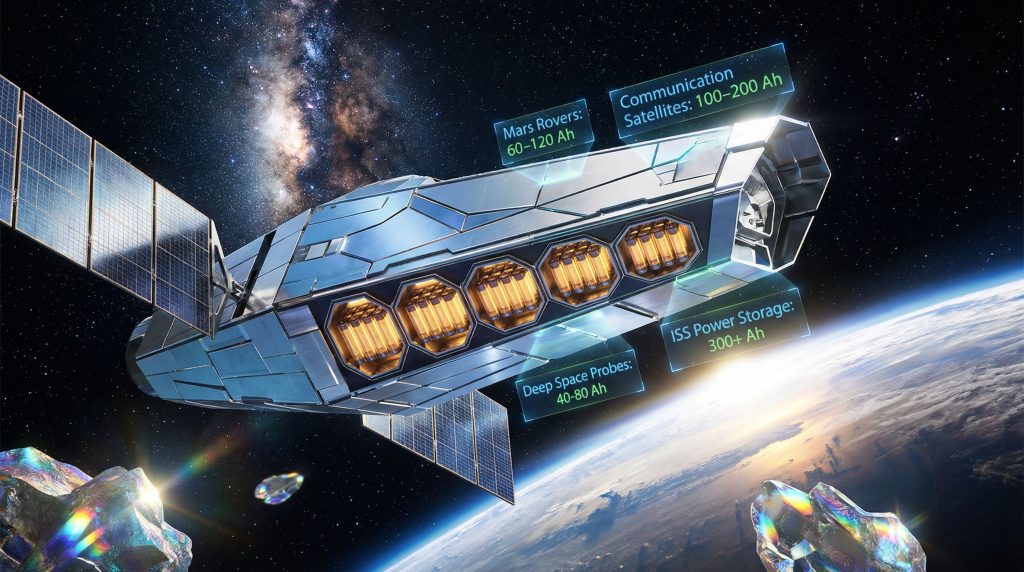
• Deep space probes: 40-80 Ah capacity for decades of autonomous operation
• International Space Station: 48 Ah per unit across redundant battery strings
Extreme Environmental Performance Parameters
Space environments subject lithium-ion batteries to temperature gradients spanning from -220°C in shadowed regions to +150°C on sun-facing surfaces. These extreme conditions create unique challenges for maintaining electrochemical stability and ionic conductivity within battery cells.
Temperature Cycling Effects on Battery Chemistry
Lunar surface operations experience temperature swings from -173°C during 14-day lunar nights to +127°C during lunar days. Mars surface missions encounter ranges from -140°C to +20°C with rapid diurnal variations. Battery capacity decreases approximately 0.5-1% per 1°C below optimal operating ranges, while self-discharge rates increase exponentially at elevated temperatures.
Perseverance rover batteries rated for -90°C to +60°C operation have maintained 85-90% original capacity after three years of Mars surface operations, demonstrating superior thermal tolerance compared to previous battery technologies.
Radiation Tolerance in Space Applications
Cosmic radiation exposure creates unique degradation mechanisms within lithium-ion cells through electrolyte radiolysis and solid electrolyte interface layer breakdown. Van Allen Belt radiation delivers dose rates of 100-1,000 rem per day, while galactic cosmic rays provide continuous 50 mrem per year exposure during interplanetary missions.
Radiation-hardened lithium-ion systems incorporate specialised shielding and modified chemistries to withstand cumulative exposure exceeding design specifications during extended mission phases.
Comparative Energy Storage Technologies
Lithium-ion technology delivers 150-200 Wh/kg energy density compared to previous space-qualified nickel-hydrogen systems operating at 60-80 Wh/kg, enabling 60-70% weight reduction for equivalent power storage capacity. In addition, innovations like asteroid mining advances may provide future sources of space-grade lithium materials.
| Battery Technology | Energy Density (Wh/kg) | Cycle Life | Temperature Range | Radiation Tolerance |
|---|---|---|---|---|
| Lithium-Ion (Space Grade) | 150-200 | 50,000+ | -90°C to +60°C | High |
| Nickel-Hydrogen | 60-80 | 20,000 | -10°C to +40°C | Moderate |
| Nickel-Cadmium | 40-60 | 15,000 | -20°C to +45°C | Low |
| Silver-Zinc | 100-130 | 500 | 0°C to +50°C | Moderate |
Cycle Life Performance Analysis
Space applications require exceptional cycle life performance due to mission durations spanning decades without maintenance capability. LEO satellites experience 5,400-5,800 charge-discharge cycles annually, while geostationary satellites encounter minimal cycling with 20,000-30,000 total cycles over mission life.
Opportunity rover exceeded original 90-sol mission specification, operating for 5,352 sols (14.6 years) with battery capacity remaining above 85% nominal value through more than 1,500 charge-discharge cycles. However, implementing a battery recycling breakthrough could reduce dependency on virgin lithium for future missions.
Advanced Space Mission Requirements
Current and planned space exploration initiatives will significantly expand lithium in space exploration across multiple mission categories requiring enhanced energy storage capabilities.
Mars Exploration Program Expansion
NASA's Mars Sample Return mission requires enhanced battery systems capable of supporting multi-year surface operations while maintaining sample preservation and communication capability with Earth during conjunction periods when Mars moves behind the sun relative to Earth.
Perseverance rover currently operates with dual 140 Wh battery packs using enhanced lithium-ion chemistry optimised for extended Martian operations. Future sample return missions will require 300-500 Wh capacity to support additional drilling, processing, and launch preparation activities.
Lunar Infrastructure Development
Permanent lunar installations must survive 14-day lunar nights without solar power generation, requiring massive energy storage systems potentially consuming thousands of tonnes of lithium for battery production. Lunar base power systems require redundant battery banks with 2-3 week energy storage capacity for crew survival during extended eclipse periods.
Projected Lunar Power Requirements:
• Habitat life support: 50-100 kW continuous during lunar night
• Scientific equipment: 20-30 kW sustained power
• Communication systems: 5-10 kW backup power
• Emergency reserves: 100% capacity redundancy
Structural Applications in Aerospace Manufacturing
Beyond energy storage, lithium serves critical roles in spacecraft construction through aluminum-lithium alloys that provide exceptional strength-to-weight ratios essential for launch vehicle efficiency and payload optimisation. For instance, developments in australia lithium innovations are advancing materials science for aerospace applications.
Aluminum-Lithium Alloy Performance
Aerospace manufacturers utilise aluminum-lithium alloys for fuel tank construction, structural components, and thermal protection systems. These materials deliver 10-18% weight reduction compared to conventional aluminum alloys while providing 3-10% strength increases and improved thermal properties.
SpaceX Falcon 9 rocket utilises aluminum-lithium alloys for fuel tank construction, enabling larger payload capacity through reduced structural mass. NASA's Space Launch System employs similar alloy technology for main propellant tanks supporting Artemis lunar missions.
| Component Application | Weight Reduction | Strength Improvement | Manufacturing Benefits |
|---|---|---|---|
| Fuel Tank Structures | 10-15% | +5-8% | Enhanced formability |
| Airframe Components | 8-12% | +3-6% | Improved weldability |
| Thermal Protection | 12-18% | +7-10% | Superior fatigue resistance |
Advanced Manufacturing Processes
Lithium alloys offer improved formability and weldability compared to traditional aerospace materials, enabling more complex component geometries and reduced assembly complexity. These manufacturing advantages reduce production costs while improving structural performance under launch and operational stress conditions.
The next major ASX story will hit our subscribers first
Supply Chain Dependencies and Strategic Implications
Growing space economy creates additional demand pressures on global lithium markets beyond terrestrial electric vehicle and energy storage applications. Space applications could consume 5,000-8,000 tonnes annually by 2035, representing 2-3% of global lithium production dedicated to aerospace requirements.
Geographic Resource Distribution
Lithium production concentrates in the South American lithium triangle encompassing Chile, Argentina, and Bolivia, alongside Australian hard rock mining operations. These regions provide politically stable jurisdictions with established mining infrastructure capable of supporting space industry quality requirements.
Space-grade lithium must meet stringent purity standards exceeding 99.95% lithium carbonate equivalent, compared to 99.5% requirements for automotive applications. This quality premium creates specialised market segments with higher pricing for aerospace applications. Furthermore, argentinian lithium opportunities may help diversify supply chains for space-grade materials.
Geopolitical Considerations
Space programme independence requires secure access to lithium resources, driving strategic partnerships between aerospace companies and mining operations in politically stable jurisdictions. China's early recognition of lithium's strategic importance has created supply chain vulnerabilities for Western space programmes.
The United States and European Union actively develop alternative supply chains to reduce dependence on Chinese-controlled lithium processing capacity, particularly for space-qualified materials requiring advanced purification processes.
Technological Innovation Frontiers
Research and development efforts focus on enhancing lithium battery performance for increasingly demanding space missions requiring decades of reliable operation in extreme environments.
Solid-State Battery Development
Next-generation solid-state lithium batteries promise improved safety, energy density exceeding 300 Wh/kg, and enhanced temperature tolerance for deep space exploration missions. These systems eliminate liquid electrolyte components that can freeze or degrade under extreme temperature conditions.
Solid-state technology reduces fire risk in oxygen-rich spacecraft environments while providing superior cycle life performance for missions requiring 20+ years of autonomous operation without maintenance capability. Recent studies show that lithium-ion batteries in satellite applications are proving essential for long-duration missions.
Radiation-Hardened Cell Engineering
Specialised lithium-ion cells incorporate radiation shielding materials and modified electrode chemistries to withstand cosmic ray exposure and solar particle events during extended missions. These cells utilise ceramic separators and enhanced electrolyte formulations to maintain performance under cumulative radiation doses exceeding terrestrial nuclear facility exposure limits.
Advanced radiation-hardened cells demonstrate capacity retention above 80% after exposure to 1,000 krad total ionising dose, compared to 40-50% retention for standard lithium-ion cells.
Investment Implications and Market Opportunities
The intersection of space exploration and lithium technology creates unique investment themes across multiple sectors with potential for sustained growth driven by expanding space economy applications.
Aerospace Battery Manufacturing
Companies specialising in space-qualified lithium-ion systems benefit from high-margin contracts and long-term mission requirements with government and commercial space customers. Typical space battery contracts range from $10-50 million per mission with 5-10 year development timelines.
Space-grade battery systems command pricing premiums of 300-500% compared to terrestrial applications due to extensive qualification testing, radiation tolerance requirements, and mission-critical reliability standards.
High-Purity Lithium Production
Mining operations capable of producing battery-grade lithium with space industry certifications command premium pricing for specialised applications. Space-qualified lithium carbonate trades at $80,000-120,000 per tonne compared to $20,000-30,000 per tonne for standard battery-grade material.
Investment Opportunity Assessment:
• Space battery manufacturers: High-margin, long-term contracts with government backing
• Ultra-high purity lithium producers: Premium pricing for specialised applications
• Aluminum-lithium alloy producers: Growing demand from commercial space sector
• Radiation-hardening technology developers: Niche market with high barriers to entry
Future Mission Scenarios and Demand Projections
Planned space exploration initiatives will significantly expand lithium in space exploration requirements across government and commercial space programmes through the next two decades.
Commercial Space Expansion
Satellite constellation deployments by companies like Starlink, OneWeb, and Amazon's Project Kuiper will require thousands of lithium-ion battery systems for orbital operations. Each satellite requires 100-300 Ah battery capacity for eclipse operations over 5-7 year operational lifespans.
Commercial space manufacturing platforms in low Earth orbit will require megawatt-scale energy storage systems for continuous operations, potentially consuming hundreds of tonnes of lithium annually for battery production and replacement. Moreover, research indicates that space-based energy storage technologies are revolutionising space exploration capabilities.
Interplanetary Mission Complexity
Future Mars missions involving crew transportation and permanent settlements will require redundant power systems capable of supporting human life during extended dust storms and equipment failures. Crew survival requirements mandate 100% power system redundancy with minimum 30-day emergency backup capability.
Europa and Enceladus exploration missions targeting subsurface oceans will require autonomous operation for 5-10 years while transmitting scientific data across interplanetary distances, demanding enhanced energy storage capacity and radiation tolerance.
Disclaimer: This analysis contains forward-looking projections based on current space exploration plans and technological development trends. Actual lithium demand from space applications may vary significantly based on mission delays, technological breakthroughs, and changes in government space exploration priorities. Investment decisions should consider the speculative nature of space industry growth projections and the volatility of commodity markets.
Space exploration represents a growing but currently minor segment of total lithium demand compared to electric vehicles and stationary energy storage. However, the specialised requirements and premium pricing for space-grade materials create distinct market opportunities for companies capable of meeting aerospace industry quality and reliability standards.
Interested in Capitalising on Space-Grade Lithium Opportunities?
Discovery Alert's proprietary Discovery IQ model delivers real-time alerts on significant lithium and aerospace mineral discoveries across the ASX, instantly empowering subscribers to identify actionable opportunities ahead of the broader market. Begin your 14-day free trial today and secure your market-leading advantage in the expanding space technology mineral sector.