August 14, 2026
Market Forces Drive Strategic Lithium Transactions Across Australia
Australia's hard-rock lithium sector exhibits distinct operational characteristics that create unique opportunities during commodity price cycles. The Core Lithium and Glencore partnership exemplifies how operational flexibility enables producers to optimise cash flow management during volatile market conditions. Unlike brine-based operations in South America, hard-rock spodumene mines can suspend and restart operations with greater flexibility.
This operational advantage has become increasingly valuable as lithium prices experience dramatic swings between supply gluts and demand recovery phases. Furthermore, the structural dynamics of Australia's lithium mining landscape reflect broader commodity market patterns where integrated trading houses capitalise on producer financial stress.
Major commodity traders possess the capital reserves and market expertise to execute counter-cyclical purchasing strategies. Consequently, they acquire inventory during producer distress periods and position for subsequent price recovery phases, demonstrating sophisticated commodity trading strategy.
When big ASX news breaks, our subscribers know first
Strategic Inventory Monetisation Signals Market Recovery
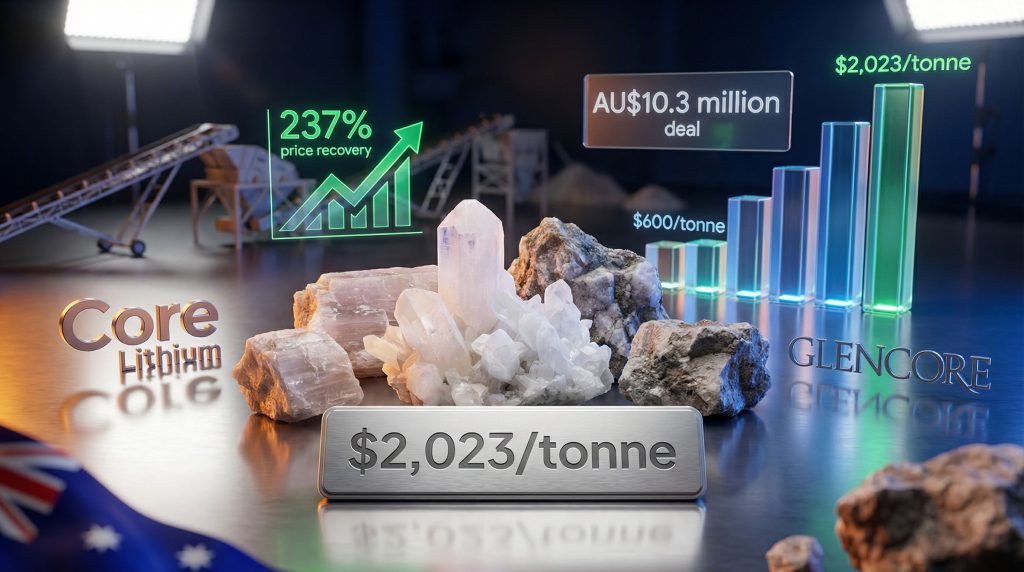
Core Lithium's recent disposal of 5,100 tonnes of lithium concentrate to Glencore demonstrates sophisticated timing in commodity market cycles. The transaction, valued at approximately AUD $10.3 million, represents more than simple inventory liquidation. At $2,023 per tonne, the pricing reflects a 237% recovery from mid-2025 lows of around $600 per tonne.
This substantial price improvement indicates remarkable market rehabilitation over an eight-month period. Moreover, the transaction structure reveals critical market intelligence about supply-demand rebalancing across the sector.
Core Lithium accumulated this concentrate inventory during the Finniss mine's suspension period that began in early 2024. This approach effectively created a strategic option to monetise production during favourable pricing conditions, contrasting sharply with continuous production strategies that might have generated losses during the price trough.
Key Transaction Metrics:
• Volume: 5,100 tonnes of spodumene concentrate
• Unit Price: $2,023 AUD per tonne
• Total Value: Approximately $10.3 million AUD
• Price Recovery: 237% increase from 2025 lows
• Premium to Feasibility Study: 50% above restart assumptions
The exclusion of lithium fines from this transaction suggests Core Lithium maintains optionality for different processing pathways. In addition, lithium fines require specialised handling and processing compared to standard concentrate, potentially commanding different pricing structures.
Trading House Strategy Reveals Market Positioning
Glencore's acquisition represents classic commodity trading house methodology during market inflection points. The company's integrated business model combines proprietary mining operations with third-party commodity trading, creating multiple revenue streams and risk management capabilities.
This transaction exemplifies the "buy low, process, and sell high" strategy that defines successful commodity trading operations. Furthermore, the timing of this acquisition eliminates typical mining development risks for Glencore.
Rather than committing capital to exploration, permitting, and construction over 24-36 month development cycles, the company secured immediate inventory access at current market pricing. This approach provides instant supply chain positioning without geological or regulatory uncertainties, aligning with broader mining innovation trends.
Strategic Advantages for Glencore:
• Immediate inventory access without development timeline
• Elimination of exploration and construction capital requirements
• Diversified supplier base reducing concentration risk
• Counter-cyclical purchasing during producer financial stress
• Enhanced customer service capabilities through flexible supply
Glencore's diversified sourcing approach across multiple Australian producers creates pricing flexibility and supply resilience. Consequently, by avoiding dependence on single large-scale operations, the company maintains negotiating leverage and operational flexibility.
What Makes Hard-Rock Lithium Mining Operationally Flexible?
The Finniss mine suspension and subsequent stockpile monetisation illustrate fundamental advantages of Australian hard-rock lithium operations. Core Lithium suspended operations in early 2024 when continued production would have generated operating losses, demonstrating the ability to preserve capital during unfavourable market conditions.
This operational flexibility stems from the nature of spodumene processing compared to brine evaporation operations. For instance, hard-rock mines can halt crushing, grinding, and flotation processes relatively quickly, while maintaining infrastructure for future restart.
However, brine operations in Chile and Argentina cannot easily suspend evaporation pond operations without significant environmental and operational complications. This distinction becomes particularly relevant in supporting Australia lithium innovations across the sector.
Working Capital Management Benefits:
• Asset monetisation during price recovery phases
• Inventory accumulation during suspension periods
• Strategic timing of restart capital deployment
• Preservation of infrastructure and equipment during downturns
The transaction demonstrates how Australian lithium producers leverage operational flexibility as a financial management tool. Rather than accepting losses during market downturns, Core Lithium accumulated valuable inventory while minimising cash burn.
Restart Economics in Current Market Environment
Current lithium concentrate pricing at $2,023 per tonne represents a 50% premium above the approximately $1,349 per tonne baseline used in Core Lithium's 2025 restart feasibility study. This pricing improvement fundamentally alters the economics of returning Finniss to production, shifting from marginal economics to potentially attractive returns.
The substantial margin above feasibility study assumptions provides cushion against operational uncertainties and restart capital requirements. Furthermore, hard-rock lithium mine restarts typically require significant expenditure on equipment maintenance, workforce reactivation, and environmental compliance updates.
Capital Allocation Priorities for Mine Restart:
- Working capital restoration – Immediate liquidity for operational expenses
- Equipment maintenance and upgrades – Servicing flotation cells, crushers, and grinding mills
- Workforce reactivation costs – Rehiring and training operational personnel
- Environmental compliance updates – Monitoring systems and regulatory requirements
"The current pricing environment creates substantial margin expansion compared to feasibility study economics, directly improving restart investment returns and reducing operational risk."
The $674 per tonne premium above feasibility assumptions provides significant economic cushion for restart decision-making. This margin improvement enables management to commit restart capital with greater confidence in positive returns, supporting the broader Core Lithium and Glencore partnership objectives.
Industry-Wide Implications for Suspended Projects
The Core Lithium and Glencore partnership provides market validation for other suspended Australian lithium operations evaluating restart potential. Several factors determine restart probability across the sector, with current pricing representing just one component of complex decision matrices.
Project Restart Probability Assessment Framework:
| Factor | Importance | Current Market Position |
|---|---|---|
| Pricing vs. Breakeven | High | Favourable (50% premium achieved) |
| Infrastructure Condition | Medium | Varies by maintenance during suspension |
| Market Access | Medium | Demonstrated via trading house interest |
| Financial Resources | High | Improved through inventory monetisation |
Projects with maintained infrastructure, established processing capabilities, and adequate financial resources are best positioned to benefit from current market conditions. Moreover, the demonstration effect of successful stockpile disposal may accelerate similar transactions across the sector.
Competitive Dynamics During Recovery:
• Market share redistribution as suspended projects restart
• Supply response lag creating temporary market tightness
• Geographic concentration risks in continuously operating mines
• Enhanced negotiating position for producers with restart optionality
This market validation occurs within Australia's broader strategy supporting critical minerals energy transition initiatives across the mining sector.
The next major ASX story will hit our subscribers first
Commodity Trading Integration in Battery Metals Markets
Glencore's lithium acquisition strategy reflects broader evolution in battery metals trading. Traditional commodity trading houses are expanding their presence across the battery supply chain, from raw material procurement through refined product distribution. This vertical integration creates multiple profit centres and enhanced customer service capabilities.
The company's hybrid model combines proprietary mining operations with third-party commodity trading, providing natural hedging against price volatility. When commodity prices are high, mining operations generate enhanced returns. However, during price weakness, trading operations can capitalise on volatility and inventory management strategies.
Portfolio Diversification Benefits:
• Risk distribution across multiple production sources
• Flexibility in supply timing and volume commitments
• Enhanced market-making capabilities in volatile markets
• Natural hedging between mining and trading operations
This diversified approach enables Glencore to serve customers across varying market conditions while maintaining profitability. Furthermore, the Core Lithium inventory acquisition exemplifies tactical procurement supporting this integrated strategy, as reported by Trading View.
Australia's Critical Minerals Competitive Position
The transaction occurs within Australia's broader framework aimed at securing domestic processing capabilities and export market development. Government support frameworks for critical minerals designation provide infrastructure investment coordination and enhanced international competitiveness compared to alternative jurisdictions.
Australia's hard-rock lithium operations possess distinct advantages in rapid production scaling compared to brine-based operations in South America. While brine operations may achieve lower long-term production costs, hard-rock facilities can adjust output levels more quickly in response to market demand variations.
International Competitiveness Factors:
• Established infrastructure and processing expertise
• Political stability and regulatory predictability
• Geographic proximity to Asian battery manufacturing markets
• Currency and trade relationship advantages with key importers
"Australia's operational flexibility in hard-rock lithium mining creates competitive advantages in rapid production scaling that distinguish it from brine-based operations in other jurisdictions."
The Core Lithium and Glencore partnership demonstrates international confidence in Australian lithium production capabilities and market access. This validation may encourage similar strategic partnerships between domestic producers and global commodity trading networks, supporting the implementation of Australia's critical minerals strategy.
Market Psychology and Investment Implications
The successful completion of this transaction at premium pricing provides psychological validation for broader market recovery expectations. Commodity markets often exhibit momentum characteristics where successful transactions at improving prices encourage additional market activity and investment commitment.
The 50% premium above feasibility study assumptions signals that market participants are increasingly confident in sustained demand recovery. This confidence level influences capital allocation decisions across the lithium supply chain, from mining operations through battery manufacturing.
Investment Decision Catalysts:
• Demonstrated market pricing above feasibility thresholds
• Strategic buyer interest from established trading houses
• Operational flexibility advantages during volatile markets
• Government support for critical minerals development
The transaction timing suggests market participants have shifted from crisis management to recovery positioning. Consequently, this psychological transition often precedes broader sector investment activity and operational restart decisions across multiple projects.
How Do Technical Specifications Impact Processing?
The distinction between lithium concentrate and lithium fines in the transaction highlights important technical considerations in spodumene processing. Standard spodumene concentrate typically ranges from 150-300 microns in particle size, while fines represent particles below 45-100 microns requiring specialised processing equipment.
Different particle sizes serve distinct market applications and processing pathways. For instance, some buyers prefer specific size distributions for their downstream processing requirements, while others focus primarily on lithium oxide content regardless of particle characteristics.
Processing Pathway Implications:
• Concentrate particles: Standard flotation and chemical processing
• Lithium fines: Specialised beneficiation and fine grinding requirements
• Market applications: Different end-users prefer specific size distributions
• Processing costs: Fines typically require higher processing expenditure
Core Lithium's retention of lithium fines suggests the company maintains processing optionality for alternative market applications. Furthermore, this approach provides flexibility for future technological developments in lithium extraction methods.
Future Market Trajectory and Strategic Positioning
The Core Lithium and Glencore partnership provides market validation for lithium price recovery sustainability beyond temporary demand spikes. The strategic nature of the acquisition, combined with restart economics improvement, suggests market participants expect continued demand growth supporting current pricing levels.
Global battery supply chains increasingly seek diversified sourcing strategies to reduce concentration risk in critical raw materials. Australian hard-rock lithium operations provide geographic diversification compared to brine operations concentrated in South America's lithium triangle.
This diversification trend creates structural demand for Australian lithium production beyond traditional cost-based competition. Supply chain resilience considerations add premium value to geographically distributed sourcing strategies, potentially supporting sustained pricing improvement.
The successful monetisation of accumulated inventory during market recovery demonstrates the value of operational flexibility in commodity markets. This approach may influence future operational strategies across the sector, with producers maintaining greater optionality during market downturns rather than accepting continuous losses through unfavourable pricing cycles.
Moreover, as detailed in Mining.com's analysis, Glencore's broader strategy includes diversified commodity exposure that complements their lithium investments, creating portfolio benefits that extend beyond single commodity exposure.
Ready to Capitalise on Australia's Critical Minerals Boom?
Discovery Alert's proprietary Discovery IQ model delivers instant notifications when significant ASX mineral discoveries are announced, helping subscribers identify actionable opportunities in lithium, critical minerals, and other commodities before the broader market responds. Begin your 14-day free trial today and gain the market-leading advantage you need to position yourself ahead of strategic partnerships like Core Lithium and Glencore's recent transaction.