June 12, 2026
The Geological Bet Beneath Alberta's Oil Country
Long before lithium became a household word in the context of electric vehicles and energy storage, Alberta's subsurface was already saturated with it. Embedded within the same sedimentary formations that made the province a petroleum powerhouse, deep saline brines carry dissolved lithium concentrations that are now attracting serious engineering attention. The question for the global critical minerals industry is no longer whether Alberta's brine lithium is real — it is whether the technology exists to extract it economically, at scale, and fast enough to matter.
The answer to that question is increasingly taking shape around the LithiumBank SLB Alberta brine project, a collaboration that combines one of Canada's most advanced lithium brine portfolios with one of the world's largest oilfield services companies now repositioning itself as an end-to-end lithium production solutions provider.
When big ASX news breaks, our subscribers know first
Why Sedimentary Brine Lithium Is Structurally Different From Every Other Lithium Source
Most of the world's lithium currently comes from two fundamentally different geological settings: hard-rock spodumene pegmatites, mined like conventional ore in Australia and parts of Africa, and evaporative brine lakes concentrated in the high-altitude salars of Chile, Argentina, and Bolivia. Both approaches carry significant constraints.
Hard-rock mining requires crushing, flotation, and energy-intensive roasting of ore, producing a spodumene concentrate that must then be chemically converted into battery-grade lithium compounds. The process is capital-intensive, generates considerable waste rock, and is geographically fixed to discrete ore bodies.
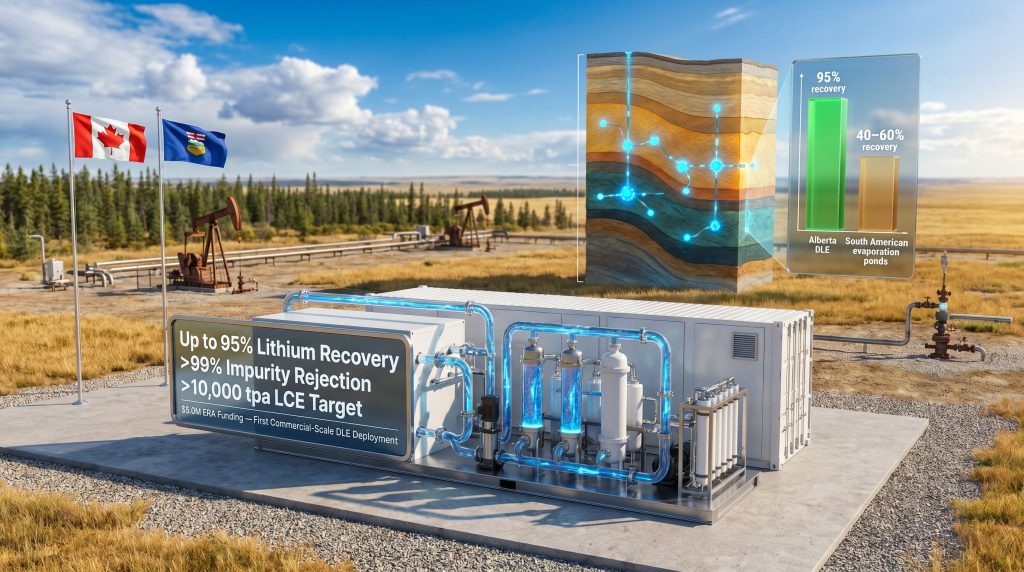
Salar-based brine operations in South America depend on solar evaporation across enormous pond systems, a process that can take 12 to 18 months per cycle, consumes vast land areas, and draws heavily on freshwater resources in some of the world's most arid and ecologically sensitive environments. Recovery rates from conventional evaporation ponds typically range between 40% and 60% of available lithium, with the remainder lost to co-precipitation and process inefficiencies.
Alberta's sedimentary lithium deposits underlying much of western Alberta host formation waters that have evolved over hundreds of millions of years into highly concentrated saline solutions. Within these brines, lithium occurs in ionic form, dissolved and mobile, making it chemically accessible to selective extraction technologies without the need for conventional mining, blasting, or ore processing infrastructure.
Brine Grade Comparisons Across Global Jurisdictions
Understanding relative brine quality matters enormously for project economics. Chile's Atacama Salar, the global benchmark, hosts lithium concentrations exceeding 1,500 mg/L in some areas, though operational averages are considerably lower. Argentina's Lithium Triangle assets vary widely, from marginal grades below 200 mg/L to premium deposits approaching 800 mg/L.
LithiumBank has characterised its Boardwalk and Park Place assets as holding the highest-grade lithium brine resources in Alberta, positioning them at the competitive frontier of Canadian brine development, though direct numerical comparisons to Atacama-class deposits should be evaluated within each project's specific hydrogeological context.
Boardwalk and Park Place: Two Assets, One Strategic Vision
LithiumBank's flagship asset, the Boardwalk project, sits in northwest Alberta within a geological corridor that benefits from both high brine lithium concentrations and proximity to the province's dense network of oil and gas infrastructure. The secondary flagship, Park Place, is located in west-central Alberta and has also demonstrated high-grade brine characteristics during testing.
Together, these projects anchor a broader brine licence portfolio spanning Alberta and Saskatchewan, giving LithiumBank one of the largest contiguous brine lithium land positions in Canada. The scale of this position matters for a modular development strategy, because it creates the optionality to sequence commercial units across multiple assets rather than concentrating all capital and execution risk on a single project.
A resource modelling programme supported by SLB's subsurface geological workflows — integrating seismic interpretation, well log analysis, and brine sampling data — produced a reported greater than 30% increase in the Boardwalk lithium resource estimate. Higher-confidence resource estimates directly affect a project's bankability, as lenders and project finance institutions require demonstrable resource size and continuity before committing capital at the scale required for commercial lithium production.
What the FEED Agreement Actually Means for Project Development
A Front-End Engineering Design agreement is the engineering industry's formal transition point between studying a project and building it. It follows a preliminary economic assessment, which Boardwalk completed in 2024, and precedes a final investment decision. The FEED process produces the detailed engineering specifications, integrated process flow designs, equipment sizing parameters, and capital cost estimates that lenders, boards, and joint venture partners require before committing construction capital.
What makes the LithiumBank SLB Alberta brine project's FEED agreement strategically significant is the identity of the engineering partner. SLB is not a conventional mining engineering firm. It is a company with deep competency in subsurface reservoir characterisation, fluid dynamics, and wellbore engineering — all of which are directly applicable to brine lithium production in ways that traditional mining consultancies cannot fully replicate.
SLB's proprietary integrated lithium production solution covers the complete process chain:
- Brine treatment and pre-conditioning to remove suspended solids and manage chemical interferences before lithium extraction begins
- Direct lithium extraction using selective sorbent or ion-exchange materials that capture lithium ions from the brine matrix while allowing the depleted brine to be reinjected
- Impurity removal systems that strip co-extracted elements including magnesium, calcium, sodium, and potassium from the lithium-rich eluate
- Lithium conversion processing the purified solution into battery-grade lithium carbonate equivalent or lithium hydroxide
The consequence of engaging SLB at the FEED stage, rather than through a conventional demonstration facility pathway, is a meaningful compression of the development timeline. By leveraging SLB's proven technology platform and its pilot testing results on Boardwalk and Park Place brine samples, LithiumBank is structuring a direct bridge from pilot data to commercial engineering, potentially eliminating two to four years from the conventional development sequence.
The Direct Lithium Extraction Process: A Step-by-Step Technical Breakdown
DLE technology represents one of the most consequential innovations in critical minerals processing of the past decade, yet its mechanics remain poorly understood outside specialist circles. The process applied to the LithiumBank SLB Alberta brine project follows a defined sequence:
- Brine Extraction — Subsurface formation water is pumped from depth using well infrastructure, drawing on existing oil and gas well networks wherever practical to reduce capital expenditure
- Pre-Treatment — Raw brine passes through conditioning systems that remove suspended solids and adjust chemistry to optimise DLE performance
- DLE Adsorption — The pre-treated brine contacts SLB's proprietary sorbent material, which selectively captures lithium ions while allowing the bulk of the brine chemistry to pass through
- Desorption and Elution — The lithium-loaded sorbent is washed with a recovery solution that releases a concentrated lithium eluate; the regenerated sorbent re-enters the adsorption cycle
- Brine Reinjection — Depleted brine, now stripped of its lithium content, is returned to the subsurface formation, substantially reducing surface water consumption and environmental footprint
- Impurity Rejection — The concentrated eluate undergoes multi-stage purification to remove magnesium, calcium, and other interfering elements
- Lithium Conversion — The purified lithium solution is processed through precipitation or membrane-based steps to produce battery-grade lithium carbonate equivalent
Pilot Testing Performance at Boardwalk and Park Place
| Metric | Reported Performance |
|---|---|
| Lithium Recovery Rate | Up to 95% |
| Impurity Rejection Rate | Greater than 99% |
| Brine Sampled (April 2026) | 150 m³ |
| Target Commercial Brine Throughput | ~25,000 m³/day |
| Target Production Capacity | Greater than 10,000 tonnes per annum LCE |
The 95% recovery rate is particularly significant when benchmarked against the 40–60% typical of South American evaporation pond operations. At equivalent brine grades, a DLE-based operation recovering 95% of available lithium produces roughly 1.6 to 2.4 times the output per unit of brine processed compared to conventional evaporation methods.
Alberta's Infrastructure Legacy as a Commercial Advantage
One of the least-discussed but most financially material aspects of the LithiumBank SLB Alberta brine project is what already exists underground and above ground across the province. Alberta's petroleum industry has, over seven decades, installed hundreds of thousands of kilometres of pipeline, drilled tens of thousands of wells into the sedimentary basin, and built a workforce with deep expertise in subsurface fluid management, wellbore integrity, and produced water handling.
All of these assets are directly applicable to lithium brine extraction. Well casings penetrating brine-bearing formations can be repurposed or provide offset data. Produced water handling systems share fundamental engineering similarities with brine pre-treatment. Pipeline networks reduce the capital required for fluid transport between wellfields and processing facilities.
This infrastructure overlap creates a cost structure that remote greenfield brine developments in South America or geothermal fields in Europe cannot easily replicate. A project in the Atacama must construct every physical asset from scratch across difficult terrain at high altitude. A project in Alberta can inherit decades of petroleum investment.
Furthermore, the Alberta Energy Regulator also provides a known, experienced permitting pathway for subsurface fluid operations, a regulatory familiarity that reduces the uncertainty premium typically applied to novel resource development in jurisdictions without analogous industrial precedent. By contrast, geothermal brine lithium projects in Europe face considerably more complex and less established regulatory environments.
Alberta DLE vs South American Evaporation Ponds: A Comparative View
| Factor | Alberta Brine with DLE | South American Evaporation Ponds |
|---|---|---|
| Water Consumption | Low, brine is reinjected | High, evaporation losses are permanent |
| Lithium Recovery Rate | Up to 95% | Typically 40–60% |
| Time to Production | Faster via modular build | Slower, pond construction takes years |
| Infrastructure Dependency | Leverages oil and gas legacy | Requires complete greenfield build |
| Environmental Surface Footprint | Lower, no large pond systems | Large land area required |
| Elevation and Access Challenges | Minimal | Significant at high-altitude salars |
The next major ASX story will hit our subscribers first
Non-Dilutive Funding and What It Signals to the Market
One of the more technically nuanced aspects of project financing at the pre-production stage is the distinction between dilutive and non-dilutive capital. Equity raises dilute existing shareholders by issuing new shares, directly reducing the proportional ownership and earnings-per-share exposure of the existing register. Grants and co-funding contributions from government bodies provide capital without requiring equity issuance.
Emissions Reduction Alberta has committed $5.0 million toward Boardwalk's first commercial-scale DLE deployment pilot, with an additional $3.9 million in non-dilutive funding confirmed to support advancement toward commercial production. For a project at the FEED stage, this funding reduces the equity capital required to reach a final investment decision, which directly benefits shareholders by limiting the dilution that typically accompanies capital-intensive development milestones.
From an investor psychology perspective, non-dilutive funding at this stage also functions as a form of technical validation. Funding bodies conducting due diligence before committing public capital apply engineering and commercial scrutiny to the projects they support, meaning a successful grant application carries implicit third-party endorsement of the project's technical credibility.
The Commercial Production Pathway and What 10,000 Tonnes Per Annum Means
LithiumBank has targeted a production threshold of greater than 10,000 tonnes per annum of lithium carbonate equivalent as the benchmark for first commercial-scale brine lithium production in Canada. To put this in context, a single large-format lithium-ion battery gigafactory typically requires between 30,000 and 50,000 tonnes per annum of LCE to operate at full capacity, meaning a Phase 1 Boardwalk operation would supply a meaningful but partial share of one major battery manufacturing facility's annual requirements.
The modular development philosophy underpinning the project is designed to allow sequential commercial unit additions once the first module is operating and generating cash flow, compressing the capital intensity of each subsequent expansion. Consequently, the global lithium market stands to benefit from a diversified North American supply source that reduces dependence on South American and Australian producers.
| Development Scenario | Production Scale | Strategic Significance |
|---|---|---|
| Phase 1 Commercial | Greater than 10,000 tpa LCE | First commercial brine lithium production in Canada |
| Expanded Operations | Multiple commercial modules | Meaningful domestic battery supply chain contribution |
| Full Portfolio Deployment | Boardwalk plus Park Place combined | Potential top-tier North American brine lithium position |
Key Milestones and What Investors Should Watch
The transition from exploration-stage to engineering-stage development is the single most significant derisking event in the life of a resource project. For the LithiumBank SLB Alberta brine project, the following milestones represent the most consequential near-term indicators of commercial progress:
- Completion of the FEED study and delivery of integrated process designs and capital cost estimates
- Results from the April 2026 brine sampling campaign, specifically DLE optimisation data and battery-grade conversion test outcomes
- Any further updates to the Boardwalk resource estimate, building on the greater than 30% increase already reported
- Confirmation of additional non-dilutive funding tranches or project financing discussions
- Progress toward a formal final investment decision timeline
The structural shift represented by this partnership is not simply technical. It reflects a broader repositioning of Alberta, and Canada more broadly, within the global critical minerals supply chain. Whether the LithiumBank SLB Alberta brine project becomes the first commercial brine lithium operation in the country will depend on execution across engineering, financing, and market conditions that remain subject to change.
This article contains forward-looking statements and projections based on publicly available information. Readers should conduct independent due diligence before making investment decisions. Resource estimates, production targets, and development timelines are subject to material risks and uncertainties.
Want To Be First When The Next Major Critical Minerals Discovery Hits The ASX?
Discovery Alert's proprietary Discovery IQ model scans ASX announcements in real time, instantly identifying significant mineral discoveries — including lithium and other critical minerals — and delivering actionable insights directly to subscribers before the broader market reacts. Explore historic discovery returns on Discovery Alert's dedicated discoveries page and begin your 14-day free trial today to position yourself ahead of the next major find.