June 16, 2026
Europe's Critical Minerals Crossroads and What It Means for Industrial Sovereignty
The global race to secure critical raw materials has fundamentally changed how governments and industrial planners evaluate mining assets. What was once assessed purely on tonnage and grade is now weighed against geopolitical risk, downstream processing capability, and the speed at which nations can build sovereign supply chains. Furthermore, the European raw materials supply landscape has made decisions taken inside Scandinavian courtrooms carry consequences that extend far beyond national borders.
Sweden's Land and Environmental Court delivered one such decision in June 2026, granting the LKAB permit for expanded mining at Malmberget, a ruling that simultaneously secured the future of a 135-year-old operation and unlocked an entirely new industrial trajectory for northern Sweden. Understanding why this matters requires looking well beyond the tonnage figures.
When big ASX news breaks, our subscribers know first
What the Malmberget Permit Actually Authorises
The ruling issued by Sweden's Land and Environmental Court is more architecturally complex than a standard operating licence renewal. It functions as a compound approval, covering multiple distinct activities across the same site:
- Continuation of existing underground iron ore extraction at Malmberget in Gällivare Municipality
- Expansion of extraction volumes and the broader operational footprint
- Environmental mitigation commitments targeting air quality management and water discharge controls
- Authorisation to construct a fossil-free sponge iron demonstration plant
- Approval for a new apatite processing facility with downstream links to Luleå
This type of multi-purpose ruling is relatively uncommon in Nordic environmental law proceedings, where each industrial activity frequently requires a discrete permitting process. The bundled nature of the approval reflects both the maturity of LKAB's environmental case and the scale of planning invested across the application period.
Compound permits of this kind signal that the regulator has assessed the integrated operational footprint as a whole, rather than evaluating each activity in isolation, which typically requires applicants to demonstrate systemic environmental coherence across all proposed activities.
A Mineral Resource Base That Defies Conventional Mine Life Logic
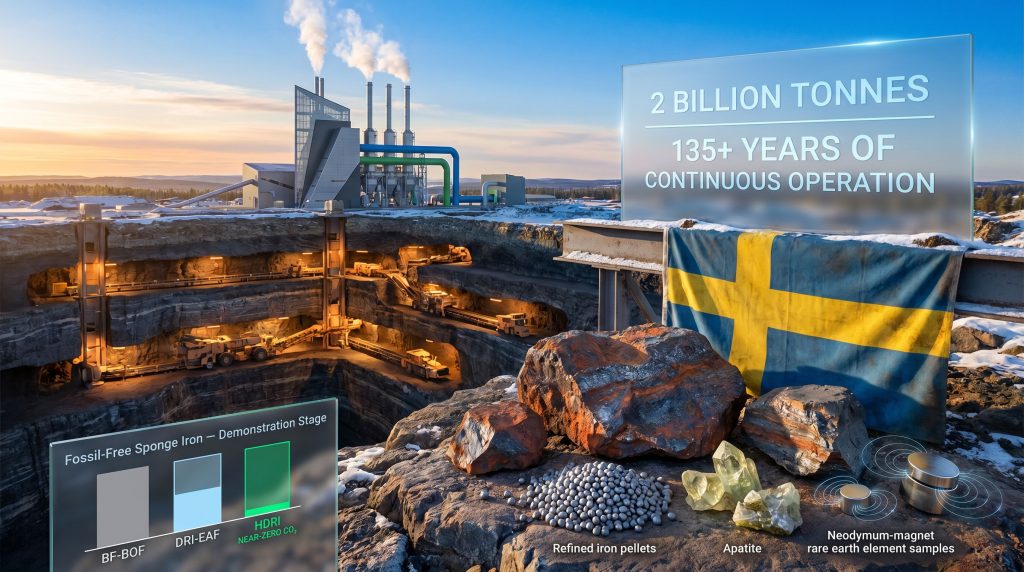
One of the most analytically striking dimensions of the Malmberget story is the scale of the resource base relative to its extraction history. Mining commenced at Malmberget in 1890, making it one of Europe's most enduring continuous underground operations. Yet rather than approaching depletion after more than 135 years of production, the identified mineral resource inventory has grown in recent years and now exceeds 2 billion tonnes.
| Metric | Detail |
|---|---|
| Total Identified Mineral Resources | More than 2 billion tonnes |
| Operational Start Date | 1890 |
| Years of Continuous Operation | 135+ years |
| Resource Trajectory | Increasing, driven by improved subsurface mapping |
| Primary Commodities | High-grade iron ore, phosphorus, rare earth elements |
The 2 billion tonne resource figure is significant for one particularly counterintuitive reason: it surpasses the entire cumulative volume of material extracted from the site across its full operational history. This positions Malmberget not as a mature asset entering decline, but as a resource platform with a generational extraction horizon still ahead of it.
This dynamic is partly explained by advances in underground geophysical surveying and three-dimensional geological modelling, which have progressively revealed mineralised zones that earlier exploration methodologies were unable to define with confidence. For analysts tracking mine life extensions across the iron ore sector, Malmberget represents an instructive case study in how legacy assets can be technically reconstituted.
The Apatite Facility: Where Iron Ore Meets Critical Minerals Strategy
Why Apatite Is the Hidden Strategic Layer in This Permit
To the casual observer, Malmberget reads as an iron ore story. To a critical minerals analyst, it reads as something considerably more interesting. Embedded within the iron ore deposit are significant concentrations of apatite, a phosphate mineral that serves as a carrier for both phosphorus and rare earth elements.
The newly permitted apatite processing facility will extract apatite concentrate from the ore stream at Malmberget. That concentrate will then be transported to LKAB's planned industrial park in Luleå, where two distinct processing pathways will operate in parallel:
- Phosphorus extraction for use in mineral fertilisers, addressing global food security supply chain requirements
- Rare earth element (REE) separation, targeting materials essential for electric vehicle motors, wind turbine generators, and defence sector applications
The REE Composition Question: What We Know and What Remains Undisclosed
A technically important point that receives limited public attention is the specific REE profile of Malmberget's apatite fraction. The deposit is understood to contain REE-bearing apatite, but the detailed mineralogical breakdown of which rare earth elements are present, and at what concentrations, has not been publicly disaggregated in detail. This matters from an industrial planning perspective because not all REEs carry equivalent strategic weight.
| REE Application Sector | Key Elements Required |
|---|---|
| Electric Vehicle Permanent Magnets | Neodymium (Nd), Praseodymium (Pr), Dysprosium (Dy) |
| Wind Turbine Direct-Drive Generators | Neodymium, Praseodymium |
| Defence Guidance and Sensor Systems | Multiple heavy and light REEs |
| Consumer Electronics (speakers, motors) | Neodymium, Samarium |
What is clear is that European access to domestically controlled REE sources has become a policy priority of the highest order. The EU Critical Raw Materials Act identifies rare earth elements as among the most strategically sensitive material categories. In addition, the European critical minerals supply chain framework makes Malmberget's apatite-hosted REE inventory a genuinely sovereign European resource within an already-permitted operational framework.
Unlike greenfield critical mineral projects that face years of exploration, permitting, and feasibility risk, Malmberget's REE pathway is attached to an existing, operating mine, dramatically compressing the timeline from resource to production.
Fossil-Free Sponge Iron: The Decarbonisation Dimension
How Hydrogen-Based Iron Reduction Works and Why It Matters
The permit's authorisation of a fossil-free sponge iron demonstration plant places Malmberget at the operational frontier of one of industrial decarbonisation's most technically demanding challenges. Indeed, hydrogen iron ore reduction represents one of the few credible pathways to eliminating CO₂ output from primary iron production entirely.
Sponge iron, technically referred to as Direct Reduced Iron (DRI), is produced by chemically reducing iron ore without the use of a blast furnace and coking coal. In conventional steelmaking, coking coal acts as both a heat source and a chemical reductant, combining with oxygen stripped from the iron ore to produce CO₂ as a byproduct. Replacing coal with green hydrogen eliminates this CO₂ output entirely, producing water vapour as the sole byproduct of the reduction reaction.
| Production Method | Reductant | CO₂ Output | Commercial Status |
|---|---|---|---|
| Blast Furnace (BF-BOF) | Coking Coal | ~1.8 tonnes CO₂ per tonne of steel | Fully mature |
| Gas-Based DRI (Midrex/HYL) | Natural Gas | ~1.0 tonne CO₂ per tonne of steel | Commercially established |
| Hydrogen-Based DRI (H-DRI) | Green Hydrogen | Near-zero | Demonstration phase |
Conventional blast furnace steelmaking contributes approximately 7 to 9 percent of global CO₂ emissions annually, according to the World Steel Association. The hydrogen DRI pathway is one of the few technically credible routes to decarbonising this sector at industrial scale.
LKAB has been an active participant in Sweden's HYBRIT initiative, a joint venture between LKAB, steelmaker SSAB, and energy company Vattenfall, which aims to commercialise hydrogen-based iron reduction at industrial scale. The Malmberget demonstration plant will generate critical operational data to support the scaling decisions that follow. Consequently, the wider steel and iron ore market is watching this initiative closely as a potential inflection point for green steelmaking viability.
Why Demonstration Plants Matter More Than They Appear To
A subtlety frequently missed in coverage of green steel initiatives is the distinction between laboratory proof-of-concept, pilot demonstration, and commercial-scale validation. Each stage addresses entirely different risk categories:
- Pilot scale confirms the chemistry works at controlled volumes
- Demonstration scale validates engineering parameters, material handling logistics, and operational stability at near-commercial throughput
- Commercial scale deploys capital at a level where unit economics become the central variable
The Malmberget demonstration plant occupies the second, critical stage in this progression. Its output will directly inform whether, and at what rate, hydrogen-based DRI can be scaled across LKAB's broader operational network.
Sweden's Environmental Permitting Framework and What This Ruling Signals
The Swedish Environmental Code as a Regulatory Architecture
The permit was evaluated under Sweden's Environmental Code (Miljöbalken), the primary legislative framework governing land use, water management, emissions, and industrial activities with environmental implications. Obtaining approval under this framework requires applicants to demonstrate that all proposed activities can be conducted within defined environmental thresholds, not merely that they will attempt to do so.
The conditions attached to the Malmberget permit include:
- Air quality controls targeting particulate emissions and dust generation from expanded extraction and processing
- Water management protocols governing discharge quality and volume into local waterways and catchment areas
- Localised environmental improvement commitments tied to the expanded operational scope
LKAB's Malmberget environmental permit approval confirms that the site's area manager welcomed the ruling as enabling concrete environmental improvements to be implemented locally alongside the expansion activities. This reflects a broader dynamic in Scandinavian environmental regulation, where expansion permits are increasingly structured as conditional improvement obligations rather than simple continuance approvals.
It is worth emphasising that approval under Miljöbalken does not represent regulatory relaxation. It reflects a judicial determination that expanded operations, as proposed, can meet the environmental thresholds established under Swedish law.
The next major ASX story will hit our subscribers first
The Luleå Industrial Park Model and Its Broader Significance
From Mine to Industrial Cluster: A Replicable Template
One of the less-discussed strategic dimensions of the LKAB permit for expanded mining at Malmberget is what it enables at Luleå, roughly 300 kilometres to the south. The apatite concentrate produced at Malmberget forms the raw material input for the Luleå industrial park, where phosphorus separation and REE processing will take place.
This model, co-locating extraction, concentrate production, and downstream processing within a nationally integrated supply chain, mirrors industrial cluster strategies that EU policymakers have been advocating as a response to supply chain concentration risk. However, understanding the full scope of the rare earth processing challenges that accompany such ambitions is essential for realistic industrial planning.
The Luleå model is instructive for three reasons:
- It monetises what was previously treated as a processing byproduct, converting apatite from a waste stream management challenge into a value-generating asset
- It creates vertically integrated domestic supply chains for both phosphorus and REEs within a single EU member state
- It demonstrates that legacy mining operations can be repositioned as multi-commodity industrial platforms without requiring entirely new project development
State Ownership, Regional Economics, and the National Dimension
LKAB operates as a wholly state-owned enterprise, which adds a layer of national strategic interest to every major permitting decision it navigates. The Gällivare region's economic structure is deeply dependent on LKAB's operational continuity, and the Malmberget expansion secures employment and regional economic activity across a multi-decade horizon.
At the national level, Sweden's position as one of Europe's leading iron ore producers depends on maintaining and growing output from its northern operational base. The June 2026 ruling provides the regulatory foundation for that continuity. LKAB's president and chief executive noted that the ruling was awaited with significant urgency, characterising the LKAB permit for expanded mining at Malmberget as essential not merely for growth, but for the basic continuation of mining activities at the site.
This framing carries important context: without an updated permit covering expanded activities, LKAB faced the prospect of operational constraints at one of its most significant producing assets. The ruling resolves that uncertainty.
Key Takeaways for Industry Observers and Policy Analysts
The LKAB permit for expanded mining at Malmberget is best understood not as a single regulatory decision, but as a convergence point for several long-running industrial and policy trajectories:
- A 135-year-old underground mine has been repositioned as a multi-commodity, multi-decade industrial platform through a compound environmental ruling
- The 2 billion tonne resource base exceeds cumulative historical output, confirming Malmberget as a long-duration asset rather than a legacy operation approaching closure
- The apatite processing facility unlocks domestic European access to phosphorus and REE supply chains from within an already-operating mining context
- The hydrogen DRI demonstration plant advances Sweden's position at the leading edge of green steel technology at commercial-relevant scale
- The Luleå industrial park model provides a template for converting mining concentrate streams into downstream industrial cluster development
- Sweden's Miljöbalken framework demonstrates that rigorous environmental regulation and strategic industrial expansion are not mutually exclusive objectives
Disclaimer: This article is intended for informational purposes only and does not constitute financial or investment advice. Forecasts, projections, and references to future activities are based on publicly available information and company disclosures. Readers should conduct independent research before making any investment decisions.
Want to Identify the Next Major Mineral Discovery Before the Broader Market Does?
Discovery Alert's proprietary Discovery IQ model delivers real-time alerts on significant ASX mineral discoveries, instantly translating complex mineral data into actionable investment insights for both short-term traders and long-term investors — begin your 14-day free trial today and explore why historic mineral discoveries have generated exceptional returns for those positioned early.