June 16, 2026
The Magnet at the Heart of the Clean Energy Economy
The global transition away from fossil fuels is, at its most fundamental level, a transition toward electromagnetism. Behind every electric motor, every wind turbine generator, and every precision aerospace actuator lies a carefully engineered permanent magnet. Within that category, no material performs more efficiently or more powerfully than sintered neodymium-iron-boron, better known as NdFeB. The country that masters the production of these magnets does not merely participate in the clean energy economy. It helps define its terms.
India has long sat on the consuming end of this equation, importing the vast majority of its sintered NdFeB magnets from a supply chain dominated by China. That calculus may now be shifting, and the Proterial rare earth magnet plant in Andhra Pradesh represents one of the most consequential steps in that directional change.
When big ASX news breaks, our subscribers know first
Understanding NdFeB Magnets: The Material That Makes Modern Industry Move
Composition, Performance, and Why Nothing Else Quite Compares
Sintered NdFeB permanent magnets are produced through a powder metallurgy process in which neodymium, iron, and boron are melted together, pulverised into fine particles, aligned under a magnetic field, pressed into a die, and then sintered at high temperatures to produce a dense, crystalline structure. The result is a material with the highest energy product of any permanent magnet commercially available, meaning it can store and deliver more magnetic force per unit of volume than any competing option.
For manufacturers, this translates directly into smaller, lighter, more efficient motors. A traction motor using NdFeB magnets in an electric vehicle can deliver significantly more torque from a smaller form factor compared to motors using ferrite or bonded alternatives. In direct-drive wind turbines, where gearboxes are eliminated entirely, the performance characteristics of NdFeB magnets make the design viable at scale.
Key Applications Across Critical Industry Sectors
| Industry Sector | Role of NdFeB Magnets | Strategic Importance |
|---|---|---|
| Electric Vehicles | Traction motors and regenerative braking | Core to EV performance and range |
| Wind Energy | Direct-drive turbine generators | Eliminates gearbox dependency |
| Industrial Motors | High-efficiency servo and spindle motors | Energy savings at scale |
| Aerospace and Defence | Guidance systems, actuators | National security sensitivity |
| Consumer Electronics | Hard drives, speakers, sensors | Mass-volume demand driver |
One technical detail rarely discussed outside specialist circles involves the role of heavy rare earth elements, particularly dysprosium and terbium, in NdFeB formulations. These elements are added in small quantities to improve the coercivity of the magnet, meaning its ability to resist demagnetisation at elevated operating temperatures. Without dysprosium additions, NdFeB magnets in EV traction motors would risk performance degradation under the thermal loads generated during sustained driving. This makes dysprosium not just an additive but a critical performance enabler, and its supply is even more geographically concentrated than neodymium itself. Furthermore, the growing critical minerals demand driven by the energy transition only intensifies pressure on these already-constrained supply networks.
Proterial: The Company Bringing Decades of Magnetic Materials Mastery to India
From Hitachi Metals to Proterial
Proterial, which operated for decades under the Hitachi Metals brand before rebranding, is widely recognised as one of the original commercial developers of NdFeB magnet technology. The foundational patents on sintered NdFeB technology, developed in the early 1980s, trace directly back to this lineage. That heritage matters enormously in a sector where process know-how, patent portfolios, and materials science expertise represent genuine competitive moats.
The company produces a broad range of magnetic materials and posted consolidated revenues equivalent to approximately ₹45,000 crore in its most recent fiscal year. This is not a speculative entrant testing an unfamiliar market. It is a proven global manufacturer with deep institutional knowledge of the exact technology India needs.
Why Proterial's Entry Is Structurally Different from Generic FDI
Most foreign direct investment in India's manufacturing sector involves assembly, fabrication, or downstream integration. Proterial's proposed facility represents something categorically different: mid-stream advanced materials production requiring proprietary sintering processes, precision powder metallurgy, and materials science expertise that cannot be readily replicated without decades of institutional knowledge. This is technology transfer with genuine industrial depth.
The Andhra Pradesh Investment: What Is Confirmed and What Remains Pending
Project Specifics as Currently Reported
Based on informed reporting, the Proterial rare earth magnet plant in Andhra Pradesh involves the following key parameters:
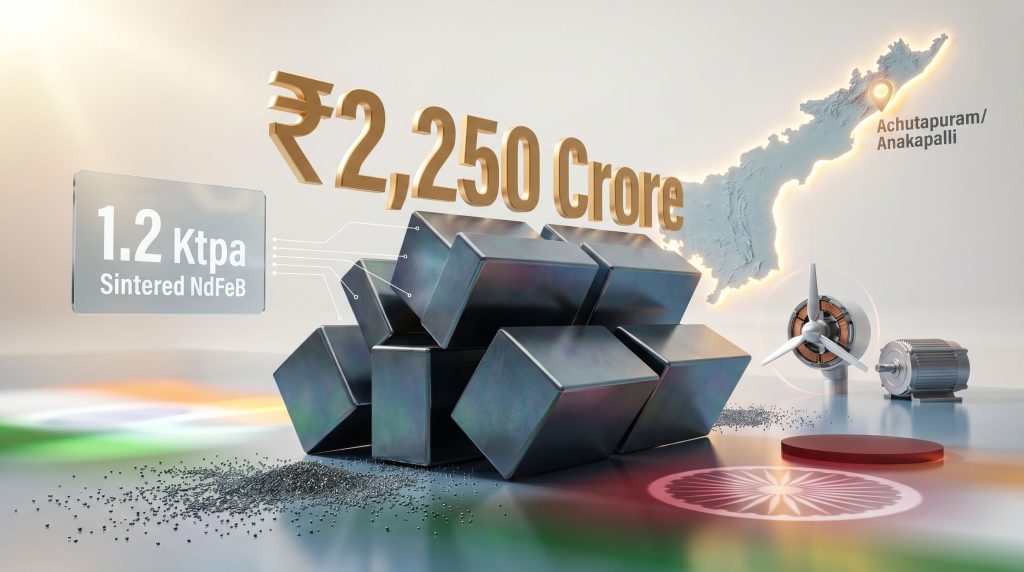
- Investment value: ₹2,250 crore
- Location: Achutapuram, Anakapalli district, Andhra Pradesh
- Product: Sintered NdFeB permanent magnets
- Planned production capacity: 1.2 kilotonnes per annum (ktpa)
- Current status: Approved by the State Investment Promotion Committee
Important clarification: The details of this project have emerged through informed sources rather than a formal public announcement from Proterial directly. The company did not respond to media queries at the time of original reporting. Separately, Proterial India has an existing presence in the state related to amorphous electrical steel manufacturing, which is a distinct product line. Readers and investors should treat the magnet-specific investment as subject to final confirmation, pending a formal investment decision, environmental clearances, and construction commencement. State Investment Promotion Committee approval is an early-stage milestone, not a guarantee of project delivery.
The Achutapuram location within Anakapalli district offers proximity to port infrastructure, existing special economic zone development, and Andhra Pradesh's established industrial corridor framework, factors that likely influenced site selection.
Translating 1.2 Ktpa Into Real-World Industrial Impact
How Far Does This Volume Actually Go?
The proposed annual production capacity of 1,200 tonnes of sintered NdFeB magnets is a figure that demands contextualisation to be meaningful.
- A typical battery electric passenger vehicle uses between 1 and 3 kg of NdFeB magnets in its traction motor
- A large direct-drive offshore wind turbine requires approximately 600 to 700 kg of NdFeB magnets per installation
- Industrial servo motors use between 0.1 and 2 kg per unit depending on power rating
At full production, the facility could theoretically supply magnets for somewhere between 400,000 and 1.2 million electric vehicles annually, or support several hundred large-scale wind turbine installations per year. Against India's stated ambition of deploying 500 GW of renewable energy capacity by 2030 and its rapidly expanding domestic EV market, this volume is meaningful but not transformational on its own. It represents a foundation, not a ceiling.
India's domestic demand for NdFeB magnets is projected to grow substantially through the decade as EV penetration accelerates and wind energy capacity additions continue. The 1.2 ktpa facility addresses a real gap but capacity expansion phases will likely be necessary to meet demand growth through 2030 and beyond.
India's Rare Earth Value Chain: Mapping the Gap This Facility Targets
Where the Structural Weakness Actually Lies
India possesses the world's fifth-largest rare earth reserves, estimated at approximately 6.9 million tonnes according to the US Geological Survey. Yet despite this geological endowment, the country has historically failed to develop downstream processing and manufacturing capability. The value chain breakdown is instructive:
| Value Chain Stage | Current India Status | Post-Facility Outlook |
|---|---|---|
| Rare Earth Mining | Limited domestic output | Remains import-dependent |
| Rare Earth Separation and Refining | Early-stage domestic capacity | Partially developing |
| Alloy and Magnet Manufacturing | Near-absent | Proterial facility directly addresses this gap |
| Component Integration for EV and Wind | Growing OEM base | Domestic magnet supply becomes viable |
The critical weakness has never been India's geology. It has been the mid-stream processing and manufacturing capability that converts raw mineral wealth into finished industrial components. A sintered NdFeB magnet facility directly targets this missing link. In addition, India's critical mineral strategy has increasingly prioritised closing precisely this kind of value chain gap.
The Raw Material Sourcing Question
One underappreciated complexity involves where the neodymium, praseodymium, and dysprosium feedstock for the Andhra Pradesh facility will actually originate. India's domestic rare earth processing capacity is insufficient to supply a facility of this scale in the near term. This means initial operations will likely rely on imported rare earth alloy or oxide feedstock, potentially from Japan's established supply relationships or third-country sources. Developing an integrated domestic supply chain from mining through to finished magnets remains a longer-term ambition rather than a near-term operational reality.
The next major ASX story will hit our subscribers first
The Geopolitical Logic: Why Japan-India Cooperation in Magnets Makes Strategic Sense
China's Structural Dominance and Its Consequences
China currently accounts for approximately 85 to 90 percent of global sintered NdFeB magnet production, according to industry estimates. This concentration creates systemic vulnerability for every country that depends on these components for clean energy infrastructure, defence systems, or advanced manufacturing. When China tightened rare earth export controls in 2010 following a diplomatic dispute with Japan, global prices for rare earth elements spiked dramatically, in some cases by several hundred percent within months. That episode remains a reference point for supply chain planners and policymakers across the world.
However, China's rare earth export restrictions have continued to evolve well beyond 2010, reinforcing the urgency of building alternative production capacity. Japan has since invested heavily in diversifying its own rare earth supply chains, developing processing facilities in third countries and building strategic stockpiles. Proterial's decision to establish manufacturing capacity in India reflects this same strategic logic extended to production rather than just procurement.
The concentration of any critical industrial input within a single national jurisdiction creates leverage that can be exercised in ways that go well beyond normal commercial competition. For industries as strategically sensitive as defence and clean energy, this concentration represents a structural risk that commercial market forces alone are unlikely to resolve.
India's Policy Framework for Domestic Magnet Production
The Indian central government recently approved a dedicated incentive programme specifically targeting domestic production of sintered rare earth permanent magnets. This policy development signals a recognition that India cannot afford to remain dependent on imports for components that are foundational to its own energy transition and defence manufacturing ambitions. The existence of this incentive framework creates a more attractive investment environment for facilities of the type Proterial is proposing, though the specific terms and applicability to this project have not been publicly detailed.
Amorphous Electrical Steel: Proterial's Complementary Technology Footprint in India
Beyond the rare earth magnet investment, Proterial's existing manufacturing presence in Andhra Pradesh for amorphous electrical steel deserves attention in its own right. Amorphous electrical steel is a non-crystalline metallic material used in transformer cores that significantly reduces energy losses compared to conventional grain-oriented silicon steel. In transformer applications, amorphous cores can reduce no-load losses by 60 to 70 percent compared to conventional alternatives.
The material is also finding application in certain motor designs where its low-loss characteristics complement the performance of NdFeB magnets. Having Proterial present across both of these advanced material categories within the same state creates potential for industrial clustering effects, supplier ecosystem development, and technology cross-fertilisation that strengthens India's clean energy manufacturing base more broadly.
Risk Factors That Could Affect Project Delivery
What Investors and Industry Observers Should Monitor
Several material uncertainties exist between the current approval stage and first production:
- Final investment decision: State committee approval does not constitute a binding commitment to proceed. Proterial must formally sanction capital expenditure before construction begins.
- Environmental and regulatory clearances: Advanced materials manufacturing facilities require environmental impact assessments and clearances that can introduce timeline variability.
- Feedstock security: Establishing reliable supply of rare earth alloy inputs at commercial scale and competitive cost requires supply chain development that runs parallel to construction.
- Skilled workforce development: Precision powder metallurgy and sintering operations require specialist technical expertise that is not currently abundant in India's manufacturing labour market.
- Timeline realism: Advanced materials facilities of this technical complexity typically require three to five years from approval to first commercial production.
Disclaimer: This article contains forward-looking assessments based on publicly available reporting and industry context. It does not constitute financial or investment advice. Project timelines, investment figures, and capacity parameters are subject to change pending formal announcements from Proterial. Readers should conduct independent due diligence before drawing investment conclusions.
Frequently Asked Questions
What is the total investment figure associated with this facility?
Reporting based on informed sources indicates a proposed investment of ₹2,250 crore.
Where precisely is the facility planned to be located?
The proposed site is at Achutapuram in the Anakapalli district of Andhra Pradesh.
What type of magnets will the facility manufacture?
The facility is reported to focus on sintered neodymium-iron-boron (NdFeB) permanent magnets at a planned capacity of 1.2 ktpa.
Is Proterial the same company as Hitachi Metals?
Yes. Proterial is the rebranded successor to Hitachi Metals, retaining the same operational assets, technology portfolios, and global manufacturing network.
Has the project received full government approval?
The State Investment Promotion Committee has approved the project. This is an enabling approval, not a final investment decision. Environmental clearances and formal capital sanctioning represent subsequent milestones.
When might production begin?
No formal commissioning timeline has been publicly announced. Based on the complexity of facilities of this type, a realistic timeline from committee approval to first commercial production would span several years.
The Strategic Horizon: What This Investment Signals for India's Industrial Trajectory
The Proterial rare earth magnet plant in Andhra Pradesh, if it proceeds as reported, represents more than a single manufacturing facility. It is a proof-of-concept for India's ability to attract world-class advanced materials manufacturers into mid-stream production rather than merely downstream assembly. The distinction is critical. Mid-stream manufacturing creates genuine technological capability, builds specialised human capital, generates supplier ecosystems, and establishes the institutional knowledge base from which export competitiveness eventually grows.
Consequently, rare earth supply chain diversification has become a strategic imperative not just for India but for every economy seeking to reduce its exposure to single-source dependencies. India's path to becoming a meaningful participant in the global rare earth supply chains of the 2030s requires not one facility but a cluster of them, integrated with developing upstream processing capability and downstream component manufacturing.
The Proterial investment, as recent industry analysis highlights, also surfaces important questions about overcapacity risks and the broader fault lines within global magnet supply chains. Whether it catalyses the broader cluster that India's clean energy ambitions ultimately require will depend on policy consistency, infrastructure delivery, and the commercial success of the first mover.
The physics of permanent magnets have not changed. What is changing is the geography of where the world's most powerful of them will be made. Proterial's own press releases will be closely watched by industry observers for formal confirmation of the next milestones in this strategically significant project.
Want to Track the Next Major Mineral Discovery Before the Market Does?
Discovery Alert's proprietary Discovery IQ model scans ASX announcements in real time, instantly identifying significant mineral discoveries — including the critical and rare earth materials powering the clean energy transition — and delivering actionable alerts to subscribers ahead of the broader market. Explore Discovery Alert's discoveries page to see how historic ASX mineral discoveries have generated substantial returns, and begin a 14-day free trial to position yourself at the forefront of the next major find.