July 17, 2026
How Geopolitics Shattered the Traditional Logic of LME Aluminium Warehouse Inventories
Global commodity exchanges were never designed to function as geopolitical scoreboards. Their original purpose was straightforward: provide a transparent, liquid mechanism for price discovery and physical delivery. Yet in 2026, the London Metal Exchange's aluminium warehouse system has become something far more complex. The composition of metal sitting inside those warehouses now tells a story about sanctions enforcement, regional conflict, and the strategic flexibility of emerging-market producers that no price chart alone can reveal.
Understanding why LME aluminium warehouse inventories declined nearly 45% across the first half of 2026 requires looking beyond aggregate tonnage figures. The real insight lies in which metal left, which stayed behind, and where the departed metal ultimately went.
When big ASX news breaks, our subscribers know first
The Numbers Behind the Drawdown
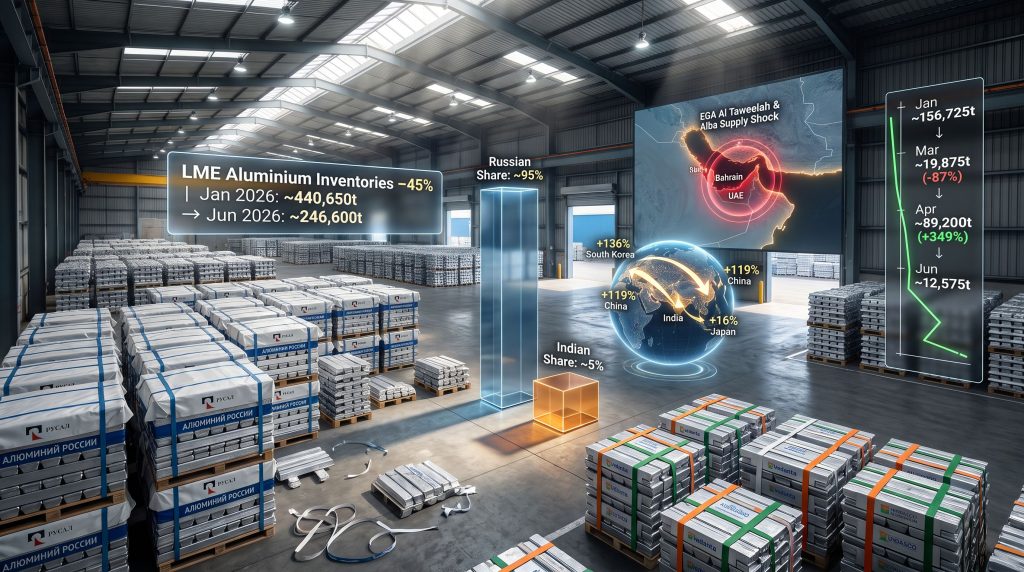
Total LME on-warrant aluminium stocks fell from approximately 440,650 tonnes in January 2026 to around 246,600 tonnes by June 2026. That six-month decline of nearly 45% stands in sharp contrast to the inventory recovery that characterised the first half of 2025, when stocks climbed from a low of roughly 206,900 tonnes in February to approximately 338,000 tonnes by June.
The 2025 recovery was partly attributable to Vedanta's BALCO preparing to commission its 435,000-tonne annual aluminium expansion during Q2 2025, which brought additional Indian-origin metal into the exchange warehouse system. The 2026 story reversed that trajectory entirely, and the reasons are structural rather than seasonal. Furthermore, broader shifts in China commodity demand have contributed to evolving global metal trade dynamics throughout this period.
| Metric | January 2026 | June 2026 | Change |
|---|---|---|---|
| Total LME On-Warrant Stocks | ~440,650 t | ~246,600 t | -45% |
| Russian-Origin Share | ~58% | ~95% | +37 percentage points |
| Indian-Origin Share | ~36% | ~5% | -31 percentage points |
| Russian Absolute Volume | ~255,075 t | ~234,025 t | -8.3% |
| Indian Absolute Volume | ~156,725 t | ~12,575 t | -92% |
Two forces drove this divergence: the ongoing sanctions architecture around Russian aluminium and the geopolitical supply shock created by the Iran-US conflict in the Gulf. These forces operated independently but compounded each other within the same warehouse system.
Sanctions, Compliance Friction, and the Slow Erosion of Russian Market Access
Why Russian Aluminium Accumulated a Near-Monopoly on LME Warrant
Since April 2024, both the United States and the United Kingdom have prohibited Russian aluminium produced after that date from being registered into LME warehouses. Metal produced before the cut-off date retains its legal eligibility for exchange delivery. However, legal eligibility and commercial desirability are two very different things.
The practical impact of the sanctions extends well beyond the formal prohibition. In addition, trade barriers in metals have further complicated the landscape for producers and buyers attempting to navigate these restrictions:
-
Banks and commodity finance houses with compliance obligations have progressively reduced exposure to Russian-origin aluminium, narrowing the pool of buyers who can transact with financing
-
Industrial consumers operating under environmental, social and governance frameworks have treated Russian-origin metal as a reputational liability, regardless of production date
-
Verifying that individual batches predate the April 2024 cut-off introduces operational complexity into procurement workflows, creating additional friction that discourages all but the most price-motivated buyers
-
As non-Russian inventories were withdrawn at a significantly faster rate, Russian metal's proportional share of total warehouse stocks rose by default
This last point is critical and frequently misread by market participants. Russian-origin aluminium climbing from roughly 58% of LME warehouse stocks in January to approximately 95% by June does not indicate a surge in Russian warehouse registrations. According to data on LME warehouse stock composition, Russian absolute volumes declined from approximately 255,075 tonnes to 234,025 tonnes over the same period, a reduction of around 8.3%. What actually happened is that non-Russian inventories were withdrawn far more aggressively, shrinking the denominator and inflating Russia's proportional share.
A rising share of restricted-origin metal within an exchange warehouse system is a lagging indicator of market exclusion, not a leading indicator of new supply entering the system.
The Relative Share Illusion: Step-by-Step
Understanding this compositional mechanics is essential for correctly interpreting LME data:
-
Non-Russian stocks, including Indian, Middle Eastern, and other origins, were withdrawn rapidly throughout Q1 and Q2 2026
-
Russian stocks declined only modestly in absolute terms, falling by approximately 21,000 tonnes across the six-month period
-
As total LME inventory contracted sharply, Russian metal's percentage of the remaining pool rose from ~58% to ~95%
-
This is a compositional shift driven by differential withdrawal rates, not evidence of increased Russian warehouse registrations
-
An analogous pattern emerged in LME copper, where Chinese-origin copper rose from approximately 53% to 59% of total copper inventories as non-Chinese stocks were withdrawn at a faster pace
Where Russian Aluminium Actually Goes
If Western institutional buyers have largely stepped back from Russian-origin aluminium, the obvious question is who is absorbing it. The answer lies primarily in bilateral trade flows that bypass the LME system entirely.
China has systematically expanded its direct procurement of Russian primary aluminium. Chinese imports of Russian aluminium grew from approximately 291,000 tonnes in 2021 to 1.13 million tonnes in 2024, before increasing a further 48% year-on-year during the first four months of 2025. Russia's aluminium exports to China then increased from approximately 477,678 tonnes in Q4 2025 to 589,133 tonnes in Q1 2026.
Beyond China, a smaller cohort of price-sensitive Asian buyers continued purchasing eligible pre-sanctions Russian aluminium directly from LME warehouses. These buyers were motivated primarily by the discount-to-market pricing that Russian-origin metal commanded, and Gulf supply disruptions in early 2026 elevated regional premiums sufficiently to make even discounted Russian aluminium commercially viable for origin-agnostic purchasers.
This explains why Russian LME stocks declined gradually rather than remaining completely static throughout the period.
The Gulf Supply Shock and India's Pivot Away from Exchange Warehouses
How the Iran-US Conflict Reshaped Regional Aluminium Trade
The Iran-US conflict commenced on 28 February 2026, with a significant escalation occurring on 28 March 2026 when missile strikes targeted two of the Gulf region's largest aluminium production facilities:
-
EGA's Al Taweelah smelter in the United Arab Emirates
-
Alba in Bahrain
The combined effect temporarily removed an estimated half of the Gulf region's aluminium production capacity from active supply. The immediate consequence was an acute regional shortage of non-sanctioned, non-Gulf primary aluminium, creating urgent demand for alternative sources precisely at the moment when Russian-origin metal carried maximum commercial and reputational risk. Consequently, shifts in aluminium and alumina markets accelerated considerably as participants scrambled to identify reliable supply alternatives.
Indian producers were structurally well-positioned to fill that gap. The question was whether exchange warehouse economics or direct bilateral contracts offered the better commercial outcome.
India's Opportunistic Use of the LME Warehouse System
Unlike Russian producers, whose metal remains in LME warehouses partly because exit options are constrained by buyer aversion, Indian producers have always treated exchange warehouse registration as a discretionary commercial decision rather than a structural supply channel.
Producers including Hindalco Industries and Vedanta's BALCO maintain primary commercial relationships with domestic customers and bilateral export partners. Approximately 70% of Hindalco's aluminium production is absorbed domestically, with exports of roughly 25-30% directed predominantly through direct agreements with Asian buyers. LME warehouse registration historically occurs when exchange delivery economics exceed the returns available through direct sales.
When the Gulf supply shock elevated physical premiums, that calculus shifted decisively. Buyers willing to pay significant spot premiums for non-Russian, non-Gulf aluminium made LME delivery economics comparatively unattractive, and Indian producers redirected metal accordingly.
The monthly inventory data captures this dynamic with striking clarity:
| Month | Indian LME Stocks (tonnes) | Month-on-Month Change |
|---|---|---|
| January 2026 | ~156,725 | – |
| February 2026 | ~152,500 | -2.7% |
| March 2026 | ~19,875 | -87.0% |
| April 2026 | ~89,200 | +348.8% |
| May 2026 | ~17,450 | -80.4% |
| June 2026 | ~12,575 | -27.9% |
The 87% collapse between February and March corresponds directly to the Gulf conflict escalation. The sharp April recovery likely reflected a temporary window in which physical premiums moderated or short-term commercial incentives aligned with exchange delivery, before direct market opportunities reasserted themselves and drove warehouse stocks back down through May and June.
This pattern of rapid entry and exit is a defining characteristic of Indian warehouse behaviour and distinguishes it fundamentally from the inertia evident in Russian stock movements.
Tracing the Redirected Trade Flows
The metal that exited LME warehouses did not disappear into storage. Official trade data confirms it was actively consumed by end-use manufacturing buyers across Asia:
| Export Destination | Q4 2025 (tonnes) | Q1 2026 (tonnes) | Change |
|---|---|---|---|
| South Korea | 27,061 | 64,010 | +136% |
| Japan | 34,623 | 40,330 | +16% |
| China | 11,567 | 25,321 | +119% |
Hindalco indicated that export volumes to Japan, South Korea, and Taiwan increased materially as the company positioned itself to fill supply gaps created by the Gulf disruption. The trade data supports this, with South Korean and Chinese shipment volumes more than doubling in a single quarter.
This represents a meaningful structural development in India's role within global aluminium trade. Rather than functioning primarily as an exchange-registered supplier, India demonstrated the capacity to act as a rapid-response bilateral exporter during acute supply crises. This mirrors evolving aluminium operations strategy seen among major global producers adapting to geopolitical disruptions.
LME Warehouse Data as a Geopolitical Instrument
Beyond Inventory Levels: Reading the Compositional Signal
The 2026 warehouse experience has reframed how practitioners should interpret LME aluminium inventory data. Three distinct signals are now embedded in warehouse composition figures that were not meaningful in prior market cycles:
-
Sanctions effectiveness signal – The progressive narrowing of Western institutional participation in Russian-origin aluminium is measurable through warehouse composition shifts, providing a proxy indicator of sanctions enforcement effectiveness even when absolute Russian volumes decline only modestly
-
Physical market tightness signal – Rapid withdrawal of non-Russian, non-sanctioned inventory confirms that accessible metal is being actively consumed rather than accumulated, indicating genuine physical demand pressure rather than speculative inventory building
-
Trade route diversification signal – The speed with which Indian producers redirected metal from exchange warehouses to bilateral export markets demonstrates the operational flexibility of emerging-market aluminium supply chains under geopolitical stress conditions
Cross-Metal Comparison: Aluminium vs. Copper Warehouse Dynamics
| Factor | LME Aluminium | LME Copper |
|---|---|---|
| Dominant warehouse origin (June 2026) | Russian (~95%) | Chinese (~59%) |
| Driver of share concentration | Western sanctions and non-Russian drawdown | Non-Chinese inventory withdrawal |
| Absolute change in dominant origin | Modest decline (-8.3%) | Modest decline |
| Primary market interpretation | Sanctions-driven compositional shift | Trade flow and demand-driven shift |
The parallel dynamics across both metals reinforce a broader pattern: exchange warehouse composition is increasingly reflecting macroeconomic and geopolitical forces rather than purely supply-demand fundamentals. However, reviewing the global steel outlook alongside these aluminium trends reveals just how widespread this shift in commodity market dynamics has become. Furthermore, ING's analysis of Russian aluminium's dominance in LME stocks provides additional context for understanding how this concentration has developed over time.
The next major ASX story will hit our subscribers first
Key Takeaways for Market Participants
The 45% decline in LME aluminium warehouse inventories across H1 2026 is the product of three forces operating simultaneously: sanctions-driven fragmentation of the Russian aluminium market, a geopolitical supply shock that temporarily removed half of Gulf production capacity, and the commercial flexibility of Indian producers who redirected metal to where physical premiums were highest.
Five strategic implications deserve attention from aluminium market participants:
-
LME warehouse composition is now a geopolitical indicator – the origin breakdown of on-warrant stocks reflects trade fragmentation dynamics that price charts alone cannot capture
-
Indian aluminium's role in global supply chains is upgrading structurally – the country's producers demonstrated swing-supplier capability during a genuine regional supply crisis, a function historically associated with Middle Eastern capacity
-
Russian aluminium's commercial reach is narrowing but not collapsing – China's expanding direct procurement has absorbed volumes that Western buyers have exited, sustaining Russian export revenues entirely outside the LME system
-
Gulf aluminium infrastructure carries concentrated strategic risk – the scale of the supply shock following the March 2026 strikes underscored how geographically concentrated significant global smelting capacity has become
-
Physical premium arbitrage is increasingly governing exchange inventory behaviour – for producers with bilateral market access, LME warehouse registration is a dynamic commercial optimisation decision, not a passive storage outcome
Disclaimer: This article contains forward-looking analysis, market interpretations, and data-based projections. All figures cited reflect reported data available at time of writing and are subject to revision. Nothing in this article constitutes financial or investment advice. Readers should conduct independent research before making any commercial or investment decisions based on commodity market data.
Want to Identify the Next Major Mineral Discovery Before the Broader Market?
Discovery Alert's proprietary Discovery IQ model delivers real-time alerts on significant ASX mineral discoveries, transforming complex mineral data into clear, actionable insights for both short-term traders and long-term investors — explore historic examples of major discovery returns to understand the potential at stake, then begin your 14-day free trial at Discovery Alert to position yourself ahead of the market.