August 6, 2026
The Legal Reset Behind America's New Trade Enforcement Playbook
When the US imposes new 25% tariffs on Brazil, it signals far more than a bilateral trade dispute. The administration's response to the Supreme Court's February 2026 ruling was methodical: pivot toward a statutory framework with deeper legal roots, one that had already survived decades of judicial scrutiny. That framework is Section 301 of the Trade Act of 1974, and its revival as a multi-country enforcement weapon represents one of the most consequential shifts in American trade law architecture in a generation.
Brazil is the first country to feel the full weight of this reconstituted approach. The decision to impose new 25% tariffs on a broad range of Brazilian goods, effective July 22, 2026, is not merely a bilateral trade dispute. It is a stress test of a new legal template that Washington intends to scale globally. Furthermore, the broader implications for trade wars and supply chains across multiple economies cannot be understated.
When big ASX news breaks, our subscribers know first
Section 301: From China-Specific Tool to Universal Enforcement Mechanism
Most trade analysts associate Section 301 of the Trade Act of 1974 with the US-China tariff tensions that intensified from 2018 onward. The statute empowers the US Trade Representative to investigate foreign government practices deemed unfair, unreasonable, or discriminatory, and to impose trade remedies when negotiations fail to resolve identified grievances.
What distinguishes Section 301 from the emergency powers the Supreme Court dismantled in early 2026 is its procedural architecture. The statute requires:
- A formal investigation with documented evidence of unfair practices.
- A public comment period allowing affected industries to submit testimony.
- A negotiation window during which the targeted country can seek resolution.
- A final order supported by an administrative record.
This process, while slower than executive emergency declarations, produces a legally defensible outcome that is substantially harder to overturn through judicial challenge. The administration's pivot to Section 301 is consequently not a retreat from trade confrontation but a recalibration toward more durable enforcement architecture.
"The Brazil case demonstrates that Section 301 can now be applied across a far broader range of policy grievances than its historical use against Chinese intellectual property practices, including environmental enforcement failures, digital payment infrastructure, and supply chain labour standards."
A Sector-by-Sector Look at What the US Imposes New 25% Tariffs on Brazil Covers
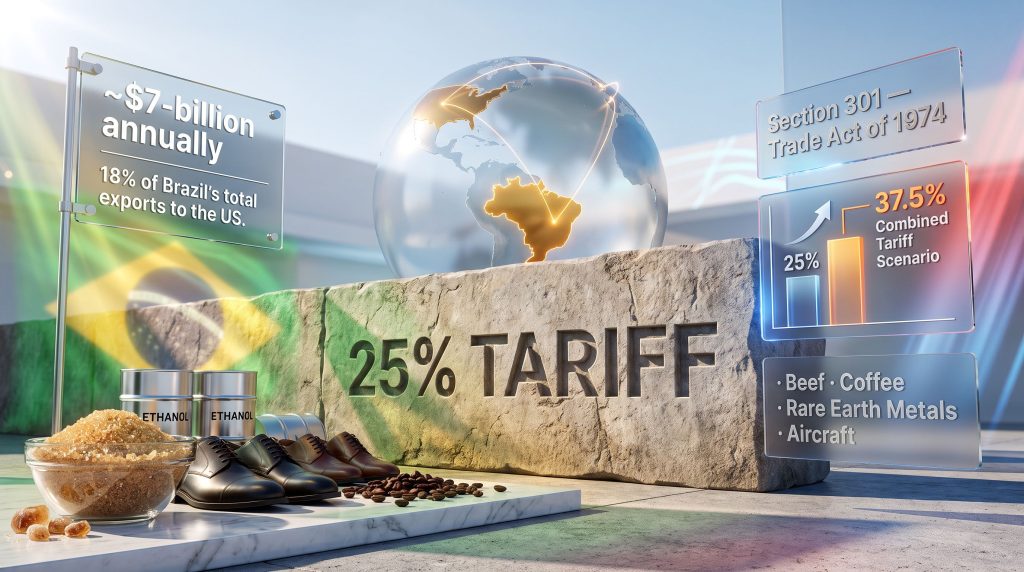
The scope of the new duties is significant but deliberately structured. Approximately 18% of Brazil's total exports to the United States, valued at roughly $7-billion annually, fall within the tariff's reach. The affected product categories span multiple industries:
| Product Category | Tariff Status | Trade Impact |
|---|---|---|
| Sugar | Subject to 25% tariff | Major exposure |
| Agricultural machinery | Subject to 25% tariff | Major exposure |
| Footwear and apparel | Subject to 25% tariff | Major exposure |
| Electrical machinery and paper | Subject to 25% tariff | Significant |
| Pig iron and mining equipment | Subject to 25% tariff | Significant |
| Ethanol | Subject to 25% tariff | Structural disadvantage |
| Furniture and timber | Subject to 25% tariff | Among hardest hit |
| Beef | Exempt | ~$11B exemption pool |
| Coffee and unflavoured instant coffee | Exempt | Included |
| Rare earth metals | Exempt | Strategic exclusion |
| Aircraft and aircraft parts | Exempt | Included |
| Petroleum and energy products | Exempt | Included |
| Pig iron for EAF steelmakers | Exempt | Newly added |
| Organic honey | Exempt | Newly added |
The exemption pool covers an estimated $11-billion in annual bilateral trade, representing a 25% expansion from the originally proposed exemption list, according to the American Chamber of Commerce for Brazil. Despite this, the chamber characterised the outcome as placing Brazil among the nations facing the most restrictive conditions for accessing the US market.
Brazil's Trade Minister Marcio Elias Rosa confirmed that timber, furniture, footwear, and machinery exporters face the most severe structural disruption. The ethanol sector carries particular strategic significance: Brazil's sugarcane-based ethanol industry is already in direct competition with US corn-derived ethanol, and a 25% tariff sharply diminishes Brazil's cost advantage in the American market.
Why the Rare Earth Exemption Reveals a Strategic Contradiction
The deliberate exclusion of rare earth metals from the tariff schedule is one of the most analytically revealing details in the entire announcement. Washington's decision to carve out rare earths reflects an acknowledgement that punitive trade policy cannot override supply chain dependency. Brazil holds significant rare earth reserves, and US manufacturers in defence, electronics, and clean energy technology remain exposed to global rare earth supply chains constraints.
This exemption illustrates a fundamental tension in the administration's trade logic: the same geopolitical concerns that motivate resource security policy limit the scope of economic punishment against resource-rich nations. It is a constraint that will likely shape the design of every subsequent Section 301 order targeting major commodity exporters.
The Four Allegations at the Heart of the Investigation
The USTR investigation into Brazil, formally opened in July 2025 following a year of inconclusive bilateral negotiations, cited four core categories of alleged unfair trade practice:
-
Digital trade restrictions arising from Brazil's Pix instant payment system. Operated by the Banco Central do Brasil, Pix processes transactions at near-zero cost, which Washington argues structurally disadvantages American credit card networks by eroding their transaction fee revenue base in the Brazilian market.
-
Illegal deforestation subsidies, with the US contending that agricultural land cleared through legally prohibited deforestation provides Brazilian producers with an artificially low cost base relative to US competitors who must comply with domestic environmental standards.
-
Ethanol market access barriers, citing domestic Brazilian policy frameworks as limiting fair competition for US ethanol exporters.
-
Forced labour supply chain exposure, addressed through a concurrent but separate Section 301 investigation covering dozens of countries, with Brazil specifically identified.
Brazil's government rejected every allegation, with President Luiz Inácio Lula da Silva characterising the tariffs as politically motivated rather than grounded in legitimate trade grievances. Brazilian officials had privately conveyed similar assessments throughout the negotiation period, framing Washington's posture as resistant to resolution regardless of what Brasília offered at the table.
The framing of the Pix allegation is particularly noteworthy from a trade policy perspective. It represents an expansion of Section 301 logic into the domain of financial infrastructure regulation, suggesting that any domestic payment system innovation that reduces American financial companies' market share could theoretically constitute an actionable unfair trade practice under this framework.
The 37.5% Scenario: A Second Tariff Wave Is Approaching
The 25% base tariff may not represent the ceiling of Brazil's trade exposure. A separate USTR investigation into forced labour connections across global supply chains was scheduled to conclude on July 24, 2026, two days after the initial tariff's effective date. If confirmed, the investigation would add a further 12.5% surcharge to affected Brazilian product categories.
Brazil's Trade Minister indicated the government anticipates the supplementary tariff will be formalised. If applied, the combined burden would reach 37.5% for impacted goods, a cumulative rate that would position Brazil as one of the most heavily tariffed major economies accessing the US market.
"At 37.5%, Brazilian exporters in affected sectors would face pricing pressure equivalent to structural exclusion from meaningful US market participation across several product categories, without any formal trade embargo being declared."
The deliberate sequencing of these two investigations, with the forced labour ruling arriving two days after the initial tariffs take effect, also ensures that Washington maintains continuous tariff pressure through the expiry of the temporary 10% global baseline tariff on July 24, 2026. There is no gap in the enforcement architecture. Reuters reporting on the announcement confirms the precise timeline of these sequenced measures.
Brazil's Retaliatory Options and Their Practical Limits
Brazil's response combined diplomatic protest with legal mobilisation. President Lula publicly rejected the tariffs' legitimacy, while Foreign Affairs Minister Mauro Vieira condemned statements from US Secretary of State Marco Rubio as offensive and unacceptable to the Brazilian government and people, signalling a meaningful deterioration in bilateral diplomatic relations.
On the legal front, Brazil activated two parallel instruments:
-
The Reciprocity Law, a domestic legislative framework enabling proportional countermeasures against trading partners deemed to have acted unfairly. This law allows Brazil to impose equivalent trade restrictions on American goods without requiring prior WTO authorisation, functioning as a deterrent designed to raise the economic cost of US unilateralism.
-
WTO dispute settlement proceedings, seeking multilateral arbitration of the conflict through the organisation's formal mechanisms.
The practical deterrent value of both instruments remains constrained. WTO dispute resolution operates on multi-year timelines, during which tariff damage accumulates. Brazil's retaliatory tariffs under the Reciprocity Law carry escalation risk, particularly given the scale asymmetry between the two economies. The US exported approximately $43-billion in goods to Brazil in 2024, giving Washington considerably more structural leverage in any tit-for-tat escalation.
The next major ASX story will hit our subscribers first
What the Brazil Precedent Means for India, China, Japan, South Korea, and the EU
The USTR has confirmed that Section 301 investigations are underway or anticipated against India, China, Japan, South Korea, and the European Union. Brazil's designation as the first country to receive a final tariff order under this revived framework establishes both procedural precedent and political signal. In addition, the broader commodity market tariff impacts are already being felt across interconnected global markets.
Ajay Srivastava, founder of the Global Trade Research Initiative, has framed the Brazil case as a template with explicit implications for India, noting that Washington has demonstrated willingness to deploy trade enforcement action not only over market access reciprocity but also against any domestic policy perceived as disadvantageous to US commercial interests.
India faces compounding exposure. Ongoing Section 301 probes cite insufficient enforcement of forced labour prohibitions and excess industrial capacity as grounds for potential duties. The combination of these allegations, mirroring the structure used against Brazil, suggests India could face a similarly layered tariff outcome if negotiations remain unresolved.
For the European Union, the Pix precedent carries particular significance. European financial regulators and central banks have been actively developing domestic payment infrastructure, including the EU's own instant payment framework. If Washington treats payment system innovation as an actionable trade grievance, European financial infrastructure policy could consequently become subject to future Section 301 investigation.
The Political Economy of How These Tariffs Were Designed
Several structural choices in the tariff's design reveal deliberate political calculation beneath the policy architecture. The Straits Times has characterised the Brazil action as opening shots in a broader tariffs offensive, further reinforcing the template-driven nature of the approach.
-
The announcement was made late at night, compressing market reaction windows and limiting real-time political blowback.
-
The July 22 effective date was set to precede the July 24 expiry of existing temporary tariff measures, ensuring uninterrupted trade pressure through the transition period.
-
The expansion of the exemptions list, particularly for rare earths and agricultural products like beef and coffee, reflects active lobbying by US industry coalitions with downstream supply chain dependencies on Brazilian inputs.
-
Products already covered under Section 232 tariffs on steel, aluminium, copper, and automobiles were explicitly excluded from double-counting, preserving the administrative coherence of the broader tariff framework.
Dan Anthony, executive director of We Pay The Tariffs, a coalition representing more than 1,200 US small businesses, publicly argued that the import taxes function as a blunt instrument with a weak connection between the practices cited as justification and the American companies that ultimately absorb the costs. This perspective reflects a broader tension within the US business community between protectionist policy objectives and the operational realities of integrated bilateral supply chains. Furthermore, understanding the wider metals and mining geopolitics helps contextualise why certain sectors were shielded from these measures.
Frequently Asked Questions: US Imposes New 25% Tariffs on Brazil
When do the new US tariffs on Brazil take effect?
The 25% tariff measures took effect on July 22, 2026, following a USTR announcement by Trade Representative Jamieson Greer.
What legal authority is being used?
The tariffs are imposed under Section 301 of the US Trade Act of 1974, which authorises the executive branch to take trade action against countries engaged in practices deemed unfair to US commerce.
What Brazilian goods are exempt?
Key exemptions include beef, coffee, unflavoured instant coffee, organic honey, rare earth metals, aircraft and aircraft parts, petroleum products, and pig iron used by electric-arc furnace steelmakers.
Could total tariff exposure reach 37.5%?
Yes. A concurrent forced labour investigation expected to conclude July 24, 2026 could add a further 12.5% surcharge, bringing combined exposure to 37.5% for affected product categories.
How much Brazilian trade is directly affected?
Approximately 18% of Brazil's exports to the US, valued at around $7-billion annually, are subject to the new duties. An estimated $11-billion in trade benefits from exemptions.
What is the Pix payment system and why is it relevant?
Pix is Brazil's central bank-operated instant payment platform. The US argues it structurally disadvantages American credit card companies by reducing their transaction fee revenues in the Brazilian market, framing domestic financial infrastructure policy as an actionable trade grievance.
Disclaimer: This article is intended for informational purposes only and does not constitute financial, legal, or investment advice. Trade policy developments involve inherent uncertainty, and forward projections regarding tariff outcomes, retaliatory measures, or economic impacts are speculative by nature. Readers should consult qualified professionals before making decisions based on trade policy analysis.
Want to Stay Ahead of Market-Moving Commodity and Trade Developments?
Discovery Alert's proprietary Discovery IQ model delivers real-time alerts on significant ASX mineral discoveries, cutting through the complexity of global commodity disruptions — from rare earth supply chain shifts to trade-driven sector repricing — to surface actionable investment opportunities the moment they emerge on the ASX. Explore historic discoveries and their exceptional market returns, then begin your 14-day free trial to position yourself ahead of the broader market.