August 6, 2026
What the LME Forward Curve Is Actually Telling Commodity Markets Right Now
Commodity markets rarely move in straight lines, and few base metals expose the underlying mechanics of supply and demand as transparently as aluminium does through the structure of its forward curve. When the London Metal Exchange's prompt cash price begins trading at a meaningful premium to the three-month forward contract, the market is transmitting a specific technical signal: physical metal is scarce, buyers need it now, and the exchange's warehouse network cannot comfortably bridge that gap. Understanding that structure is the starting point for interpreting the LME aluminium price above 3700 per tonne sustained throughout May 2026.
When big ASX news breaks, our subscribers know first
How the LME Aluminium Price Held Above $3,700 Per Tonne
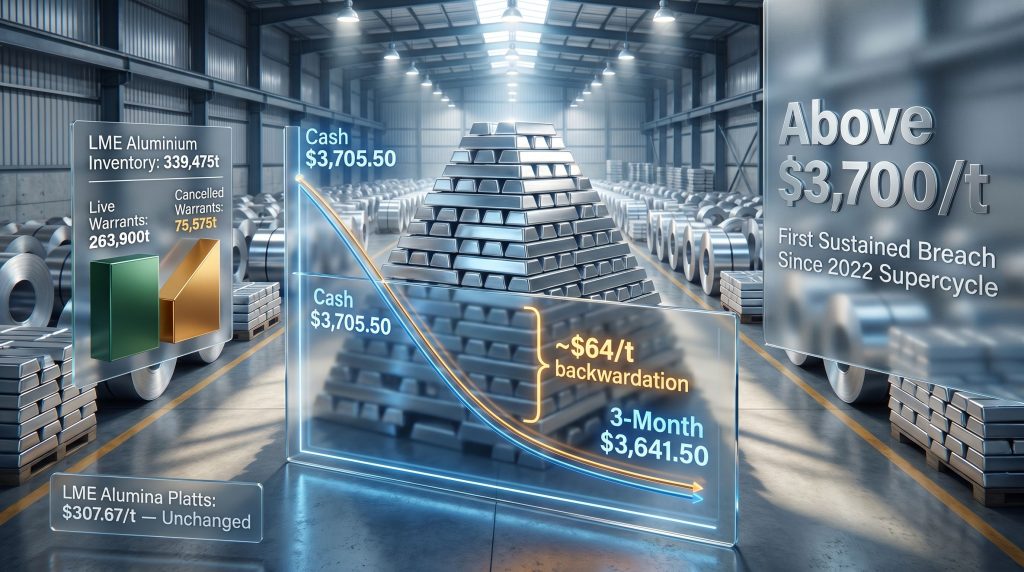
The LME aluminium cash price has been navigating a technically significant zone throughout May 2026. On the May 22 session, the cash bid settled at $3,705.50 per tonne against an offer of $3,706.00 per tonne, representing a day-on-day easing of approximately 0.34 to 0.38 per cent from the prior session's elevated levels. Despite this modest pullback, the price sustained its position above the psychologically important $3,700 per tonne threshold, confirming the level as a floor rather than a ceiling.
The $3,700 per tonne mark carries significance beyond its numeric value. In futures markets, round-number price levels attract concentrated institutional activity including stop-loss orders, options strike positioning, and algorithmic trigger points. The difference between a price briefly touching this level versus closing above it across multiple consecutive sessions represents a meaningful shift in market structure. The May 2026 data reflects the latter, suggesting that the move above $3,700 per tonne carries structural rather than purely speculative underpinning.
LME Aluminium Price Snapshot: May 22, 2026
| Contract | Bid (USD/t) | Offer (USD/t) | Day-on-Day Change |
|---|---|---|---|
| Cash | $3,705.50 | $3,706.00 | -0.34% / -0.38% |
| 3-Month | $3,641.50 | $3,642.00 | -0.18% / -0.19% |
| Dec-27 | $3,233.00 | $3,238.00 | +0.34% |
| 3-Month Reference | $3,621.50 | N/A | +0.43% from prior session |
For context, LME trading volumes and cash prices last sustained comparable levels during the commodity supercycle of 2022, when post-pandemic demand acceleration collided with severe energy market disruptions across Europe. The current breach of $3,700 per tonne in May 2026 marks the first confirmed return to those levels, making the forward curve structure particularly relevant to assessing whether the move has durability.
The Backwardation Signal: Decoding the Forward Curve Structure
The single most analytically important feature of the May 22 data is the relationship between the cash price and the three-month forward price. With the cash bid at $3,705.50 per tonne and the three-month bid at $3,641.50 per tonne, the market is exhibiting backwardation with a cash-to-three-month spread of approximately $64 per tonne.
Technical Note: Backwardation in commodity markets occurs when immediate delivery commands a premium over future delivery. In a well-supplied, normally functioning aluminium market, the opposite structure, known as contango, typically prevails, where forward prices exceed spot prices to reflect the cost of storage, financing, and insurance.
Backwardation in the LME aluminium market does not occur routinely. It requires a genuine dislocation in the prompt physical market, where buyers are either unable or unwilling to wait for future deliveries and are therefore paying a premium to access metal immediately. A $64 per tonne spread is substantial by historical standards and reflects meaningful stress in the near-term supply chain.
The behaviour of longer-dated contracts adds a further layer of nuance. While near-term prices eased slightly on May 22, the December 2027 contract gained 0.34 per cent, with the bid rising from $3,222 to $3,233 per tonne and the offer moving to $3,238 per tonne. This divergence — near-term softening alongside long-dated price appreciation — suggests market participants are pricing in an eventual resolution of current supply constraints over a multi-year horizon while acknowledging that prompt availability remains constrained.
What Backwardation Means for Different Market Participants
- Physical traders face immediate cash flow implications when rolling long positions in a backwardated market, incurring negative roll yield as they sell higher-priced near-term contracts and buy cheaper forward ones
- Smelters and producers may accelerate forward sales at current elevated spot levels, which creates natural selling pressure on the three-month curve
- Downstream fabricators face pressure to secure forward cover quickly, as waiting risks paying even higher spot premiums
- Speculative long holders experience the unusual dynamic of positive carry erosion in a market where spot outperforms forward
LME Inventory Mechanics: Understanding Warrants and What They Reveal
LME warehouse stocks provide one of the most transparent real-time windows into physical metal availability anywhere in global commodity markets. The May 22 session recorded total opening stocks of 339,475 tonnes, unchanged from the prior session. This stability is notable because it marked the first session of zero net change since March 25, 2026, approximately two months prior, during which LME aluminium stocks had been on a sustained drawdown trajectory.
Warrant Structure Breakdown: May 22, 2026
| Inventory Category | Level (Tonnes) | Change |
|---|---|---|
| Total Opening Stocks | 339,475 | Unchanged |
| Live Warrants | 263,900 | -0.44% (from 265,075t) |
| Cancelled Warrants | 75,575 | +1.58% (from 74,400t) |
Understanding the distinction between live and cancelled warrants is essential for interpreting what these numbers actually mean in practice:
- Live warrants represent metal held in LME-registered warehouses that is immediately available for delivery against exchange contracts. Their continued decline signals that physical buyers are actively drawing on exchange stocks rather than relying on alternative supply channels.
- Cancelled warrants represent tonnage that has been formally earmarked for removal from LME warehouses by their owners. Once cancelled, this metal is no longer available for exchange delivery and is typically destined for specific physical buyers or regional markets.
The simultaneous decline in live warrants and increase in cancelled warrants is a leading indicator of further drawdowns ahead. With cancelled warrants at 75,575 tonnes representing approximately 22.3 per cent of total stocks, the share of metal committed for physical removal remains at elevated levels. Historically, a cancelled warrant ratio above 20 per cent has preceded accelerated inventory drawdowns in LME aluminium markets.
What to Watch: If the cancelled warrant ratio continues climbing while live warrants contract, total LME aluminium stocks are likely to resume their downward trajectory, potentially testing levels below 300,000 tonnes — a scenario that would reinforce structural support for cash prices above $3,700 per tonne.
Furthermore, a lesser-known dynamic worth noting is that LME warehouse stocks represent only a fraction of global aluminium inventory. A significant portion of available metal is held in off-warrant locations, private warehouses, and producer stockpiles not captured in LME data. When LME stocks decline sharply while off-warrant stocks also tighten, the combined effect on prompt market pricing can be dramatically amplified. The current warrant structure suggests that off-warrant availability may also be under pressure, as buyers are choosing to draw down exchange stocks rather than source metal through other channels.
Supply-Side Dynamics: Why Physical Aluminium Remains Scarce
Primary aluminium production is constrained by a combination of structural and cyclical factors that have been building across multiple years. Energy costs remain the dominant variable in the smelting cost curve. European smelter capacity has been curtailed meaningfully since 2021–2022, with high electricity costs making a significant portion of the continent's production capacity economically unviable at historical energy price levels.
According to the International Aluminium Institute, European primary aluminium production declined from approximately 3.5 million tonnes in 2021 to below 3 million tonnes by 2023 — a structural reduction that has not been fully reversed. Consequently, the ripple effects across aluminium and alumina markets have been considerable, reshaping regional supply flows and trade patterns.
Chinese production dynamics represent the other critical variable. China accounts for roughly 57 to 60 per cent of global primary aluminium output, meaning shifts in Chinese smelter operating rates have an outsized influence on global supply balances. Chinese production has been subject to periodic curtailments driven by power rationing, environmental compliance requirements, and provincial energy consumption limits. These curtailments do not always align with global demand cycles, creating episodic tightening of the international market.
The upstream cost structure also matters for interpreting current pricing. LME alumina platts held unchanged at $307.67 per tonne on May 22. Alumina is the primary feedstock for aluminium smelting, typically requiring approximately 1.9 to 2 tonnes of alumina per tonne of primary aluminium produced. Stable alumina pricing at current levels means smelter input costs are not escalating, which in turn implies that the current aluminium price elevation is being driven by demand and supply tightness rather than upstream cost inflation alone. This is a subtle but important distinction: it means smelter margins are expanding, which may eventually incentivise capacity re-activation, but that response typically takes six to eighteen months to materialise in meaningful new production volume.
The April-to-May Price Progression
The move above $3,700 per tonne did not occur overnight. LME aluminium cash prices were approaching $3,685 per tonne as early as late April 2026, with exchange stocks already in a sustained decline phase. The progression from that level to a confirmed LME aluminium price above 3700 per tonne in May reflects the cumulative effect of several concurrent developments:
- Persistent drawdowns across LME-registered warehouse locations over a period of weeks
- Elevated cancelled warrant ratios signalling committed physical demand outpacing new deposits
- Reduced availability of off-warrant stock in key regional trading hubs
- A backwardated forward curve discouraging new warehouse deposits by removing the financial incentive for merchants to store metal
In addition, the imposition of US aluminium tariffs has introduced further complexity into global supply routing, redirecting metal flows and contributing to tightness in certain regional markets.
How the $3,700 Per Tonne Level Affects the Entire Aluminium Value Chain
Producers and Smelters
For primary aluminium producers operating with all-in cash costs in the range of $2,400 to $2,900 per tonne — a range that covers the majority of mid-cost global smelters — current pricing above $3,700 per tonne generates free cash flow margins of $800 to $1,300 per tonne before hedging adjustments. This is exceptional by historical standards and creates strong incentives for producers to accelerate capital allocation toward capacity maintenance, debottlenecking, and in some cases, new project development.
However, producers operating in regions with high energy costs face a more compressed margin picture, and the incentive to lock in forward sales at current elevated prices creates structural selling pressure on the three-month and six-month forward curve.
Downstream Fabricators and Manufacturers
For aluminium fabricators, the elevated input cost environment creates a margin compression challenge. Sectors including automotive components, aerospace sheet, building extrusions, and packaging foil all face higher raw material costs that may or may not be fully recoverable through downstream price increases.
A less widely appreciated dynamic is the conversion cost differential between primary and scrap-fed operations. Secondary aluminium producers — who melt and refine scrap rather than smelting from alumina — operate with a significant cost advantage when primary prices are elevated. At $3,700 per tonne for primary metal, the spread between primary and secondary production economics widens, incentivising scrap collection and processing, and potentially moderating long-term primary price appreciation through substitution effects.
Commodity Traders and Investors
For market participants with long futures positions, backwardation creates a nuanced challenge. The negative roll yield in a backwardated market means that rolling an expiring near-term contract into the next month results in a financial loss relative to simply holding the spot price. This dynamic discourages passive long exposure in futures and can reduce speculative positioning, even when the fundamental outlook supports higher prices.
Physical arbitrage — the practice of profiting from price differences between LME-registered warehouse locations and off-market storage sites — also becomes more complex and potentially more rewarding in backwardated markets. Metal held in non-LME locations can command significant premiums in certain regional markets when exchange availability is constrained. The broader commodity price impacts on mining company performance further underscore how these dynamics affect the wider investment landscape.
The next major ASX story will hit our subscribers first
Scenario Framework: Where LME Aluminium Prices Could Go From Here
| Scenario | Primary Catalyst | 3-Month Price Target |
|---|---|---|
| Bullish Continuation | Stocks fall below 300,000t; cancelled warrants above 25% | $3,750–$3,850/t |
| Sideways Consolidation | Inventory stabilises; no new supply shocks | $3,600–$3,700/t |
| Bearish Correction | Macro deterioration; Chinese production acceleration | $3,400–$3,550/t |
Key Signals to Monitor
Bullish continuation indicators:
- Cancelled warrant ratio rising beyond 25 per cent of total stocks
- Cash-to-three-month spread widening beyond $75 to $80 per tonne
- LME alumina platts beginning an upward trend, indicating upstream cost acceleration
- Any news of Chinese provincial power restrictions or export policy adjustments
Bearish reversal risks:
- Rapid increase in new LME warehouse deposits reversing the cancelled warrant trend
- Demand destruction signals from downstream sectors if prices approach $3,800 per tonne
- US dollar strengthening materially, which historically exerts inverse pressure on dollar-denominated commodity prices
- Announcement of significant new smelting capacity coming online in the Middle East or Asia, where energy cost advantages support economically viable greenfield production
However, one additional macro consideration is China industrial demand, which remains a pivotal swing factor for global base metal consumption. Any material shift in Chinese manufacturing activity or infrastructure spending could alter the demand side of the aluminium equation meaningfully. For the most current aluminium price data, monitoring live benchmark feeds remains essential for both physical traders and investors navigating this elevated-price environment.
Disclaimer: This article is intended for informational and educational purposes only. It does not constitute financial advice, investment recommendations, or a solicitation to buy or sell any financial instruments. Commodity markets involve significant risk, and past price behaviour is not indicative of future results. Readers should consult qualified financial professionals before making investment decisions.
Want to Know When the Next Major Mineral Discovery Hits the ASX?
Discovery Alert's proprietary Discovery IQ model delivers real-time alerts on significant ASX mineral discoveries, cutting through complex market data to surface actionable opportunities the moment they're announced — explore historic discoveries and their returns to understand the potential, then start your 14-day free trial at Discovery Alert to position yourself ahead of the broader market.